Check your gauge on the piece. Begin the pattern and measure the piece itself as you go.
After round 1 a short end, measured between its two corner stitches, is about 5.6 in (14.2 cm). If both short ends are longer than that, work round 1 again with a smaller hook; if both are shorter, with a larger hook; the number of stitches stays the same. Put the short ends right first, with the hook. When they are right and only a long side ripples or draws in, keep the hook and change the number of stitches on the long sides, as the pattern says under your size.
For a piece of your own, round 1 must leave a multiple of 3 that is an odd number between two corner stitches on every side (9, 15, 21, 27 and so on). A short end whose number of stitches is of that kind gives one sc for each stitch, with 3 sc in its first and its last; a short end with another number is brought to the nearest of that kind: work 2 sc in one stitch or skip one, here and there, evenly spread between its two corners. A knitted or woven scarf has, along a short end, as many loops of blanket stitch as that number, and along a long side 2 loops fewer than the number between its corner stitches. On a long side work out the stitches from its length, 15 to every 4 in (10.2 cm), take the nearest number of that kind, and spread them evenly; the first and the last of them are the side stitches of the two corners. In rounds 2 and 3 a side of S stitches has S ÷ 3 V stitches, so the bracket of round 2 is worked S ÷ 3 - 1 times on that side, and the bracket of round 3 (S ÷ 3 - 1) ÷ 2 times. Round 4 is one rev sc in every stitch. One V stitch pair more (6 stitches) is about 1.6 in (4.1 cm).
Notes
How many stitches for the row ends: along a long side work 15 sc to every 4 in (10.2 cm). On rows of single crochet that is 6 sc over every 7 rows (one in each of 6 row ends, skip 1); on half double crochet 6 over every 5 rows (one in each of 4 row ends, 2 in the 5th), as this pattern does; on double crochet 15 over every 8 rows (2 in each of 7 row ends, 1 in the 8th). On a knitted or woven scarf sew blanket stitch round it first, as the next note says.
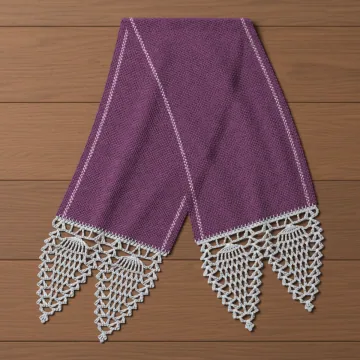
Blanket stitch, only for a knitted or woven scarf: thread the sharp needle with yarn A, a length of about 40 in (101.6 cm) at a time, and hold the scarf with its right side facing you and the edge you are working on toward you. Fasten the yarn on the wrong side at the left-hand corner of a short end (at the right-hand corner if you are left handed). A stitch stands in each of the four corners, and the first one is the one in the corner where you begin. For a corner stitch of this kind put the needle in from the front about 0.2 in (0.5 cm) from both edges, bring its point out beyond the tip of the corner and over the yarn that lies there, and draw up until the yarn lies along the edge without puckering it. From there sew to the right (to the left if you are left handed): put the needle in about 0.2 in (0.5 cm) inside the edge and about 0.27 in (0.7 cm) farther along, bring its point out beyond the edge and over the yarn, and draw up in the same way. The yarn that lies along the edge between two stitches is one loop, and round 1 is worked into the loops. An edge has one stitch fewer between its two corner stitches than it has loops; how many that is, is said under your size. Set the stitch in the next corner, turn the scarf so that the next edge lies toward you, and go on along all four edges. From the last stitch bring the yarn along the edge to the first stitch, pass the needle under that one where it turns at the corner, and fasten off on the wrong side. When a length of yarn runs out, end it and begin the next on the wrong side, in the same hole. In round 1 the first and the last loop of a short end take the 3 sc of a corner, as the first and the last stitch of a row or of the foundation edge do, and every other loop takes one sc: along a long side that is one sc in each loop, in place of the row ends and the brackets in the line of round 1.
Corner stitch: the middle one of the 3 sc in a corner of round 1. Round 1 begins with 2 sc and ends with 1 sc in the same first stitch: those are the 3 sc of the first corner, and its corner stitch is the first sc of the round.
With the right side facing you and the last row of the scarf at the top, the first st is the one at the right-hand end of the last row (the left-hand end if you are left handed). Round 1 goes along that short end, down the row ends of the next long side, along the foundation edge and up the row ends of the last side. The foundation edge is the underside of the starting chain: work into what each chain has left free.
Round 3: the "next ch-3 sp" you join in is the first corner space, right after the ch 3 that began round 2. That ch 3 is not worked into.
Round 4 is worked from left to right, the opposite of your usual direction (right to left if you are left handed), with the right side still facing: in that round "next st" is the next one to the right (to the left if you are left handed).
Reverse single crochet (rev sc): insert the hook from front to back in the next stitch to the right (to the left if you are left handed), yo and draw a loop through to the front (two loops on the hook), yo and draw through both loops.
A stitch worked into a chain space goes into the open space under the chain, not into a chain stitch. Stitches that lie before the space are passed over and left unworked.
Stitches in round brackets with a place after them, or several of one stitch with one place after them, are all worked into that one place. The brackets at the end of a row hold its count.
What is in square brackets is worked as many times as the number after them says, in all.
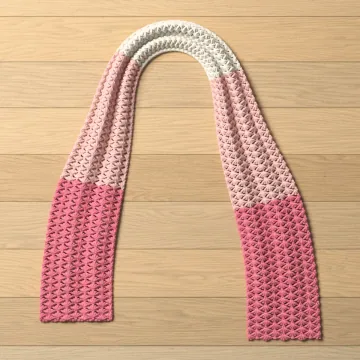
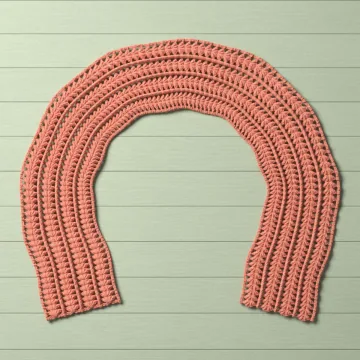
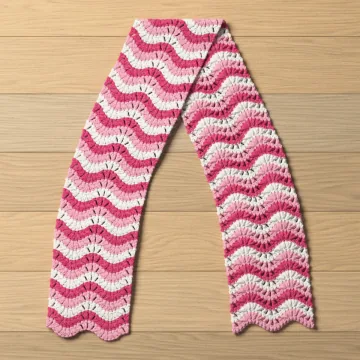
The scarf is 21 stitches wide and 186 rows long, about 5.6 in (14.2 cm) by 59.5 in (151.1 cm); with the border on it is about 8.5 in (21.6 cm) by 62.4 in (158.5 cm). The border is about 1.5 in (3.8 cm) wide all round.
Round 1 leaves 21 stitches between the corner stitches of a short end and 225 between those of a long side.
To keep a long side from rippling: after round 1, when the short ends measure what the gauge says, lay the scarf flat and compare each long edge with the middle of the scarf. If the edge is longer, it will ripple: work round 1 again, with the same hook and 6 sc fewer on each long side. On a crocheted scarf, in 6 of the brackets of that side, spread evenly, work 1 sc instead of 2 in the fifth row end; on a knitted or woven scarf skip 6 of the loops of that side, spread evenly. If the edge is shorter, it will draw in: work round 1 again, with the same hook and 6 sc more on each long side. On a crocheted scarf, in 6 of the brackets of that side, spread evenly, work 2 sc instead of 1 in one of the first four row ends; on a knitted or woven scarf, in 6 of the loops of that side, spread evenly, work 2 sc instead of one. The short ends and the four corners stay as they are.
After such a change, with 6 sc fewer: on each long side the bracket of round 2 is worked 72 times and that of round 3 36 times, and round 4 ends with rev sc in next 499 sts. With 6 sc more: 76 times, 38 times and next 523 sts. The counts at the ends of the rounds change, in all, by 12 sc in round 1, by 8 dc and 4 ch-1 sps in round 2, by 10 dc and 2 sc in round 3 and by 12 rev sc in round 4, fewer or more.
Only for a knitted or woven scarf: blanket stitch of 21 loops along each short end (20 stitches between the two corner stitches) and 223 along each long side (222 stitches between the two corner stitches), 15 loops to every 4 in (10.2 cm), about 0.27 in (0.7 cm) apart. It takes 14 lengths of yarn A of 40 in (101.6 cm), which are not in the amounts: buy about 16 yd (14.6 m) more. Their tails are 28 ends more to weave in.
The border is 4 rounds and the plain scarf is 186 rows.
If you have no scarf, work the plain scarf first; it is written out after the border. The amount of yarn C is for that scarf alone.
Left-handed. Work everything as it is written, the other way: rows from left to right, rounds clockwise. Left-handed crochet
Abbreviations
Written in US terms. Where the UK name differs it is given beside the US one.
Yarn A creamabout 115 yd (105 m), an estimatefirst rounds and edge
Yarn B rustabout 60 yd (55 m), an estimateshells
Yarn C tealabout 450 yd (411 m), an estimateplain scarf
Yarn in all
About 625 yd (572 m) or 250 g, an estimate
Weight
Light weight, 3 on the label (UK DK)
Hook
5 mm (US H-8), or the size that gives you the gauge
Also
Yarn needle, scissors, tape measure, a finished scarf, or yarn C for the plain scarf and a sharp needle with a large eye, only for a knitted or woven scarf
Border: every round is worked with the right side facing; do not turn. The ch 3 at the start of a round counts as a dc, and the ch 1 does not count as a stitch. Plain scarf: turn once between rows, where the row says so; the ch 1 does not count as a stitch.
A V stitch is (dc, ch 1, dc) in one stitch. In round 2 the first corner is the ch 3 that counts as dc, the ch 3 after it and the dc in the same st.
When a round begins with "Join", fasten off the yarn you have at the end of the round before (cut it, leaving a tail of about 6 in (15.2 cm), and draw the tail through the last loop). Then join the yarn named with a slip stitch in the place named.
Border
Yarns in order of use: A, cream; B, rust.
StartA finished piece of 21 sts by 186 rows, RS facing.
Rnd 1Join A with sl st in first st,ch 1,2 sc in first st,sc in next 19 sts,3 sc in last st,[repeat: sc in end of each of next 4 rows,2 sc in end of next row]37 times,sc in end of next row,3 sc in first ch of foundation edge,sc in next 19 chs,3 sc in last ch of foundation edge,[repeat: sc in end of each of next 4 rows,2 sc in end of next row]37 times,sc in end of next row,sc in first st,sl st in first sc to joinleaves (496 sc)
Rnd 2Ch 3 (counts as dc),ch 3,dc in same st,sk next st,(dc, ch 1, dc) in next st,[repeat: sk next 2 sts,(dc, ch 1, dc) in next st]6 times,sk next st,(dc, ch 3, dc) in next st,sk next st,(dc, ch 1, dc) in next st,[repeat: sk next 2 sts,(dc, ch 1, dc) in next st]74 times,sk next st,(dc, ch 3, dc) in next st,sk next st,(dc, ch 1, dc) in next st,[repeat: sk next 2 sts,(dc, ch 1, dc) in next st]6 times,sk next st,(dc, ch 3, dc) in next st,sk next st,(dc, ch 1, dc) in next st,[repeat: sk next 2 sts,(dc, ch 1, dc) in next st]74 times,sk next st,sl st in top of ch-3 to joinleaves (336 dc, 4 ch-3 sps, 164 ch-1 sps)
Rnd 3Join B with sl st in next ch-3 sp,ch 3 (counts as dc),6 dc in same sp,[repeat: sc in next ch-1 sp,5 dc in next ch-1 sp]3 times,sc in next ch-1 sp,7 dc in next ch-3 sp,[repeat: sc in next ch-1 sp,5 dc in next ch-1 sp]37 times,sc in next ch-1 sp,7 dc in next ch-3 sp,[repeat: sc in next ch-1 sp,5 dc in next ch-1 sp]3 times,sc in next ch-1 sp,7 dc in next ch-3 sp,[repeat: sc in next ch-1 sp,5 dc in next ch-1 sp]37 times,sc in next ch-1 sp,sl st in top of ch-3 to joinleaves (428 dc, 84 sc)
Rnd 4Join A with sl st in first st,ch 1,rev sc in first st,rev sc in next 511 sts,sl st in first rev sc to joinleaves (512 rev sc)
Lay the scarf flat, pull every shell to its round, dampen the border lightly, and let it dry.
About
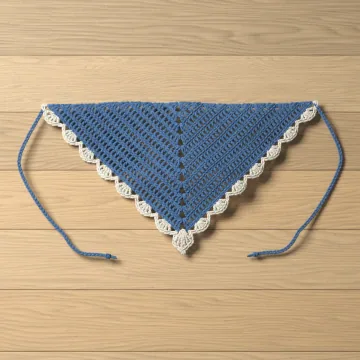
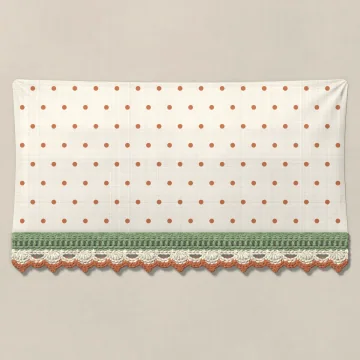
A shell border for a scarf, worked all round a long narrow piece: V stitches, rust shells, flat corners and a corded edge in DK yarn. Easy, three sizes. It says how many stitches to pick up along the row ends, so that the long sides neither ripple nor draw in.