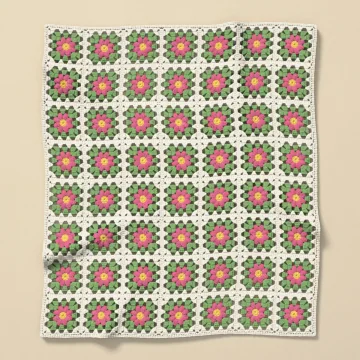
Sunflower hexagon throw crochet pattern
Crochet, 31¼ × 39½ in, 4 colors, intermediate
Size: Baby Change size
Which size? Blanket size chart
PDF. Prints on US Letter and A4.
What you need
Each amount is an estimate.
- Yarn A wheat creamabout 550 yd (503 m)main color
- Yarn B chestnutabout 190 yd (174 m)the sunflower hexagon, rounds 1 and 2 and the half hexagon, row 1
- Yarn C sun mustardabout 350 yd (320 m)stripe
- Yarn D fernabout 290 yd (265 m)stripe
- Yarn in all
- About 1,380 yd (1,262 m) or 690 g
- Weight
- Medium weight, 4 on the label (UK aran)
- Hook
- 5.5 mm (US I-9), or the size that gives you the gauge
- Ends
- 310 to weave in, in this size
- Also
- A yarn needle, scissors and a tape measure
- Gauge
- 14 stitches and 8 rounds to 4 in (10 cm) in double crochet in rounds. How to check it
Instructions Baby
How to read these rounds
US terms · Show UK terms
- ch chain, sl st slip stitch, sc single crochet (UK double crochet), dc double crochet (UK treble), tr treble crochet (UK double treble).
- sc2tog 2 sc made into one, sc3tog 3 sc made into one, sk skip, yo yarn over the hook, RS right side, the one that shows.
- 2 sc in next st: both in one stitch. dc in next 8 sts: one in each. ch-1 sp: the gap under the one chain; the hook goes in the gap.
- [ ] 6 times: work what is inside 6 times in all. ( ): all of it goes into the one place.
- (6 pop, 6 ch-1 sps): the stitches you have when the round is done. How to read a pattern.
- Working in the round. Joining squares. Changing colors.
- The ch 1, ch 2, ch 3 or ch 4 at the start of a round does not count as a stitch unless the round says that it does, and a joining sl st never counts. Where a round begins with a stitch in the "next st" or in the "same st as join", that is the st the joining sl st was made in, the first one of the round before. A ch 3 that counts stands on that st, or in the space where the yarn is joined.
- In rows 2 to 5 of a half hexagon the ch 3 counts as the first dc and stands on the first st; "dc in same st" goes into that first st too, so that two stitches stand at each end of the row. The last 2 dc go into the top of the turning chain, the ch 3 (in row 2 the ch 4) that began the row before. In row 6 the ch 1 does not count, the first 2 sc go into the first st and the last 2 into the top of the ch 3.
Special stitches
Sunflower hexagon make 32
Yarns in order of use: B, chestnut; C, sun mustard; D, fern; A, wheat cream.
- StartWith B, make a magic ring.
- Rnd 1Ch 2, repeat: pop in ring, ch 1 6 times; pull the tail to close the ring; join with sl st in first popleaves (6 pop, 6 ch-1 sps)
- Rnd 2Ch 1, repeat: sc in next st, 2 sc in next ch-1 sp 6 times; join with sl st in first scleaves (18 sc)
The petals
- Rnd 3With C, ch 4, repeat: dcl in next st, ch 1 18 times; join with sl st in first dclleaves (18 dcl, 18 ch-1 sps)
The leaves
- Rnd 4Join D with sl st in next ch-1 sp, ch 3 (counts as dc), (dc, ch 2, 2 dc) in same sp, 2 dc in next ch-1 sp, 2 dc in next ch-1 sp, repeat: (2 dc, ch 2, 2 dc) in next ch-1 sp, 2 dc in next ch-1 sp, 2 dc in next ch-1 sp 5 times; join with sl st in top of beg ch-3leaves (48 dc, 6 ch-2 sps)
The frame
- Rnd 5Join A with sl st in next ch-2 sp, ch 3 (counts as dc), (ch 2, dc) in same sp, dc in next 8 sts, repeat: (dc, ch 2, dc) in next ch-2 sp, dc in next 8 sts 5 times; join with sl st in top of beg ch-3leaves (60 dc, 6 ch-2 sps)
- Rnd 6Ch 1, sc in same st as join, (sc, ch 2, sc) in next ch-2 sp, repeat: sc in next 10 sts, (sc, ch 2, sc) in next ch-2 sp 5 times, sc in next 9 sts; join with sl st in first scleaves (72 sc, 6 ch-2 sps)
- EndFasten off.
Half hexagon make 6
Yarns in order of use: B, chestnut; C, sun mustard; D, fern; A, wheat cream.
- StartWith B, make a magic ring.
- Row 1RSCh 4 (counts as tr), 2 dc in ring, ch 2, 2 dc in ring, ch 2, 2 dc in ring, tr in ring. Pull the tail to close the ring.leaves (2 tr, 6 dc, 2 ch-2 sps)
- Row 2With C, ch 3 (counts as dc), turn; dc in same st, dc in next 2 sts, (dc, ch 2, dc) in next ch-2 sp, dc in next 2 sts, (dc, ch 2, dc) in next ch-2 sp, dc in next 2 sts, 2 dc in top of turning chleaves (14 dc, 2 ch-2 sps)
- Row 3Ch 3 (counts as dc), turn; dc in same st, dc in next 4 sts, (dc, ch 2, dc) in next ch-2 sp, dc in next 4 sts, (dc, ch 2, dc) in next ch-2 sp, dc in next 4 sts, 2 dc in top of turning chleaves (20 dc, 2 ch-2 sps)
- Row 4With D, ch 3 (counts as dc), turn; dc in same st, dc in next 6 sts, (dc, ch 2, dc) in next ch-2 sp, dc in next 6 sts, (dc, ch 2, dc) in next ch-2 sp, dc in next 6 sts, 2 dc in top of turning chleaves (26 dc, 2 ch-2 sps)
- Row 5With A, ch 3 (counts as dc), turn; dc in same st, dc in next 8 sts, (dc, ch 2, dc) in next ch-2 sp, dc in next 8 sts, (dc, ch 2, dc) in next ch-2 sp, dc in next 8 sts, 2 dc in top of turning chleaves (32 dc, 2 ch-2 sps)
- Row 6Ch 1, turn; 2 sc in next st, sc in next 10 sts, (sc, ch 2, sc) in next ch-2 sp, sc in next 10 sts, (sc, ch 2, sc) in next ch-2 sp, sc in next 10 sts, 2 sc in top of turning chleaves (38 sc, 2 ch-2 sps)
- EndFasten off.
Border
Yarns in order of use: A, wheat cream; D, fern; C, sun mustard.
- Work it when all the pieces are sewn to each other (Putting it together), from right to left along the top edge and so on round the throw. The first st is the st just after the ch-2 sp at the top right corner; that corner space is the last place of the round. The four corners are the outer ch-2 sps at the straight ends of the top row and of the bottom row.
- Along the top edge and the bottom edge every hexagon shows two sides of 12 sts with the ch-2 sp of its point between them, and a notch lies between two hexagons: the two ch-2 sps that meet at the bottom of it, one of each hexagon, are passed over.
- Along the left edge and the right edge every hexagon of a long row shows one side of 12 sts between two ch-2 sps, and every half hexagon its straight edge: the end of its row of sc (1 sc), the ends of its five rows of dc from the outermost to row 1, the ends of the same five rows from row 1 outward on the other side of the ring (2 sc each, 20 in all, none in the ring itself), and the end of the row of sc again.
- StartWork around the edge of the joined hexagons, right side facing: the 5 hexagons of the top edge, the 7 rows of the left edge, the 5 hexagons of the bottom edge, the 7 rows of the right edge.
- Rnd 1Join A with sl st in first st, ch 1, sc in first st, sc in next 11 sts, sc in next ch-2 sp, sc in next 12 sts, sk next 2 ch-2 sps, repeat: sc in next 12 sts, sc in next ch-2 sp, sc in next 12 sts, sk next 2 ch-2 sps 3 times, sc in next 12 sts, sc in next ch-2 sp, sc in next 12 sts, sc in next ch-2 sp, repeat: sc in next 12 sts, sc in next ch-2 sp, sc in end of next row, 2 sc in end of each of next 10 rows, sc in end of next row, sc in next ch-2 sp 3 times, sc in next 12 sts, sc in next ch-2 sp, repeat: sc in next 12 sts, sc in next ch-2 sp, sc in next 12 sts, sk next 2 ch-2 sps 4 times, sc in next 12 sts, sc in next ch-2 sp, sc in next 12 sts, sc in next ch-2 sp, repeat: sc in next 12 sts, sc in next ch-2 sp, sc in end of next row, 2 sc in end of each of next 10 rows, sc in end of next row, sc in next ch-2 sp 3 times, sc in next 12 sts, sc in next ch-2 sp; join with sl st in first scleaves (494 sc)
- Rnd 2With D, ch 1, sc in same st as join, sc in next 11 sts, repeat: 3 sc in next st, sc in next 11 sts, sc2tog, sc in next 11 sts 4 times, 3 sc in next st, sc in next 12 sts, 3 sc in next st, sc in next 120 sts, 3 sc in next st, sc in next 12 sts, repeat: 3 sc in next st, sc in next 11 sts, sc2tog, sc in next 11 sts 4 times, 3 sc in next st, sc in next 12 sts, 3 sc in next st, sc in next 120 sts, 3 sc in next st; join with sl st in first scleaves (506 sc, 8 sc2tog)
- Rnd 3Ch 1, sc in same st as join, sc in next 24 sts, repeat: sc3tog, sc in next 23 sts 3 times, sc3tog, sc in next 176 sts, repeat: sc3tog, sc in next 23 sts 3 times, sc3tog, sc in next 151 sts; join with sl st in first scleaves (490 sc, 8 sc3tog)
- Rnd 4With C, ch 1, sc in same st as join, sc in next 12 sts, repeat: 3 sc in next st, sc in next 10 sts, sc3tog, sc in next 10 sts 4 times, 3 sc in next st, sc in next 14 sts, 3 sc in next st, sc in next 122 sts, 3 sc in next st, sc in next 14 sts, repeat: 3 sc in next st, sc in next 10 sts, sc3tog, sc in next 10 sts 4 times, 3 sc in next st, sc in next 14 sts, 3 sc in next st, sc in next 122 sts, 3 sc in next st, sc in next st; join with sl st in first scleaves (502 sc, 8 sc3tog)
- EndFasten off.
Assembly
- Weave in the ends of every piece. There are 32 sunflower hexagons and 6 halves.
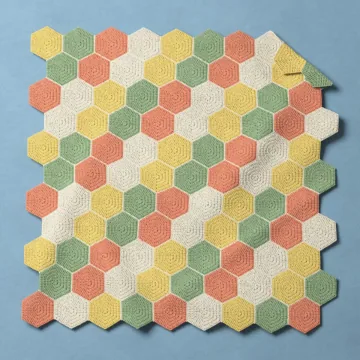
- How the pieces lie: every hexagon lies with a corner at the top and a straight side on its left and right. A long row is 5 hexagons side by side. A short row is 4 hexagons with a half hexagon at each end, its straight edge outward, so that the sides of the blanket are straight. Row 1, at the top, is a long row, row 2 a short one, and so on by turns, 7 rows in all; each row is moved by half a hexagon against the row above it, so that a corner of one row stands where two pieces of the other meet.
- Sew with whip stitch, right sides together, one side of a piece to one side of the next: 14 stitches a side, one in the ch-2 sp at the first corner, 12 in the sts and one in the ch-2 sp at the second corner. At the straight edge of a half hexagon there is no corner space: the first or the last st of its last row takes its place. Fasten every piece and every length of yarn at both ends, as the note on whip stitch says.
- First sew the pieces of each row to one another along their upright sides, 4 seams in a long row and 5 in a short one, 31 seams in all, 14 stitches each: for each of them cut a piece of A about 22 in (56 cm) long.
- Then sew row to row along the zigzag between them, 10 sides, one side after the other without cutting the yarn between them, 14 stitches a side, turning the pieces at every corner so that the next two sides lie together: 6 zigzags, each with 3 lengths of A about 50 in (127 cm) long; each length sews 4 sides, the last one 2. At each corner, take the corner spaces of all the pieces that meet there.
- Then work the border.
Finishing
- Weave in the ends of the seams and of the border with the yarn needle.
- Lay the throw flat, damp it, pat its points sharp and its sides straight, and leave it until it is dry.
About
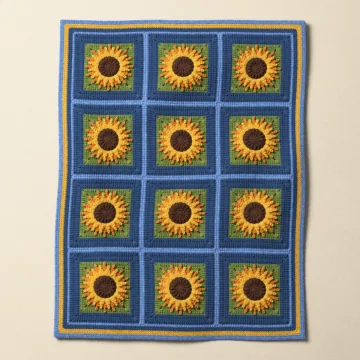
A honeycomb of sunflowers: every hexagon has a heart of six chestnut popcorns, eighteen long mustard petals, a round of fern green and a cream frame. Half hexagons in the same rings of color fill the ends of every second row, so that the two long sides are straight; the top and the bottom keep their points, and a border of cream, green and mustard goes all the way round.