Cross stitch guide
Cross stitch frame size chart
On 14 count cloth, which has 14 stitches to the inch (2.5 cm), a frame sold as 5 by 7 inches (12.7 by 17.8 cm) takes a design up to 56 by 84 stitches with half an inch (1.3 cm) of bare cloth all round. Filled edge to edge, an opening of that size holds 70 by 98 stitches, but the lip of a frame hides a little of what is behind it.
On this page 23 parts
- The short answer
- How to read the charts
- Half an inch of cloth all round, on 14 count
- An inch of cloth all round, on 14 count
- Half an inch of cloth all round, on 16 count
- Half an inch of cloth all round, on 18 count
- Half an inch of cloth all round, on 11 count
- Edge to edge, on 14 count
- Edge to edge, on 16 count
- Edge to edge, on 18 count
- Edge to edge, on 11 count
- The sum for any frame
- How wide a border to leave
- Evenweave and linen
- Which metric frame is which
- Metric frames on 14 count
- Which frame to buy for a finished piece
- When the size is odd: use a mat
- Round and square openings
- How much cloth to cut
- Finding a design by its size
- Common mistakes
- Where to go next
The short answer
With half an inch (1.3 cm) of bare cloth all round, on 14 count, the largest design is:
- 4 by 6 inch frame (10.2 by 15.2 cm): 42 by 70 stitches
- 5 by 7 inch frame (12.7 by 17.8 cm): 56 by 84 stitches
- 8 by 10 inch frame (20.3 by 25.4 cm): 98 by 126 stitches
- 11 by 14 inch frame (27.9 by 35.6 cm): 140 by 182 stitches
- 16 by 20 inch frame (40.6 by 50.8 cm): 210 by 266 stitches
For another frame or another count, go on to the charts. If your piece is stitched already, go to "Which frame to buy for a finished piece", lower down.
How to read the charts
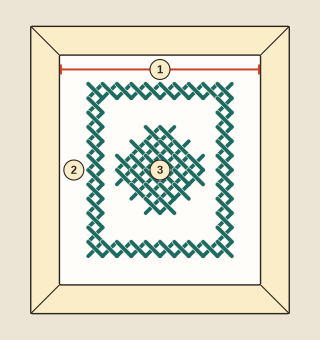
Count is the number of stitches to the inch of cloth. Cloth is sold by it: 14 count, 16 count and so on. The opening (1 in the picture) is what you see of the piece from the front. It is a little smaller than the size the frame is sold by, because the frame has a lip that comes over the edge. On one teacher's small frame the lip hid a good quarter inch (6 mm) all round.
There are two kinds of chart:
- With a border. In these charts "Stitched size" is the design alone. To get the frame, add the border on both sides. In the half inch (1.3 cm) charts add 1 inch (2.5 cm) to each number: the row that reads 4 by 6 inches (10.2 by 15.2 cm) is for a frame sold as 5 by 7 inches (12.7 by 17.8 cm). In the one inch (2.5 cm) chart add 2 inches (5.1 cm): the row that reads 6 by 8 inches (15.2 by 20.3 cm) is for an 8 by 10 inch frame (20.3 by 25.4 cm). The lip takes its bit from the bare cloth, so no stitch goes under it. You then see a narrower border than half an inch (1.3 cm).
- Edge to edge. Here "Stitched size" is the opening itself, with no bare cloth showing. Use these only with an opening you have measured from the front. If you go by the size the frame is sold by, the outer stitches end up under the lip.
Two numbers the other way round are the same frame turned on its side. A design smaller than the row is fine: the bare cloth is then a little wider.
The cloth columns. Inches and centimeters are each rounded up by themselves, so the two do not agree to the last bit. Cut by the one your ruler shows. Either is enough.
The usual ready-made frames go by the sizes of photographs: 4 by 6, 5 by 7, 8 by 10, 11 by 14 and 16 by 20 inches (10.2 by 15.2, 12.7 by 17.8, 20.3 by 25.4, 27.9 by 35.6 and 40.6 by 50.8 cm). Sizes of 6 by 8 and 9 by 12 inches (15.2 by 20.3 and 22.9 by 30.5 cm) are made too, and square ones.
Half an inch of cloth all round, on 14 count
| Design, in stitches | Stitched size, inches | Stitched size, centimeters | Fabric to cut, inches | Fabric to cut, centimeters |
|---|---|---|---|---|
| 42 × 42 | 3 × 3 in | 7.6 × 7.6 cm | 9 × 9 in | 23 × 23 cm |
| 42 × 70 | 3 × 5 in | 7.6 × 12.7 cm | 9 × 11 in | 23 × 28 cm |
| 56 × 56 | 4 × 4 in | 10.2 × 10.2 cm | 10 × 10 in | 26 × 26 cm |
| 56 × 84 | 4 × 6 in | 10.2 × 15.2 cm | 10 × 12 in | 26 × 31 cm |
| 70 × 70 | 5 × 5 in | 12.7 × 12.7 cm | 11 × 11 in | 28 × 28 cm |
| 70 × 98 | 5 × 7 in | 12.7 × 17.8 cm | 11 × 13 in | 28 × 33 cm |
| 98 × 98 | 7 × 7 in | 17.8 × 17.8 cm | 13 × 13 in | 33 × 33 cm |
| 98 × 126 | 7 × 9 in | 17.8 × 22.9 cm | 13 × 15 in | 33 × 38 cm |
| 112 × 154 | 8 × 11 in | 20.3 × 27.9 cm | 14 × 17 in | 36 × 43 cm |
| 126 × 126 | 9 × 9 in | 22.9 × 22.9 cm | 15 × 15 in | 38 × 38 cm |
| 140 × 182 | 10 × 13 in | 25.4 × 33.0 cm | 16 × 19 in | 41 × 49 cm |
| 154 × 154 | 11 × 11 in | 27.9 × 27.9 cm | 17 × 17 in | 43 × 43 cm |
| 210 × 266 | 15 × 19 in | 38.1 × 48.3 cm | 21 × 25 in | 54 × 64 cm |
The fabric to cut leaves 3 inches (7.5 cm) on every side for framing, rounded up to a whole inch or centimeter. For a design of another size, open the fabric calculator on 56 × 84 stitches at this count and change the numbers.
An inch of cloth all round, on 14 count
| Design, in stitches | Stitched size, inches | Stitched size, centimeters | Fabric to cut, inches | Fabric to cut, centimeters |
|---|---|---|---|---|
| 42 × 70 | 3 × 5 in | 7.6 × 12.7 cm | 9 × 11 in | 23 × 28 cm |
| 56 × 56 | 4 × 4 in | 10.2 × 10.2 cm | 10 × 10 in | 26 × 26 cm |
| 56 × 84 | 4 × 6 in | 10.2 × 15.2 cm | 10 × 12 in | 26 × 31 cm |
| 84 × 84 | 6 × 6 in | 15.2 × 15.2 cm | 12 × 12 in | 31 × 31 cm |
| 84 × 112 | 6 × 8 in | 15.2 × 20.3 cm | 12 × 14 in | 31 × 36 cm |
| 98 × 140 | 7 × 10 in | 17.8 × 25.4 cm | 13 × 16 in | 33 × 41 cm |
| 112 × 112 | 8 × 8 in | 20.3 × 20.3 cm | 14 × 14 in | 36 × 36 cm |
| 126 × 168 | 9 × 12 in | 22.9 × 30.5 cm | 15 × 18 in | 38 × 46 cm |
| 140 × 140 | 10 × 10 in | 25.4 × 25.4 cm | 16 × 16 in | 41 × 41 cm |
| 196 × 252 | 14 × 18 in | 35.6 × 45.7 cm | 20 × 24 in | 51 × 61 cm |
The fabric to cut leaves 3 inches (7.5 cm) on every side for framing, rounded up to a whole inch or centimeter. For a design of another size, open the fabric calculator on 84 × 84 stitches at this count and change the numbers.
Half an inch of cloth all round, on 16 count
| Design, in stitches | Stitched size, inches | Stitched size, centimeters | Fabric to cut, inches | Fabric to cut, centimeters |
|---|---|---|---|---|
| 48 × 48 | 3 × 3 in | 7.6 × 7.6 cm | 9 × 9 in | 23 × 23 cm |
| 48 × 80 | 3 × 5 in | 7.6 × 12.7 cm | 9 × 11 in | 23 × 28 cm |
| 64 × 64 | 4 × 4 in | 10.2 × 10.2 cm | 10 × 10 in | 26 × 26 cm |
| 64 × 96 | 4 × 6 in | 10.2 × 15.2 cm | 10 × 12 in | 26 × 31 cm |
| 80 × 80 | 5 × 5 in | 12.7 × 12.7 cm | 11 × 11 in | 28 × 28 cm |
| 80 × 112 | 5 × 7 in | 12.7 × 17.8 cm | 11 × 13 in | 28 × 33 cm |
| 112 × 112 | 7 × 7 in | 17.8 × 17.8 cm | 13 × 13 in | 33 × 33 cm |
| 112 × 144 | 7 × 9 in | 17.8 × 22.9 cm | 13 × 15 in | 33 × 38 cm |
| 128 × 176 | 8 × 11 in | 20.3 × 27.9 cm | 14 × 17 in | 36 × 43 cm |
| 160 × 208 | 10 × 13 in | 25.4 × 33.0 cm | 16 × 19 in | 41 × 49 cm |
| 240 × 304 | 15 × 19 in | 38.1 × 48.3 cm | 21 × 25 in | 54 × 64 cm |
The fabric to cut leaves 3 inches (7.5 cm) on every side for framing, rounded up to a whole inch or centimeter. For a design of another size, open the fabric calculator on 64 × 96 stitches at this count and change the numbers.
Half an inch of cloth all round, on 18 count
| Design, in stitches | Stitched size, inches | Stitched size, centimeters | Fabric to cut, inches | Fabric to cut, centimeters |
|---|---|---|---|---|
| 54 × 54 | 3 × 3 in | 7.6 × 7.6 cm | 9 × 9 in | 23 × 23 cm |
| 54 × 90 | 3 × 5 in | 7.6 × 12.7 cm | 9 × 11 in | 23 × 28 cm |
| 72 × 72 | 4 × 4 in | 10.2 × 10.2 cm | 10 × 10 in | 26 × 26 cm |
| 72 × 108 | 4 × 6 in | 10.2 × 15.2 cm | 10 × 12 in | 26 × 31 cm |
| 90 × 90 | 5 × 5 in | 12.7 × 12.7 cm | 11 × 11 in | 28 × 28 cm |
| 90 × 126 | 5 × 7 in | 12.7 × 17.8 cm | 11 × 13 in | 28 × 33 cm |
| 126 × 126 | 7 × 7 in | 17.8 × 17.8 cm | 13 × 13 in | 33 × 33 cm |
| 126 × 162 | 7 × 9 in | 17.8 × 22.9 cm | 13 × 15 in | 33 × 38 cm |
| 144 × 198 | 8 × 11 in | 20.3 × 27.9 cm | 14 × 17 in | 36 × 43 cm |
| 180 × 234 | 10 × 13 in | 25.4 × 33.0 cm | 16 × 19 in | 41 × 49 cm |
| 270 × 342 | 15 × 19 in | 38.1 × 48.3 cm | 21 × 25 in | 54 × 64 cm |
The fabric to cut leaves 3 inches (7.5 cm) on every side for framing, rounded up to a whole inch or centimeter. For a design of another size, open the fabric calculator on 72 × 108 stitches at this count and change the numbers.
Half an inch of cloth all round, on 11 count
| Design, in stitches | Stitched size, inches | Stitched size, centimeters | Fabric to cut, inches | Fabric to cut, centimeters |
|---|---|---|---|---|
| 33 × 33 | 3 × 3 in | 7.6 × 7.6 cm | 9 × 9 in | 23 × 23 cm |
| 33 × 55 | 3 × 5 in | 7.6 × 12.7 cm | 9 × 11 in | 23 × 28 cm |
| 44 × 44 | 4 × 4 in | 10.2 × 10.2 cm | 10 × 10 in | 26 × 26 cm |
| 44 × 66 | 4 × 6 in | 10.2 × 15.2 cm | 10 × 12 in | 26 × 31 cm |
| 55 × 55 | 5 × 5 in | 12.7 × 12.7 cm | 11 × 11 in | 28 × 28 cm |
| 55 × 77 | 5 × 7 in | 12.7 × 17.8 cm | 11 × 13 in | 28 × 33 cm |
| 77 × 77 | 7 × 7 in | 17.8 × 17.8 cm | 13 × 13 in | 33 × 33 cm |
| 77 × 99 | 7 × 9 in | 17.8 × 22.9 cm | 13 × 15 in | 33 × 38 cm |
| 88 × 121 | 8 × 11 in | 20.3 × 27.9 cm | 14 × 17 in | 36 × 43 cm |
| 110 × 143 | 10 × 13 in | 25.4 × 33.0 cm | 16 × 19 in | 41 × 49 cm |
| 165 × 209 | 15 × 19 in | 38.1 × 48.3 cm | 21 × 25 in | 54 × 64 cm |
The fabric to cut leaves 3 inches (7.5 cm) on every side for framing, rounded up to a whole inch or centimeter. For a design of another size, open the fabric calculator on 44 × 66 stitches at this count and change the numbers.
Edge to edge, on 14 count
| Design, in stitches | Stitched size, inches | Stitched size, centimeters | Fabric to cut, inches | Fabric to cut, centimeters |
|---|---|---|---|---|
| 28 × 28 | 2 × 2 in | 5.1 × 5.1 cm | 8 × 8 in | 21 × 21 cm |
| 42 × 42 | 3 × 3 in | 7.6 × 7.6 cm | 9 × 9 in | 23 × 23 cm |
| 56 × 56 | 4 × 4 in | 10.2 × 10.2 cm | 10 × 10 in | 26 × 26 cm |
| 56 × 84 | 4 × 6 in | 10.2 × 15.2 cm | 10 × 12 in | 26 × 31 cm |
| 70 × 70 | 5 × 5 in | 12.7 × 12.7 cm | 11 × 11 in | 28 × 28 cm |
| 70 × 98 | 5 × 7 in | 12.7 × 17.8 cm | 11 × 13 in | 28 × 33 cm |
| 84 × 84 | 6 × 6 in | 15.2 × 15.2 cm | 12 × 12 in | 31 × 31 cm |
| 84 × 112 | 6 × 8 in | 15.2 × 20.3 cm | 12 × 14 in | 31 × 36 cm |
| 112 × 112 | 8 × 8 in | 20.3 × 20.3 cm | 14 × 14 in | 36 × 36 cm |
| 112 × 140 | 8 × 10 in | 20.3 × 25.4 cm | 14 × 16 in | 36 × 41 cm |
| 126 × 168 | 9 × 12 in | 22.9 × 30.5 cm | 15 × 18 in | 38 × 46 cm |
| 140 × 140 | 10 × 10 in | 25.4 × 25.4 cm | 16 × 16 in | 41 × 41 cm |
| 154 × 196 | 11 × 14 in | 27.9 × 35.6 cm | 17 × 20 in | 43 × 51 cm |
| 168 × 168 | 12 × 12 in | 30.5 × 30.5 cm | 18 × 18 in | 46 × 46 cm |
| 224 × 280 | 16 × 20 in | 40.6 × 50.8 cm | 22 × 26 in | 56 × 66 cm |
The fabric to cut leaves 3 inches (7.5 cm) on every side for framing, rounded up to a whole inch or centimeter. For a design of another size, open the fabric calculator on 56 × 84 stitches at this count and change the numbers.
Edge to edge, on 16 count
| Design, in stitches | Stitched size, inches | Stitched size, centimeters | Fabric to cut, inches | Fabric to cut, centimeters |
|---|---|---|---|---|
| 48 × 48 | 3 × 3 in | 7.6 × 7.6 cm | 9 × 9 in | 23 × 23 cm |
| 64 × 64 | 4 × 4 in | 10.2 × 10.2 cm | 10 × 10 in | 26 × 26 cm |
| 64 × 96 | 4 × 6 in | 10.2 × 15.2 cm | 10 × 12 in | 26 × 31 cm |
| 80 × 112 | 5 × 7 in | 12.7 × 17.8 cm | 11 × 13 in | 28 × 33 cm |
| 96 × 96 | 6 × 6 in | 15.2 × 15.2 cm | 12 × 12 in | 31 × 31 cm |
| 128 × 160 | 8 × 10 in | 20.3 × 25.4 cm | 14 × 16 in | 36 × 41 cm |
| 144 × 192 | 9 × 12 in | 22.9 × 30.5 cm | 15 × 18 in | 38 × 46 cm |
| 176 × 224 | 11 × 14 in | 27.9 × 35.6 cm | 17 × 20 in | 43 × 51 cm |
| 256 × 320 | 16 × 20 in | 40.6 × 50.8 cm | 22 × 26 in | 56 × 66 cm |
The fabric to cut leaves 3 inches (7.5 cm) on every side for framing, rounded up to a whole inch or centimeter. For a design of another size, open the fabric calculator on 80 × 112 stitches at this count and change the numbers.
Edge to edge, on 18 count
| Design, in stitches | Stitched size, inches | Stitched size, centimeters | Fabric to cut, inches | Fabric to cut, centimeters |
|---|---|---|---|---|
| 54 × 54 | 3 × 3 in | 7.6 × 7.6 cm | 9 × 9 in | 23 × 23 cm |
| 72 × 72 | 4 × 4 in | 10.2 × 10.2 cm | 10 × 10 in | 26 × 26 cm |
| 72 × 108 | 4 × 6 in | 10.2 × 15.2 cm | 10 × 12 in | 26 × 31 cm |
| 90 × 126 | 5 × 7 in | 12.7 × 17.8 cm | 11 × 13 in | 28 × 33 cm |
| 108 × 108 | 6 × 6 in | 15.2 × 15.2 cm | 12 × 12 in | 31 × 31 cm |
| 144 × 180 | 8 × 10 in | 20.3 × 25.4 cm | 14 × 16 in | 36 × 41 cm |
| 162 × 216 | 9 × 12 in | 22.9 × 30.5 cm | 15 × 18 in | 38 × 46 cm |
| 198 × 252 | 11 × 14 in | 27.9 × 35.6 cm | 17 × 20 in | 43 × 51 cm |
| 288 × 360 | 16 × 20 in | 40.6 × 50.8 cm | 22 × 26 in | 56 × 66 cm |
The fabric to cut leaves 3 inches (7.5 cm) on every side for framing, rounded up to a whole inch or centimeter. For a design of another size, open the fabric calculator on 90 × 126 stitches at this count and change the numbers.
Edge to edge, on 11 count
| Design, in stitches | Stitched size, inches | Stitched size, centimeters | Fabric to cut, inches | Fabric to cut, centimeters |
|---|---|---|---|---|
| 33 × 33 | 3 × 3 in | 7.6 × 7.6 cm | 9 × 9 in | 23 × 23 cm |
| 44 × 44 | 4 × 4 in | 10.2 × 10.2 cm | 10 × 10 in | 26 × 26 cm |
| 44 × 66 | 4 × 6 in | 10.2 × 15.2 cm | 10 × 12 in | 26 × 31 cm |
| 55 × 77 | 5 × 7 in | 12.7 × 17.8 cm | 11 × 13 in | 28 × 33 cm |
| 66 × 66 | 6 × 6 in | 15.2 × 15.2 cm | 12 × 12 in | 31 × 31 cm |
| 88 × 110 | 8 × 10 in | 20.3 × 25.4 cm | 14 × 16 in | 36 × 41 cm |
| 99 × 132 | 9 × 12 in | 22.9 × 30.5 cm | 15 × 18 in | 38 × 46 cm |
| 121 × 154 | 11 × 14 in | 27.9 × 35.6 cm | 17 × 20 in | 43 × 51 cm |
| 176 × 220 | 16 × 20 in | 40.6 × 50.8 cm | 22 × 26 in | 56 × 66 cm |
The fabric to cut leaves 3 inches (7.5 cm) on every side for framing, rounded up to a whole inch or centimeter. For a design of another size, open the fabric calculator on 55 × 77 stitches at this count and change the numbers.
The sum for any frame
Do it once for the width and once for the height. It works for every count and any border.
- Take the opening. Measure what you can see from the front, in inches. Say 5 inches (12.7 cm).
- Take off the border. Subtract the bare cloth you want on both sides. For half an inch (1.3 cm) a side, take off 1 inch (2.5 cm). That leaves 4 inches (10.2 cm).
- Multiply by the stitches to the inch. 4 times 14 is 56 stitches.
Or open the fabric calculator on a 5 by 7 inch (12.7 by 17.8 cm) frame: it lists what fills an opening of that size, edge to edge, on every count.
How wide a border to leave
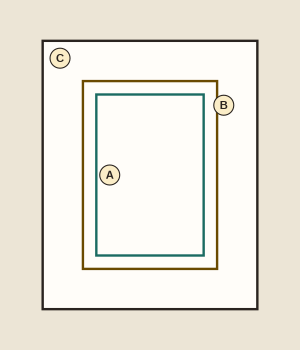
There is no fixed width: choose by eye. One teacher leaves about half an inch (1.3 cm) all round: a design 4 by 6 inches (10.2 by 15.2 cm) then goes in an opening of 5 by 7 inches (12.7 by 17.8 cm). A larger piece can take an inch (2.5 cm) or more. A design with a stitched border of its own can go closer to the frame than one with no edge.
Frames are not all one shape. A 4 by 6 is longer for its width than a 5 by 7, and an 8 by 10 is nearer to square. So a design that fills one frame neatly will not fill the next size up: the border comes out wider on two of the sides.
Evenweave and linen
Evenweave and linen are cloths of plain single threads, with no blocks to count. A cross is usually stitched over two threads each way, so 28 threads to the inch (2.5 cm) make 14 stitches, and 32 threads make 16. Use the 14 count charts for 28 count cloth and the 16 count charts for 32 count. Evenweave and stitching over two shows how it is done.
Which metric frame is which
The rows of the next chart, from the top, fill openings of 10 by 15 cm, 13 by 18 cm, 20 by 25 cm, A4 (21 by 29.7 cm), A3 (29.7 by 42 cm) and 30 by 40 cm. They go edge to edge, with no bare cloth. Each is rounded down to whole stitches, so the design comes out a shade smaller than the opening. For a border, take it off both sides first, as in the sum above. The sum is the same with one more step: centimeters divided by 2.54 are inches, and inches times the count are stitches. For 10 cm on 14 count that is 10 divided by 2.54, times 14: 55 stitches.
A 10 by 15 cm frame and a 4 by 6 inch one are close but not equal (10.2 by 15.2 cm). The same goes for 13 by 18 cm and 5 by 7 inches (12.7 by 17.8 cm). Measure before you cut the board the piece is stretched over.
Metric frames on 14 count
| Design, in stitches | Stitched size, inches | Stitched size, centimeters | Fabric to cut, inches | Fabric to cut, centimeters |
|---|---|---|---|---|
| 55 × 82 | 3 7/8 × 5 7/8 in | 10.0 × 14.9 cm | 10 × 12 in | 25 × 30 cm |
| 71 × 99 | 5 1/8 × 7 1/8 in | 12.9 × 18.0 cm | 12 × 14 in | 28 × 33 cm |
| 110 × 137 | 7 7/8 × 9 3/4 in | 20.0 × 24.9 cm | 14 × 16 in | 35 × 40 cm |
| 115 × 163 | 8 1/4 × 11 5/8 in | 20.9 × 29.6 cm | 15 × 18 in | 36 × 45 cm |
| 163 × 231 | 11 5/8 × 16 1/2 in | 29.6 × 41.9 cm | 18 × 23 in | 45 × 57 cm |
| 165 × 220 | 11 3/4 × 15 3/4 in | 29.9 × 39.9 cm | 18 × 22 in | 45 × 55 cm |
The fabric to cut leaves 3 inches (7.5 cm) on every side for framing, rounded up to a whole inch or centimeter. For a design of another size, open the fabric calculator on 115 × 163 stitches at this count and change the numbers.
Which frame to buy for a finished piece
To go in a frame, the piece is stretched over a sheet of stiff board, and the spare cloth is folded to the back. The board sits behind the lip, in the recess at the back of the frame.
- Measure the stitching. Lay it flat and measure the width and the height of the stitches themselves, not the cloth.
- Add the border. Add twice the bare cloth you want to see to each measure. This is the opening you need.
- Find the nearest frame. Take the next standard size at or above both numbers. Check the width and the height: one may fit and the other not.
- Measure its opening from the front before you buy. It is smaller than the size the frame is sold by, and the window of a mat sold with a frame can be smaller than its label says.
- If the opening is too small, accept a narrower border, as long as bare cloth shows on all four sides. If not, take the next size up, and use a mat if that leaves too much.
- Check the cloth. You need an inch or two (2.5 to 5 cm) beyond the board on every side to fold to the back.
- Measure the recess. Turn the frame over and measure the space at the back, where the glass lies. It is bigger than the opening at the front.
- Cut the board a little smaller than the recess. Take one eighth of an inch (3 mm) off its width and off its height, or up to a quarter of an inch (6 mm) for thick cloth. That leaves room for the cloth that wraps round it. The board is still larger than the opening at the front, so it cannot fall through.
Say the stitching is 4 by 5 inches (10.2 by 12.7 cm). With half an inch (1.3 cm) all round it wants an opening of 5 by 6 inches (12.7 by 15.2 cm). The next frame up is sold as 5 by 7 inches (12.7 by 17.8 cm). If its lip hides a quarter inch (6 mm) all round, its opening is 4 1/2 by 6 1/2 inches (11.4 by 16.5 cm). You would then see a quarter inch (6 mm) of cloth at the sides and three quarters (1.9 cm) at top and bottom. If that is too tight at the sides, take the next size up, or a mat.
When the size is odd: use a mat
A mat is a sheet of stiff card with a window cut in it. It lies in the frame, in front of the piece. It turns a frame of one size into an opening of another, and it holds the glass off the stitches.
- The window is the design plus the border on both sides.
- The frame is the outside of the mat.
- The mat's own width is usually equal all round, or a little deeper at the bottom. A small frame takes a narrower mat than a large one.
So a piece that wants an opening 5 by 6 inches (12.7 by 15.2 cm) can go in an 8 by 10 inch frame (20.3 by 25.4 cm). The mat is then 1.5 inches (3.8 cm) at the sides and 2 inches (5.1 cm) at top and bottom. Without a mat, the piece can be mounted on a larger board covered in plain cloth, or the frame can be made to measure. How to frame a cross stitch has the order of work.
Round and square openings
In a square frame, a square design has the same border on four sides. A long design does not, so choose a frame of its own shape.
In a round opening the corners touch first. Measure the design from corner to corner: that line has to be shorter than the opening is wide. A design 42 by 56 stitches on 14 count is 3 by 4 inches (7.6 by 10.2 cm), and from corner to corner it is 5 inches (12.7 cm). It will not go in a 4 inch (10.2 cm) round frame, though its sides would. Add an inch (2.5 cm) for clear cloth and it wants 6 inches (15.2 cm). Hoop sizes has that worked out for square designs.
How much cloth to cut
The figures marked "Fabric to cut" in the charts give it: the stitched size and 3 inches (7.5 cm) more on every side. That is the border you see, the thickness of the board and the part that folds to the back. Some stitchers add 5 inches (13 cm) to the width and the height in all for a picture, and 3 inches (7.5 cm) for a small piece.
If a piece is done and the cloth is too short to fold, do not trim it to fit. Strips of plain cloth can be sewn to the edges: see joining two pieces of fabric.
Finding a design by its size
Every cross stitch pattern on this site prints its width and height in stitches, and its size on the usual counts. For frames up to about 5 by 7 inches (12.7 by 17.8 cm) look through the small patterns. For large frames see the large patterns, and for round ones the round patterns.
A pattern that is nearly right can be moved to another count. A design 80 stitches wide is too wide for a 5 inch (12.7 cm) opening on 14 count, and fills it exactly on 16.
Common mistakes
| What goes wrong | What to do |
|---|---|
| The design touches the frame | It was counted to fill the opening. Take the border off before you multiply. |
| The border is even on two sides and not on the others | The design and the frame are different shapes. Use a mat, or choose a squarer or longer frame. |
| The frame was measured across the outside | Measure the opening at the front. |
| The piece on evenweave came out twice the size of the sum | It was counted by threads. Over two threads, 28 count gives 14 stitches to the inch, not 28. |
| The cloth ends at the edge of the board | Plan the margin before the first stitch. To save the piece, sew strips to the edges. |
Where to go next
When the size is settled, mount and lace the piece and then frame it. For a piece you have not begun, fabric sizes has the same sums without the frame. The fabric calculator, opened on 70 by 98 stitches, does them for any design. No frame to hand for the stitching itself? See how to make a stitching frame.