Cross stitch guide
How to cross stitch a circle
Yes, you can cross stitch a circle. A chart is made of squares, so the circle is built from short straight runs that step round the curve. A circle 3 stitches across is only a square. From about 7 stitches across it starts to look round, and the bigger it is the rounder it looks.
On this page 8 parts
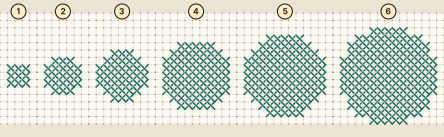
Why a stitched circle has steps
Every cross fills one square of the cloth. A curve cannot cut through a square, so a circle in whole crosses is a staircase: a flat run of stitches, a step, a shorter run, another step. Screens draw circles the same way, out of square dots.
How round it looks depends on how many squares the curve is spread over. Look at the picture:
- 3 stitches across (1) is a square of nine crosses. There is no room for a step.
- 5 across (2) is a square with its four corner stitches left out.
- 7 across (3) has two steps at each corner and begins to look round.
- 9, 11 and 13 across (4, 5 and 6) have more and shorter steps. Each one looks rounder than the last.
So the cure for a blocky circle is more stitches. Chart it larger, or keep its size and move to a finer fabric, where the same width takes more stitches.
How a circle is charted
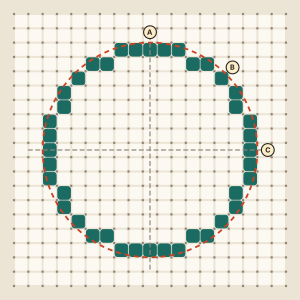
The rule is simple. Draw the circle on the grid, then fill each square whose middle lies inside it. The picture shows the outline that this rule gives for a circle 15 squares across.
Read one quarter of it, from the top round to the side:
- A flat run across the top (A). Here it is five squares, centered on the middle of the circle.
- Shorter runs, each one square lower than the last. Here, one run of two.
- A single square on the slope (B). Halfway between the top and the side the curve runs at a slant across the grid, and the square there touches its neighbors only at their corners.
- Short runs turned on their side, then a run down the side (C) that matches the run across the top.
Every quarter is the same shape turned round. You only need to work out one quarter, or even half of a quarter, and mirror it. That is also the quickest check on a chart you have drawn: fold it along either dashed line in your mind, and the two halves must match.
A circle with an odd number of stitches across has one stitch at its center. A circle with an even number has its center at the corner where four stitches meet. Both work. Choose odd when something has to sit exactly in the middle.
Circle sizes on 14 count
| Design, in stitches | Stitched size, inches | Stitched size, centimeters | Fabric to cut, inches | Fabric to cut, centimeters |
|---|---|---|---|---|
| 5 × 5 | 3/8 × 3/8 in | 0.9 × 0.9 cm | 7 × 7 in | 16 × 16 cm |
| 7 × 7 | 1/2 × 1/2 in | 1.3 × 1.3 cm | 7 × 7 in | 17 × 17 cm |
| 9 × 9 | 5/8 × 5/8 in | 1.6 × 1.6 cm | 7 × 7 in | 17 × 17 cm |
| 11 × 11 | 3/4 × 3/4 in | 2.0 × 2.0 cm | 7 × 7 in | 17 × 17 cm |
| 15 × 15 | 1 1/8 × 1 1/8 in | 2.7 × 2.7 cm | 8 × 8 in | 18 × 18 cm |
| 21 × 21 | 1 1/2 × 1 1/2 in | 3.8 × 3.8 cm | 8 × 8 in | 19 × 19 cm |
| 31 × 31 | 2 1/4 × 2 1/4 in | 5.6 × 5.6 cm | 9 × 9 in | 21 × 21 cm |
| 41 × 41 | 2 7/8 × 2 7/8 in | 7.4 × 7.4 cm | 9 × 9 in | 23 × 23 cm |
| 61 × 61 | 4 3/8 × 4 3/8 in | 11.1 × 11.1 cm | 11 × 11 in | 27 × 27 cm |
The fabric to cut leaves 3 inches (7.5 cm) on every side for framing, rounded up to a whole inch or centimeter. For a design of another size, open the fabric calculator on 11 × 11 stitches at this count and change the numbers.
Circle sizes on other counts, in centimeters
| Stitches | 11 count Aida | 14 count Aida | 16 count Aida | 18 count Aida | 28 count evenweave or linen, over two | 32 count evenweave or linen, over two |
|---|---|---|---|---|---|---|
| 5 | 1.2 cm | 0.9 cm | 0.8 cm | 0.7 cm | 0.9 cm | 0.8 cm |
| 7 | 1.6 cm | 1.3 cm | 1.1 cm | 1.0 cm | 1.3 cm | 1.1 cm |
| 9 | 2.1 cm | 1.6 cm | 1.4 cm | 1.3 cm | 1.6 cm | 1.4 cm |
| 11 | 2.5 cm | 2.0 cm | 1.7 cm | 1.6 cm | 2.0 cm | 1.7 cm |
| 15 | 3.5 cm | 2.7 cm | 2.4 cm | 2.1 cm | 2.7 cm | 2.4 cm |
| 21 | 4.8 cm | 3.8 cm | 3.3 cm | 3.0 cm | 3.8 cm | 3.3 cm |
| 31 | 7.2 cm | 5.6 cm | 4.9 cm | 4.4 cm | 5.6 cm | 4.9 cm |
| 41 | 9.5 cm | 7.4 cm | 6.5 cm | 5.8 cm | 7.4 cm | 6.5 cm |
| 61 | 14.1 cm | 11.1 cm | 9.7 cm | 8.6 cm | 11.1 cm | 9.7 cm |
How to count and stitch one
- Find the center of the circle on the chart and on the cloth. How to count cross stitch shows how to keep the two in step.
- Start with the top run. Count half its width to each side of the center line and stitch it.
- Work round one quarter, a run at a time. Say the runs to yourself as numbers: five across, two across, one, two down, five down.
- Mirror it for the other three quarters. The run at the bottom must sit directly under the run at the top, and the two side runs must face each other. If they do not, a step has been miscounted. Find it before you fill the circle in.
- Fill last. With the outline right, the inside is plain rows.
Along the slope the crosses touch only at their corners, so there is no row to run along. Finish each cross whole before you start the next.
How to make a circle smoother
- Make it bigger. More stitches across means shorter steps.
- Use a finer fabric. The steps stay the same on the chart, but each is smaller on the cloth.
- Add part stitches. A three-quarter stitch fills a triangle of a square, not the whole of it. Placed in the corner of a step, it turns a square corner into a slant. On Aida the needle has to go down through the middle of a block, where there is no hole. A sharp needle helps there. On evenweave or linen the needle slips between two threads, which is easier.
- Outline it in backstitch. A line of backstitch round the edge draws the curve over the steps. Work it after the crosses are done.
The steps are not a fault. Whole crosses and stepped edges are the look of cross stitch, and geometric designs use them on purpose. Every cross stitch pattern on this site is charted in whole crosses only, so the round shapes in them are stepped circles like the ones above.
Ovals and other curves
An oval is charted the same way: draw it on the grid and fill the squares whose middles lie inside. It still matches left to right and top to bottom, but its top run is no longer the same length as its side run. Any curved line follows the same rule. Where the line runs nearly level or nearly upright it becomes long runs, and where it slants it becomes short runs and single stitches.
Where to go next
To draw a circle of your own, open the pattern maker or print a sheet of graph paper and count out the runs. How to make a cross stitch pattern goes through the rest. The tips guide has more on diagonals and curved lines.
If what you want is a design that is round as a whole, to hang in a hoop, see the round patterns for hoops and the guide to hoop sizes.