Stitches · Intermediate
Couching
Couching draws a line with a thread that never passes through the cloth except at its two ends. You lay it along the line and tie it down there with small stitches of a second, finer thread. Use it where backstitch is too stiff: a smooth curve, a rope, a whisker, a line of metallic cord. You need two needles: one with a large eye for the laid thread, and a sharp one for the tying thread.
How to work it
Bring up the laid thread
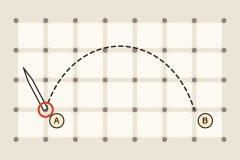
Finish the crosses round the line first. Put the thread that is to show (the laid thread) in the large-eyed needle and bring it up where the line begins (A). Leave a tail of about 1 inch (2.5 cm) hanging on the back. Do not fasten it yet: a piece of tape holds it, and it is sewn down at the end, in step 9.
Lay it along the line
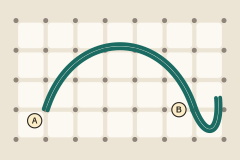
Draw the thread along the line of the chart to its end (B) and leave the rest loose on the cloth. Take the needle off it. Keep the thread on its line with a finger of your other hand.
Fasten the tying thread on the back
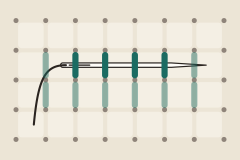
Thread a sharp needle with one strand: this is the tying thread. Turn the cloth over and run it under the backs of three or four finished stitches near A, leaving the end under them. If no stitches are near, use a waste knot: a knot left on the front, a little way off, and cut away when the line is done.
Come up beside the laid thread
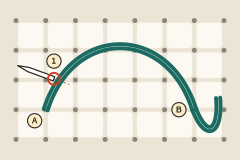
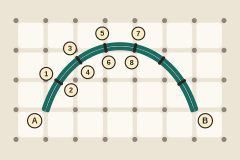
Turn the cloth face up. Bring the sharp needle up right against one side of the laid thread, about one block along from A (1). Go through the cloth wherever that falls, in a hole or in the middle of a block.
Go straight across and down
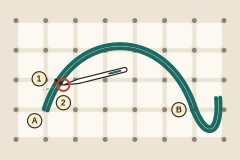
Take the needle over the laid thread and down right against its other side, straight across from where you came up (2). The stitch is as long as the laid thread is wide and no longer. Pull only until it rests on the thread. That is one tie.
Tie it down at even spaces
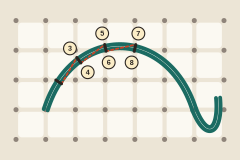
Pass behind the cloth to the next place and make another tie (3 to 4), then another (5 to 6, 7 to 8). Come up on the same side each time. In the picture the ties are about one block of Aida apart: begin with that, and keep every gap the same. Where the line bends sharply set them closer, with one at the tightest point.
If the line has a corner, tie the turn
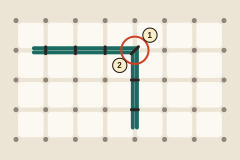
A line with no corner skips this step. At a corner, lay the thread up to the turn and make one tie across the turn itself, from outside the corner (1) to inside it (2). Then bend the laid thread round it and go on. The picture shows a different line, so its numbers begin again.
Take the laid thread to the back
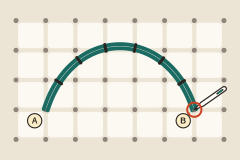
When the last tie is made, thread the loose end into the large-eyed needle again and take it down at the end of the line (B).
Sew the two ends down behind
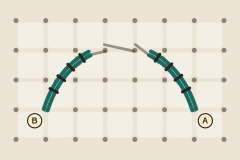
Turn the cloth over. Lay the end at B back along its own line and stitch over it with the tying thread, catching only the threads on the back, so that nothing new shows on the front. Slide the needle along under the backs of the ties to A, and sew down the tail there the same way. The gray slanting threads in the picture are the backs of the ties, which are there already.
Fasten off and trim
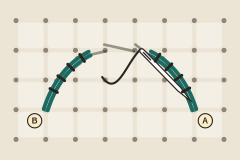
Run the tying thread under the small stitches you have just made and cut it. Trim the two ends of the laid thread, but not too close, or they may work up to the front.
At a glance
- Also called
- couching stitch, basic couching, simple couching
- Used for
- smooth curves that keep to no hole; metallic cord and braid; ropes, strings, whiskers and stems; an edge round finished crosses
- Laid thread
- Whatever is to show: several strands of floss together, pearl cotton, braid, cord or narrow ribbon. More strands make a thicker line.
- Tying thread
- Normally finer: one strand of floss in a sharp needle. The same color hides the ties, and a contrasting color makes a pattern of them.
- Spacing
- No fixed distance. About one block of Aida is where the pictures begin. Closer if the laid thread shifts between two ties or the line bends, wider if the ties crowd out the thread you want to see. All the same, whatever it is.
- Couching or backstitch
- Backstitch goes from hole to hole, so a curve comes out as short straight pieces. A couched line bends anywhere and can be thicker than a thread you could stitch with.
- On the chart
- A line, like backstitch. Read the key: couching has to be named there, with the thread to lay and the thread to tie it with.
Couching exists for threads that cannot be stitched with: too thick for the holes, too rough to pull through, or too easily worn out by rubbing. The cloth never scrapes them, because only the fine tying thread goes up and down. That is why cord and heavy metallic braid are so often couched.
It also draws what a counted stitch cannot. Crosses and backstitch are tied to the holes of the cloth. A laid thread is not, so it can be a true curve: the string of a kite, a whisker, a rope, a curly letter, a stem.
Work it last, over or beside finished crosses. The line lies on top of the stitching, the tying thread has stitches to start under, and nothing catches on it afterward. It needs a little planning only where one couched line crosses another: lay the one that passes underneath first.
A straight couched line can keep to the cloth. Lay the thread between two rows of holes and take each tie from a hole on one side to the hole across from it. On a curve the ties come wherever the line runs, which is often in the middle of a block of Aida. That is why the tying needle is a sharp one: a blunt needle will not go through a block easily.
Use two holes for each tie, one on each side of the laid thread. Some stitchers come up and go down in the same hole so that the tie is hidden, but then the laid thread can be drawn down through it to the back.
A frame or a hoop helps, since one hand has to keep the laid thread on its line while the other stitches. A magnetic needle minder can hold the loose end.
Tips
- If the laid thread is too thick for any needle, pull its end through with a loop: fold a short strong thread, put both cut ends through a needle, take the needle down where the line ends, slip the cord into the loop left on top and pull the loop to the back.
- Tying with the same color forgives spacing that is not quite even. The stronger the contrast, the more every gap shows.
- Draw a long curve on the cloth first, if the chart leaves room for doubt, with a marker that is sure to wash out.
When it goes wrong
- The line wanders
- The ties are too far apart, or the laid thread was not held. Take out the last few, lay it again, and tie it more closely.
- The laid thread is pinched at every tie
- The ties are pulled too tight, or they are shorter than the laid thread is wide. Make each long enough to reach from one side to the other, and stop pulling when it rests on the thread.
- The ties stick out like the ties of a railroad track
- They are too long. Come up and go down right against the laid thread, as in steps 4 and 5.
- The ends pop up on the front
- They were cut too close or not fastened. Sew a longer end down on the back with the tying thread.
- The laid metallic frays at its end
- Draw it through once only, with a needle whose eye is large enough to open the way, and leave the trimming until it is sewn down.
Variations
- Hidden ties on a cord. On a twisted cord, bring the needle up close beside it and take it down into the cord itself, between its twists. Pulled snug, the tie sinks out of sight.
- Two threads at once. Lay two or more threads side by side and tie them together as one. Let them lie a little loose and draw each tie snug, and they puff out between the ties.
- Couching a ribbon. A narrow ribbon is laid flat and held with a wider stitch across it, such as a row of small crosses or blanket stitches.
- Couching in hand embroidery. On plain fabric the laid thread follows a drawn line, and there are no holes to place the ties by.
- Couching on needlepoint canvas. On canvas each tie is placed by the holes of the mesh.
Questions
- What does couching mean on a cross stitch chart?
- That a thread is laid on the surface along the charted line and fastened with small stitches of another thread. The key names both threads.
- Do I couch with the same thread or a different one?
- Either. Two strands of floss can be tied down with one strand of the same floss. With cord or metallic braid, use a finer thread close to it in color.
- Do I couch before or after the cross stitch?
- After. The couched line lies on top. Its two ends go to the back and are sewn down along its own line when the last tie is made.
- How far apart are couching stitches?
- There is no set distance. Begin with one tie to each block of Aida, as in the pictures. If the laid thread shifts between two ties, or the line bends, set them closer; if the ties crowd out the thread, set them wider. Keep them all the same.
- Can I couch a line that is charted as backstitch?
- Yes, where you would like it smooth. Lay the thread along the charted line and tie it down. Short pieces and small lettering are easier in backstitch.