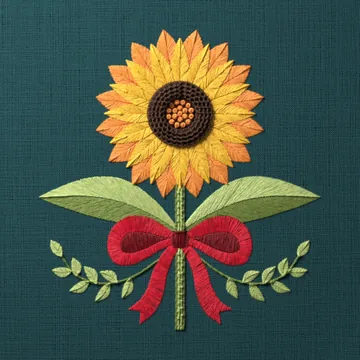
Hand embroidery guide
How to embroider a sunflower, step by step
On this page 13 parts
- Which sunflower to stitch
- How to draw a sunflower that does not look like a daisy
- 1. How to stitch a tiny sunflower
- 2. How to stitch a line sunflower
- 3. How to stitch a sunflower in satin stitch
- 4. How to stitch a sunflower in two yellows
- 5. How to stitch a sunflower with raised petals
- How to fill the center of a sunflower
- The stem and the leaves
- Half turned, drooping, in bud and far away
- Colors
- Common problems
- Questions people ask
To embroider a sunflower, stitch two rows of pointed yellow petals, the back row a deeper yellow than the front, and pack the center with brown French knots. Satin stitch or fishbone stitch fills the petals. The center goes in last, because it hides the ends of everything else.
For a flower under an inch (2.5 cm) across, a ring of lazy daisies and one knot is enough. A tiny one is the first below, and one with more to it, with a straight stitch in each loop and each gap, is in flower stitches. This page goes on from there. Pick one of the five below, draw it, and follow the part of the page with its number. The center, the stem and the leaves have parts of their own, which serve all five.

Which sunflower to stitch
| Sunflower | Size across | Petals | Center | Strands of floss | Level |
|---|---|---|---|---|---|
| 1. Tiny | 1/2 to 1 inch (1.3 to 2.5 cm) | Eight or nine lazy daisies | One large French knot or a tight bunch | 2 or 3 | Beginner |
| 2. Line only | 1 to 4 inches (2.5 to 10 cm) | Back stitch or stem stitch outlines | Seed stitch | 1 or 2 | Beginner |
| 3. Satin | 1 1/2 to 3 inches (4 to 7.5 cm) | Satin stitch at a slant, two rows | Packed French knots | 1 or 2 for petals, 3 for knots | Easy |
| 4. Two yellows | 2 to 4 inches (5 to 10 cm) | Fishbone stitch | Rings of knots, dark and light | 2 for petals, 3 for knots | Easy |
| 5. Raised | 1 1/2 to 3 inches (4 to 7.5 cm) | Woven picots over a flat back row | Knots, or turkey work clipped short | Pearl cotton size 8 (a twisted thread used whole), or 3 strands | Intermediate |
The sizes are places to begin. Stretch the cloth in a hoop. An embroidery needle size 9 or 10 takes one strand of floss, size 8 takes two and size 7 takes three. How to start and end a thread has the beginnings and endings.
More ways: closed fly stitch fills a petal of one color and makes its own ridge, closed herringbone stitch fills a petal quickly and leaves a braided middle, and a ribbon sunflower is made of ribbon stitch petals around a knotted center.
How to draw a sunflower that does not look like a daisy
A daisy has narrow round petals that stand apart. A sunflower's petals are pointed, they crowd, and they come in at least two rows around a big center.
- Draw the center, a circle a little over a third as wide as the whole flower: 1 inch (2.5 cm) across for a flower of 2 1/2 inches (6.5 cm). That flower is the size meant in flowers 3 and 4.
- Draw a larger circle lightly for the tips. It is only a guide.
- Draw the front row. Nine to twelve pointed petals, each about 3/4 inch (1.9 cm) long, widest a third of the way up and narrow at the base. Make them about the same width, but let some stop short of the outer circle, some pass it and some lean.
- Draw the back row in the gaps. Only the tips show. Stop each line where it meets a front petal.
- Leave out anything too small to fill. A sliver narrower than three threads of cloth is easier as one straight stitch.

For twelve evenly spaced petals mark the circle every 30 degrees. Flower stitches shows how to mark a circle with a protractor, or with folded paper for four or eight petals.
1. How to stitch a tiny sunflower
- Draw two circles with the same middle, 1/4 inch (6 mm) and 3/4 inch (1.9 cm) across, and nine dots evenly around each, 40 degrees apart. Eight, 45 degrees apart, will do as well.
- Make the lazy daisies in two strands of yellow, each from a dot on the small circle to the dot outside it.
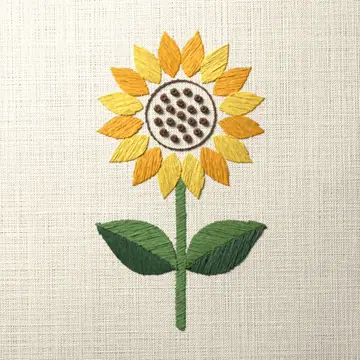
- Fill the center with brown French knots, two strands: one in the middle and six around it. In a smaller flower one knot of three strands is enough, as in the picture.
- Add a stem in stem stitch, two strands of green, and a lazy daisy leaf.
2. How to stitch a line sunflower
- Draw the flower as above. One row of petals will do.
- Outline every petal in back stitch, two strands of yellow, with stitches about 1/8 inch (3 mm) long. Put a hole right at each point.
- Work around the center circle in back stitch, two strands of brown.
- Fill the center with seed stitch, one strand of brown, close at the edge and thinner toward the middle.
- Add the stem in two rows of stem stitch and outline the leaves in back stitch.
3. How to stitch a sunflower in satin stitch
One strand for the petals, or two for a quicker, rougher surface.
- Stitch the stem and the leaves before the flower, if anything of them lies behind it.
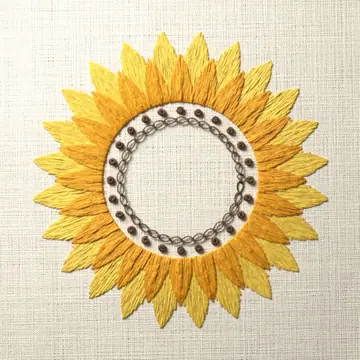
- Draw slanting lines across each petal, A in the picture. Each is higher at its right end, with the tip of the petal turned away from you.
- Fill the tips of the back row first, in the deeper yellow. Begin across the widest part that shows. Work to the point, then go back and work down to the edges of the front petals.
- Fill the front petals in the lighter yellow, B. Begin at the widest part, with the slant you drew. Work up to the tip, then go back to the middle and work down to the base. Leave about one thread of the cloth bare between two petals that touch.
- Sharpen the tip. The last slanting stitches are very short. End with one tiny upright stitch that runs out just beyond the point.
- Add one or two long stitches in gold, one strand, from the base up the middle of each front petal, not more than half its length, C.
- Pack the center as shown below, the outer knots right against the petals.

Slightly different yellows in neighboring petals also keep them apart, and then a single row will do.
4. How to stitch a sunflower in two yellows
Fishbone stitch fills a pointed petal and makes its own crease. With a needle for each yellow, one side of the petal comes out light and the other deep. Use two strands.
- Work the tips of the back row first, in the deeper yellow only, in slanting stitches from each edge down to the middle of the tip. Stop at the edges of the front petals.
- Draw a line down the middle of each front petal, A in the picture. Thread one needle with the lighter yellow and one with the deeper.
- Begin with one straight stitch in the deeper yellow, from the tip down the line, about 1/8 inch (3 mm) long.
- Come up at the left edge, close beside the tip, still in the deeper yellow. Go down just across the line, about 1/16 inch (2 mm) below the end of the straight stitch, B.
- Do the same from the right edge in the lighter yellow. It crosses the end of the stitch before it.
- Go on by turns, left and right, each stitch touching the last on its side, C, down to the base. Park the needle you are not using on the front, outside the petal.
- Lay three or four short stitches in orange or light brown at the base, of different lengths, one strand, D.

Turn the hoop for each petal, so that its tip points away from you and the deeper yellow comes on the left in every one. For a large flower shade each petal in long and short stitch from pale at the tip to gold at the base: how to shade has the rows.
5. How to stitch a sunflower with raised petals
A woven picot is a petal woven on three threads around a pin, and joined to the cloth only at its base. Learn it on its own page, woven picot, before you begin.
- Draw a center 3/4 inch (1.9 cm) across and eight marks evenly around it. With picots 5/8 inch (1.5 cm) long the flower is about 2 inches (5 cm) across.
- Draw a flat petal between each two marks, as long as the picots will be and narrow at its base. Fill it in satin stitch, in gold or medium brown.
- Weave a picot at each mark, in the lighter yellow. Set its base, 1/4 inch (6 mm) wide, on the center circle and its pin straight out. Weave loosely and use a blunt needle, so that the flat row underneath is not snagged.
- Go from side to side. Work one at the top, one at the bottom and one at each side, then the four between. The petals then come out evenly, and where bases overlap they do not push the last one out.
- Pack the center with large knots, three strands, close against the bases of the picots.
- Leave the tips free, or catch each one down with one hidden stitch if it will be handled.
Cut the thread for a picot long. It cannot be joined neatly halfway.
How to fill the center of a sunflower

The knots are French knots of one wrap: three strands in the outer rings, two in the middle.
Rings, for flowers 3, 4 and 5:
- Begin at the outside with the darkest brown, and work knots side by side against the petals, all the way around.
- Work the next ring inside it. Set each knot in a gap of the first ring.
- Change to a lighter brown or a green gold for the rings in the middle, and end with knots in the middle itself, so that no cloth shows.
Spirals, because a real head carries its seeds so:
- Draw eight curves from the middle to the edge, all bending the same way.
- Work knots along each curve, dark near the edge and lighter near the middle.
- Fill the gaps between the curves with more knots.
Three other centers:
- Mixed. One strand each of two browns in the same needle makes speckled knots with no plan.
- Fluffy. Two or three rings of turkey work around the edge, three strands, clipped short, with knots in the middle. Keep it for pictures.
- Flat. Two rings of seed stitch, dense outside and thin inside, for a line sunflower or a child's shirt.
The stem and the leaves

- Make the stem thick. Work three or four rows of stem stitch side by side, two strands, dark green on one side and lighter on the other. A thin stem is what makes a sunflower look like a daisy.
- Add hairs if you like: tiny straight stitches slanting up and out, one strand.
- Draw large leaves, an inch (2.5 cm) long or more, broad and rounded where they join the stem and pointed at the tip, each on a stalk of its own. The stalk is one row of stem stitch. Draw the veins: one down the middle and three or four to each side.
- Fill one half at a time, one strand, in slanting satin stitches from the edge down to the middle vein. If a stitch would be longer than half an inch (1.3 cm), use long and short stitch.
- Lay the veins over it in back stitch, one strand of a paler or darker green.
Leaf stitches has more ways, and shows how a stalk joins.
Half turned, drooping, in bud and far away

- Half turned. Draw the center as an oval. The petals behind are short and in the deeper yellow, those nearest you long and in the lighter. Work them in satin stitch, as in flower 3, the far ones first, then the near ones, then the knots.
- Drooping. Bend the stem over at the top, draw a green dome for the back of the head, and hang the petals below it. Work the petals in fishbone stitch, as in flower 4. Then satin stitch the dome in green, upright, over their top ends, and add a few green straight stitches that hang from it like points.
- Bud. Four straight stitches in yellow, side by side, two strands. Then close seven green lazy daisies around them, tips up, the outer ones leaning out.
- A field. Full flowers in front, smaller ones of lazy daisies behind, then yellow French knots on short green stitches, and at the back a band of yellow seed stitch. Stitch the farthest first.
- A bouquet. Draw the largest flower first and set the others partly behind it, one turned to the side. Stitch those behind first and the largest last.
Colors
Three yellows and two browns make a good flower: a soft yellow for the front petals, a golden one for the back, orange gold for the bases, then medium and darkest brown for the center. Real sunflowers also come in red, bronze, mahogany and white. On white cloth use the golden yellows, because lemon yellow fades into it. On navy or denim the soft yellow shows best.
Common problems
| Problem | Why | Cure |
|---|---|---|
| It looks like a daisy | Round, even petals, small center, thin stem | Points, two rows, a center over a third as wide, a thick stem |
| Petals crowd at the base | Too many, or drawn wide all the way down | Narrow each base, and start every second one a little way out |
| A bare ring around the center | The petals stopped at the line | Bring the stitches just inside the circle, then put knots over their ends |
| It is all one yellow blob | No difference between rows | A deeper yellow behind, gold at the bases, a hair of cloth between |
| The points are blunt | The last stitches are too long | Shorter ones, and one that runs out past the tip |
| The center bulges | Too many strands or wraps | Two strands and one wrap in the middle, three strands only in the outer rings |
| The petals pucker the cloth | Satin stitch pulled tight | Hoop it drum tight, and lay the stitches without tugging |
Questions people ask
What stitch is best for sunflower petals? Fishbone for a flower over 2 inches (5 cm), satin stitch for a smaller one, lazy daisy for a tiny one.
What order do I stitch a sunflower in? Stem and leaves, back petals, front petals, center.
How many petals does it need? Nine to twelve in the front row, with tips of a second row between them. Uneven is right.
How many strands? One or two for satin stitch petals, two for fishbone, for loops and for outlines, and three for the knots at the edge of the center.
Where are sunflowers to trace? In sunflowers, flower bouquets and wildflowers. A tulip, a poppy and eleven others are in flowers, one by one.