Hand embroidery guide
How to embroider a tulip, poppy, lotus and ten more flowers
On this page 15 parts
- Which stitch for which flower
- How to embroider a tulip
- How to embroider a poppy
- How to embroider a lotus or a water lily
- How to embroider lily of the valley
- How to embroider an iris
- How to embroider wisteria
- How to embroider a thistle
- How to embroider a hydrangea or a chrysanthemum
- How to embroider a peony
- How to embroider a pansy, cherry blossom or a dandelion
- How to embroider a sweet pea and cow parsley
- A bouquet: which flower first
- Common problems
- Questions people ask
Every flower has one thing that makes it itself: the cup of a tulip, the drooping petals of an iris, the bristles of a thistle. Draw that, choose a stitch that runs the way the petals grow, and work what lies behind before what lies in front. Pick your flower from the table and go to its part of the page, where a plan and steps show what to do first. Two more, the sweet pea and cow parsley, are not in the table: their part comes after the dandelion. Hydrangea, chrysanthemum, cherry blossom, dandelion and cow parsley have a picture of the finished flower and no dotted plan, so their steps say what to draw.
Each one has an easy way, for a small flower or a first try, and a fuller way. Petals in general, with how to mark them and shade them, are in flower stitches. The rose and the sunflower have pages of their own.
Which stitch for which flower
| Flower | Easy way | Fuller way | Level of the fuller way | Good size for the fuller way |
|---|---|---|---|---|
| Tulip | Tulip stitch | Satin stitch, three petals | Easy | 1 1/4 inches (3 cm) |
| Poppy | Buttonhole wheel | Long and short stitch, four petals | Intermediate | 2 inches (5 cm) |
| Lotus, water lily | Lazy daisies in a fan | Satin or long and short stitch, dark tips | Intermediate | 2 inches (5 cm) |
| Lily of the valley | French knots on short stalks | Satin stitch bells | Easy | 3 inches (7.5 cm) |
| Iris | Five lazy daisies | Long and short stitch with a beard of knots | Intermediate | 2 inches (5 cm) |
| Wisteria | French knots | Lazy daisies that shrink to knots | Easy | 3 inches (7.5 cm) |
| Thistle | Straight stitches over a filled oval | Straight stitches or turkey work over trellis | Intermediate | 2 inches (5 cm) |
| Hydrangea | A ball of French knots | Four-petal florets over knots | Easy | 2 inches (5 cm) |
| Chrysanthemum | Rings of straight stitches | Rings of bullion knots or loops | Intermediate | 1 1/2 inches (4 cm) |
| Pansy | Five satin stitch petals | Long and short stitch with a face | Intermediate | 1 1/2 inches (4 cm) |
| Peony | Woven wheel in a ring of loops | Broad petals in long and short stitch | Advanced | 3 inches (7.5 cm) |
| Cherry blossom | Five lazy daisies | Satin stitch, pistil stitch | Easy | 1 inch (2.5 cm) |
| Dandelion | Straight stitches from a knot | Turkey work flower, rayed clock | Easy | 1 1/2 inches (4 cm) |
Use one strand of floss for satin stitch and long and short stitch, two for lazy daisies, stems and leaves, two or three for knots, unless a step says otherwise. The sizes are of the whole drawing, with its stem where the picture has one, and are places to begin. Stretch the cloth in a hoop. An embroidery needle size 9 or 10 takes one strand, size 8 takes two and size 7 takes three.
Two things hold for every filled petal. Outline it first in split stitch, one strand, in its own color, and take the filling down just outside that line. Keep satin stitches to half an inch (1.3 cm): in a longer petal use long and short stitch, lying the same way. How to start and end a thread has the beginnings and endings, and how to transfer a pattern puts the drawing on the cloth.
How to embroider a tulip
A tulip is a cup of six petals in two rings. From the side you see three: one in front and one behind on each side.
- Draw the plan, 1 1/4 inches (3 cm) tall with its stem. The cup is a little under half of that. That is half an inch (1.3 cm), the longest that satin stitch should be. If your cup is taller, fill its petals with long and short stitch, lying the same way.
- Fill the two side petals, 1 and 2, in the deeper shade, in satin stitch. The stitches run up the petal, from base to tip. Begin in the middle of each and work out to its sides. Let each run a little way under the place of the front petal.
- Fill the front petal, 3, in the lighter shade, the same way. Its edges cover the ends of the side petals. Its outermost stitches lie over the inner sides of the two side petals, so that no cloth shows between.
- Stitch the stem, 4, from its foot up to the cup in one row of stem stitch, or two close rows for a thick one.
- Fill the leaf, 5, which is long and pointed and leaves the stem at its foot, in fishbone stitch, from its tip down.

Easy way: one tulip stitch (a lazy daisy with a second thread slid under its tie for two arms) on a stem of stem stitch. Open tulip: six pointed petals around a small dark center. Colors: red, pink, yellow, purple, white, with a green that leans to blue. The bulb is a teardrop of satin stitch in tan, with three curved lines of brown back stitch and a few straight stitches for roots.
How to embroider a poppy
Four broad crumpled petals around a dark center, on a thin hairy stem.
- Draw the plan, 2 inches (5 cm) across: a small circle in the middle, a back and a front petal, and two side petals that lie over both.
- Fill the back petal, 1, then the front petal, 2, in red or orange long and short stitch. Every stitch points from the rim to the middle.
- Fill the side petals, 3 and 4, over them, the same way.
- Put a few black straight stitches at the base of each petal, around the middle, one strand, of different lengths.
- Fill the middle, 5, with a dot of pale green satin stitch.
- Ring it with about sixteen short black stitches that point outward, each with a tiny knot at its end. Pistil stitch, a knot with a stalk, does both at once.
- Give the stem hairs if the flower has one: one row of stem stitch, tiny slanting straight stitches along it, and gray green leaves cut like a feather, in fishbone stitch.

Easy way: a buttonhole wheel in red with a black knot in its hole. Bud: a nodding green oval in satin stitch with one red stitch showing. Seed head: a round satin stitch pot with a flat lid of straight stitches.
How to embroider a lotus or a water lily
A lotus stands above the water on a stem. A water lily usually lies on it, and its petals are narrower and more.
- Draw one upright petal in front and four pairs fanning out behind it, the lowest nearly flat, 2 inches (5 cm) across.
- Begin at the back. Fill petals 1 and 2 as steps 3 and 4 say, then each pair in front, and the front petal, 9, last. Keep the gap of step 5 from the first petal on: stop each petal one thread of the cloth short of the one in front of it.
- Make the tip deep pink. Come up inside the petal and go down at its edge, long and short stitches by turns, over the outer third of the petal.
- Make the rest pale. Come up through the ends of the deep pink stitches and go down toward the base. Every stitch points to the base of the flower.
- Leave a gap one thread of the cloth wide between petals, or outline each in one strand of back stitch. The gap is left while you fill, and the back stitch comes after.
- Add a leaf: a flat oval under the flower, in level rows of stem stitch or brick stitch, two strands of green.
- Add the water: three level lines of back stitch.

Easy way: nine lazy daisies from one point. From above, a lotus or lily is rings of pointed petals around a yellow center of knots. Seed pod: a flat-topped cone in satin stitch with knots on top.
How to embroider lily of the valley
White bells hang from one side of a bending stem, beside one or two broad leaves.
- Draw the plan, 3 inches (7.5 cm) tall: a leaf, a stem that bends over, and five to twelve bells, the largest lowest on the stem.
- Fill the leaf, 1, in long and short stitch or fishbone stitch, up to its pointed tip.
- Stitch the stem, 2, in one strand of stem stitch, from its foot to its end.
- Drop short stalks, 3, from it, one small straight stitch each, all on the same side.
- Fill the bells, 4, in upright satin stitch, from the stalk down to the rim.
- Flare the rim of each with two or three tiny straight stitches that point down and out.

Easy way: French knots on short stalks, or granitos, which are several straight stitches in the same two holes. On white cloth outline the bells in pale gray back stitch, or choose colored cloth.
How to embroider an iris
Three petals stand up (the standards) and three hang down (the falls). In a drawing from the front five of the six show.
- Draw the plan, 2 inches (5 cm) tall with its stem.
- Fill the two upright petals, 1 and 2, in the paler shade of long and short stitch, from the rim down to the middle of the flower.
- Fill the side falls, 3 and 4, in the deeper shade, every stitch aimed at the middle.
- Fill the front fall, 5, the same way. It covers the inner ends of the side falls.
- Lay the beard: a line of four yellow French knots down each fall, two strands, beginning at the middle.
- Stitch the stem in one row of stem stitch.
- Add two sword leaves that end in a point: two or three rows of stem stitch side by side, which run together at the tip.

Easy way: two lazy daisies up, two out to the sides and one down, with a yellow knot where they meet. Irises come in nearly every color. Two shades of one are enough.
How to embroider wisteria
A hanging cluster, full at the top and down to single buds at the tip.
- Draw a long drop, 3 inches (7.5 cm) from top to tip, a curved line down its middle, and three lines across it, at the top, halfway and three quarters of the way down.
- Stitch the middle line in stem stitch, one strand of green.
- From line 1 to line 2 work rows of lazy daisies, two strands, three to each side of the stem. Each is about 3/16 inch (5 mm) long, with its tip down and out. Use lilac and a paler lilac by turns. Set a row every 1/4 inch (6 mm), which makes about six, and begin each row at the stem and work out.
- From line 2 to line 3 make them smaller, about 1/8 inch (3 mm), and two or one to a side. Three or four rows, as far apart as before.
- Below line 3 work French knots in the deepest purple, two by two, then one by one to the tip.
- Add two leaf stalks at the top in stem stitch, with pairs of small lazy daisies in light green and one at the end.

Easy way: French knots throughout, packed at the top and loose at the tip. Several clusters of different lengths hang better than one.
How to embroider a thistle
A prickly green bulb with a tuft of purple hairs.
- Draw the plan, 2 inches (5 cm) tall. The bulb is about half an inch (1.3 cm) wide.
- Lay slanting lines across the bulb, 1, in one strand of green: long straight stitches 1/8 inch (3 mm) apart one way, then the same the other way over them.
- Fasten every crossing with one tiny upright stitch, and outline the bulb in back stitch. This is a trellis.
- Fan the hairs, 2, up from the top of the bulb: long straight stitches, two strands, up to half an inch (1.3 cm), the middle ones upright and the outer ones leaning. Use a pale and a deep purple by turns, and let the lengths differ.
- Tip a few with a French knot.
- Add spines, three short straight stitches slanting up at each side of the bulb.
- Stitch a thick stem, 3, in two or three rows of stem stitch.
- Add a leaf: draw its jagged edge and work it in back stitch.

Easy way: a satin stitch oval and straight stitches. Fluffy: three or four rows of turkey work, six strands, in place of steps 4 and 5, cut and left shaggy.
How to embroider a hydrangea or a chrysanthemum

Hydrangea. A ball of small florets in four or five parts, 2 inches (5 cm) across with its leaves.
- Draw a circle 1 1/4 inches (3 cm) across, and two broad leaves under it.
- Fill the leaves in fishbone stitch.
- Scatter French knots over the circle in the deepest shade, two strands, about 1/8 inch (3 mm) apart.
- Work florets over them: four lazy daisies or granitos each, 1/8 inch (3 mm) long, set like a cross. Put ten or twelve in all, close together and not in rows, some past the edge. Use two or three blues, pinks or creams.
- Put one pale knot in the middle of each floret.
Chrysanthemum. Many narrow petals in rings. Some kinds curl in to a ball, some open flat.
- Draw three circles with the same middle, 1 1/2 inches (4 cm), 1 inch (2.5 cm) and 5/8 inch (1.6 cm) across.
- Work the outer ring: about eighteen lazy daisies, two strands, with their tips on the largest circle, from halfway in. Halfway means halfway from the middle of the flower to the circle: begin each loop 3/8 inch (1 cm) from the middle and make it 3/8 inch (1 cm) long.
- Work the next ring over the bases of the first, about fourteen loops, tips on the middle circle, in a deeper shade. Begin these 1/4 inch (6 mm) from the middle and make them 1/4 inch (6 mm) long.
- Work the inner ring, about nine, tips on the smallest circle. Begin these 1/8 inch (3 mm) from the middle and make them 3/16 inch (5 mm) long.
- Finish with a few short straight stitches in the middle. Golds, rusts and wine reds suit it. For petals that stand up, make the rings of curved bullion knots.
How to embroider a peony
A ring of broad petals around a crowd of narrower ones, opening from a round bud.
- Draw the plan, 3 inches (7.5 cm) across for long and short stitch: six outer petals with ragged rims, five inner ones over their bases, and three small ones in the heart.
- Fill the outer petals, 1, in long and short stitch, from a pale rim to a deeper base. Every stitch points to the middle. For a ragged rim, draw its small dips, follow them with short split stitches, and let the filling go down just outside that line all along it.
- Fill the inner petals, 2, over them, the same way.
- Fill the heart, 3, with its three small petals in the deepest pinks, or with yellow French knots for an open flower.

Easy way: a woven wheel with eight or nine lazy daisies tucked under its edge.
How to embroider a pansy, cherry blossom or a dandelion

Pansy. Five overlapping petals with a face, 1 1/2 inches (4 cm) across.
- Fill the two upper petals, 1, in the darker color, in long and short stitch from the rim inward.
- Fill the two side petals, 2, over them in the lighter color, then the wide lower one, 3.
- Work the face: short dark straight stitches out from the middle on the side and lower petals, one strand.
- Set one yellow French knot in the center.
Cherry blossom. Five rounded petals, usually drawn with a small notch in each tip, 1 inch (2.5 cm) across.
- Satin stitch each petal from the rim to the center in palest pink.
- Lay ten fine stamens over them in pistil stitch, deep pink, one strand: long and short by turns, the long ones reaching nearly half of the way out and the short ones a third.
- Set the flowers in clusters of three to five along a rough brown branch, two or three rows of stem stitch. Add round buds, French knots on short straight stitches.
Dandelion. Two flowers in one plant.
- Yellow flower: three rings of straight stitches, one inside another, in two yellows, two strands, over a short green base of satin stitch. Rings of turkey work, clipped, are fluffier.
- Clock, the round seed head: draw a circle 1 inch (2.5 cm) across with a dot in the middle, and fill a small green or brown center in satin stitch.
- Work about twenty-four fine straight stitches from the center outward, one strand of white or pale gray, long and shorter by turns.
- Put three tiny stitches like a bird's foot at the end of each.
- Stitch the stem in one row of stem stitch, up to the center.
- Flying seeds: one short line, one knot and a bird's foot, drifting to one side.
How to embroider a sweet pea and cow parsley

Sweet pea. One broad upper petal, the banner, behind two smaller wings, 1 1/4 inches (3 cm) across. Draw plan A for each flower. Like every filled petal here, outline it first in split stitch.
- Fill the banner, 1, in long and short stitch, one strand, every stitch pointing to the stalk. Let its rim wave.
- Fill the wings, 2, over its base in satin stitch, one strand, a shade paler or deeper.
- Fill the keel, 3, the small boat between the wings, with three or four satin stitches in the palest shade.
- Stitch the stalk in stem stitch, two strands, with two or three flowers on it, one above the other.
- Add leaflets in pairs, in fishbone stitch, and a curling tendril at the end of them in back stitch, one strand.
Cow parsley. A flat, lacy head of tiny white flowers, 2 inches (5 cm) across. To draw it, mark the point where the stalks meet and an arc 1 inch (2.5 cm) out from it: the flowers end on the arc. It is also called Queen Anne's lace. So is wild carrot, which is made the same way, with one dark purple knot in the middle.
- Stitch the stem in stem stitch, two strands, up to one point.
- Fan seven or eight stalks out from that point, one strand, the middle ones upright. Work a long one in small back stitches.
- Fan five or six short straight stitches from the end of each.
- Put a French knot on every tip, one strand of white or cream, with a few more between.
- Add the leaf, which is cut like a fern: a center line with side lines, in fly stitch or feather stitch, one strand, small at the tip and broad at the base.
White flowers want colored cloth. There are sweet peas to trace, and a fern has its own steps.
A bouquet: which flower first
- Draw the whole bouquet and number the flowers from the farthest back to the nearest.
- Stitch the stems and leaves that lie behind everything.
- Stitch the flowers in the order of their numbers, so that each covers the edge of the one behind it. Let the long, light ones (wisteria, lily of the valley) hang outside.
- Fill gaps last with knots, buds and single leaves.
Two sizes and three kinds are plenty for one hoop. A 3D bouquet uses woven picots or wired petals: see stumpwork. Wide ribbon makes quick petals in silk ribbon embroidery.
Common problems
| Problem | Why | Cure |
|---|---|---|
| All the flowers look alike | One stitch for every petal | Choose by shape: loops for narrow petals, satin for pointed, long and short for broad |
| Petals melt together | One shade and no gap | A deeper shade behind, or one thread of bare cloth |
| A lump in the middle | Every stitch ends at one point | Stop some short, and cover the center with knots |
| White flowers vanish | White thread on white cloth | Pale gray outlines, or colored cloth |
| It looks stiff | Both sides match exactly | Turn the flower a little, bend the stem, let one petal fold |
| Tips are blunt | Stitches end level | One longer stitch at the tip |
| Small flowers clog | Too many strands | One strand, and leave out the shading |
Questions people ask
Which of these flowers is the easiest? Cherry blossom in lazy daisies, or a tulip in tulip stitch.
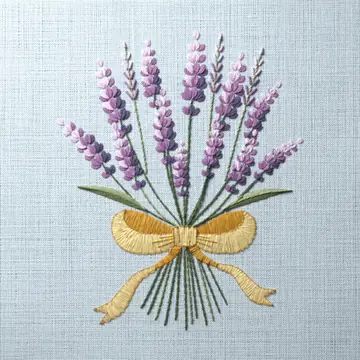
How do I embroider lavender, step by step? A stem in stem stitch and pairs of small lazy daisies that shrink toward the tip. Flower stitches has the six steps and a picture.
Which way do the stitches go in a petal? Along it, from rim to center, for every flower on this page. That is the line they lie along. A tulip petal is worked up and down the same line, with its stitches from base to tip.
How do I shade a petal? Two or three shades, the darkest where the petal goes under another or meets the center. How to shade has the steps.
What stitch is used for stems? Stem stitch, one row for a lily of the valley, two or three for a thistle. Leaf stitches covers the leaves.
Drawings to trace: tulips, poppies, lotus and water lily, lily of the valley, iris, wisteria, thistles, hydrangeas, chrysanthemums, pansies, peonies, cherry blossom, dandelions and flower bouquets.