Bow-top caravan with roses hand embroidery pattern
Intermediate · 7 colors · 4.2 × 4.6 in · 7 kinds of stitch
Download free PDFPDFPrints on US Letter and A4You may sell what you make from it by hand, in small quantities. The PDF itself is not to be sold or shared. Selling, classes and kits: the rules
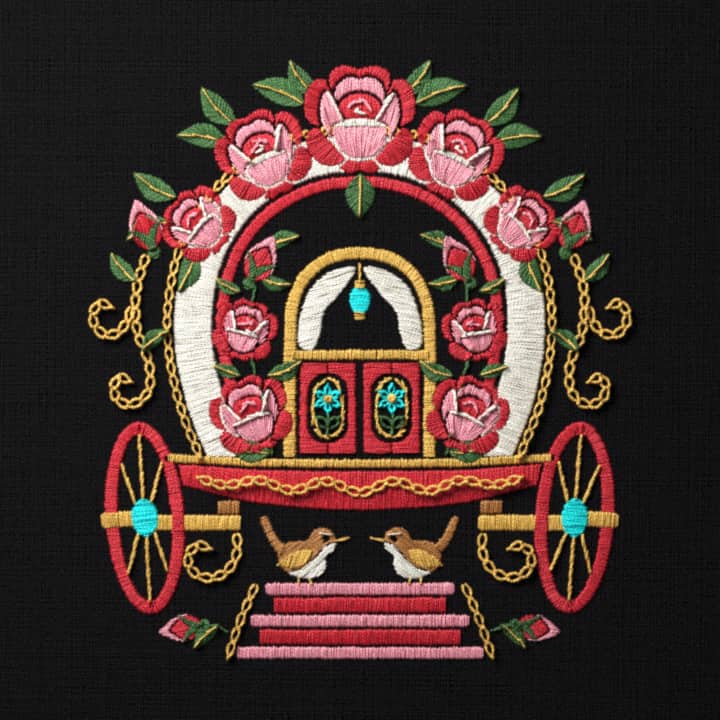
A painted bow-top wagon faces you on black cloth, the left half an exact mirror of the right. Roses and buds crown the canvas arch and climb both sides of the curtained door, gold scrolls curl out on each side, and two wrens face each other on the top step.
Size and details
Intermediate. Satin stitch over about a third of the cloth in a 6 inch hoop and a great deal of stitching; from a 6 inch hoop up some of the satin stitches are long.
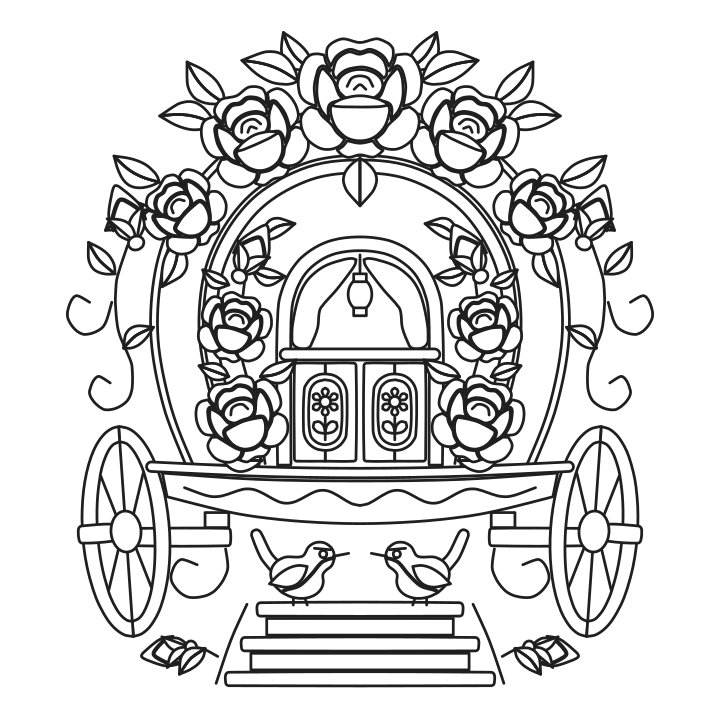
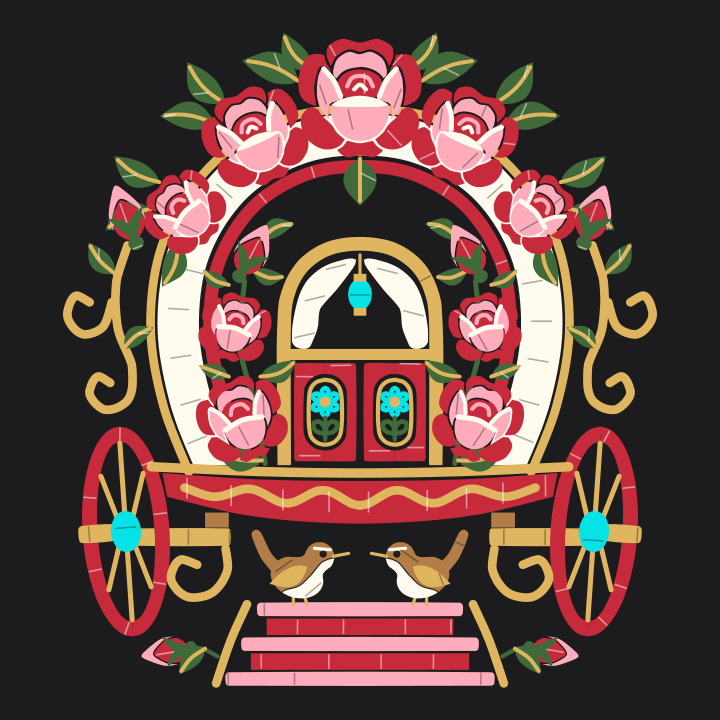
The roses, canvas, doors, wheels and wrens are satin stitch, with a hair of black cloth left between the petals. The scrolls and edgings are chain stitch in gold, the leaves are fishbone stitch with a stem stitch vein, and the turquoise flowers on the doors are lazy daisy stitch with a French knot at the heart. In the picture of where the colors go, the fine lines show which way the stitches lie.
| Hoop | Inches | Centimeters | Satin stitch up to |
|---|---|---|---|
| 3 in (8 cm) | 1.7 × 1.8 in | 4.3 × 4.6 cm | 3/16 in (5 mm) |
| 4 in (10 cm) | 2.5 × 2.8 in | 6.4 × 7.1 cm | 1/4 in (6 mm) |
| 5 in (13 cm) | 3.3 × 3.7 in | 8.4 × 9.4 cm | 5/16 in (8 mm) |
| 6 in (15 cm) | 4.2 × 4.6 in | 10.7 × 11.7 cm | 3/8 in (10 mm) |
| 8 in (20 cm) | 5.8 × 6.4 in | 14.7 × 16.3 cm | 9/16 in (14 mm) |
- In an 8 inch hoop the widest satin stitch shape is 9/16 in (14 mm) across. Satin stitches longer than about 12 mm (just under 1/2 in) tend to work loose: divide the shape into sections, or work it in long and short stitch.
- In a 3, 4 or 5 inch hoop the French knots are drawn smaller than about 2 mm (a little over 1/16 in). Use one strand of floss for them there, or choose a larger hoop.
- In a 3, 4, 5 or 6 inch hoop the shortest lazy daisy loops are drawn smaller than about 2 mm (a little over 1/16 in). Use one strand of floss for them there, or choose a larger hoop.
What you need
- Fabric
- Plain cotton or linen in black, cut 9 in (23 cm) square. On white cloth its palest threads do not show: choose other colors under Options. A pencil line does not show on it: see how to transfer a pattern to dark fabric.
- Needle
- Embroidery needle, size 9 for 1 strand, size 7 for 2 or 3 (a lower number is a thicker needle).
- Floss
- 7 colors of six-strand cotton, listed below. DMC is a brand: another brand in a like color will do.
- Marker
- A pen or a sheet that suits the fabric: how to transfer a pattern says which.
Floss
- 1DMC 3820 Dark StrawDoor frame, gold scrolls, gold edging and board rail, leaves (lighter) and 10 more parts
- 2DMC 321 RedRose petals, driving board, wheel rims, crimson lining and step risers and 3 more parts
- 3DMC 3846 Light Bright TurquoiseWheel hubs, lantern and door flowers (lighter)
- 4DMC 712 CreamCanvas hood, curtains, turned edges and wren breasts and 2 more parts
- 5DMC 3346 Hunter GreenLeaves (darker), sepals, rose stems and door flower stems
- 6DMC 435 Very Light BrownWrens, wren tails and spring blocks
- 7DMC 3706 Medium MelonInner rose petals and steps, rose buds (lighter), rose heart curls (darker)
Skeins: one of each color is enough. An estimate for the 6 inch hoop, from the length of each line and the area of each filled shape, with a fifth added for tails.
How to stitch it
- New to hand embroidery? Start here.
- Print at 100%, trace the pattern onto the fabric, and put it in the hoop: inner ring under, drawing up, tight as a drum.
- Floss is six strands. Cut 18 inches (45 cm), pull out the number given one at a time, and lay them together.
- Inside a filled shape start with two or three tiny stitches, which the filling covers. Start a line with a small knot on the back. End each thread by running the needle under the backs of a few stitches.
- Each small ring is one French knot. Each small loop is one lazy daisy: come up at its point.
- A number under “Where colors go” is a color of the list. The fine lines on the colors show which way the stitches lie.
Stitch in this order
Filled parts from the back of the picture forward, then lines, loops and knots. Where a stitch page names another number of strands, use the number here.
- Satin stitch 2 strandsAxle, wheel rims, wheel hubs, canvas hood, crimson lining, door frame, curtains, half doors, lantern, door sill, driving board, board rail, spring blocks, steps, step risers, rose petals, inner rose petals, rose hearts, rose buds, sepals, turned edges, wren tails, wrens, wren breasts, wren wings
- Fishbone stitch 2 strandsLeaves
- Stem stitch3 strands: wheel spokes2 or 3 strands: rose stems, turned edges2 strands: door panels, door flower stems, rose heart curls1 strand: leaves
- Chain stitch2 or 3 strands: gold scrolls2 strands: gold edging
- Straight stitch2 strands: lantern, wren legs, wren bills1 strand: wren brows
- Lazy daisy stitch 2 strandsDoor flowers, door flower stems
- French knot 2 strands, two wrapsDoor flowers
When it is done, take off any lines that still show and finish the hoop. A guide to this kind of work: How to embroider a rose.
More patterns like this
Intermediate 3–8 in hoop · 8 colors
Geometric rose
Intermediate 3–8 in hoop · 8 colors
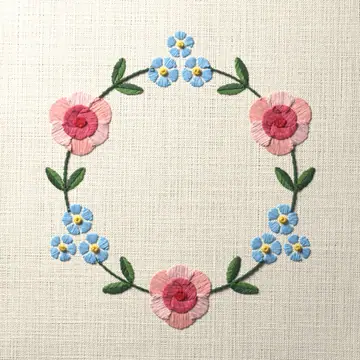
Rose and forget-me-not wreath
Intermediate prints 3–14 in · 9 colors
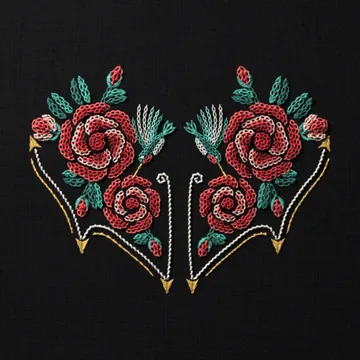
Western shirt yoke with roses
Intermediate 3–8 in hoop · 10 colors
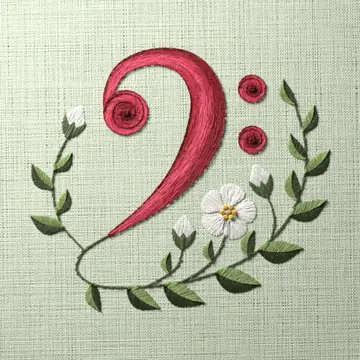
Bass clef with a white wild rose
Advanced 3–8 in hoop · 7 colors
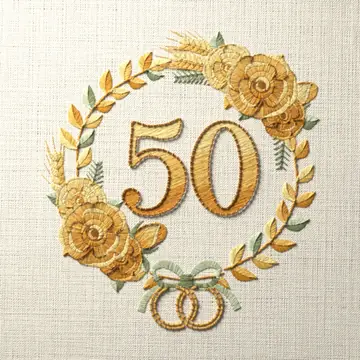
50th wedding anniversary wreath
Easy 3–8 in hoop · 7 colors
Small easy French rose spray
Easy prints 3–14 in · 7 colors
Easy crown of thorns with a rose
Easy 3–8 in hoop · 7 colors
Easy ribbon roses on a swirl
New to hand embroidery? Starting hand embroidery, step by step