Broderie anglaise border for denim hand embroidery pattern
Intermediate · 3 colors · 4.4 × 2.6 in · 7 kinds of stitch
Download free PDFPDFPrints on US Letter and A4You may sell what you make from it by hand, in small quantities. The PDF itself is not to be sold or shared. Selling, classes and kits: the rules
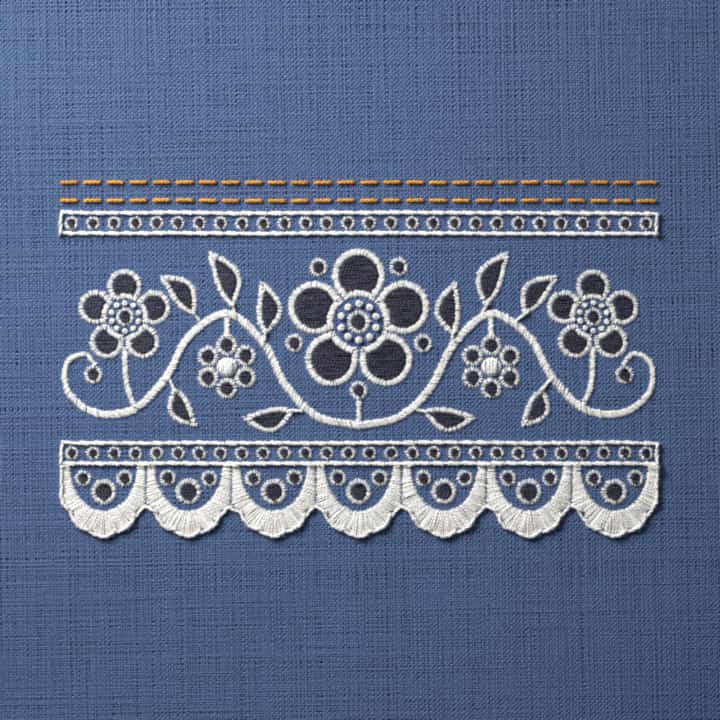
A large flower with five pear-shaped openings stands in the middle, with a ring of French knots round its center eyelet.
Size and details
Intermediate. A great deal of stitching.
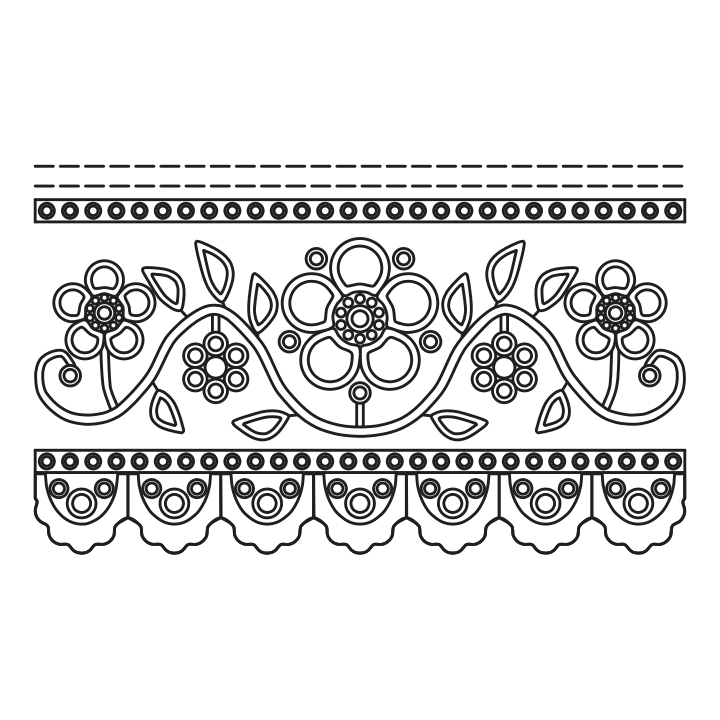
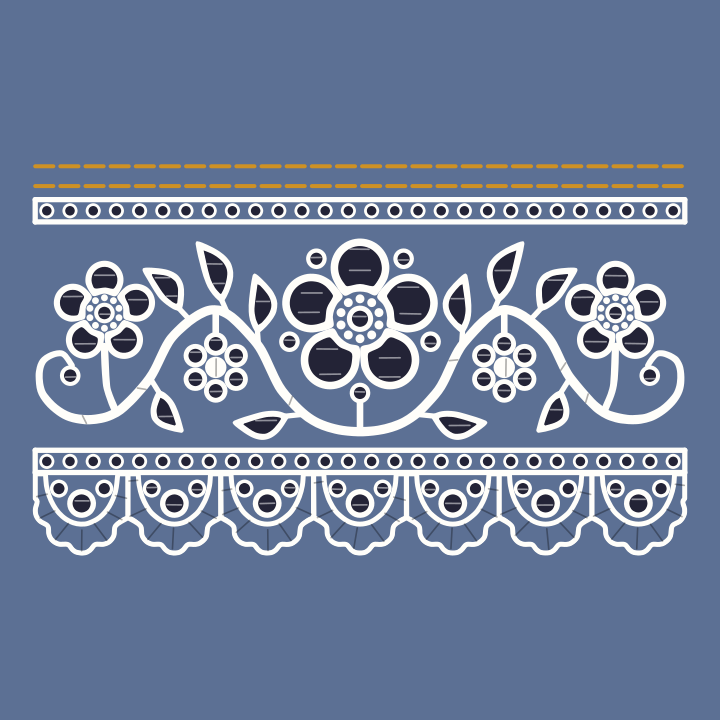
One vine in close satin stitch runs unbroken from a curl at one end to a curl at the other, rising over a small flower of six round eyelets and dipping under a five-petal flower on each side, with almond eyelet leaves along it. The rims of all the eyelets are close satin stitch worked out from the opening, the small flower hearts are padded satin stitch, and the short leaf stems and the lines of the two beading rows are stem stitch. Seven scallops finish the lower edge in close buttonhole stitch with a split stitch edge, and each holds a large eyelet between two small ones. For cut work, outline every opening in running stitch, pierce or snip it, turn the threads back and cover the edge with the rim; leave the black out. With no cutting, fill the openings in black satin stitch as pictured. Two rows of running stitch in jeans gold make the topstitched seam above. In the picture of where the colors go, the fine lines show which way the stitches lie.
| Hoop | Inches | Centimeters | Satin stitch up to |
|---|---|---|---|
| 3 in (8 cm) | 1.8 × 1.1 in | 4.6 × 2.8 cm | 1/8 in (3 mm) |
| 4 in (10 cm) | 2.6 × 1.6 in | 6.6 × 4.1 cm | 3/16 in (5 mm) |
| 5 in (13 cm) | 3.5 × 2.1 in | 8.9 × 5.3 cm | 1/4 in (6 mm) |
| 6 in (15 cm) | 4.4 × 2.6 in | 11.2 × 6.6 cm | 5/16 in (8 mm) |
| 8 in (20 cm) | 6.2 × 3.7 in | 15.7 × 9.4 cm | 7/16 in (11 mm) |
- In a 3, 4 or 5 inch hoop the French knots are drawn smaller than about 2 mm (a little over 1/16 in). Use one strand of floss for them there, or choose a larger hoop.
What you need
- Fabric
- Plain cotton or linen in denim blue, cut 9 in (23 cm) square. On white cloth its palest threads do not show: choose other colors under Options. A pencil line does not show on it: see how to transfer a pattern to dark fabric.
- Needle
- Embroidery needle, size 9 for 1 strand, size 7 for 2 or 3, size 5 for 4 (a lower number is a thicker needle).
- Floss
- 3 colors of six-strand cotton, listed below. DMC is a brand: another brand in a like color will do.
- Marker
- A pen or a sheet that suits the fabric: how to transfer a pattern says which.
On denim. Wash and dry it first. Plain denim is firm enough to need no backing: stick a printed wash-away sheet on it and stitch with a sharp needle. The strands of the list below are for jeans and jackets: take an embroidery needle 5 or 3, or a chenille 24 or 22. On a thin denim shirt take one strand fewer and a needle 7 or 5. How to embroider jeans has every step and says where the hand reaches, and the placement chart says where a design goes.
Floss
- DMC BLANC WhiteScalloped hem, beading lines, petal eyelets, vine and leaf eyelets and 11 more parts
- DMC 310 BlackOpenings
- DMC 783 Medium TopazTopstitching
Skeins: one of each color is enough. An estimate for the 6 inch hoop, from the length of each line and the area of each filled shape, with a fifth added for tails.
How to stitch it
- New to hand embroidery? Start here.
- Print at 100% on a sticky wash-away sheet, smooth it onto the denim, put it in the hoop, tight as a drum, and stitch through both.
- Floss is six strands. Cut 18 inches (45 cm), pull out the number given one at a time, and lay them together.
- On denim start with a small firm knot inside, which the cloth hides; inside a filled shape take two or three tiny stitches instead. End each thread by running the needle under the backs of a few stitches.
- Each small ring is one French knot. A dashed line is running stitch.
Stitch in this order
Filled parts from the back of the picture forward, then lines and knots. Where a stitch page names another number of strands, use the number here.
- Satin stitch 2 strandsFlower stems, leaf eyelets, openings, vine, petal eyelets, center eyelets, small flower eyelets, tendril eyelets, seed eyelets, beading eyelets, hem eyelets
- Padded satin stitch 2 strandsFlower dots
- Buttonhole stitch 3 strandsScalloped hem
- Stem stitch 3 strandsLeaf stems, beading lines
- Split stitch 3 strandsHem edge
- Running stitch 4 strandsTopstitching
- French knot 1 strand, two wrapsSeed ring
When it is done, take off any lines that still show. A guide to this kind of work: Cutwork and eyelet embroidery.
More patterns like this
Advanced prints 3–14 in · 12 colors
Modern wildflowers for denim
Easy prints 3–14 in · 3 colors
Simple lotus line for a pocket
Intermediate prints 3–14 in · 7 colors
60s bell bottom hem flower border
Intermediate prints 3–14 in · 7 colors
Back pocket flourish
Easy prints 3–14 in · 2 colors
Easy monster pocket peeker
Intermediate prints 3–14 in · 8 colors
Groovy flowers for a jeans pocket
Intermediate prints 3–14 in · 3 colors
Yellow lace flower border with scallops
Intermediate prints 3–14 in · 2 colors
Swiss eyelet flower border
New to hand embroidery? Starting hand embroidery, step by step