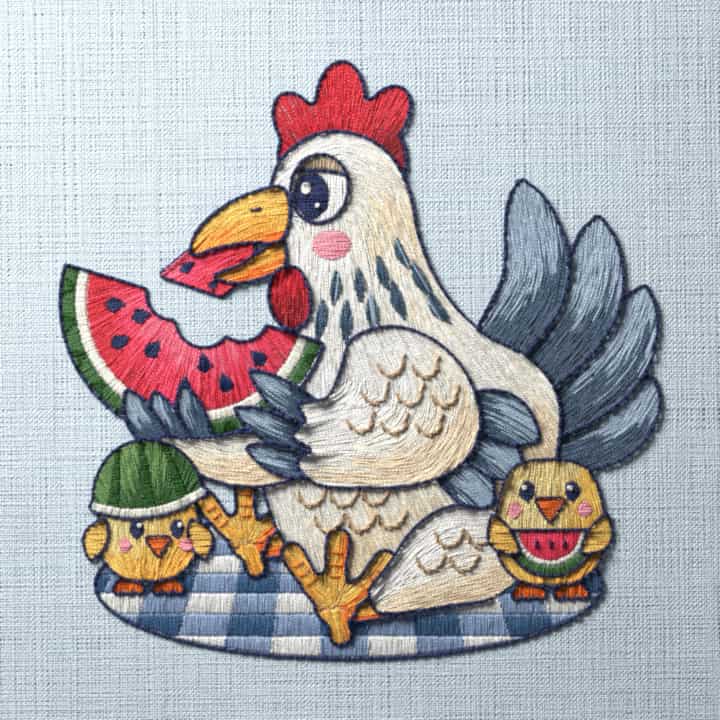
Cartoon chicken eating watermelon hand embroidery pattern
Advanced · 23 colors · 4.3 × 4.3 in · 6 kinds of stitch
Download free PDFPDFPrints on US Letter and A4You may sell what you make from it by hand, in small quantities. The PDF itself is not to be sold or shared. Selling, classes and kits: the rules
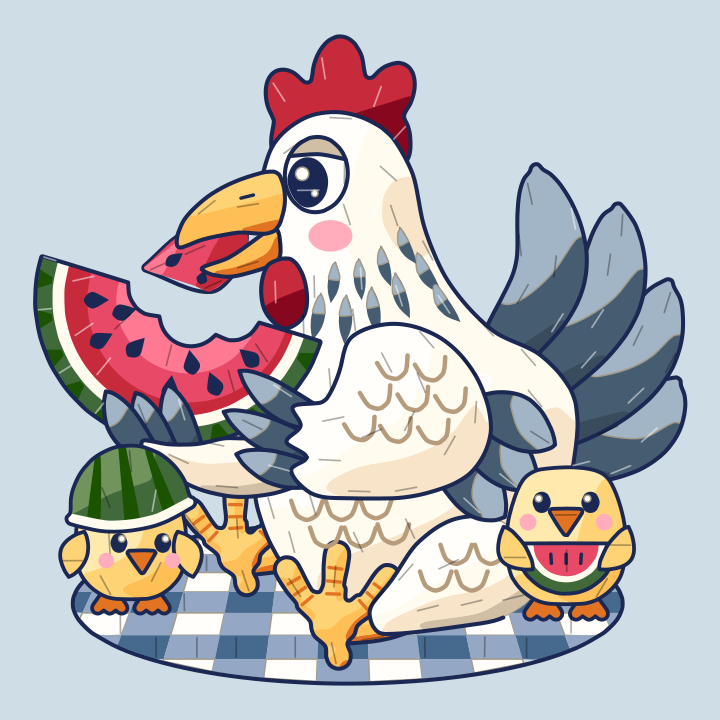
A plump white hen has sat down on a round gingham cloth with her feet stuck out in front. Her slate blue wing tips hold up a big half slice of watermelon, a bite is gone from the top of it and the piece is in her bill. One chick wears an empty rind for a helmet and the other holds a slice of its own.
Size and details
Advanced. Uses long and short stitch over much of the design, 23 colors and a great deal of stitching.
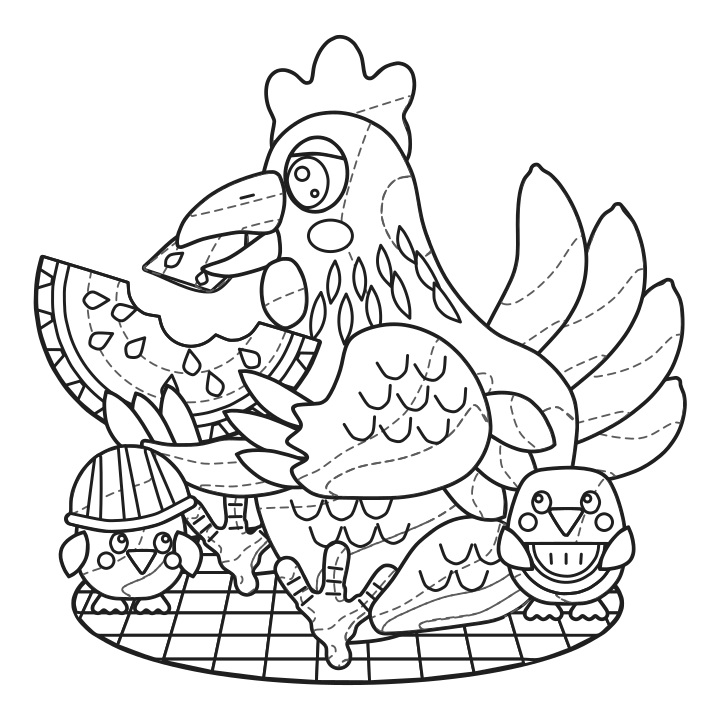
The hen, her comb, bill, feet and tail, the chicks and the red of the big melon slice are long and short stitch. The rind, seeds, eyes, neck streaks and gingham are satin stitch, the small breast and wing feathers are stem stitch, and every outline is back stitch. In the picture of where the colors go, the fine lines show which way the stitches lie.
| Hoop | Inches | Centimeters | Satin stitch up to |
|---|---|---|---|
| 3 in (8 cm) | 1.7 × 1.7 in | 4.3 × 4.3 cm | 1/8 in (3 mm) |
| 4 in (10 cm) | 2.6 × 2.6 in | 6.6 × 6.6 cm | 3/16 in (5 mm) |
| 5 in (13 cm) | 3.4 × 3.4 in | 8.6 × 8.6 cm | 1/4 in (6 mm) |
| 6 in (15 cm) | 4.3 × 4.3 in | 10.9 × 10.9 cm | 5/16 in (8 mm) |
| 8 in (20 cm) | 6 × 6 in | 15.2 × 15.2 cm | 7/16 in (11 mm) |
- In a 3, 4 or 5 inch hoop the French knots are drawn smaller than about 2 mm (a little over 1/16 in). Use one strand of floss for them there, or choose a larger hoop.
On a towel. Wash and dry the towel first. To start with, put the bottom of the design 2 to 3 inches (5 to 7.5 cm) above the hem, in the middle or in a lower corner. Keep the stitches low, and press from the back. How to embroider a towel has every step, and the placement chart has the figures for other towels.
What you need
- Fabric
- Plain cotton or linen in pale blue, cut 9 in (23 cm) square. On white cloth its palest threads do not show: choose other colors under Options.
- Needle
- Embroidery needle, size 9 for 1 strand, size 7 for 2 or 3, size 5 for 4 (a lower number is a thicker needle).
- Floss
- 23 colors of six-strand cotton, listed below. DMC is a brand: another brand in a like color will do.
- Marker
- A pen or a sheet that suits the fabric: how to transfer a pattern says which.
Floss
- 1DMC 809 Delft BlueGingham cloth (middle)
- 2DMC 798 Dark Delft BlueGingham cloth (dark)
- 3DMC BLANC WhiteBody and wings (lightest), gingham cloth (light), eye whites and eye lights
- 4DMC 939 Very Dark Navy BlueOutline, eyes, melon seeds and nostrils
- 5DMC 930 Dark Antique BlueTail feathers and wing tips (middle), neck feathers (darker)
- 6DMC 3750 Very Dark Antique BlueTail feathers and wing tips (dark)
- 7DMC 932 Light Antique BlueTail feathers and wing tips (light), neck feathers (lighter)
- 8DMC 743 Medium YellowFeet, legs and bill (light), chick (middle), chick wings
- 9DMC 922 Light CopperChick feet, toe creases and chick bill, legs, bill and feet (dark)
- 10DMC 742 Light TangerineBill, feet and legs (middle), chick (dark)
- 11DMC 321 RedComb and wattles (lighter), melon flesh (dark)
- 12DMC 815 Medium GarnetComb and wattles (darker)
- 13DMC 842 Very Light Beige BrownBody and wings (darkest), eyelids
- 14DMC 739 Ultra Very Light TanBody and wings (dark)
- 15DMC 712 CreamBody and wings (light), melon pale rind and helmet rim
- 16DMC 3801 Very Dark MelonMelon flesh (middle)
- 17DMC 3705 Dark MelonMelon flesh (light)
- 18DMC 3346 Hunter GreenMelon rind, rind helmet (darker)
- 19DMC 895 Very Dark Hunter GreenRind stripes
- 20DMC 841 Light Beige BrownBreast feathers and wing feathers
- 21DMC 3706 Medium MelonCheeks
- 22DMC 745 Light Pale YellowChick (light)
- 23DMC 3347 Medium Yellow GreenRind helmet (lighter)
Skeins: one of each color is enough. An estimate for the 6 inch hoop, from the length of each line and the area of each filled shape, with a fifth added for tails.
How to stitch it
- New to hand embroidery? Start here.
- Print at 100%, trace the pattern onto the fabric, and put it in the hoop: inner ring under, drawing up, tight as a drum.
- Floss is six strands. Cut 18 inches (45 cm), pull out the number given one at a time, and lay them together.
- Begin with no knot on the back where it is seen and washed, as on a towel, a napkin or clothes; for a piece in a hoop a small knot is fine. End each thread by whipping it around the backs of four or five stitches, with one small hitch.
- Each small ring is one French knot. A fine broken line inside a shape is where two shades meet: trace it, do not stitch it.
- A number under “Where colors go” is a color of the list. The fine lines on the colors show which way the stitches lie.
Stitch in this order
Filled parts from the back of the picture forward, then lines and knots. Where a stitch page names another number of strands, use the number here.
- Satin stitch 2 strandsGingham cloth, neck feathers, melon pale rind, melon rind, rind stripes, melon seeds, cheeks, eye whites, eyes, eye lights, eyelids, chick feet, chick wings, helmet rim, chick bill, melon flesh
- Long and short stitch 1 strandTail feathers, legs, feet, comb, body, melon flesh, wing tips, wings, bill, wattles, chick, rind helmet
- Back stitch 2 to 4 strandsOutline
- Straight stitch3 strands: melon seeds2 strands: nostrils1 strand: toe creases
- Stem stitch 2 strandsBreast feathers, wing feathers
- French knot 1 strand, two wrapsEye lights
When it is done, take off any lines that still show and finish the hoop. A guide to this kind of work: Stitches for fur, hair and feathers.
More patterns like this
Advanced 3–8 in hoop · 23 colors
Mini watermelon
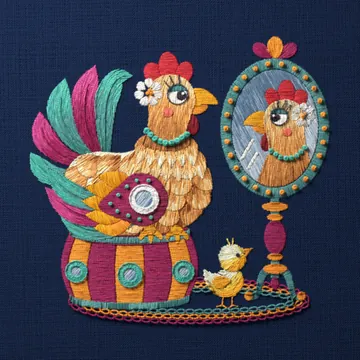
Advanced 3–8 in hoop · 22 colors
Funny hen looking in a mirror
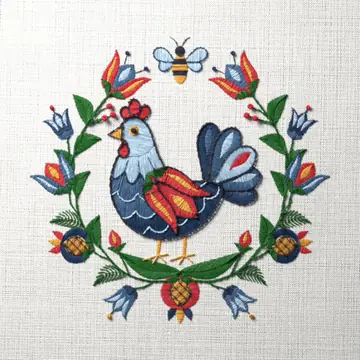
Advanced 3–8 in hoop · 7 colors
Kashubian folk chicken wreath
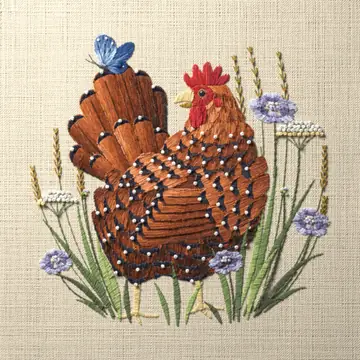
Advanced 3–8 in hoop · 23 colors
Speckled chicken in a meadow
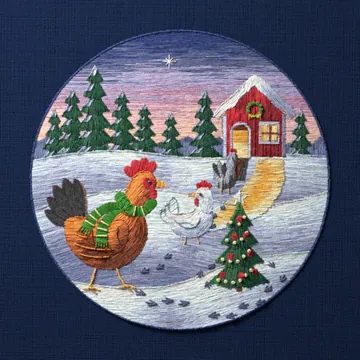
Advanced prints 3–14 in · 23 colors
Christmas chickens in the snow
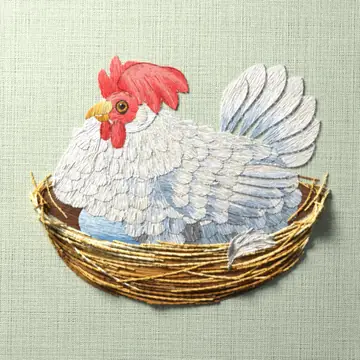
Advanced 3–8 in hoop · 24 colors
White chicken in a nest
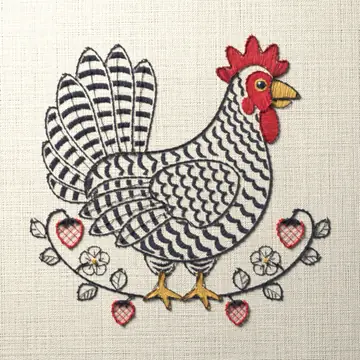
Advanced 3–8 in hoop · 5 colors
Barred Rock chicken in blackwork
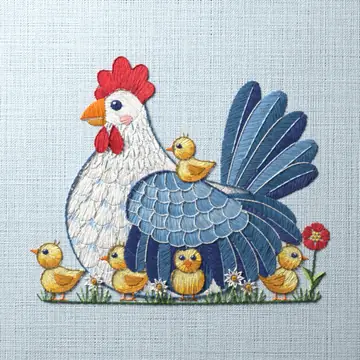
Advanced 3–8 in hoop · 16 colors
Vintage hen with chicks tea towel
New to hand embroidery? Starting hand embroidery, step by step