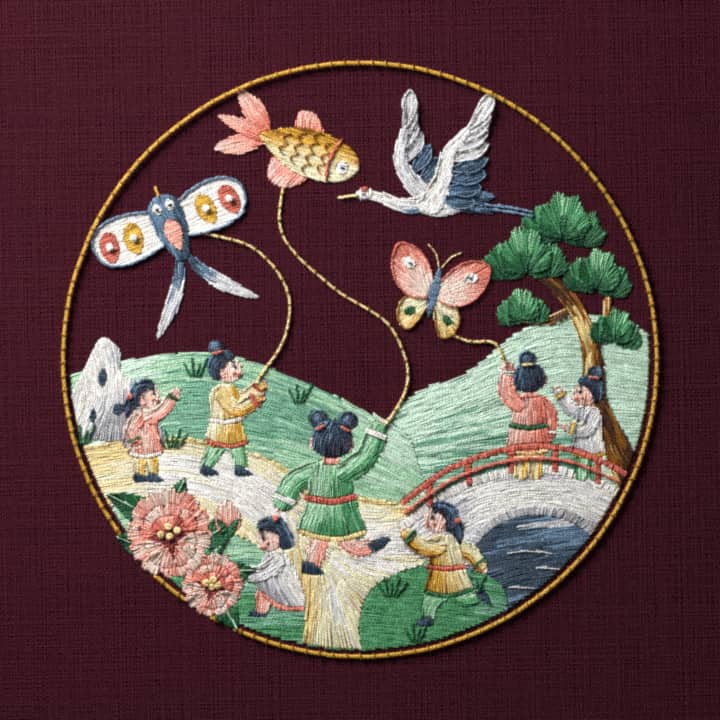
Children at play with kites hand embroidery pattern
Advanced · 24 colors · 9 kinds of stitch
Download free PDFPDF, US Letter · 174 KBFor your own stitching, gifts and handmade pieces you sell. Do not resell or share this PDF. What you may do, in full
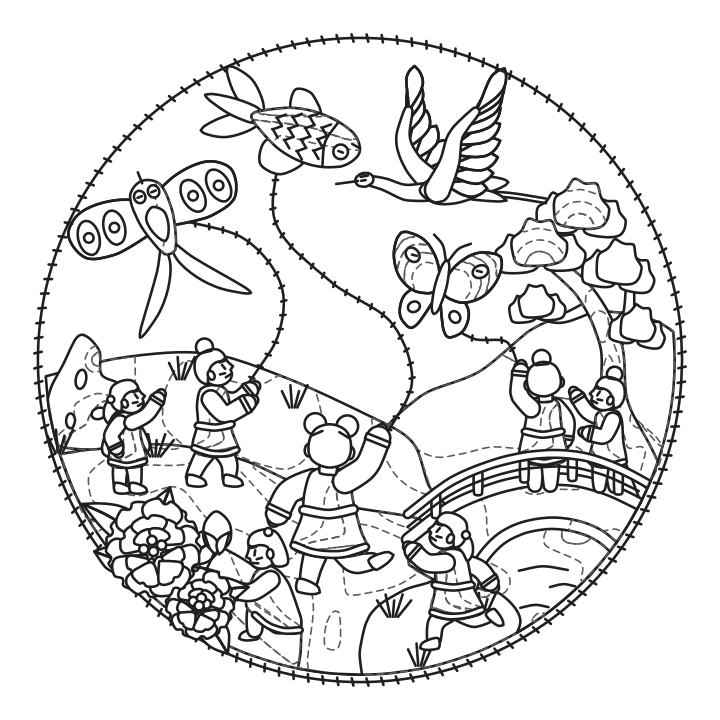
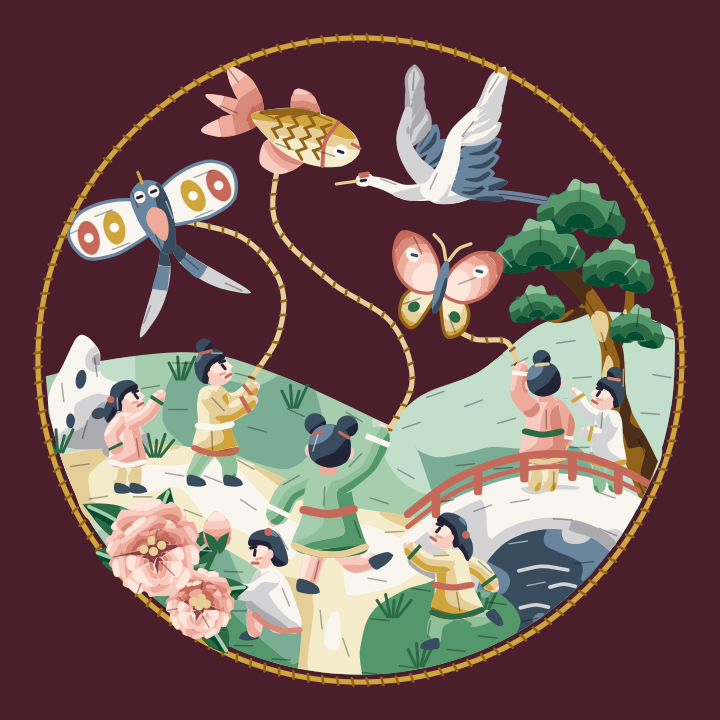
Seven children in jade, peach, pearl and gold jackets play on a winding garden terrace, some seen from behind and some in profile. A pine leans over an arched bridge, peonies bloom near the front, and a real crane flies among the swallow, fish and butterfly kites. The robes, hair, ground, kites and crane are shaded in long and short stitch. The gold kite strings and the round rim are couching, the bridge rail is satin stitch and stem stitch, and French knots mark the peony hearts. It is drawn for wine red linen. In the picture of where the colors go, the fine lines show which way the stitches lie.
Size and details
Advanced. Uses long and short stitch over much of the design, couching, 24 colors and a great deal of stitching.
24 colors of floss and 9 kinds of stitch:
- Long and short stitch
- Couching
- Satin stitch
- Straight stitch
- Fly stitch
- Stem stitch
- French knot
- Split stitch
- Back stitch
- Which stitch goes where
| Hoop | Inches | Centimeters | Satin stitch up to |
|---|---|---|---|
| 3 in (8 cm) | 2 × 2 in | 5.1 × 5.1 cm | 1/16 in (1.6 mm) |
| 4 in (10 cm) | 2.9 × 2.9 in | 7.4 × 7.4 cm | 1/8 in (3 mm) |
| 5 in (13 cm) | 3.9 × 3.9 in | 9.9 × 9.9 cm | 1/8 in (3 mm) |
| 6 in (15 cm) | 4.9 × 4.9 in | 12.4 × 12.4 cm | 3/16 in (5 mm) |
| 8 in (20 cm) | 6.9 × 6.9 in | 17.5 × 17.5 cm | 1/4 in (6 mm) |
- In a 3, 4, 5, 6 or 8 inch hoop the French knots are drawn smaller than about 2 mm (a little over 1/16 in). Use one strand of floss for them there, or choose a larger hoop.
The pattern is drawn inside a circle about half an inch (1.3 cm) smaller all around than the hoop.
What you need
- DMC 503 Medium Blue GreenFar hill (darker), lawn (dark)
- DMC 504 Very Light Blue GreenFar hill (lighter), lawn (lightest)
- DMC 564 Very Light JadeLawn (light) and 3 more parts
- DMC 562 Medium JadeLawn (darkest) and 4 more parts
- DMC 677 Very Light Old GoldPath (middle) and 4 more parts
- DMC 676 Light Old GoldPath (dark) and 11 more parts
- DMC 3865 Winter WhiteBridge and path (light) and 10 more parts
- DMC 3750 Very Dark Antique BlueStream (dark), hair (middle) and 7 more parts
- DMC 931 Medium Antique BlueStream (middle) and 8 more parts
- DMC 415 Pearl GrayBridge (middle) and 10 more parts
- DMC 780 Ultra Very Dark TopazPine trunk (middle) and 6 more parts
- DMC 898 Very Dark Coffee BrownPine trunk (dark)
- DMC 561 Very Dark JadePine needles (dark) and 9 more parts
- DMC 500 Very Dark Blue GreenPeony leaves and pine needles (darkest)
- DMC 563 Light JadeTrousers (shade 3 of 9) and 2 more parts
- DMC 318 Light Steel GrayRocks (dark) and 5 more parts
- DMC 3778 Light Terra CottaPeony petals (middle dark) and 5 more parts
- DMC 356 Medium Terra CottaBridge rail and 13 more parts
- DMC 758 Very Light Terra CottaPeony petals (middle light) and 7 more parts
- DMC 754 Light PeachPeony petals (light) and 5 more parts
- DMC 729 Medium Old GoldRim (lighter) and 7 more parts
- DMC 310 BlackHair (dark), eyes and 2 more parts
- DMC 948 Very Light PeachFaces and hands (light) and 4 more parts
- DMC 221 Very Dark Shell PinkPeony petals (darkest)
Skeins: 2 for far hill (darker), lawn (dark) and 2 for lawn (light) and 3 more parts; one of each other color. An estimate for the largest size, the 8 inch hoop: the length of each line and the area of each filled shape, a fifth added for tails and ends, a tenth of every 8 m (8.7 yd) skein kept spare.
The floss is six-strand cotton; the stitch guide says how many strands to use. You also need a hoop, an embroidery needle (a size 7 to 9 suits two or three strands) and plain cotton or linen fabric. To frame the piece in its hoop, cut a square 3 inches (8 cm) wider than the hoop: a 9 inch (23 cm) square for a 6 inch hoop.
When it is stitched, how to finish a hoop shows how to back it for the wall.
Stitch guide
- Put the pattern on the fabric (how to transfer a pattern) and the fabric in the hoop.
- Stitch the filled parts first, what lies behind before what lies in front of it.
- Then stitch the lines: stems, veins and outlines over the edges of the filled parts.
- Keep the knots for the end, so that the hoop and your hand do not flatten them.
Start each thread with a small knot on the back or one of the knotless starts, and end it by running the needle under the backs of a few stitches (starting and ending a thread). Use the strands this list gives, also where a page about a stitch names another number.
- Long and short stitch 1 to 2 strandsFar hill, lawn, path, stream, pine trunk, and 16 more
- Couching 3 to 6 strandsKite strings, rim
- Satin stitch 2 strandsBridge arch, bridge, rocks, kite patterns, and 9 more
- Straight stitch 1 to 3 strandsGrass, kite edges, mouths, kite patterns, and 5 more
- Fly stitch 1 strandScales
- Stem stitch 1 to 3 strandsScales, crane legs, ripples, bridge rail, and 2 more
- French knot 2 strands, two wrapsKite patterns, hair ribbons, peony hearts
- Split stitch 1 to 2 strandsKite edges, feather edges
- Back stitch 1 strandKite edges
Getting it onto your fabric
The PDF holds the pattern twice at actual size: once as drawn, and once mirrored for an iron-on transfer pen. Print it at 100% with scaling off and check the one-inch square (25.4 mm) with a ruler before you trace. How to transfer a pattern explains tracing, carbon paper and the other ways. The files are under Downloads.
Downloads
- Download free PDF PDF, US Letter, 3 pages, for a 6 inch (15 cm) hoop
- Download free PDF, A4 PDF, A4, 3 pages, for a 6 inch (15 cm) hoop
More patterns like this
Advanced 3–8 in hoop · 13 colors
Children holding hands name wreath
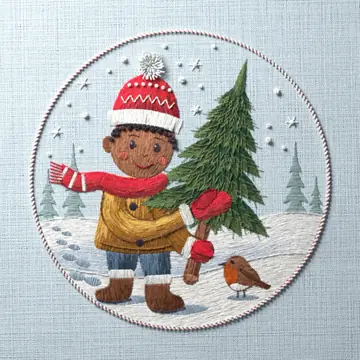
Advanced 3–8 in hoop · 24 colors
Little boy with a Christmas tree
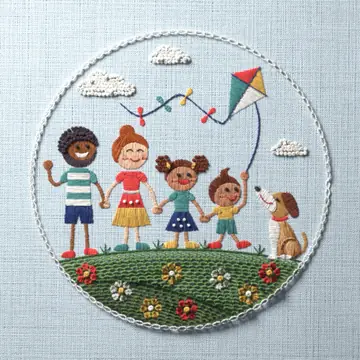
Advanced 3–8 in hoop · 18 colors
Stick figure family with a dog
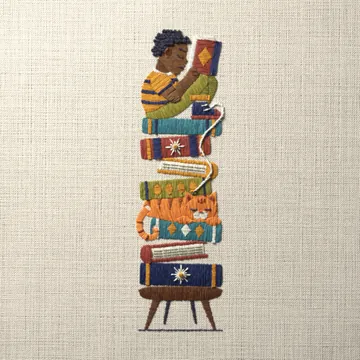
Advanced 3–8 in hoop · 13 colors
Boy reading bookmark, tower of books
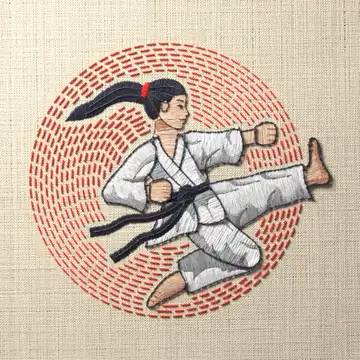
Intermediate 3–8 in hoop · 9 colors
Karate girl flying kick
Advanced 3–8 in hoop · 24 colors
Girl with flowers in her afro
Advanced 3–8 in hoop · 22 colors
Girl with curly hair and butterflies
Advanced 3–8 in hoop · 24 colors
Unicorn with rainbow tail
New to hand embroidery? Starting hand embroidery, step by step