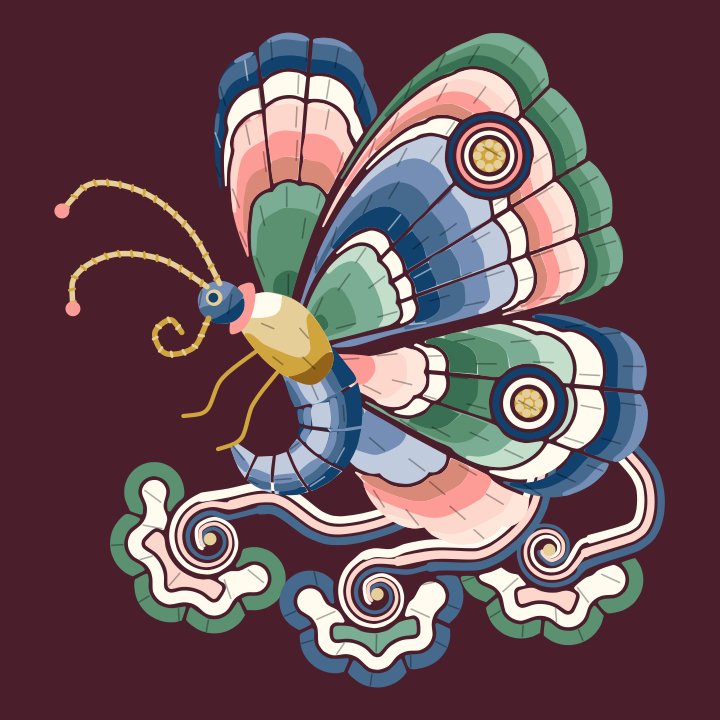
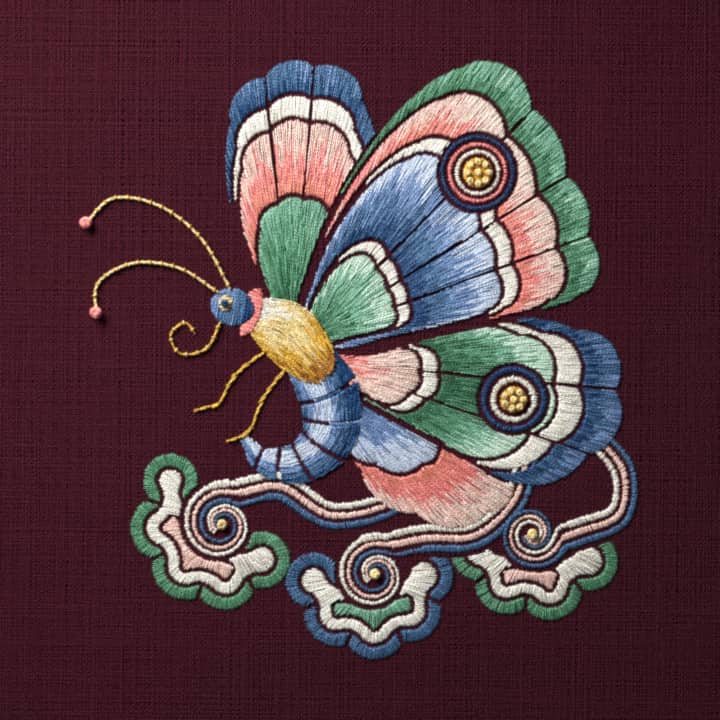
Butterfly with cloud scrolls hand embroidery pattern
Advanced · 16 colors · 4.3 × 4.6 in · 5 kinds of stitch
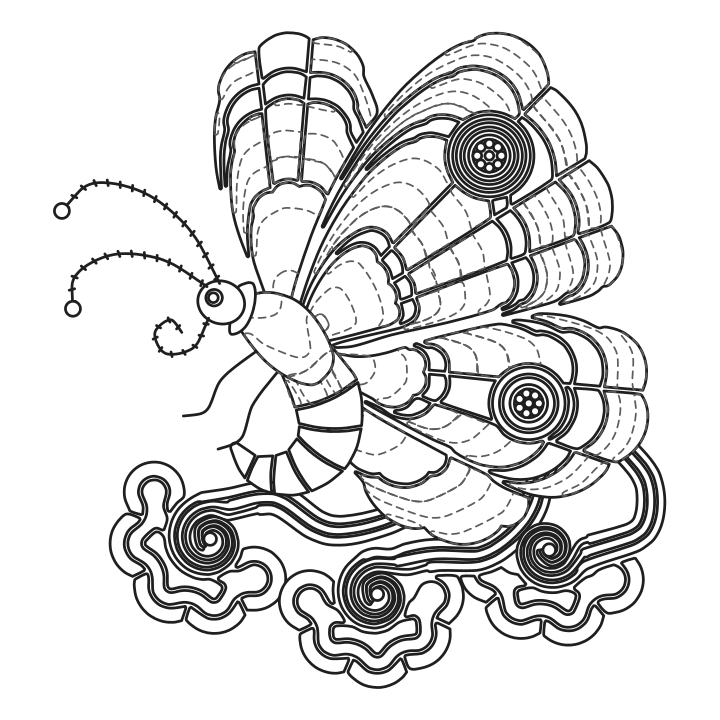
A number is a color of the list. Fine lines show which way the stitches lie: do not stitch them.
Download free PDFPDFYou may sell what you make from it by hand, in small quantities. The PDF itself is not to be sold or shared. Selling, classes and kits: the rules
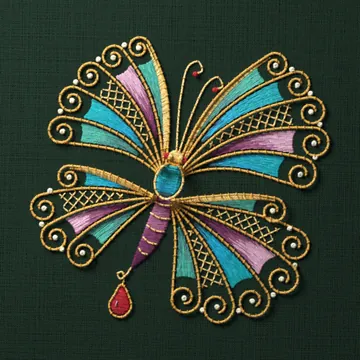
A butterfly flies to the left with one great wing raised and the other peeping out behind it.
Choose a size
| Hoop | Inches | Centimeters | Satin stitch up to |
|---|---|---|---|
| 3 in (8 cm) | 1.7 × 1.8 in | 4.3 × 4.6 cm | 1/8 in (3 mm) |
| 4 in (10 cm) | 2.6 × 2.8 in | 6.6 × 7.1 cm | 3/16 in (5 mm) |
| 5 in (13 cm) | 3.4 × 3.7 in | 8.6 × 9.4 cm | 1/4 in (6 mm) |
| 6 in (15 cm) | 4.3 × 4.6 in | 10.9 × 11.7 cm | 5/16 in (8 mm) |
| 8 in (20 cm) | 6 × 6.5 in | 15.2 × 16.5 cm | 7/16 in (11 mm) |
- In a 3, 4 or 5 inch hoop the French knots are drawn smaller than about 2 mm (a little over 1/16 in). Use one strand of floss for them there, or choose a larger hoop.
Before you start
- New to this? Try an easy pattern first, or see how to read one.
- Print at actual size (100%, not “fit”). Dark fabric: trace with a white pencil over a bright light, or use a wash-away sheet. Then put it in the hoop, tight as a drum.
- Print at actual size (100%, not “fit”), tape the sheets and trace all of it. Hoop one part, stitch it, then move the hoop; raised parts and knots last.
- Floss has six strands: cut 18 inches (45 cm), pull out the number named one at a time, and lay them together.
- Start a filling with tiny stitches, a line with a small knot; end under stitches on the back.
- On the drawing a ring is one French knot; a broken line inside a shape is where two shades meet: trace it, do not stitch it.
What you need
- Hoop
- 6 in (15 cm), 4.3 × 4.6 in stitched. Another size
- Fabric
- Plain cotton or linen in wine red or another dark color, cut 9 in (23 cm) square.
- Needle
- Embroidery needle, size 9.
- Floss
- 16 colors of six-strand cotton. Skeins: one of each color is enough, an estimate for the 6 inch hoop from the drawing’s lines and shapes.
- Also
- White pencil, small scissors.
DMC is a brand, the number its color: another brand in a like color will do.
Threads and stitches
- 1DMC 502 Blue Green
- 2DMC 712 Cream
- 3DMC 353 Peach
- 4DMC 798 Dark Delft Blue
- 5DMC 503 Medium Blue Green
- 6DMC 676 Light Old Gold
- 7DMC 800 Pale Delft Blue
- 8DMC 799 Medium Delft Blue
- 9DMC 3778 Light Terra Cotta
- 10DMC 352 Light Coral
- 11DMC 948 Very Light Peach
- 12DMC 501 Dark Blue Green
- 13DMC 504 Very Light Blue Green
- 14DMC 796 Dark Royal Blue
- 15DMC 729 Medium Old Gold
- 16DMC 780 Ultra Very Dark Topaz
Stitch in this order
Where a stitch page says otherwise, follow this list.
- Stem stitch 2 strandsLegs
- Satin stitch 2 strandsClouds, ribbon tails, near hindwing (color 2), eye spots, far forewing (color 2), near forewing (color 2), collar, head, eye
- Long and short stitch 1 strandFar hindwing, near hindwing, far forewing, near forewing, body, thorax
- Couching2 strands: feeler3 strands: antennae
- French knot two wraps2 strands: scroll ends, knots of the eye, antenna tips1 strand: eye spot hearts
Take out lines that still show, press face down, finish the hoop or sew a pillow.
About this pattern
Advanced. Uses long and short stitch over much of the design, couching, 16 colors and a great deal of stitching.
The wide bands of the wings and the body are long and short stitch, shaded from the root; the narrow ivory bands, the ribbons and the clouds are satin stitch, and every band is parted from the next by a hairline of bare cloth. Gold French knots fill the eye spots and end the scrolls. The antennae and the curled feeler are couching, and the legs are stem stitch.
1 DMC 502: near forewing (shade 4 of 13), clouds (dark), far forewing (shade 4 of 11), near hindwing (shade 4 of 12). 2 DMC 712: clouds, eye spots and thorax (lightest), ribbon tails (light), near hindwing (shade 12 of 12), near forewing (shade 13 of 13), far forewing (shade 11 of 11). 3 DMC 353: near forewing (shade 11 of 13), far hindwing (shade 6 of 7), ribbon tails (middle), far forewing (shade 9 of 11), near hindwing (shade 10 of 12), clouds (light). 4 DMC 798: near hindwing (shade 3 of 12), ribbon tails and body (dark), far forewing (shade 3 of 11), clouds (darkest), near forewing (shade 3 of 13), far hindwing (shade 1 of 7), head (middle). 5 DMC 503: near forewing (shade 7 of 13), near hindwing (shade 7 of 12), far forewing (shade 7 of 11), clouds (middle). 6 DMC 676: thorax (light), antennae, feeler and eye (lighter), eye spot hearts and scroll ends. 7 DMC 800: far hindwing (shade 5 of 7), near forewing (shade 9 of 13), body (lightest). 8 DMC 799: near forewing (shade 5 of 13), body and head (light), far hindwing (shade 2 of 7), near hindwing (shade 5 of 12), far forewing (shade 5 of 11). 9 DMC 3778: far forewing (shade 6 of 11), near forewing (shade 6 of 13), far hindwing (shade 3 of 7), near hindwing (shade 6 of 12). 10 DMC 352: far forewing (shade 8 of 11), near forewing (shade 8 of 13), far hindwing (shade 4 of 7), near hindwing (shade 8 of 12), collar and antenna tips, eye spots (light). 11 DMC 948: near forewing (shade 12 of 13), far hindwing (shade 7 of 7), near hindwing (shade 11 of 12), far forewing (shade 10 of 11). 12 DMC 501: near forewing (shade 2 of 13), near hindwing (shade 2 of 12), far forewing (shade 2 of 11). 13 DMC 504: near hindwing (shade 9 of 12), near forewing (shade 10 of 13). 14 DMC 796: body and eye spots (darkest), far forewing (shade 1 of 11), near forewing (shade 1 of 13), near hindwing (shade 1 of 12), head (dark), eye (darker). 15 DMC 729: thorax and eye spots (dark), legs, antennae and feeler (darker). 16 DMC 780: thorax (darkest).
A guide to this kind of work: How to shade and blend colors.