Christmas angel with golden wings hand embroidery pattern
Advanced · 21 colors · 9 kinds of stitch
Download free PDFPDF, US Letter · 114 KBFor your own stitching, gifts and handmade pieces you sell. Do not resell or share this PDF. What you may do, in full
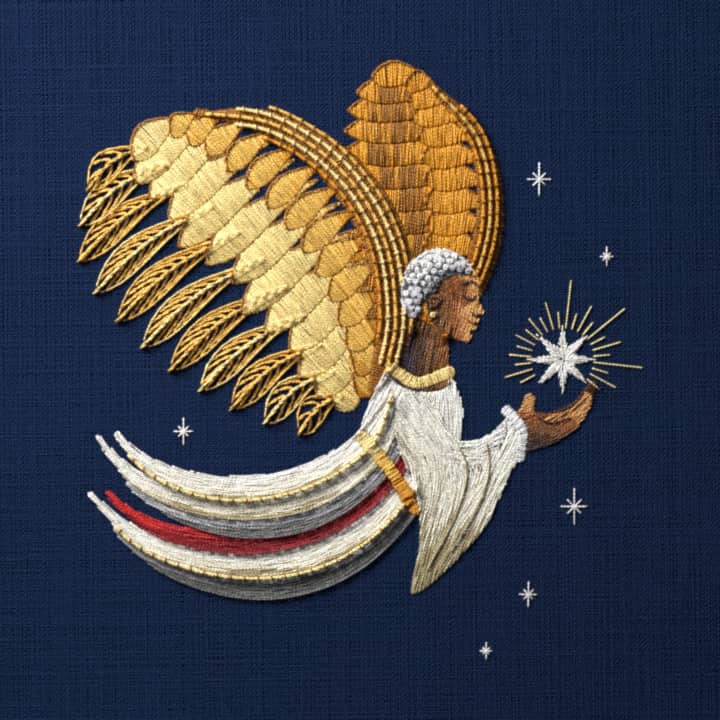
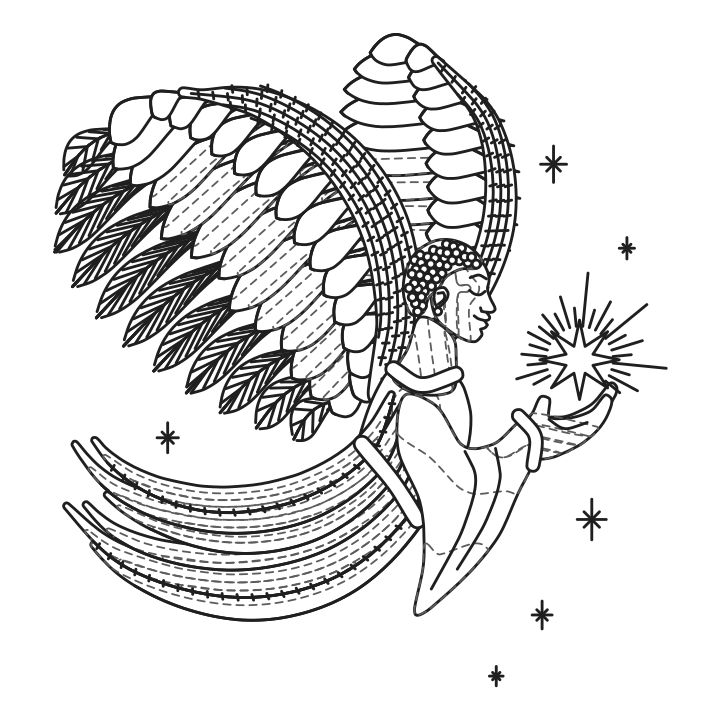
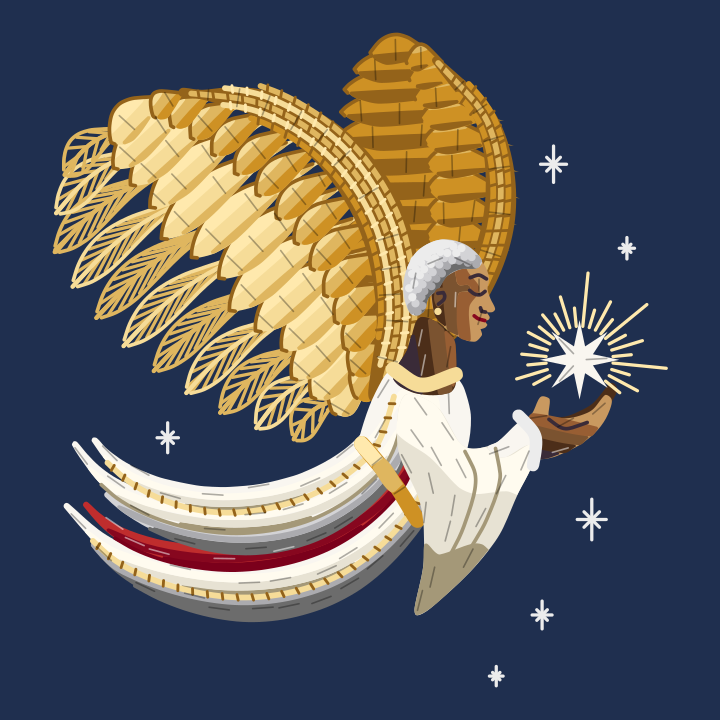
An angel with dark skin and close-cropped silver hair flies across an indigo night, a small bright star over the cupped hands. The wings have couched gold rows along the front edge, satin stitch feathers below them and open fly stitch feathers at the tips. The robe streams back in long and short stitch folds of ivory and silver with one fold of garnet and couched gold hems. The hair is French knots and the rays of the star are single straight stitches. A few little stars are left in plenty of bare cloth. In the picture of where the colors go, the fine lines show which way the stitches lie.
Size and details
Advanced. Uses couching, long and short stitch, dozens of French knots, satin stitch over about a quarter of the cloth in a 6 inch hoop, 21 colors and a great deal of stitching.
21 colors of floss and 9 kinds of stitch:
- Satin stitch
- Split stitch
- Couching
- Fly stitch
- Stem stitch
- Long and short stitch
- French knot
- Back stitch
- Straight stitch
- Which stitch goes where
| Hoop | Inches | Centimeters | Satin stitch up to |
|---|---|---|---|
| 3 in (8 cm) | 1.7 × 1.8 in | 4.3 × 4.6 cm | 1/8 in (3 mm) |
| 4 in (10 cm) | 2.5 × 2.7 in | 6.4 × 6.9 cm | 3/16 in (5 mm) |
| 5 in (13 cm) | 3.3 × 3.6 in | 8.4 × 9.1 cm | 1/4 in (6 mm) |
| 6 in (15 cm) | 4.2 × 4.5 in | 10.7 × 11.4 cm | 5/16 in (8 mm) |
| 8 in (20 cm) | 5.9 × 6.2 in | 15 × 15.7 cm | 7/16 in (11 mm) |
- In a 3 or 4 inch hoop the French knots are drawn smaller than about 2 mm (a little over 1/16 in). Use one strand of floss for them there, or choose a larger hoop.
The pattern is drawn inside a circle about half an inch (1.3 cm) smaller all around than the hoop.
What you need
- DMC 780 Ultra Very Dark TopazFar wing and feather edges (dark), wing shoulder (darkest), gold hem (darker)
- DMC 783 Medium TopazFar wing (middle), short feathers, girdle and wing shoulder (dark)
- DMC 3820 Dark StrawLong feathers (darker), short feathers and feather edges (middle) and 4 more parts
- DMC 3822 Light StrawMiddle feathers (middle), feather edges (light), gold hem (lighter) and 5 more parts
- DMC 745 Light Pale YellowMiddle feathers and girdle (light), star rays, wing shoulder (lightest)
- DMC 3865 Winter WhiteRobe and sleeve (light), star
- DMC 822 Light Beige GraySleeve and robe (dark)
- DMC 712 CreamRobe and sleeve (lightest)
- DMC 317 Pewter GrayRobe lining (dark), fold lines (middle), hair (darkest)
- DMC 318 Light Steel GrayRobe lining (middle), hair (dark)
- DMC 415 Pearl GrayRobe lining and hair (light)
- DMC 642 Dark Beige GrayFold lines (light), sleeve and robe (darkest)
- DMC 347 Very Dark SalmonGarnet fold (light)
- DMC 814 Dark GarnetFold lines and garnet fold (dark)
- DMC 815 Medium GarnetGarnet fold (middle), mouth
- DMC 898 Very Dark Coffee BrownSkin (dark)
- DMC 3371 Black BrownSkin (darkest), face lines
- DMC 433 Medium BrownSkin (middle)
- DMC 434 Light BrownSkin (light)
- DMC 436 TanSkin (lightest)
- DMC 762 Very Light Pearl GrayLittle stars and cuff, hair (lightest)
Skeins: 2 for far wing and feather edges (dark), wing shoulder (darkest), gold hem (darker) and 2 for long feathers (darker), short feathers and feather edges (middle) and 4 more parts; one of each other color. An estimate for the largest size, the 8 inch hoop: the length of each line and the area of each filled shape, a fifth added for tails and ends, a tenth of every 8 m (8.7 yd) skein kept spare.
The floss is six-strand cotton; the stitch guide says how many strands to use. You also need a hoop, an embroidery needle (a size 7 to 9 suits two or three strands) and plain cotton or linen fabric. To frame the piece in its hoop, cut a square 3 inches (8 cm) wider than the hoop: a 9 inch (23 cm) square for a 6 inch hoop.
When it is stitched, how to finish a hoop shows how to back it for the wall.
Stitch guide
- Put the pattern on the fabric (how to transfer a pattern) and the fabric in the hoop.
- Stitch the filled parts first, what lies behind before what lies in front of it.
- Then stitch the lines: stems, veins and outlines over the edges of the filled parts.
- Keep the knots for the end, so that the hoop and your hand do not flatten them.
Start each thread with a small knot on the back or one of the knotless starts, and end it by running the needle under the backs of a few stitches (starting and ending a thread). Use the strands this list gives, also where a page about a stitch names another number.
- Satin stitch 2 strandsFar wing, middle feathers, short feathers, wing shoulder, girdle, skin, collar, cuff, star
- Split stitch 1 strandFeather edges, fold lines
- Couching 3 to 4 strandsFar wing, wing shoulder, gold hem
- Fly stitch 2 strandsLong feathers
- Stem stitch 1 to 2 strandsLong feathers
- Long and short stitch 1 strandRobe, robe lining, garnet fold, skin, hair, sleeve
- French knot 1 strand, two wrapsHair, earring
- Back stitch 1 to 2 strandsFace lines, mouth
- Straight stitch 1 strandStar rays, little stars
Getting it onto your fabric
The PDF holds the pattern twice at actual size: once as drawn, and once mirrored for an iron-on transfer pen. Print it at 100% with scaling off and check the one-inch square (25.4 mm) with a ruler before you trace. How to transfer a pattern explains tracing, carbon paper and the other ways. The files are under Downloads.
Downloads
- Download free PDF PDF, US Letter, 3 pages, for a 6 inch (15 cm) hoop
- Download free PDF, A4 PDF, A4, 3 pages, for a 6 inch (15 cm) hoop
More patterns like this
Advanced 3–8 in hoop · 21 colors
Christmas angel over a snowy village
Advanced 3–8 in hoop · 22 colors
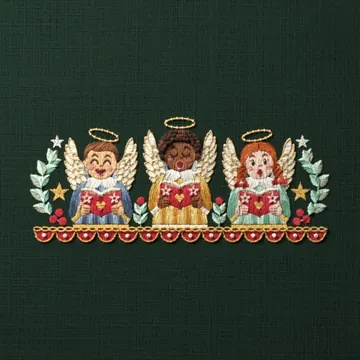
Three choir angels for a stocking cuff
Advanced 3–8 in hoop · 22 colors
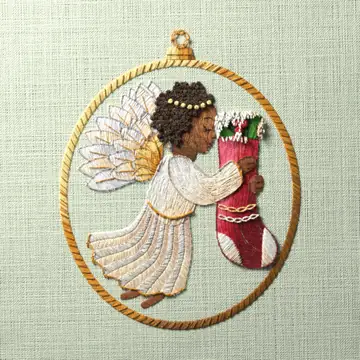
Raised angel with a stocking
Advanced 3–8 in hoop · 23 colors
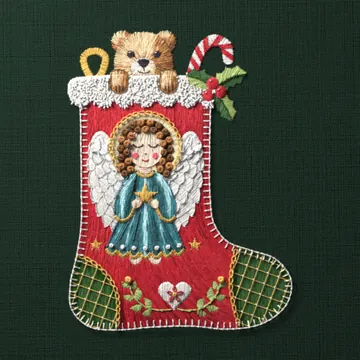
3D angel Christmas stocking
Advanced 3–8 in hoop · 23 colors
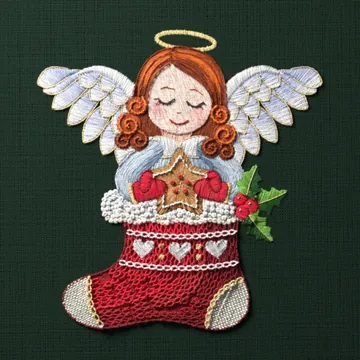
Angel Christmas stocking
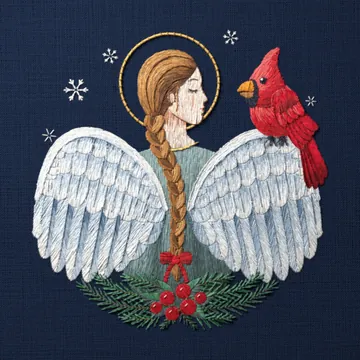
Advanced 3–8 in hoop · 24 colors
Angel with a cardinal on her wing
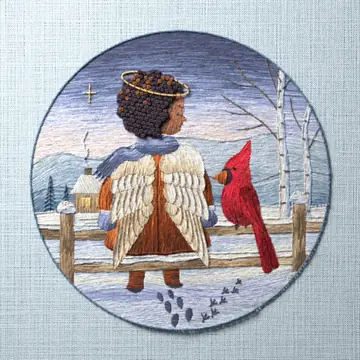
Advanced 3–8 in hoop · 24 colors
Christmas angel with a red cardinal
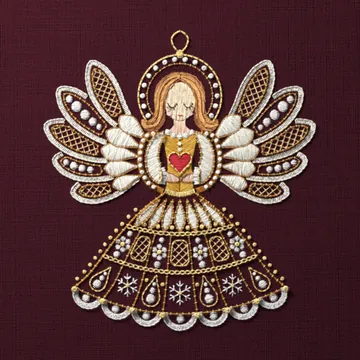
Advanced 3–8 in hoop · 15 colors
Filigree angel lace ornament
New to hand embroidery? Starting hand embroidery, step by step