Claw hammer Renaissance bookmark hand embroidery pattern
Advanced · 14 colors · 1.7 × 4.6 in · 8 kinds of stitch
Download free PDFPDFPrints on US Letter and A4You may sell what you make from it by hand, in small quantities. The PDF itself is not to be sold or shared. Selling, classes and kits: the rules
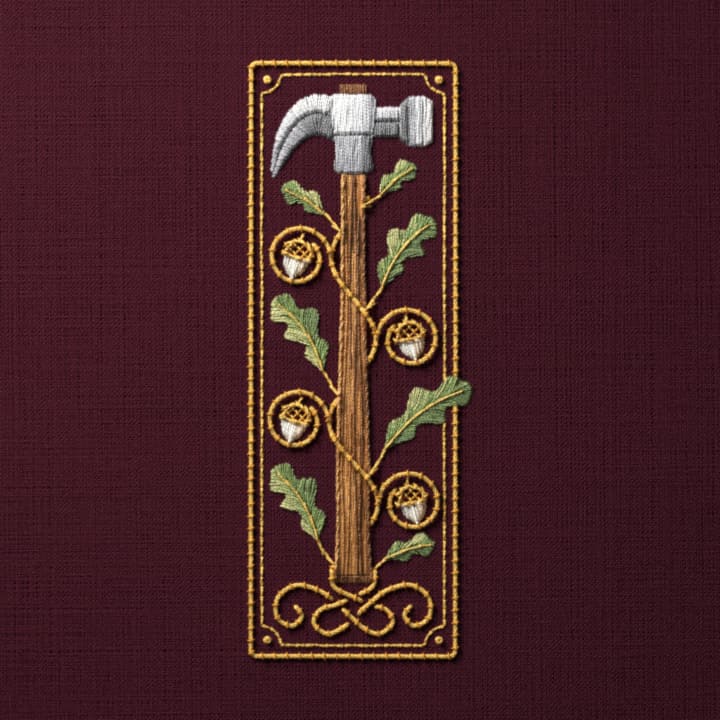
A carpenter’s claw hammer stands in a tall panel with a gold border on all four sides. An oak vine rises from a knotted root, winds up the handle and holds an ivory acorn in each of its four scrolls.
Size and details
Advanced. Uses couching, padded satin stitch, trellis stitch, long and short stitch, 14 colors and a little satin stitch; from a 6 inch hoop up the satin stitches are long.
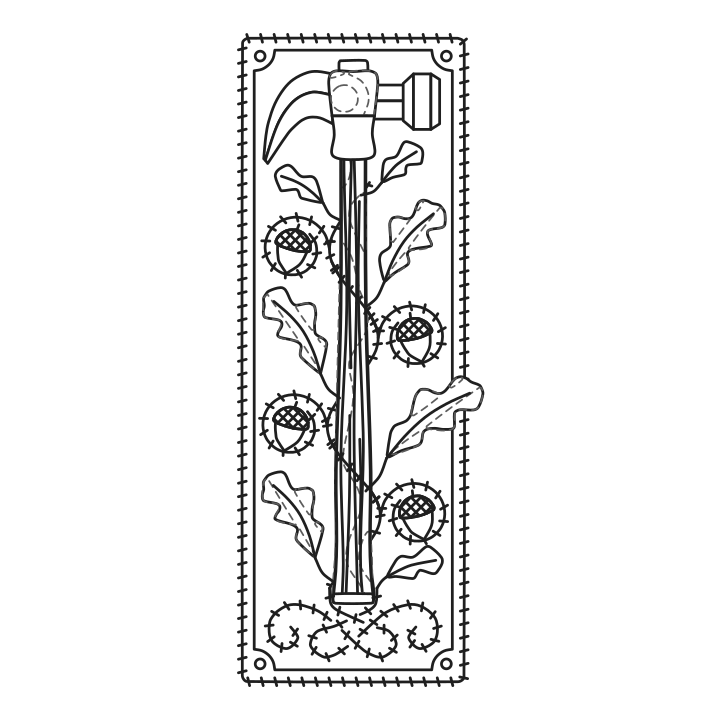
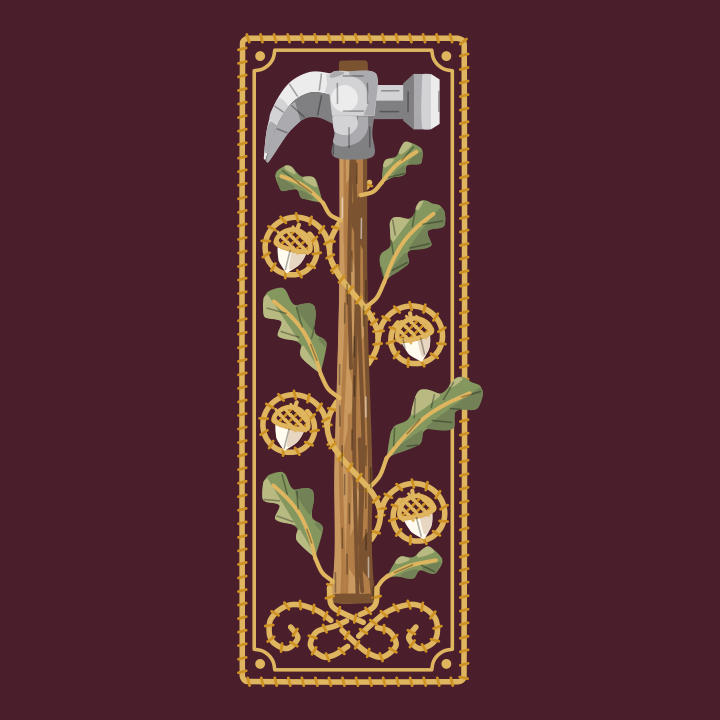
The head is padded satin stitch, the handle long and short stitch with a grain of stem stitch, and the vine, the root and the border are couching. The acorn cups are trellis stitch and the oak leaves long and short stitch. It is drawn for wine red linen. In the picture of where the colors go, the fine lines show which way the stitches lie.
| Hoop | Inches | Centimeters | Satin stitch up to |
|---|---|---|---|
| 3 in (8 cm) | 0.7 × 1.8 in | 1.8 × 4.6 cm | 1/8 in (3 mm) |
| 4 in (10 cm) | 1 × 2.8 in | 2.5 × 7.1 cm | 1/4 in (6 mm) |
| 5 in (13 cm) | 1.4 × 3.7 in | 3.6 × 9.4 cm | 5/16 in (8 mm) |
| 6 in (15 cm) | 1.7 × 4.6 in | 4.3 × 11.7 cm | 3/8 in (10 mm) |
| 8 in (20 cm) | 2.4 × 6.4 in | 6.1 × 16.3 cm | 9/16 in (14 mm) |
- In an 8 inch hoop the widest satin stitch shape is 9/16 in (14 mm) across. Satin stitches longer than about 12 mm (just under 1/2 in) tend to work loose: divide the shape into sections, or work it in long and short stitch.
- In a 3, 4 or 5 inch hoop the French knots are drawn smaller than about 2 mm (a little over 1/16 in). Use one strand of floss for them there, or choose a larger hoop.
What you need
- Fabric
- Plain cotton or linen in wine red, cut 9 in (23 cm) square. On white cloth its palest threads do not show: choose other colors under Options. A pencil line does not show on it: see how to transfer a pattern to dark fabric. The strip is cut out of it when the stitching is done.
- Needle
- Embroidery needle, size 9 for 1 strand, size 7 for 2 or 3, size 3 for 4 to 6 (a lower number is a thicker needle).
- Floss
- 14 colors of six-strand cotton, listed below. DMC is a brand: another brand in a like color will do.
- Marker
- A pen or a sheet that suits the fabric: how to transfer a pattern says which.
As a bookmark. The strip is the size of the design, and it can be printed taller under Options. Stitch it, trim the cloth to the strip with a little to turn in, and cover the back with a second strip or a ribbon of the same width, sewn along both edges. Felt needs no hem: two layers, with blanket stitch round the edge. A ribbon or a tassel goes between the two at one end. How to embroider felt has the two layers and their edge, tassels and cords has what hangs from its end, and the name maker sets a name to stitch on it.
Floss
- 1DMC 3820 Dark StrawBorder, oak vine and knotted root (lighter), border inner line and 6 more parts
- 2DMC 783 Medium TopazAcorn cups, border, oak vine and knotted root (darker)
- 3DMC 712 CreamAcorns (lighter)
- 4DMC 3047 Light Yellow BeigeAcorns (darker)
- 5DMC 433 Medium BrownWood grain and handle (dark), handle wedge
- 6DMC 435 Very Light BrownHandle and wood grain (middle)
- 7DMC 436 TanHandle and wood grain (light)
- 8DMC 762 Very Light Pearl GrayHammer head (lightest)
- 9DMC 318 Light Steel GrayHammer head (dark)
- 10DMC 415 Pearl GrayHammer head (light)
- 11DMC 414 Dark Steel GrayHammer head (darkest)
- 12DMC 3364 Pine GreenOak leaves (middle)
- 13DMC 3363 Medium Pine GreenOak leaves (dark)
- 14DMC 3013 Light Khaki GreenOak leaves (light)
Skeins: one of each color is enough. An estimate for the 6 inch hoop, from the length of each line and the area of each filled shape, with a fifth added for tails.
How to stitch it
- New to hand embroidery? Start here.
- Print at 100%, trace the pattern onto the fabric, and put it in the hoop: inner ring under, drawing up, tight as a drum.
- Floss is six strands. Cut 18 inches (45 cm), pull out the number given one at a time, and lay them together.
- Inside a filled shape start with two or three tiny stitches, which the filling covers. Start a line with a small knot on the back. End each thread by running the needle under the backs of a few stitches.
- Each small ring is one French knot. A fine broken line inside a shape is where two shades meet: trace it, do not stitch it.
- A number under “Where colors go” is a color of the list. The fine lines on the colors show which way the stitches lie.
Stitch in this order
Filled parts from the back of the picture forward, then lines and knots. Where a stitch page names another number of strands, use the number here.
- Padded satin stitch 2 strandsAcorns, hammer head
- Trellis stitch 1 strandAcorn cups
- Satin stitch 2 strandsHandle wedge, handle
- Long and short stitch2 strands: handle1 strand: oak leaves
- Couching 6 strandsBorder, oak vine, knotted root
- Back stitch 2 strandsBorder inner line
- Stem stitch2 strands: acorn cup edges, acorn stalks, leaf stalks1 or 2 strands: wood grain1 strand: leaf veins
- French knot 2 strands, two wrapsCorner knots
When it is done, take off any lines that still show.
More patterns like this
Advanced 3–8 in hoop · 8 colors
Renaissance bookmark in the Polish style
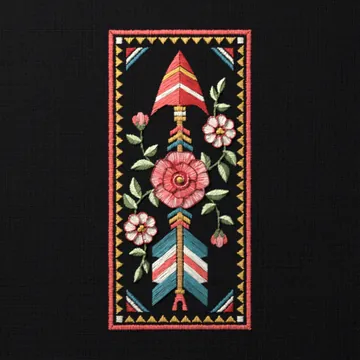
Advanced 3–8 in hoop · 14 colors
Floral tribal arrow bookmark
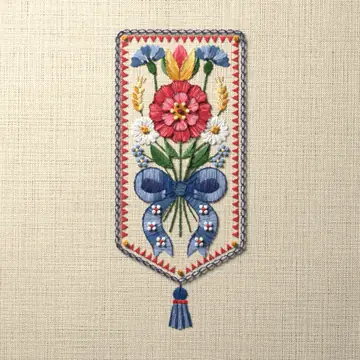
Advanced 3–8 in hoop · 15 colors
Vintage Czech style ribbon bookmark
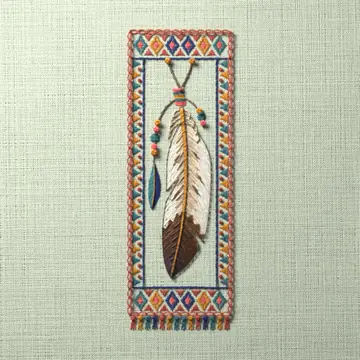
Advanced 3–8 in hoop · 13 colors
Eagle feather bookmark
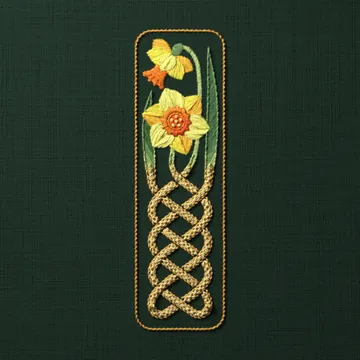
Advanced 3–8 in hoop · 13 colors
Welsh Celtic knot daffodil bookmark
Advanced 3–8 in hoop · 13 colors
Boy reading bookmark, tower of books
Advanced prints 3–14 in · 19 colors
Wren on a wrench
Advanced 3–8 in hoop · 19 colors
Elf with a saw in the snow
New to hand embroidery? Starting hand embroidery, step by step