Covered wagon pioneer belt loop hand embroidery pattern
Advanced · 24 colors · 7 kinds of stitch
Download free PDFPDF, US Letter · 54 KBFor your own stitching, gifts and handmade pieces you sell. Do not resell or share this PDF or copies of it. Selling, classes and kits: the rules
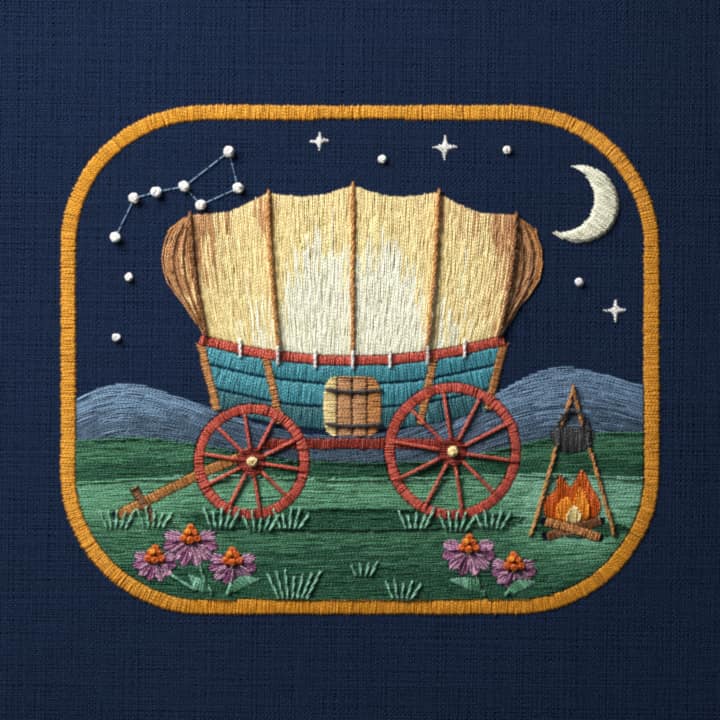
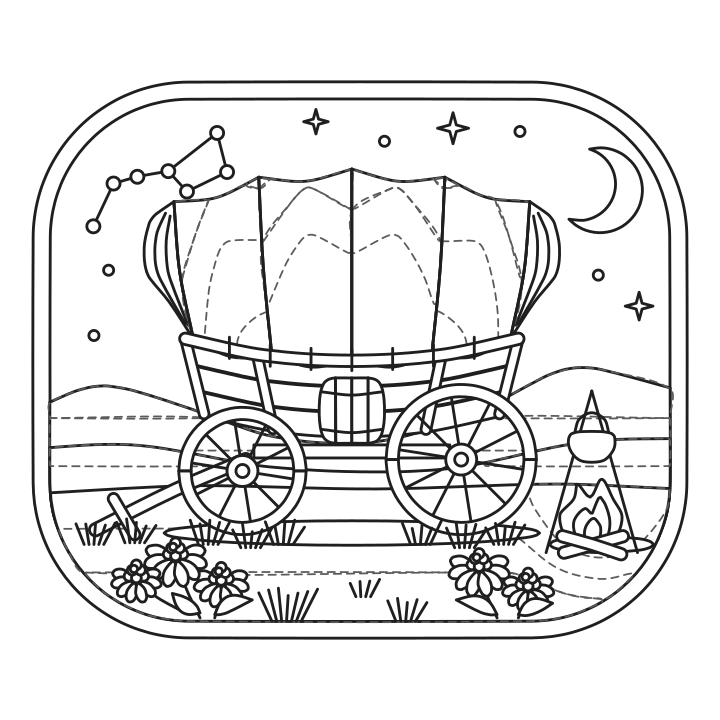
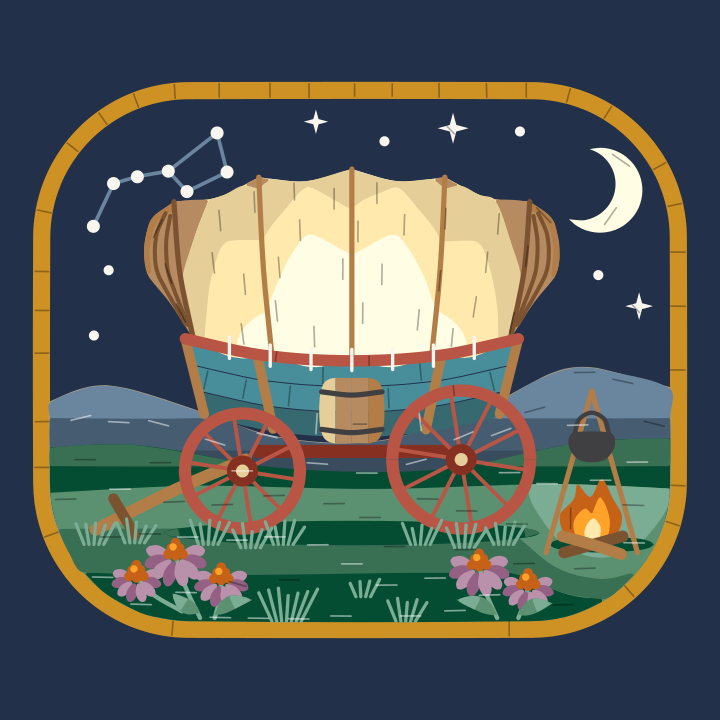
A prairie wagon stands for the night with its tongue in the grass and a lantern’s glow showing through the canvas. The canvas, hills and meadow are long and short stitch, and the wagon box, wheel rims, barrel, campfire and coneflower petals are satin stitch. The bows over the canvas and the kettle tripod are stem stitch, and the spokes and grass are straight stitch. The moon is padded satin stitch, the stars of the Big Dipper are French knots joined by back stitch, and a satin stitch border closes the patch on all sides. It is drawn for navy linen. In the picture of where the colors go, the fine lines show which way the stitches lie.
Size and details
Advanced. Uses long and short stitch over much of the design, dozens of French knots, 24 colors and a great deal of stitching.
24 colors of floss and 7 kinds of stitch:
- Satin stitch
- Back stitch
- French knot
- Padded satin stitch
- Long and short stitch
- Stem stitch
- Straight stitch
- Which stitch goes where
| Hoop | Inches | Centimeters | Satin stitch up to |
|---|---|---|---|
| 3 in (8 cm) | 1.8 × 1.5 in | 4.6 × 3.8 cm | 1/8 in (3 mm) |
| 4 in (10 cm) | 2.7 × 2.3 in | 6.9 × 5.8 cm | 3/16 in (5 mm) |
| 5 in (13 cm) | 3.6 × 3 in | 9.1 × 7.6 cm | 1/4 in (6 mm) |
| 6 in (15 cm) | 4.5 × 3.8 in | 11.4 × 9.7 cm | 5/16 in (8 mm) |
| 8 in (20 cm) | 6.2 × 5.3 in | 15.7 × 13.5 cm | 7/16 in (11 mm) |
- In a 3, 4 or 5 inch hoop the French knots are drawn smaller than about 2 mm (a little over 1/16 in). Use one strand of floss for them there, or choose a larger hoop.
The pattern is drawn inside a circle about half an inch (1.3 cm) smaller all around than the hoop.
What you need
- 1DMC 783 Medium TopazBorder
- 2DMC 931 Medium Antique BlueFar hills (light), star lines
- 3DMC 3865 Winter WhiteStars, canvas ties and bright stars
- 4DMC 3823 Ultra Pale YellowCanvas cover (lightest), moon
- 5DMC 3750 Very Dark Antique BlueFar hills (dark)
- 6DMC 930 Dark Antique BlueFar hills (middle)
- 7DMC 500 Very Dark Blue GreenNear hills and shadows (darker), meadow (darkest)
- 8DMC 501 Dark Blue GreenMeadow (dark), near hills and shadows (lighter)
- 9DMC 502 Blue GreenMeadow (light), flower leaves (darker)
- 10DMC 503 Medium Blue GreenMeadow (lightest), grass and flower stems, flower leaves (lighter)
- 11DMC 3777 Very Dark Terra CottaRunning gear, wheel hubs (darker)
- 12DMC 435 Very Light BrownBox posts, tongue and kettle tripod, wagon bows (lighter) and 3 more parts
All it stitches
Box posts, tongue and kettle tripod, wagon bows and firewood (lighter), gathered ends (darker), water barrel (dark) - 13DMC 433 Medium BrownGathers and crosspiece, wagon bows and firewood (darker)
- 14DMC 3810 Dark TurquoiseWagon box (lighter)
- 15DMC 3808 Ultra Very Dark TurquoiseWagon box (darker)
- 16DMC 3828 Hazelnut BrownGathered ends (lighter), canvas cover (darkest), water barrel (middle)
- 17DMC 745 Light Pale YellowCanvas cover and campfire (light)
- 18DMC 676 Light Old GoldCanvas cover (dark), water barrel (light), wheel hubs (lighter)
- 19DMC 3830 Terra CottaWheel rims, wheel spokes and box rail
- 20DMC 3799 Very Dark Pewter GrayKettle, barrel hoops and kettle handle
- 21DMC 921 CopperCampfire (dark), flower cones (darker)
- 22DMC 741 Medium TangerineCampfire (middle), flower cones (lighter)
- 23DMC 3836 Light GrapeConeflowers (lighter)
- 24DMC 3835 Medium GrapeConeflowers (darker)
Skeins: 7 for border; one of each other color. An estimate for the 8 inch hoop, from the length of each line and the area of each filled shape, with a fifth added for tails.
The floss is six-strand cotton; the stitch guide says how many strands to use. You also need a hoop, an embroidery needle (a size 9 or 10 for one strand, 7 to 9 for two or three, and 3 to 5 for four or more) and plain cotton or linen fabric, in navy, the color it is drawn for. A pencil line does not show on it: see how to transfer a pattern to dark fabric. To frame the piece in its hoop, cut a square 3 inches (8 cm) wider than the hoop: a 9 inch (23 cm) square for a 6 inch hoop.
When it is stitched, how to finish a hoop shows how to back it for the wall.
Stitch guide
- Put the pattern on the fabric (how to transfer a pattern) and the fabric in the hoop.
- Stitch the filled parts first, what lies behind before what lies in front of it.
- Then stitch the lines: stems, veins and outlines over the edges of the filled parts.
- Keep the knots for the end, so that the hoop and your hand do not flatten them.
Inside a filled shape start with two or three tiny stitches, which the filling covers: a knot shows as a bump. A line may start with a small knot on the back or one of the knotless starts. End each thread by running the needle under the backs of a few stitches. (Starting and ending a thread shows how.) Use the strands this list gives, and begin as it says, also where a page about a stitch names another number or begins with a knot.
- Satin stitch 2 strandsBorder, bright stars, running gear, tongue, crosspiece, wagon box, box posts, box rail, water barrel, wheel rims, wheel hubs, campfire, kettle, firewood, coneflowers, flower leaves
- Back stitch 1 strandStar lines
- French knot 1 to 2 strands, two wraps2 strands: stars, wheel hubs1 or 2 strands: flower cones
- Padded satin stitch 2 strandsMoon
- Long and short stitch 1 strandFar hills, near hills, meadow, shadows, gathered ends, canvas cover
- Stem stitch 1 to 3 strands3 strands: wagon bows, barrel hoops, kettle tripod2 strands: kettle handle, flower stems1 strand: gathers
- Straight stitch 2 to 4 strands4 strands: wheel spokes3 strands: canvas ties2 strands: grass
Getting it onto your fabric
The PDF holds the pattern twice at actual size: once as drawn, and once mirrored for an iron-on transfer pen. Print it at 100% with scaling off and check the one-inch square (25.4 mm) with a ruler before you trace. How to transfer a pattern explains tracing, carbon paper, the sticky wash-away sheet for knits, denim and dark cloth, and the other ways. The files are under Downloads.
Downloads
- Download free PDF PDF, US Letter, 3 pages, for a 6 inch (15 cm) hoop
- Download free PDF, A4 PDF, A4, 3 pages, for a 6 inch (15 cm) hoop
More patterns like this
Advanced prints 3–14 in · 24 colors
Covered wagon on the prairie
Advanced prints 3–14 in · 24 colors
Wagon wheel with roses
Advanced prints 3–14 in · 24 colors
Santa belt Christmas countdown
Advanced 3–8 in hoop · 22 colors
Jewel beetle and moth bug belt
Advanced 3–8 in hoop · 18 colors
Tied black belt with plum blossom
Advanced 3–8 in hoop · 18 colors
Martial arts kicks, white to black belt
Advanced 3–8 in hoop · 14 colors
Lotus waist belt for a saree
Advanced 3–8 in hoop · 23 colors
Horseshoe with a star
New to hand embroidery? Starting hand embroidery, step by step