Ducks on a green tractor hand embroidery pattern
Advanced · 22 colors · 7 kinds of stitch
Download free PDFPDF, US Letter · 85 KBFor your own stitching, gifts and handmade pieces you sell. Do not resell or share this PDF. What you may do, in full
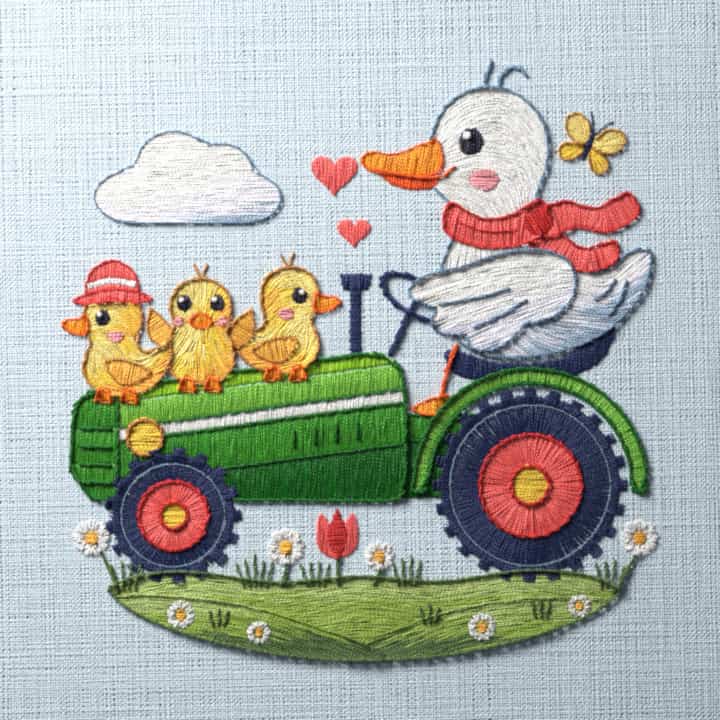
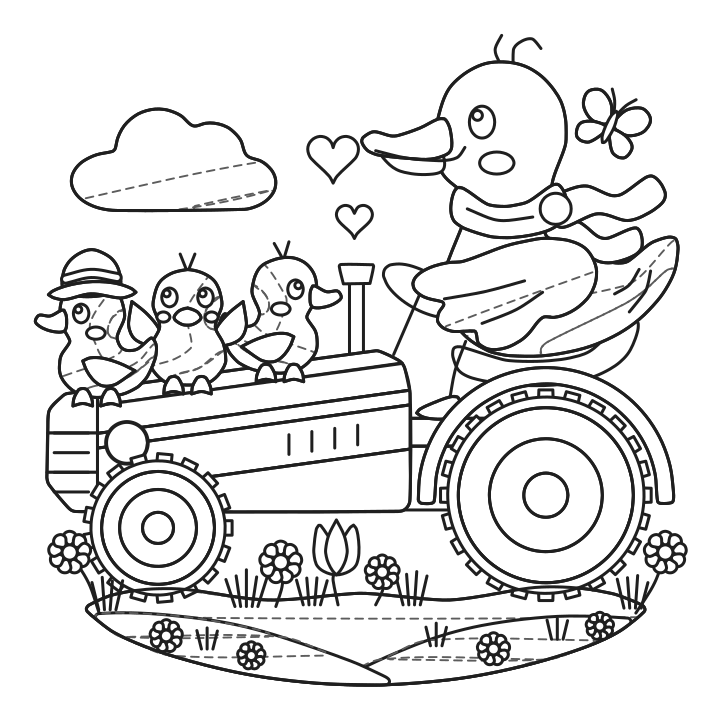
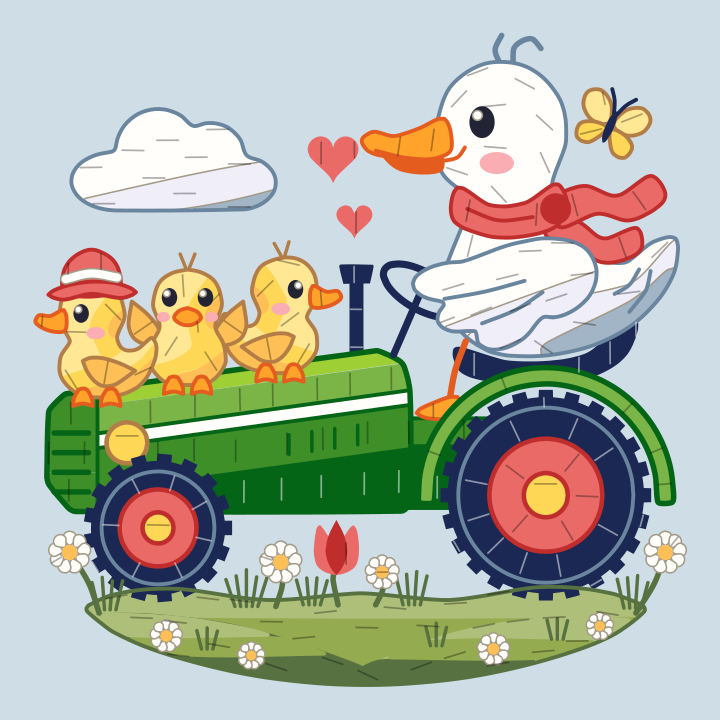
A white mother duck in a coral scarf sits at the wheel of a green tractor, and three yellow ducklings ride on the hood: one in a sun hat, one facing us with both wings up, and one looking back at her. The ducks, the cloud and the grass bank are long and short stitch; the tractor panels, tires, hubs, scarf, daisies and tulip are satin stitch. Stem stitch edges the tractor and draws the steering wheel, and split stitch edges the ducks and the scarf. The lights in the eyes are French knots, the grass blades are straight stitch and the butterfly’s feelers are back stitch. It is drawn for pale blue linen. In the picture of where the colors go, the fine lines show which way the stitches lie.
Size and details
Advanced. Uses long and short stitch over much of the design, satin stitch over about a quarter of the cloth in a 6 inch hoop, 22 colors and a great deal of stitching; from a 6 inch hoop up some of the satin stitches are long.
22 colors of floss and 7 kinds of stitch:
- Long and short stitch
- Split stitch
- Satin stitch
- Back stitch
- Straight stitch
- Stem stitch
- French knot
- Which stitch goes where
| Hoop | Inches | Centimeters | Satin stitch up to |
|---|---|---|---|
| 3 in (8 cm) | 1.7 × 1.7 in | 4.3 × 4.3 cm | 3/16 in (5 mm) |
| 4 in (10 cm) | 2.5 × 2.5 in | 6.4 × 6.4 cm | 1/4 in (6 mm) |
| 5 in (13 cm) | 3.4 × 3.4 in | 8.6 × 8.6 cm | 5/16 in (8 mm) |
| 6 in (15 cm) | 4.2 × 4.2 in | 10.7 × 10.7 cm | 7/16 in (11 mm) |
| 8 in (20 cm) | 5.9 × 5.9 in | 15 × 15 cm | 9/16 in (14 mm) |
- In an 8 inch hoop the widest satin stitch shape is 9/16 in (14 mm) across. Satin stitches longer than about 12 mm (just under 1/2 in) tend to work loose: divide the shape into sections, or work it in long and short stitch.
- In a 3, 4 or 5 inch hoop the French knots are drawn smaller than about 2 mm (a little over 1/16 in). Use one strand of floss for them there, or choose a larger hoop.
The pattern is drawn inside a circle about half an inch (1.3 cm) smaller all around than the hoop.
What you need
- DMC BLANC WhiteMother duck and cloud (light), wing (lighter), daisies, stripe, hat band and eye lights
- DMC 932 Light Antique BlueMother duck and cloud (dark)
- DMC 27 White VioletMother duck and cloud (middle), wing (darker)
- DMC 931 Medium Antique BlueDuck edges, tire lines, cloud edge, wing feathers, head feathers and tail feathers
- DMC 351 CoralHubs, sun hat and hearts, scarf and tulips (lighter)
- DMC 744 Pale YellowDucklings (light), butterfly wings (lighter)
- DMC 435 Very Light BrownDuckling edges, butterfly edges, lamp edge and tufts
- DMC 726 Light TopazDucklings (middle), hub caps and lamp, butterfly wings (darker)
- DMC 939 Very Dark Navy BlueTires, tire lugs, seat, exhaust, steering wheel, butterfly feelers and butterfly body
- DMC 699 GreenChassis, tractor edges, grille and vents
- DMC 701 Light GreenSide panel, nose and step
- DMC 704 Bright ChartreuseHood (lighter)
- DMC 703 ChartreuseHood (darker), fender
- DMC 720 Dark Orange SpiceBill edges, smile and mother duck leg, bills (darker)
- DMC 741 Medium TangerineBills (lighter), feet and mother duck foot
- DMC 310 BlackEyes
- DMC 3326 Light RoseCheeks
- DMC 347 Very Dark SalmonScarf edge and hub edges, tulips and scarf (darker)
- DMC 742 Light TangerineDuckling wings and daisy hearts, ducklings (dark)
- DMC 470 Light Avocado GreenGrass bank (middle)
- DMC 471 Very Light Avocado GreenGrass bank (light)
- DMC 987 Dark Forest GreenGrass bank (dark), bank edge, grass and flower stems
Skeins: 2 for tires, tire lugs, seat, exhaust, steering wheel, butterfly feelers and butterfly body; one of each other color. An estimate for the largest size, the 8 inch hoop: the length of each line and the area of each filled shape, a fifth added for tails and ends, a tenth of every 8 m (8.7 yd) skein kept spare.
The floss is six-strand cotton; the stitch guide says how many strands to use. You also need a hoop, an embroidery needle (a size 7 to 9 suits two or three strands) and plain cotton or linen fabric. To frame the piece in its hoop, cut a square 3 inches (8 cm) wider than the hoop: a 9 inch (23 cm) square for a 6 inch hoop.
When it is stitched, how to finish a hoop shows how to back it for the wall.
Stitch guide
- Put the pattern on the fabric (how to transfer a pattern) and the fabric in the hoop.
- Stitch the filled parts first, what lies behind before what lies in front of it.
- Then stitch the lines: stems, veins and outlines over the edges of the filled parts.
- Keep the knots for the end, so that the hoop and your hand do not flatten them.
Start each thread with a small knot on the back or one of the knotless starts, and end it by running the needle under the backs of a few stitches (starting and ending a thread). Use the strands this list gives, also where a page about a stitch names another number.
- Long and short stitch 1 strandCloud, mother duck, wing, ducklings, grass bank
- Split stitch 1 to 2 strandsCloud edge, butterfly edges, tractor edges, duck edges, bill edges, tail feathers, smile, scarf edge, wing feathers, duckling edges, and 2 more
- Satin stitch 2 strandsHearts, butterfly wings, butterfly body, exhaust, chassis, step, hood, stripe, side panel, nose, lamp, seat, mother duck foot, bills, eyes, and 14 more
- Back stitch 1 strandButterfly feelers
- Straight stitch 2 to 3 strandsVents, tufts, grass
- Stem stitch 2 to 5 strandsGrille, tractor edges, lamp edge, head feathers, mother duck leg, steering wheel, hub edges, flower stems
- French knot 1 strand, two wrapsEye lights
Getting it onto your fabric
The PDF holds the pattern twice at actual size: once as drawn, and once mirrored for an iron-on transfer pen. Print it at 100% with scaling off and check the one-inch square (25.4 mm) with a ruler before you trace. How to transfer a pattern explains tracing, carbon paper and the other ways. The files are under Downloads.
Downloads
- Download free PDF PDF, US Letter, 3 pages, for a 6 inch (15 cm) hoop
- Download free PDF, A4 PDF, A4, 3 pages, for a 6 inch (15 cm) hoop
More patterns like this
Advanced 3–8 in hoop · 16 colors
Duck driving a tractor with ducklings
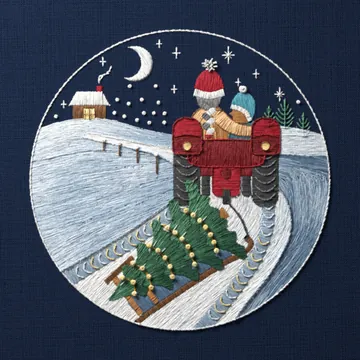
Advanced 3–8 in hoop · 21 colors
Christmas tractor in the snow
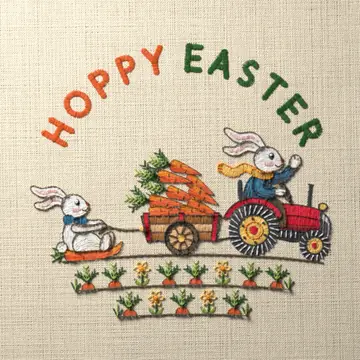
Advanced 3–8 in hoop · 19 colors
Hoppy Easter
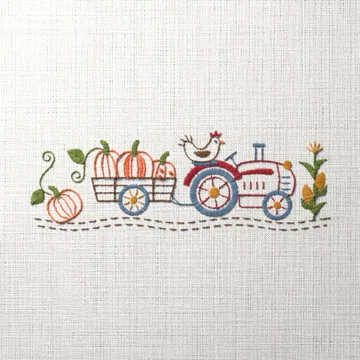
Easy 3–8 in hoop · 6 colors
Tractor outline with pumpkins border
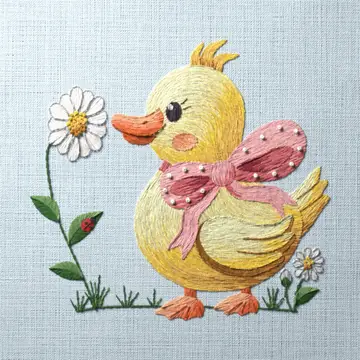
Advanced 3–8 in hoop · 22 colors
Vintage duckling with a bow and daisy
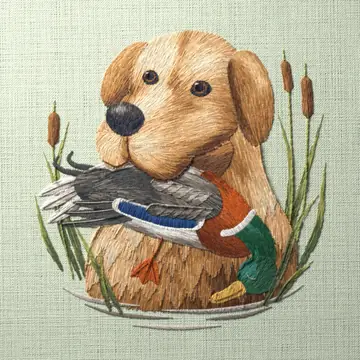
Advanced 3–8 in hoop · 22 colors
Hunting Labrador with a duck
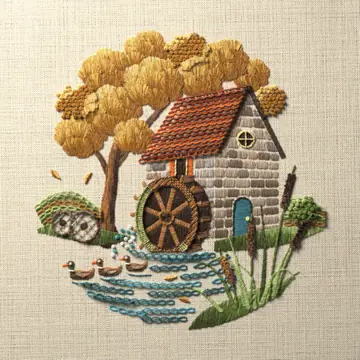
Advanced 3–8 in hoop · 21 colors
Seventies water mill and mill pond
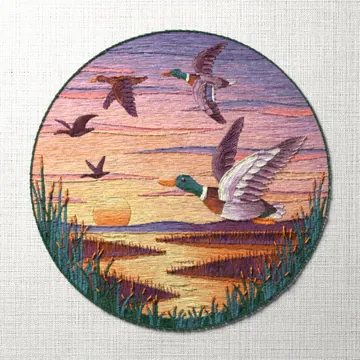
Advanced 3–8 in hoop · 24 colors
Flying ducks over the marsh at sunset
New to hand embroidery? Starting hand embroidery, step by step