Fairy ring with dancing fairies hand embroidery pattern
Advanced · 24 colors · 9 kinds of stitch
Download free PDFPDF, US Letter · 137 KBFor your own stitching, gifts and handmade pieces you sell. Do not resell or share this PDF. What you may do, in full
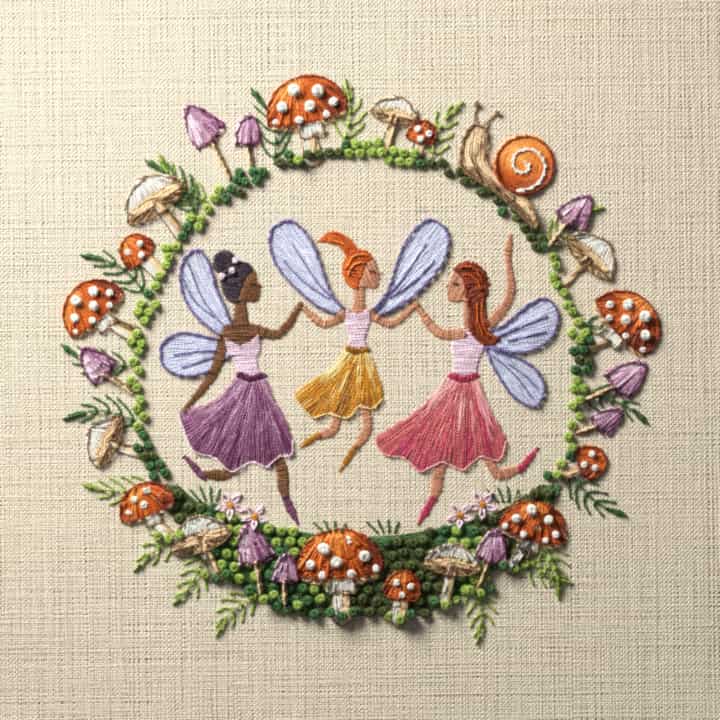
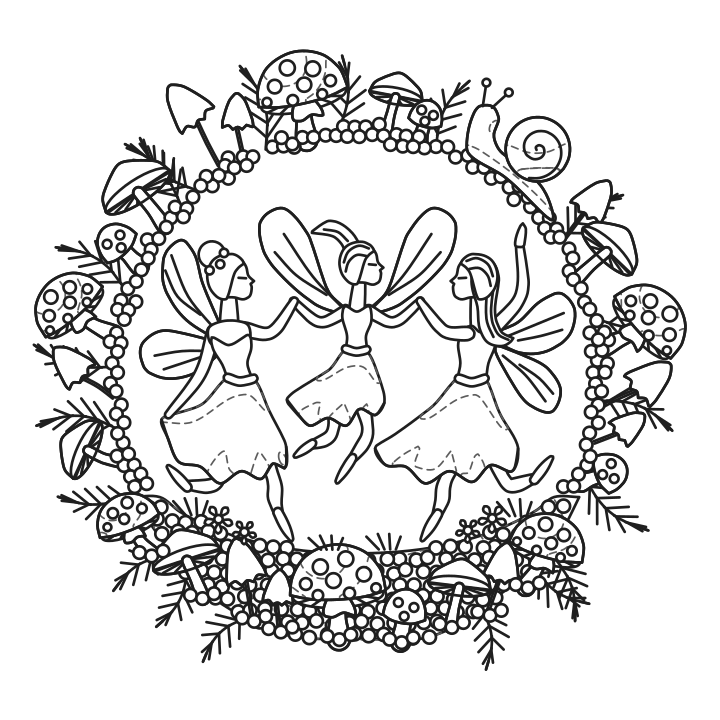
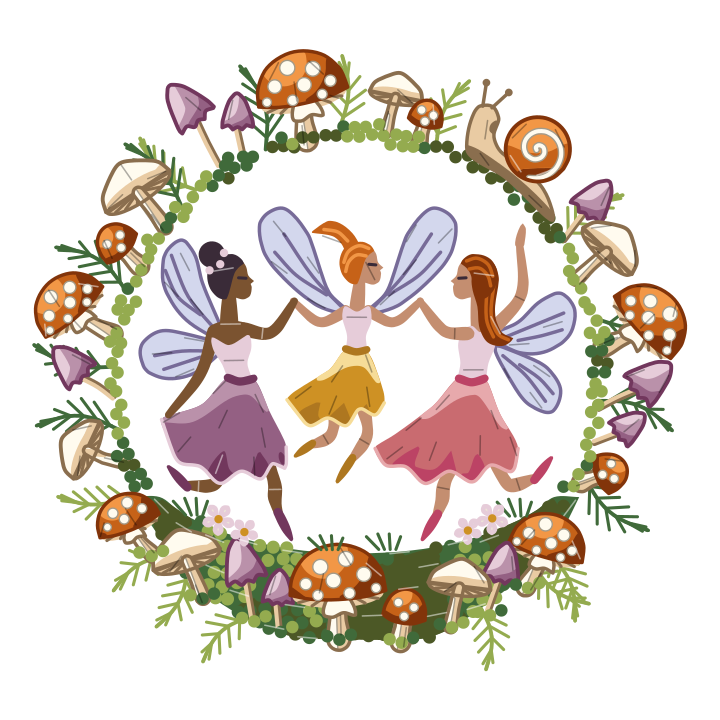
Three fairies dance hand in hand on a bank of moss, their violet, gold and rose skirts swinging the same way. Round them runs a closed ring of French knots set with toadstools and ferns, and a snail walks along the top. The caps, skirts and wings are long and short stitch, the faces, arms and bodices are satin stitch, and the ferns are fly stitch. The wing edges and skirt hems are split stitch, and the little violets are lazy daisy stitch. In the picture of where the colors go, the fine lines show which way the stitches lie.
Size and details
Advanced. Uses long and short stitch over much of the design, more than a hundred French knots, 24 colors and a great deal of stitching.
24 colors of floss and 9 kinds of stitch:
- Fly stitch
- Stem stitch
- Long and short stitch
- Split stitch
- Satin stitch
- Straight stitch
- French knot
- Back stitch
- Lazy daisy stitch
- Which stitch goes where
| Hoop | Inches | Centimeters | Satin stitch up to |
|---|---|---|---|
| 3 in (8 cm) | 1.9 × 1.8 in | 4.8 × 4.6 cm | 1/8 in (3 mm) |
| 4 in (10 cm) | 2.8 × 2.7 in | 7.1 × 6.9 cm | 3/16 in (5 mm) |
| 5 in (13 cm) | 3.8 × 3.6 in | 9.7 × 9.1 cm | 1/4 in (6 mm) |
| 6 in (15 cm) | 4.7 × 4.5 in | 11.9 × 11.4 cm | 5/16 in (8 mm) |
| 8 in (20 cm) | 6.6 × 6.3 in | 16.8 × 16 cm | 7/16 in (11 mm) |
- In a 3, 4, 5 or 6 inch hoop the French knots and the shortest lazy daisy loops are drawn smaller than about 2 mm (a little over 1/16 in). Use one strand of floss for them there, or choose a larger hoop.
The pattern is drawn inside a circle about half an inch (1.3 cm) smaller all around than the hoop.
What you need
- DMC 3346 Hunter GreenTurf (lighter), ferns (darker), moss ring (middle), grass
- DMC 470 Light Avocado GreenMoss ring (light), ferns (lighter)
- DMC 3862 Dark Mocha BeigeStalk edges, cream cap edges and gill lines and 5 more parts
- DMC 738 Very Light TanGills, stalks (middle), snail (lighter) and 2 more parts
- DMC 3836 Light GrapeLilac caps (middle), skirts (shade 7 of 9)
- DMC 3835 Medium GrapeSkirts (shade 3 of 9), lilac caps (dark)
- DMC 153 Very Light VioletBodices, lilac caps (light), skirt hems (middle) and 2 more parts
- DMC 3834 Dark GrapeLilac cap edges, skirts (shade 1 of 9), slippers and sashes (dark)
- DMC 712 CreamCream caps (lighter), cap spots, stalks (light) and 2 more parts
- DMC 921 CopperRusset caps and snail shell (middle), hair (light), hair lights (darker)
- DMC 918 Dark Red CopperRusset cap edges, russet caps (dark), hair (middle) and 2 more parts
- DMC 3853 Dark Autumn GoldRusset caps and snail shell (light), hair lights (lighter)
- DMC 936 Very Dark Avocado GreenTurf (darker), moss ring (dark)
- DMC 783 Medium TopazSkirts (shade 6 of 9), violets (darker)
- DMC 3747 Very Light Blue VioletWings
- DMC 3746 Dark Blue VioletWing edges and wing veins
- DMC 3064 Desert SandArms, legs, faces and necks (lighter)
- DMC 782 Dark TopazSkirts (shade 4 of 9), slippers and sashes (light)
- DMC 3822 Light StrawSkirts (shade 9 of 9), skirt hems (light)
- DMC 3371 Black BrownHair (dark), eyes
- DMC 433 Medium BrownArms, legs, faces and necks (darker), backs
- DMC 3350 Ultra Dark Dusty RoseSkirts (shade 2 of 9), slippers and sashes (middle)
- DMC 3687 MauveSkirts (shade 5 of 9)
- DMC 3688 Medium MauveSkirts (shade 8 of 9), skirt hems (dark)
Skeins: one of each color is enough. An estimate for the largest size, the 8 inch hoop: the length of each line and the area of each filled shape, a fifth added for tails and ends, a tenth of every 8 m (8.7 yd) skein kept spare.
The floss is six-strand cotton; the stitch guide says how many strands to use. You also need a hoop, an embroidery needle (a size 7 to 9 suits two or three strands) and plain cotton or linen fabric. To frame the piece in its hoop, cut a square 3 inches (8 cm) wider than the hoop: a 9 inch (23 cm) square for a 6 inch hoop.
When it is stitched, how to finish a hoop shows how to back it for the wall.
Stitch guide
- Put the pattern on the fabric (how to transfer a pattern) and the fabric in the hoop.
- Stitch the filled parts first, what lies behind before what lies in front of it.
- Then stitch the lines: stems, veins and outlines over the edges of the filled parts.
- Keep the knots for the end, so that the hoop and your hand do not flatten them.
Start each thread with a small knot on the back or one of the knotless starts, and end it by running the needle under the backs of a few stitches (starting and ending a thread). Use the strands this list gives, also where a page about a stitch names another number.
- Fly stitch 2 strandsFerns
- Stem stitch 1 to 3 strandsFerns, lilac stalks, lilac cap edges, cream cap edges, shell spiral, snail edge
- Long and short stitch 1 to 2 strandsLilac caps, stalks, russet caps, cream caps, turf, snail, snail shell, wings, skirts, hair
- Split stitch 1 to 2 strandsStalk edges, russet cap edges, cream cap edges, snail edge, wing veins, wing edges, skirt hems, hair lights
- Satin stitch 2 strandsGills, stalk collars, legs, slippers, arms, necks, bodices, sashes, faces, hair, backs
- Straight stitch 1 to 2 strandsGill lines, grass, eyes
- French knot 1 to 2 strands, two wrapsCap spots, moss ring, snail horns, violets, hair flowers
- Back stitch 2 strandsSnail horns
- Lazy daisy stitch 2 strandsViolets
Getting it onto your fabric
The PDF holds the pattern twice at actual size: once as drawn, and once mirrored for an iron-on transfer pen. Print it at 100% with scaling off and check the one-inch square (25.4 mm) with a ruler before you trace. How to transfer a pattern explains tracing, carbon paper and the other ways. The files are under Downloads.
Downloads
- Download free PDF PDF, US Letter, 3 pages, for a 6 inch (15 cm) hoop
- Download free PDF, A4 PDF, A4, 3 pages, for a 6 inch (15 cm) hoop
More patterns like this
Advanced 3–8 in hoop · 23 colors
Pixie dust bookmark
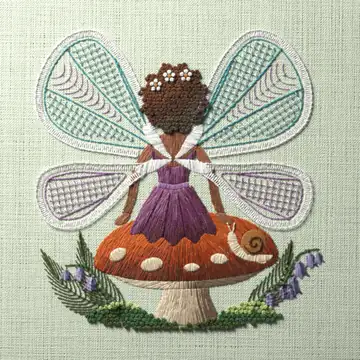
Advanced 3–8 in hoop · 23 colors
Fairy with lace wings on a mushroom
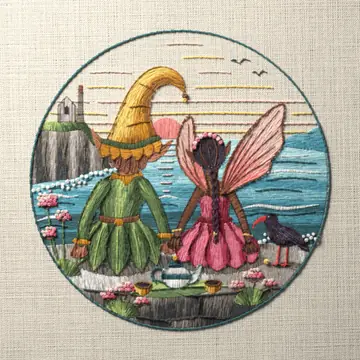
Advanced 3–8 in hoop · 24 colors
Cornish pixie and fairy by the sea
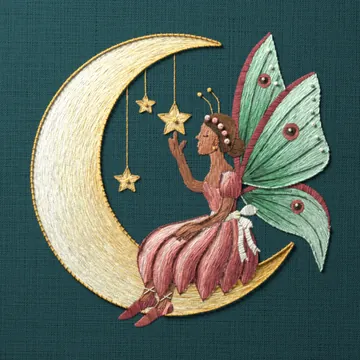
Advanced 3–8 in hoop · 23 colors
Vintage fairy on a crescent moon
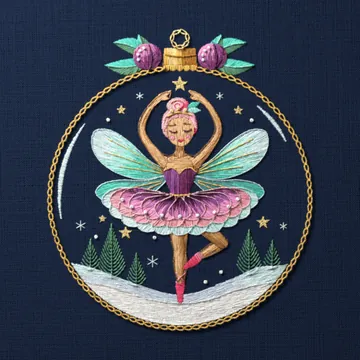
Advanced 3–8 in hoop · 23 colors
Small sugar plum fairy ornament
Advanced 3–8 in hoop · 22 colors
Tooth fairy on the moon
Advanced 3–8 in hoop · 20 colors
Fairy girl riding a moose
Advanced 3–8 in hoop · 19 colors
Flower fairy with raised petals
New to hand embroidery? Starting hand embroidery, step by step