Fat cat on a kitchen scale hand embroidery pattern
Advanced · 15 colors · 6 kinds of stitch
Download free PDFPDF, US Letter · 60 KB
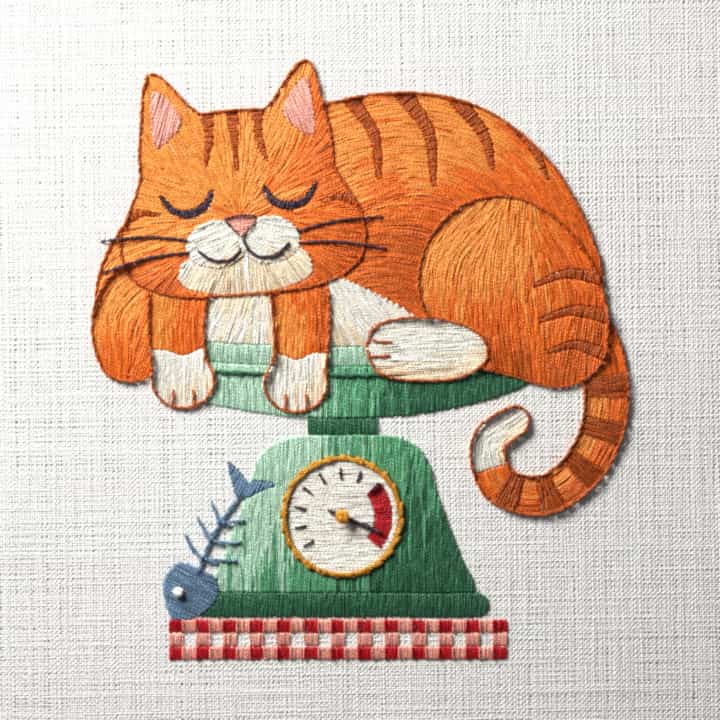
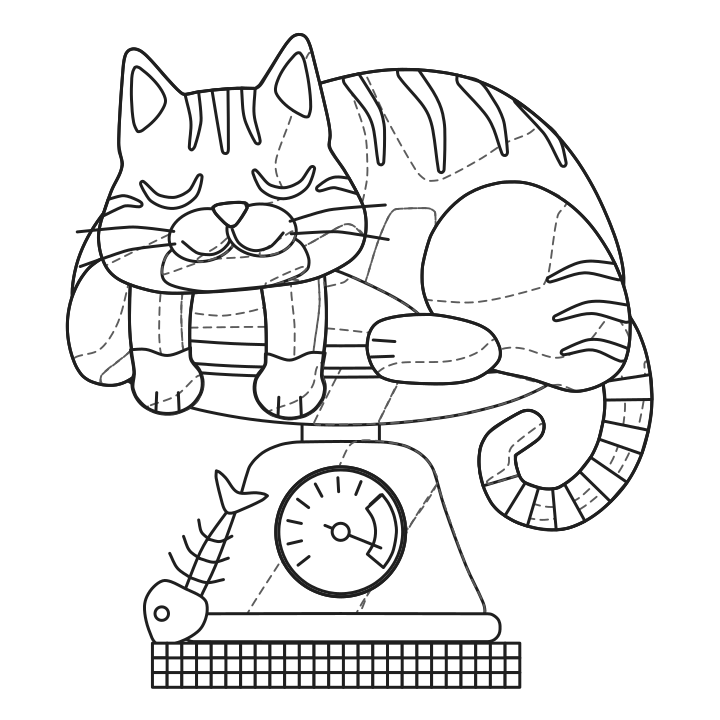
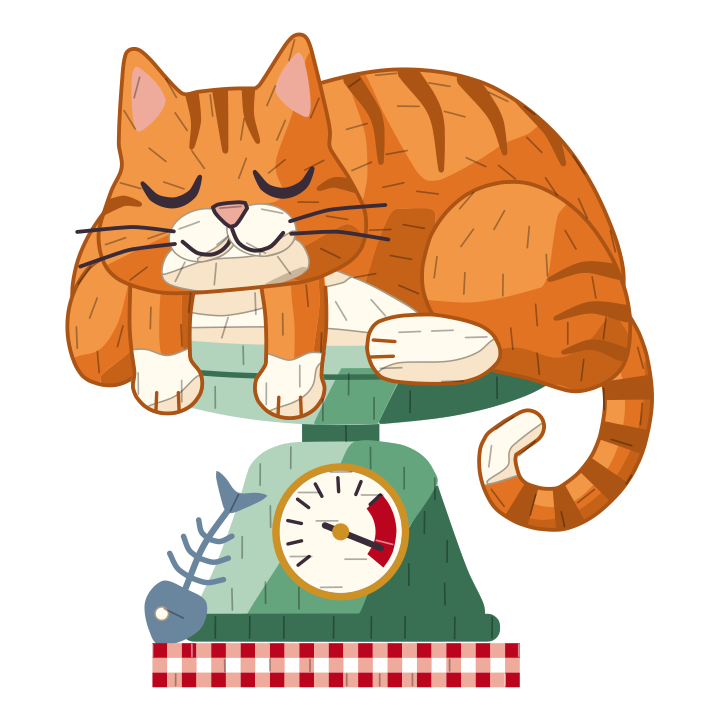
A huge orange tabby has poured itself into the pan of a green kitchen scale. Its front paws and tail hang over the rim, its eyes are shut, the needle has swung into the red and one clean fish bone leans on the scale. The fur, the pan and the body of the scale are long and short stitch; the stripes, eyelids, fish head, rim and gingham squares are satin stitch. Split stitch draws the edges, mouth and whiskers, and stem stitch makes the ring of the dial, the needle and the fish bone. Toes and dial marks are straight stitches. In the picture of where the colors go, the fine lines show which way the stitches lie.
Size and details
Advanced. Uses long and short stitch over much of the design, 15 colors and a great deal of stitching; from a 6 inch hoop up the widest satin stitches are long.
15 colors of floss and 6 kinds of stitch:
- Long and short stitch
- Satin stitch
- Split stitch
- Straight stitch
- Stem stitch
- French knot
- Which stitch goes where
| Hoop | Inches | Centimeters | Satin stitch up to |
|---|---|---|---|
| 3 in (8 cm) | 1.5 × 1.7 in | 3.8 × 4.3 cm | 3/16 in (5 mm) |
| 4 in (10 cm) | 2.3 × 2.6 in | 5.8 × 6.6 cm | 1/4 in (6 mm) |
| 5 in (13 cm) | 3.1 × 3.4 in | 7.9 × 8.6 cm | 5/16 in (8 mm) |
| 6 in (15 cm) | 3.8 × 4.3 in | 9.7 × 10.9 cm | 7/16 in (11 mm) |
| 8 in (20 cm) | 5.4 × 6 in | 13.7 × 15.2 cm | 9/16 in (14 mm) |
- In an 8 inch hoop the widest satin stitch shape is 9/16 in (14 mm) across. Satin stitches longer than about 12 mm (just under 1/2 in) tend to work loose: divide the shape into sections, or work it in long and short stitch.
- In a 3, 4 or 5 inch hoop the French knots are drawn smaller than about 2 mm (a little over 1/16 in). Use one strand of floss for them there, or choose a larger hoop.
The pattern is drawn inside a circle about half an inch (1.3 cm) smaller all around than the hoop.
What you need
- DMC 922 Light CopperBody, haunch, tail, head, front legs and flank (middle)
- DMC 921 CopperBody, haunch, head, tail, front legs and flank (dark)
- DMC 3853 Dark Autumn GoldBody, head, front legs, haunch, flank and tail (light)
- DMC 920 Medium CopperFur edge, stripes, paw edge and toes
- DMC 712 CreamBelly, hind paw, paws, muzzle and tail tip (lighter), dial and fish eye, chin (light)
- DMC 739 Ultra Very Light TanBelly, hind paw, paws, tail tip and muzzle (darker), chin (middle)
- DMC 501 Dark Blue GreenPan and scale body (dark), scale foot, neck and pan line
- DMC 3813 Light Blue GreenPan and scale body (light), pan rim
- DMC 3816 Celadon GreenScale body and pan (middle)
- DMC 817 Very Dark Coral RedGingham (darker), red zone
- DMC 3371 Black BrownWhiskers, eyes, mouth and dial marks, needle (darker)
- DMC 783 Medium TopazDial ring, needle (lighter)
- DMC 3864 Light Mocha BeigeChin (dark)
- DMC 758 Very Light Terra CottaGingham (lighter), inner ears and nose
- DMC 931 Medium Antique BlueFish head, fish bone and fish tail
The floss is six-strand cotton; the stitch guide says how many strands to use. You also need a hoop, an embroidery needle (a size 7 to 9 suits two or three strands) and plain cotton or linen fabric. To frame the piece in its hoop, cut a square 3 inches (8 cm) wider than the hoop: a 9 inch (23 cm) square for a 6 inch hoop.
Stitch guide
- Long and short stitch 2 strandsTail, tail tip, scale body, dial, pan, body, belly, flank, haunch, hind paw, front legs, paws, head, chin, muzzle
- Satin stitch 2 strandsStripes, neck, scale foot, red zone, pan rim, inner ears, eyes, nose, fish tail, fish head, gingham
- Split stitch 1 to 3 strandsFur edge, paw edge, mouth, whiskers
- Straight stitch 2 strandsDial marks, toes
- Stem stitch 3 to 5 strandsDial ring, needle, pan line, fish bone
- French knot 2 strands, two wrapsNeedle, fish eye
Getting it onto your fabric
The PDF holds the pattern twice at actual size: once as drawn, and once mirrored for an iron-on transfer pen. Print it at 100% with scaling off and check the one-inch square (25.4 mm) with a ruler before you trace. How to transfer a pattern explains tracing, carbon paper and the other ways. The files are under Downloads.
Downloads
- Download free PDF PDF, US Letter, 3 pages, for a 6 inch (15 cm) hoop
- Download free PDF, A4 PDF, A4, 3 pages, for a 6 inch (15 cm) hoop
For your own stitching, gifts and handmade pieces you sell. Do not resell or share this PDF.
The same subject in other styles
More patterns like this
New to hand embroidery? Starting hand embroidery, step by step