Flying pig with angel wings hand embroidery pattern
Advanced · 17 colors · 7 kinds of stitch
Download free PDFPDF, US Letter · 97 KBFor your own stitching, gifts and handmade pieces you sell. Do not resell or share this PDF. What you may do, in full
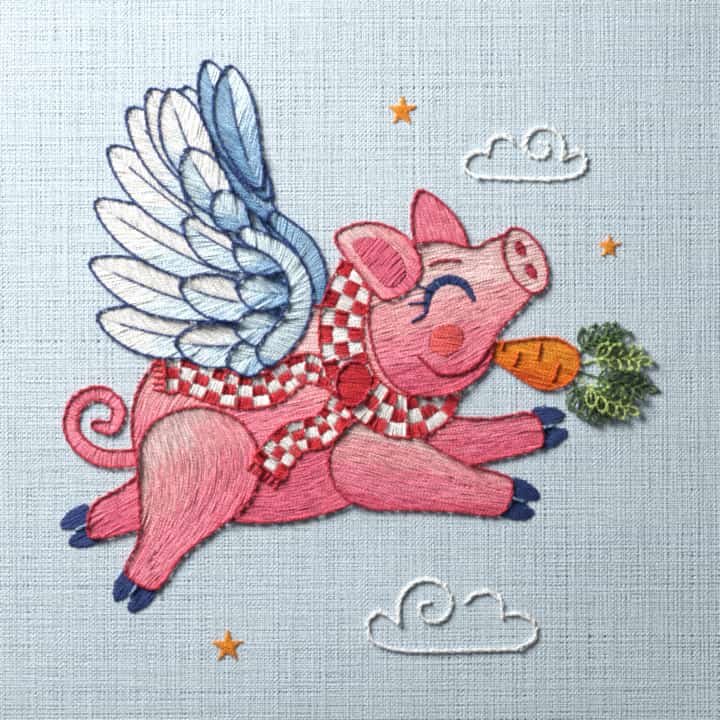
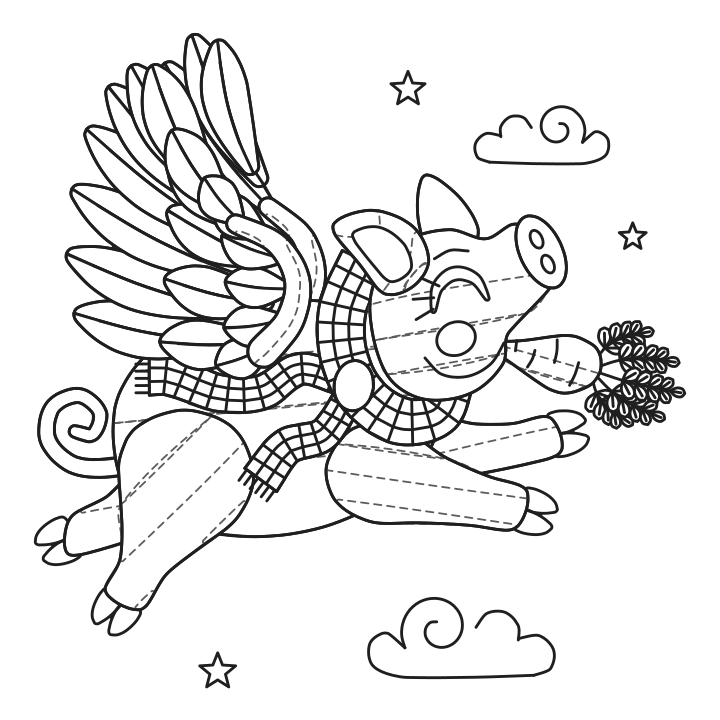
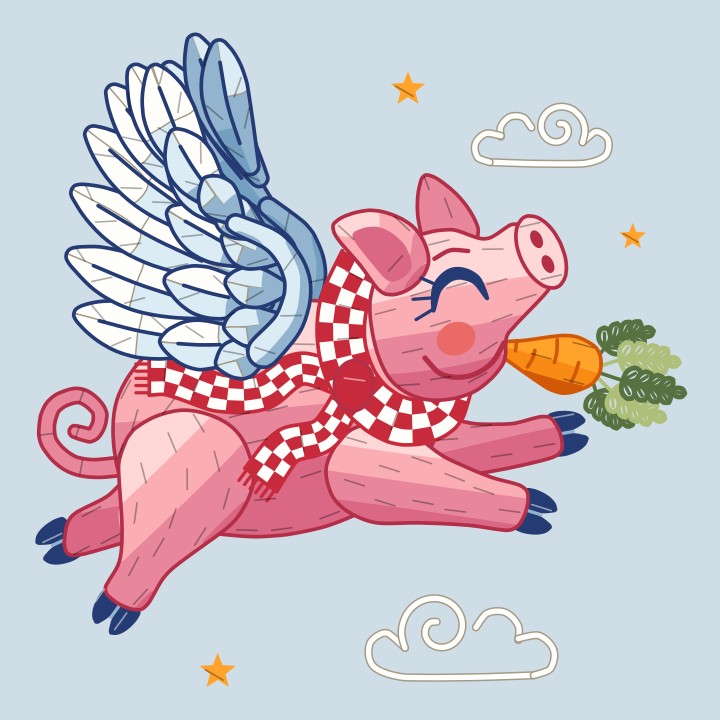
A plump pink pig flies to the right, nose up, legs stretched and eye shut in a smile, with a carrot in its mouth. The body, the carrot and the wing feathers are long and short stitch, shaded from light to dark, with split stitch edges. The scarf checks, snout, hooves, inner ear, curly tail and small stars are satin stitch, and the scarf is edged in back stitch. The carrot greens are lazy daisy stitches along split stitch stalks, lashes and scarf fringe are straight stitch, and two open cloud curls are stem stitch. It is drawn for pale blue linen. In the picture of where the colors go, the fine lines show which way the stitches lie.
Size and details
Advanced. Uses long and short stitch over much of the design, 17 colors and a great deal of stitching.
17 colors of floss and 7 kinds of stitch:
- Satin stitch
- Long and short stitch
- Split stitch
- Straight stitch
- Lazy daisy stitch
- Back stitch
- Stem stitch
- Which stitch goes where
| Hoop | Inches | Centimeters | Satin stitch up to |
|---|---|---|---|
| 3 in (8 cm) | 1.8 × 1.8 in | 4.6 × 4.6 cm | 1/8 in (3 mm) |
| 4 in (10 cm) | 2.7 × 2.7 in | 6.9 × 6.9 cm | 3/16 in (5 mm) |
| 5 in (13 cm) | 3.5 × 3.5 in | 8.9 × 8.9 cm | 1/4 in (6 mm) |
| 6 in (15 cm) | 4.4 × 4.4 in | 11.2 × 11.2 cm | 5/16 in (8 mm) |
| 8 in (20 cm) | 6.2 × 6.2 in | 15.7 × 15.7 cm | 7/16 in (11 mm) |
- In a 3 or 4 inch hoop the shortest lazy daisy loops are drawn smaller than about 2 mm (a little over 1/16 in). Use one strand of floss for them there, or choose a larger hoop.
The pattern is drawn inside a circle about half an inch (1.3 cm) smaller all around than the hoop.
What you need
- DMC 334 Medium Baby BlueFar wing (dark)
- DMC 3755 Baby BlueFar wing (middle), wing base, shoulder feathers (darker) and 4 more parts
- DMC 162 Ultra Very Light BlueLong feathers and middle feathers (middle) and 3 more parts
- DMC 336 Navy BlueLong feathers edge, hooves, far wing edge and feather shafts and 5 more parts
- DMC 3731 Very Dark Dusty RoseBody, head, near legs and ears (darkest), far legs (darker), inner ear
- DMC 3733 Dusty RoseNear legs, body, head and ears (dark), far legs (lighter), tail
- DMC 3831 Dark RaspberryOutline, scarf knot edge, smile, nostrils and brow
- DMC 987 Dark Forest GreenCarrot greens (darker)
- DMC 471 Very Light Avocado GreenCarrot greens (lighter)
- DMC 741 Medium TangerineCarrot (light), stars
- DMC 900 Dark Burnt OrangeCarrot edge and carrot rings, carrot (dark)
- DMC 970 Light PumpkinCarrot (middle)
- DMC 3326 Light RoseBody, near legs, head and ears (light)
- DMC 963 Ultra Very Light Dusty RoseHead, body, near legs and ears (lightest), snout
- DMC 321 RedScarf (darker), scarf edge, scarf knot and scarf fringe
- DMC BLANC WhiteLong feathers and middle feathers (light), scarf (lighter), clouds
- DMC 351 CoralBlush
Skeins: one of each color is enough. An estimate for the largest size, the 8 inch hoop: the length of each line and the area of each filled shape, a fifth added for tails and ends, a tenth of every 8 m (8.7 yd) skein kept spare.
The floss is six-strand cotton; the stitch guide says how many strands to use. You also need a hoop, an embroidery needle (a size 7 to 9 suits two or three strands) and plain cotton or linen fabric. To frame the piece in its hoop, cut a square 3 inches (8 cm) wider than the hoop: a 9 inch (23 cm) square for a 6 inch hoop.
When it is stitched, how to finish a hoop shows how to back it for the wall.
Stitch guide
- Put the pattern on the fabric (how to transfer a pattern) and the fabric in the hoop.
- Stitch the filled parts first, what lies behind before what lies in front of it.
- Then stitch the lines: stems, veins and outlines over the edges of the filled parts.
Start each thread with a small knot on the back or one of the knotless starts, and end it by running the needle under the backs of a few stitches (starting and ending a thread). Use the strands this list gives, also where a page about a stitch names another number.
- Satin stitch 2 strandsFar wing, hooves, tail, scarf, wing base, wing front, scarf knot, inner ear, snout, nostrils, blush, eye, stars
- Long and short stitch 1 strandFar wing, far legs, ears, carrot, body, near legs, long feathers, middle feathers, shoulder feathers, head
- Split stitch 1 to 2 strandsFar wing edge, feather shafts, outline, carrot greens, carrot edge, carrot rings, long feathers edge, middle feathers edge, and 3 more
- Straight stitch 1 to 2 strandsHoof clefts, carrot greens, scarf fringe, lashes
- Lazy daisy stitch 2 strandsCarrot greens
- Back stitch 2 strandsScarf edge
- Stem stitch 2 to 3 strandsBrow, smile, clouds
Getting it onto your fabric
The PDF holds the pattern twice at actual size: once as drawn, and once mirrored for an iron-on transfer pen. Print it at 100% with scaling off and check the one-inch square (25.4 mm) with a ruler before you trace. How to transfer a pattern explains tracing, carbon paper and the other ways. The files are under Downloads.
Downloads
- Download free PDF PDF, US Letter, 3 pages, for a 6 inch (15 cm) hoop
- Download free PDF, A4 PDF, A4, 3 pages, for a 6 inch (15 cm) hoop
More patterns like this
Advanced 3–8 in hoop · 21 colors
Steampunk wings with gears
Advanced 3–8 in hoop · 12 colors
Angel wings and halo
Advanced 3–8 in hoop · 19 colors
One hog at a time, please
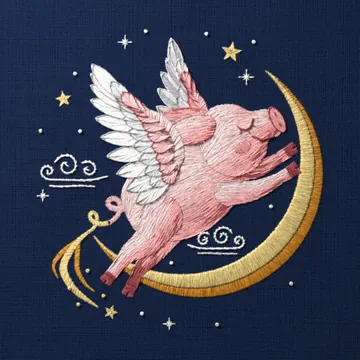
Advanced 3–8 in hoop · 10 colors
Flying pig over the moon
Advanced 3–8 in hoop · 4 colors
Angel wing cross bookmark in backstitch
Intermediate 3–8 in hoop · 4 colors
Awareness ribbon with wings
Intermediate 3–8 in hoop · 3 colors
Pair of raised wings
Advanced 3–8 in hoop · 18 colors
Wild hog in the oak woods
New to hand embroidery? Starting hand embroidery, step by step