Honey bee redwork hand embroidery pattern
Easy · 1 color · 4.6 × 4.3 in · 6 kinds of stitch
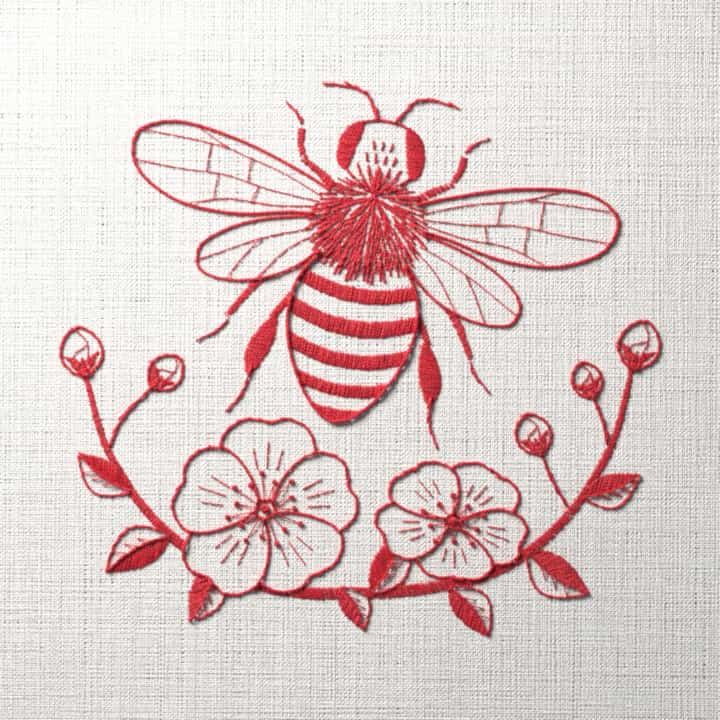
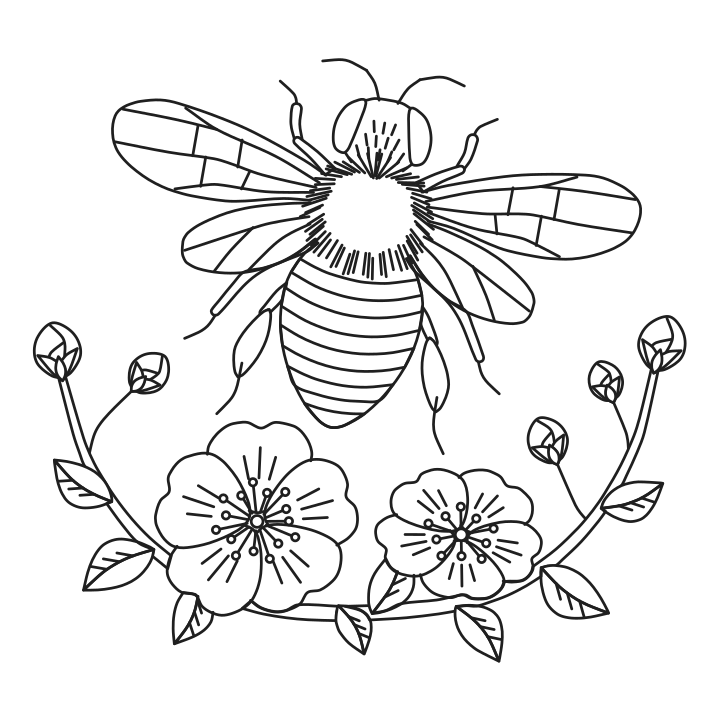
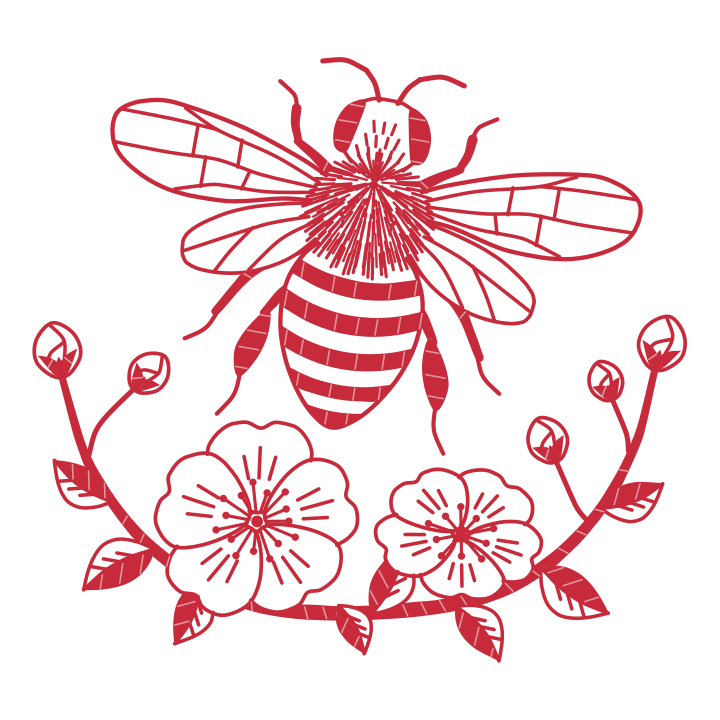
A number is a row of the list. Fine lines show which way the stitches lie: do not stitch them.
Download free PDFPDFPrints on US Letter and A4You may sell what you make from it by hand, in small quantities. The PDF itself is not to be sold or shared. Selling, classes and kits: the rulesNew to it? Next: how to start
A honey bee seen from above spreads her wings over a curved bough with two open blossoms, five buds and small leaves.
Choose a size
| Hoop | Inches | Centimeters | Satin stitch up to |
|---|---|---|---|
| 3 in (8 cm) | 1.8 × 1.7 in | 4.6 × 4.3 cm | 1/16 in (1.6 mm) |
| 4 in (10 cm) | 2.8 × 2.6 in | 7.1 × 6.6 cm | 1/8 in (3 mm) |
| 5 in (13 cm) | 3.7 × 3.4 in | 9.4 × 8.6 cm | 1/8 in (3 mm) |
| 6 in (15 cm) | 4.6 × 4.3 in | 11.7 × 10.9 cm | 3/16 in (5 mm) |
| 8 in (20 cm) | 6.5 × 6 in | 16.5 × 15.2 cm | 1/4 in (6 mm) |
- In a 3, 4 or 5 inch hoop the French knots are drawn smaller than about 2 mm (a little over 1/16 in). Use one strand of floss for them there, or choose a larger hoop.
Before you start
- New to this? How to read a pattern.
- Print at actual size (100%, not “fit”), trace the black lines, and put the fabric in the hoop, tight as a drum.
- Print at actual size (100%, not “fit”), tape the sheets and trace all of it. Hoop one part, stitch it, then move the hoop; raised parts and knots last.
- Floss has six strands: cut 18 inches (45 cm), pull out the number named one at a time, and lay them together.
- Start a filling with tiny stitches, a line with a small knot; end under stitches on the back.
- On the drawing a ring is one French knot.
What you need
- Hoop
- 6 in (15 cm), 4.6 × 4.3 in stitched. Another size
- Fabric
- Plain cotton or linen in a light color, cut 9 in (23 cm) square.
- Needle
- Embroidery needle, size 9, and size 5 for 4 strands.
- Floss
- 1 color of six-strand cotton. Skeins: 2 of DMC 321, an estimate for the 6 inch hoop from the drawing’s lines and shapes.
- Also
- Water-soluble pen or sharp pencil, small scissors.
DMC is a brand, the number its color: another brand in a like color will do.
Threads and stitches
- DMC 321 RedFur, leaves, blossom petals, abdomen bands, wing veins, boughs, legs, fore wings, petal veins, buds, hind wings, pollen baskets, stamens, sepals, abdomen, eyes, leaf veins, bud folds, stamen tips, stalks, antennae, head and blossom center
Stitch in this order
Where a stitch page says otherwise, follow this list.
- Stem stitch 3 strandsStalks
- Back stitch 1 strandBud folds
- Split stitch 3 strandsHead
- Satin stitch 2 strandsBoughs, leaves, sepals, legs, pollen baskets, abdomen bands, eyes
- Split stitch2 strands: edges of the leaves3 strands: buds, blossom petals, hind wings4 strands: fore wings, abdomen
- Stem stitch2 strands: lines of the legs3 strands: antennae
- Back stitch 1 strandLeaf veins, petal veins, wing veins
- Straight stitch1 strand: stamens2 strands: fur
- French knot two wraps1 strand: stamen tips2 strands: blossom center
Take out lines that still show, press face down, finish the hoop.
About this pattern
Easy. Short satin stitches, no shading.
Wings, body, petals and buds are outlined in split stitch, with wing veins, petal lines and leaf veins in back stitch. The bands, eyes, pollen baskets, upper legs, bough and half of each leaf are satin stitch. Her fur and the stamens are straight stitch, the anthers are French knots, and the stalks, antennae and feet are stem stitch. It takes a single red thread.
A guide to this kind of work: Redwork embroidery.
More patterns like this
Bike and trike redwork border
Intermediate 3 to 8 in hoop 1 color
Grandmother knitting a stocking, redwork
Intermediate 3 to 8 in hoop 1 color
Easy bumblebee asleep on a daisy
Easy 3 to 14 in 3 colors
Easy queen bee with clover
Easy 3 to 14 in 7 colors
Bee in honeycomb hexagon
Easy 3 to 14 in 5 colors
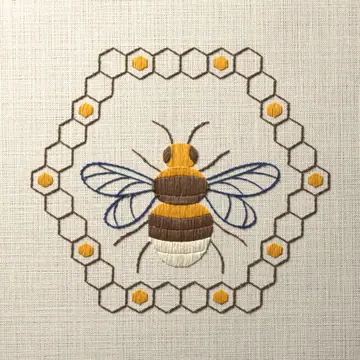
Bumblebee in honeycomb hexagon
Intermediate 3 to 8 in hoop 4 colors
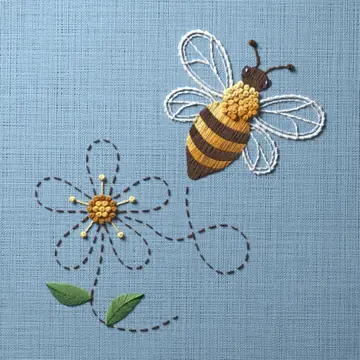
Small bee with a looping trail
Intermediate 3 to 14 in 10 colors
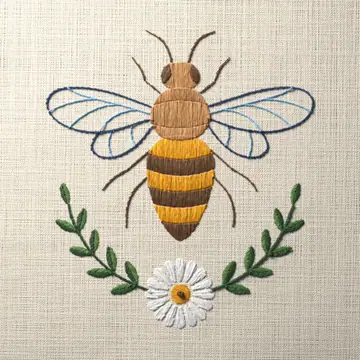
Bee over daisy crescent
Intermediate 3 to 8 in hoop 8 colors
New to hand embroidery? Starting hand embroidery, step by step