Life is better, cats with a striped cat hand embroidery pattern
Advanced · 18 colors · 4.8 × 4.1 in · 7 kinds of stitch
Download free PDFPDFPrints on US Letter and A4You may sell what you make from it by hand, in small quantities. The PDF itself is not to be sold or shared. Selling, classes and kits: the rules
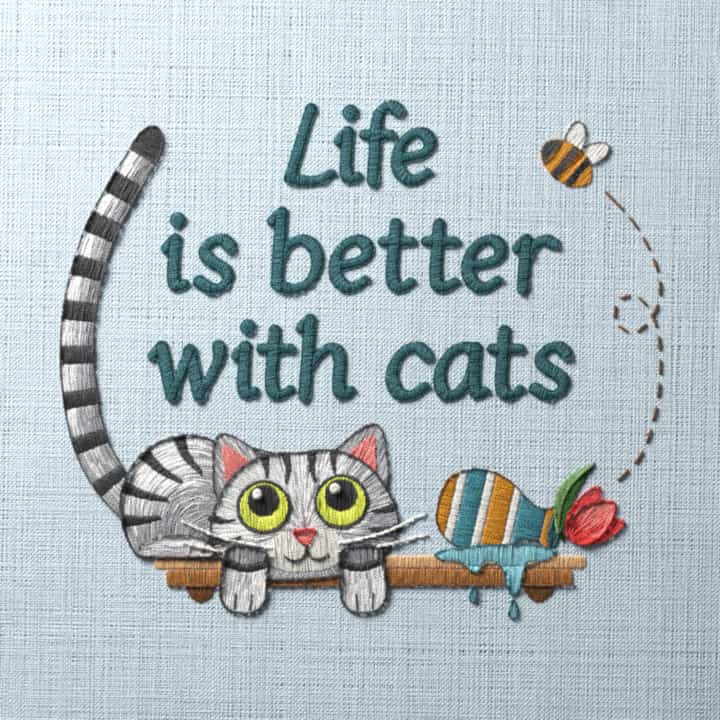
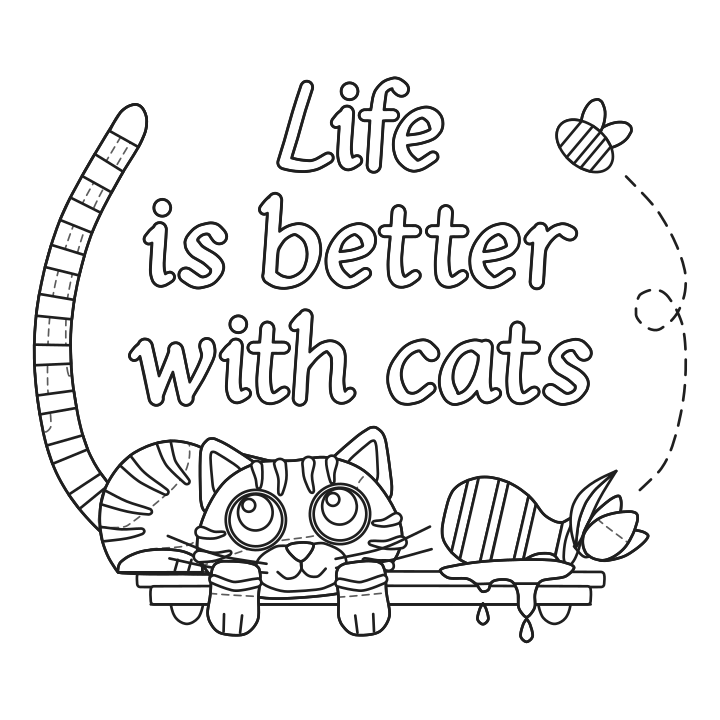
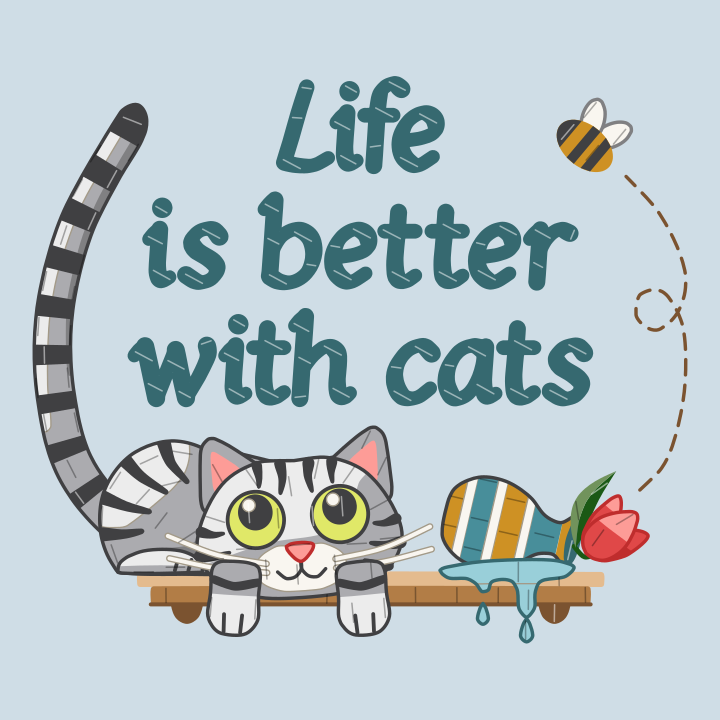
The words “Life is better with cats” with a grey tabby cat peering over a shelf edge beside a tipped striped vase and a tulip, with a bee flying off.
Size and details
Advanced. Uses long and short stitch, satin stitch over about a sixth of the cloth in a 6 inch hoop, 18 colors and a great deal of stitching.
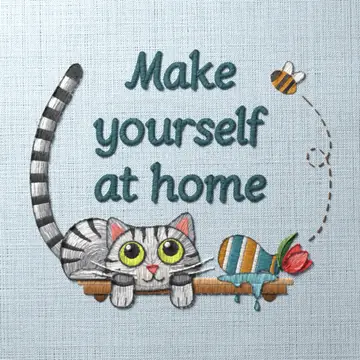
The words are worked in satin stitch, in an upright pen hand. A grey tabby crouches on a wooden shelf with its chin and paws over the edge, one round hip behind it and its tail up one side. A striped vase lies on its side, water runs off the board, a coral tulip lies at the right, and a bee flies away. The fur and tulip are long and short stitch, the stripes, vase, shelf and eyes are satin stitch, and the outlines are split stitch and stem stitch. It is drawn for pale blue linen. In the picture of where the colors go, the fine lines show which way the stitches lie.
| Hoop | Inches | Centimeters | Satin stitch up to |
|---|---|---|---|
| 3 in (8 cm) | 1.9 × 1.6 in | 4.8 × 4.1 cm | 1/8 in (3 mm) |
| 4 in (10 cm) | 2.9 × 2.5 in | 7.4 × 6.4 cm | 3/16 in (5 mm) |
| 5 in (13 cm) | 3.8 × 3.3 in | 9.7 × 8.4 cm | 1/4 in (6 mm) |
| 6 in (15 cm) | 4.8 × 4.1 in | 12.2 × 10.4 cm | 5/16 in (8 mm) |
| 8 in (20 cm) | 6.7 × 5.8 in | 17 × 14.7 cm | 1/2 in (13 mm) |
- In an 8 inch hoop the widest satin stitch shape is 1/2 in (13 mm) across. Satin stitches longer than about 12 mm (just under 1/2 in) tend to work loose: divide the shape into sections, or work it in long and short stitch.
- In a 3, 4 or 5 inch hoop the French knots are drawn smaller than about 2 mm (a little over 1/16 in). Use one strand of floss for them there, or choose a larger hoop.
What you need
- Fabric
- Plain cotton or linen in pale blue, cut 9 in (23 cm) square. On white cloth its palest threads do not show: choose other colors under Options.
- Needle
- Embroidery needle, size 9 for 1 strand, size 7 for 2 or 3 (a lower number is a thicker needle).
- Floss
- 18 colors of six-strand cotton, listed below. DMC is a brand: another brand in a like color will do.
- Marker
- A pen or a sheet that suits the fabric: how to transfer a pattern says which.
Floss
- 1DMC 318 Light Steel GrayTail and body (middle), head and paws (darker), ears
- 2DMC 414 Dark Steel GrayBody and tail (dark), bee wings (darker)
- 3DMC 762 Very Light Pearl GrayHead and paws (lighter), tail and body (light)
- 4DMC 3799 Very Dark Pewter GrayOutlines, tabby stripes, eye rims and pupils, vase (darkest) and 3 more parts
- 5DMC 433 Medium BrownBee path, shelf edge and shelf corbels
- 6DMC 437 Light TanShelf (lighter)
- 7DMC 435 Very Light BrownShelf (darker)
- 8DMC 783 Medium TopazVase (light), bee
- 9DMC 3865 Winter WhiteMuzzle, whiskers and eye lights, vase (lightest), bee wings (lighter)
- 10DMC 3810 Dark TurquoiseVase (dark)
- 11DMC 3808 Ultra Very Dark TurquoiseWords, water edge and vase mouth
- 12DMC 3345 Dark Hunter GreenTulip leaves (darker), tulip stem
- 13DMC 3347 Medium Yellow GreenTulip leaves (lighter)
- 14DMC 350 Medium CoralTulip (middle)
- 15DMC 347 Very Dark SalmonTulip edges, tulip (dark), mouth (lighter)
- 16DMC 352 Light CoralInner ears and nose, tulip (light)
- 17DMC 3766 Light Peacock BlueWater and water drops
- 18DMC 3819 Light Moss GreenEyes
Skeins: one of each color is enough. An estimate for the 6 inch hoop, from the length of each line and the area of each filled shape, with a fifth added for tails.
How to stitch it
- New to hand embroidery? Start here.
- Print at 100%, trace the pattern onto the fabric, and put it in the hoop: inner ring under, drawing up, tight as a drum.
- Floss is six strands. Cut 18 inches (45 cm), pull out the number given one at a time, and lay them together.
- Inside a filled shape start with two or three tiny stitches, which the filling covers. Start a line with a small knot on the back. End each thread by running the needle under the backs of a few stitches.
- Each small ring is one French knot. A dashed line is running stitch. A fine broken line inside a shape is where two shades meet: trace it, do not stitch it.
- A number under “Where colors go” is a color of the list. The fine lines on the colors show which way the stitches lie.
Stitch in this order
Filled parts from the back of the picture forward, then lines and knots. Where a stitch page names another number of strands, use the number here.
- Long and short stitch 1 strandTail, body, paws, tulip, ears, head
- Satin stitch 2 strandsTabby stripes, shelf corbels, shelf, vase, vase mouth, water, water drops, inner ears, muzzle, nose, eye rims, eyes, pupils, bee wings, bee, bee stripes, words
- Fishbone stitch 2 strandsTulip leaves
- Split stitch1 or 2 strands: outlines, mouth1 strand: vase, tulip edges, water edge, bee wings, words
- Stem stitch3 strands: tulip stem2 strands: shelf edge, whiskers1 strand: toes
- Running stitch 3 strandsBee path
- French knot 2 strands, two wrapsEye lights
When it is done, take off any lines that still show and finish the hoop. A guide to this kind of work: Stitches for letters, words and names.
The same picture with other words
Advanced 3–8 in hoop · 18 colors
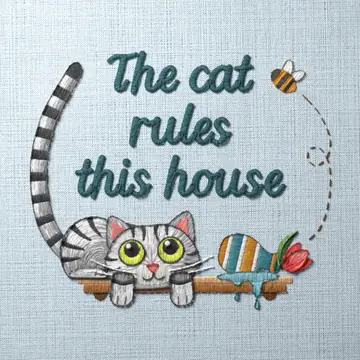
The cat rules this house, striped cat
Advanced 3–8 in hoop · 18 colors
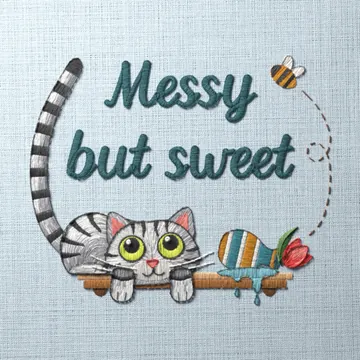
Messy but sweet with a striped cat
Advanced 3–8 in hoop · 18 colors
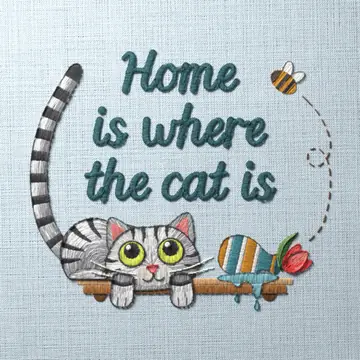
Home is where the cat is, striped cat
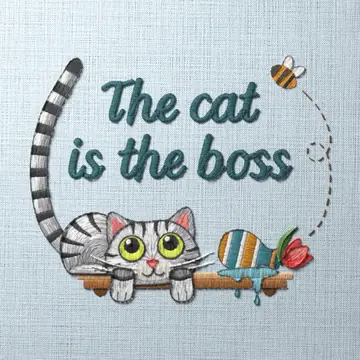
Advanced 3–8 in hoop · 18 colors
The cat is the boss with a striped cat
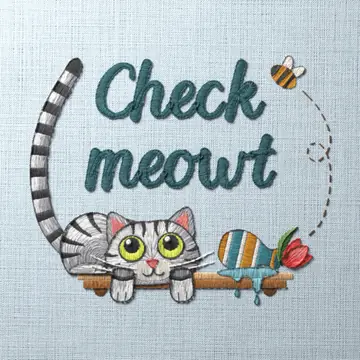
Advanced 3–8 in hoop · 18 colors
Check meowt with a guilty tabby cat
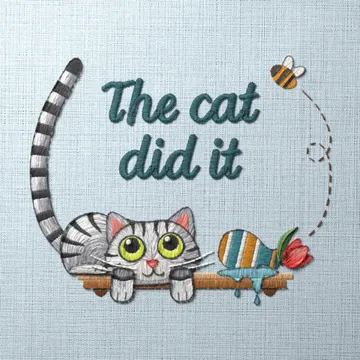
Advanced 3–8 in hoop · 18 colors
The cat did it with a striped cat
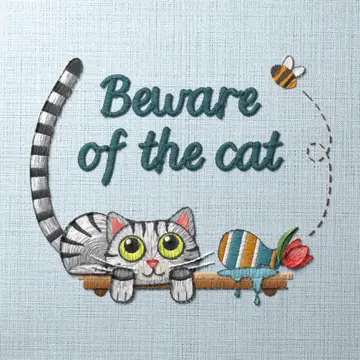
Advanced 3–8 in hoop · 18 colors
Beware of the cat with a striped cat
Advanced 3–8 in hoop · 18 colors
Make yourself at home with a striped cat
Advanced 3–8 in hoop · 18 colors
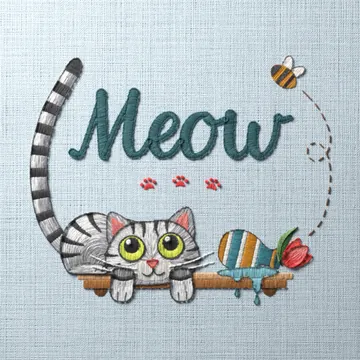
Meow with a guilty tabby cat
Advanced 3–8 in hoop · 18 colors
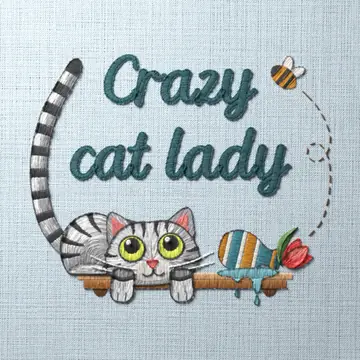
Crazy cat lady with a guilty tabby cat
More patterns like this
New to hand embroidery? Starting hand embroidery, step by step