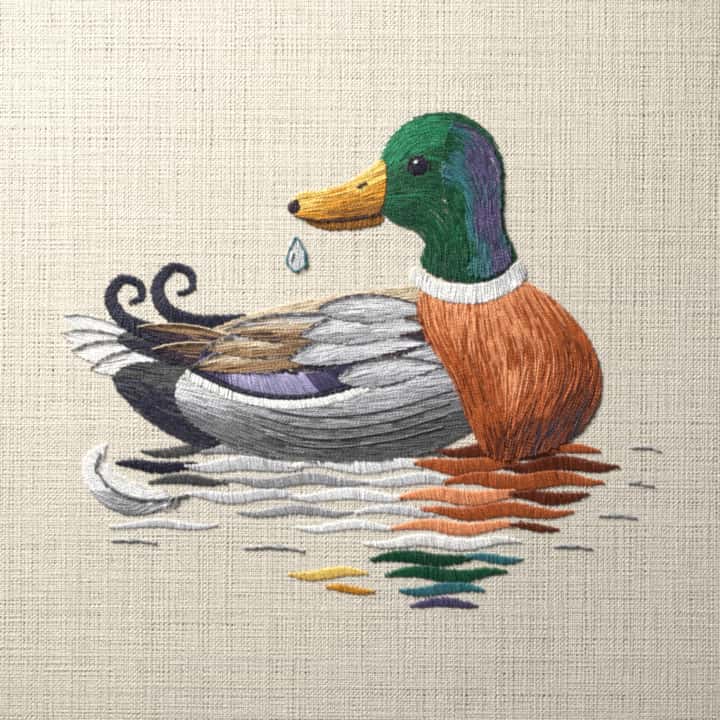
Mallard duck on still water hand embroidery pattern
Advanced · 24 colors · 5 kinds of stitch
Download free PDFPDF, US Letter · 61 KBFor your own stitching, gifts and handmade pieces you sell. Do not resell or share this PDF. What you may do, in full
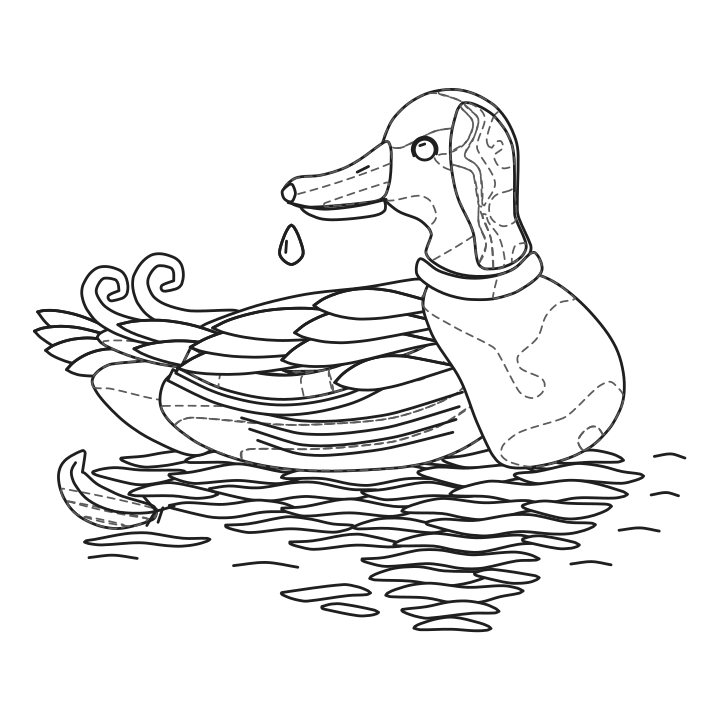
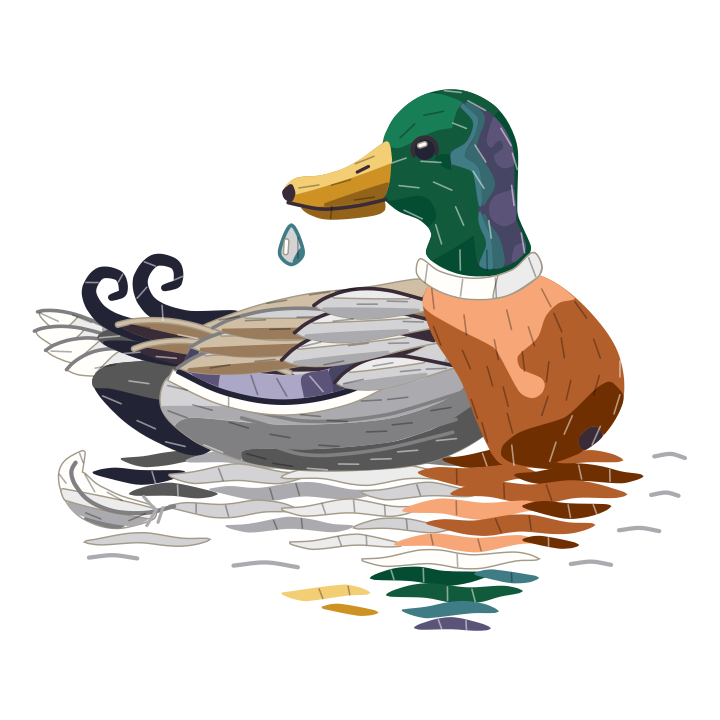
A drake rides still water with his head turned back toward the light, so the green runs from bottle through peacock to violet at the nape. Long and short stitch shades the head, chestnut breast, white collar, gray flank and the feathers of back and wing, and split stitch draws the feather edges. Satin stitch makes the black tail curls, the violet blue wing bar and the loose ripples of the reflection. A few stem stitch lines of water thin away into bare cloth, and straight stitches catch the light in the eye and the drop. In the picture of where the colors go, the fine lines show which way the stitches lie.
Size and details
Advanced. Uses long and short stitch over much of the design, 24 colors and a great deal of stitching.
24 colors of floss and 5 kinds of stitch:
| Hoop | Inches | Centimeters | Satin stitch up to |
|---|---|---|---|
| 3 in (8 cm) | 1.8 × 1.5 in | 4.6 × 3.8 cm | 1/8 in (3 mm) |
| 4 in (10 cm) | 2.7 × 2.2 in | 6.9 × 5.6 cm | 3/16 in (5 mm) |
| 5 in (13 cm) | 3.6 × 3 in | 9.1 × 7.6 cm | 3/16 in (5 mm) |
| 6 in (15 cm) | 4.5 × 3.7 in | 11.4 × 9.4 cm | 1/4 in (6 mm) |
| 8 in (20 cm) | 6.3 × 5.2 in | 16 × 13.2 cm | 3/8 in (10 mm) |
The pattern is drawn inside a circle about half an inch (1.3 cm) smaller all around than the hoop.
What you need
- DMC 413 Dark Pewter GrayFlank (darkest), upper tail and under tail (lighter), ripples (shade 5 of 16)
- DMC 318 Light Steel GrayFlank (light), tail feathers (dark), ripples (shade 11 of 16) and 4 more parts
- DMC 414 Dark Steel GrayFlank (dark), feather edges (middle), flank lines and 3 more parts
- DMC 300 Very Dark MahoganyRipples (shade 2 of 16), breast (dark)
- DMC 301 Medium MahoganyBreast (light), ripples (shade 8 of 16)
- DMC 310 BlackUnder tail, upper tail and wing bar edges (darker), tail curls and 2 more parts
- DMC 415 Pearl GrayFlank (lightest), shoulder feathers (middle), ripples (shade 14 of 16) and 2 more parts
- DMC 762 Very Light Pearl GrayRipples (shade 15 of 16), tail feathers (middle) and 3 more parts
- DMC 402 Very Light MahoganyBreast (lightest), ripples (shade 12 of 16)
- DMC BLANC WhiteTail feathers (light), floating feather (lightest) and 5 more parts
- DMC 500 Very Dark Blue GreenHead (shade 1 of 7), ripples (shade 3 of 16)
- DMC 3809 Very Dark TurquoiseRipples (shade 7 of 16), head (shade 7 of 7), drop (darker)
- DMC 3821 StrawBill (light), ripples (shade 13 of 16)
- DMC 3818 Ultra Very Dark Emerald GreenHead (shade 3 of 7), ripples (shade 4 of 16)
- DMC 783 Medium TopazBill (middle), ripples (shade 10 of 16)
- DMC 333 Very Dark Blue VioletHead (shade 4 of 7), wing bar (middle), ripples (shade 6 of 16)
- DMC 842 Very Light Beige BrownBack and feather edges (light), wing feathers (middle)
- DMC 3371 Black BrownBack and feather edges (dark), wing tips (darker), bill line and 4 more parts
- DMC 840 Medium Beige BrownBack (middle), wing feathers (dark), wing tips (lighter)
- DMC 340 Medium Blue VioletWing bar (light)
- DMC 791 Very Dark Cornflower BlueHead (shade 2 of 7), wing bar (dark)
- DMC 910 Dark Emerald GreenHead (shade 6 of 7)
- DMC 3808 Ultra Very Dark TurquoiseHead (shade 5 of 7)
- DMC 780 Ultra Very Dark TopazBill (dark)
Skeins: one of each color is enough. An estimate for the largest size, the 8 inch hoop: the length of each line and the area of each filled shape, a fifth added for tails and ends, a tenth of every 8 m (8.7 yd) skein kept spare.
The floss is six-strand cotton; the stitch guide says how many strands to use. You also need a hoop, an embroidery needle (a size 7 to 9 suits two or three strands) and plain cotton or linen fabric. To frame the piece in its hoop, cut a square 3 inches (8 cm) wider than the hoop: a 9 inch (23 cm) square for a 6 inch hoop.
When it is stitched, how to finish a hoop shows how to back it for the wall.
Stitch guide
- Put the pattern on the fabric (how to transfer a pattern) and the fabric in the hoop.
- Stitch the filled parts first, what lies behind before what lies in front of it.
- Then stitch the lines: stems, veins and outlines over the edges of the filled parts.
Start each thread with a small knot on the back or one of the knotless starts, and end it by running the needle under the backs of a few stitches (starting and ending a thread). Use the strands this list gives, also where a page about a stitch names another number.
- Satin stitch 2 strandsRipples, tail curls, wing bar edges, wing bar, bill, bill tip, eye, drop
- Stem stitch 2 strandsWater lines, feather shaft
- Long and short stitch 1 strandTail feathers, under tail, upper tail, flank, back, wing tips, wing feathers, shoulder feathers, breast, head, collar, bill, floating feather
- Split stitch 1 strandFeather edges, flank lines, bill line, eye ring, drop
- Straight stitch 1 to 2 strandsNostril, eye light, drop light, feather barbs
Getting it onto your fabric
The PDF holds the pattern twice at actual size: once as drawn, and once mirrored for an iron-on transfer pen. Print it at 100% with scaling off and check the one-inch square (25.4 mm) with a ruler before you trace. How to transfer a pattern explains tracing, carbon paper and the other ways. The files are under Downloads.
Downloads
- Download free PDF PDF, US Letter, 3 pages, for a 6 inch (15 cm) hoop
- Download free PDF, A4 PDF, A4, 3 pages, for a 6 inch (15 cm) hoop
More patterns like this
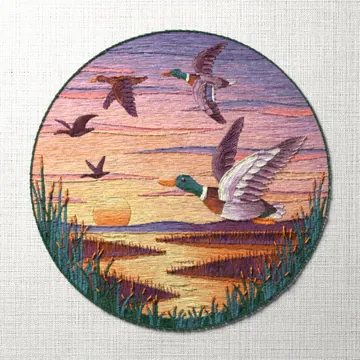
Advanced 3–8 in hoop · 24 colors
Flying ducks over the marsh at sunset
Advanced 3–8 in hoop · 24 colors
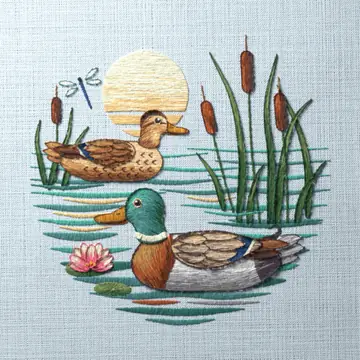
Ducks and bulrushes
Advanced 3–8 in hoop · 24 colors
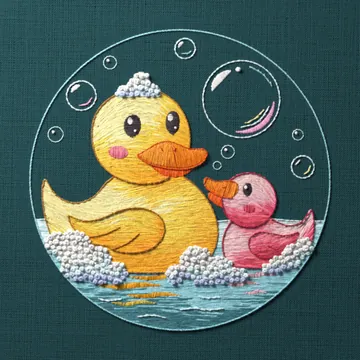
Two rubber ducks with bubbles
Advanced 3–8 in hoop · 22 colors
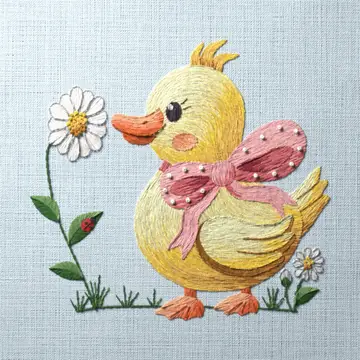
Vintage duckling with a bow and daisy
Advanced 3–8 in hoop · 22 colors
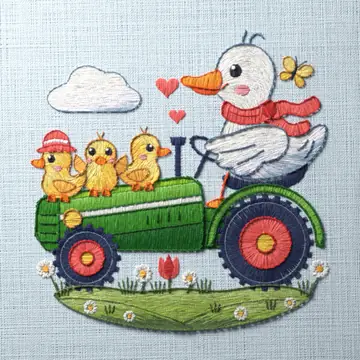
Ducks on a green tractor
Advanced 3–8 in hoop · 22 colors
Hunting Labrador with a duck
Advanced 3–8 in hoop · 21 colors
Seventies water mill and mill pond
Advanced 3–8 in hoop · 19 colors
Baby’s first stocking, room for a name
New to hand embroidery? Starting hand embroidery, step by step