Medieval raised work bird and vine arch hand embroidery pattern
Advanced · 15 colors · 4.1 × 4.4 in · 8 kinds of stitch
Download free PDFPDFPrints on US Letter and A4You may sell what you make from it by hand, in small quantities. The PDF itself is not to be sold or shared. Selling, classes and kits: the rules
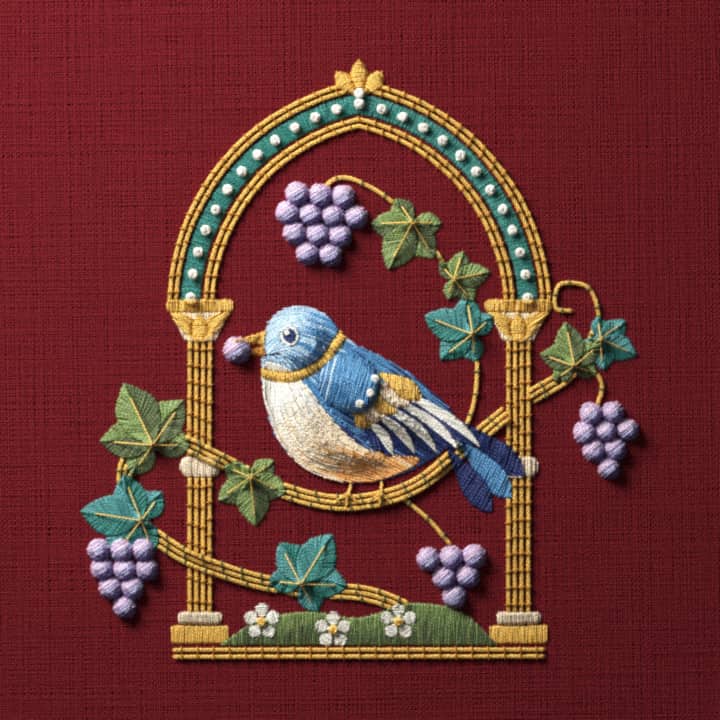
On deep madder red, a pointed arch on two slim columns frames one plump blue bird. The grapevine rises out of the mound, crosses in front of the left column, swings back under the bird and passes behind the right column to a curling tendril.
Size and details
Advanced. Uses couching, padded satin stitch, long and short stitch, 15 colors and a great deal of stitching; from a 5 inch hoop up the widest satin stitches are long.
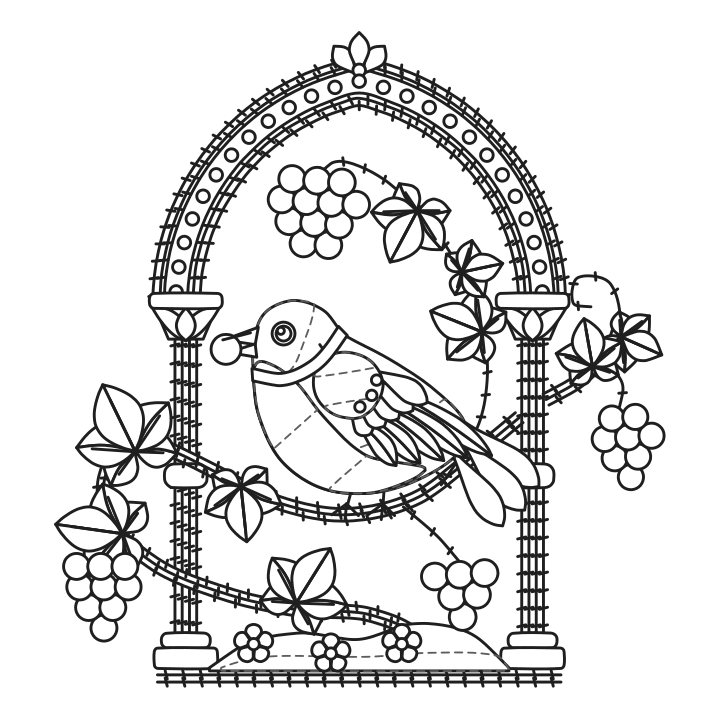
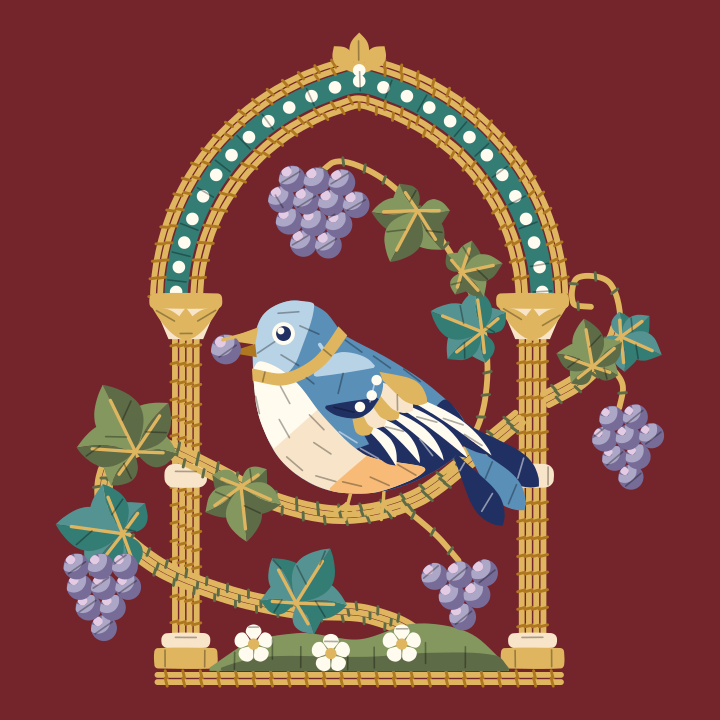
Arch, columns and vine are couched in old gold, and the green band of the arch carries French knots like pearls. Grapes are padded satin stitch standing clear of the cloth, and the leaves are fishbone stitch in olive and blue-green with straight stitch veins. The bird is long and short stitch over a padded breast, with split stitch feathers on his back and a wing in three layers: satin shoulder, padded coverts and fishbone feathers. He has one stolen grape in his bill. In the picture of where the colors go, the fine lines show which way the stitches lie.
| Hoop | Inches | Centimeters | Satin stitch up to |
|---|---|---|---|
| 3 in (8 cm) | 1.6 × 1.8 in | 4.1 × 4.6 cm | 3/16 in (5 mm) |
| 4 in (10 cm) | 2.4 × 2.6 in | 6.1 × 6.6 cm | 1/4 in (6 mm) |
| 5 in (13 cm) | 3.3 × 3.5 in | 8.4 × 8.9 cm | 3/8 in (10 mm) |
| 6 in (15 cm) | 4.1 × 4.4 in | 10.4 × 11.2 cm | 7/16 in (11 mm) |
| 8 in (20 cm) | 5.7 × 6.1 in | 14.5 × 15.5 cm | 5/8 in (16 mm) |
- In an 8 inch hoop the widest satin stitch shape is 5/8 in (16 mm) across. Satin stitches longer than about 12 mm (just under 1/2 in) tend to work loose: divide the shape into sections, or work it in long and short stitch.
- In a 3, 4 or 5 inch hoop the French knots are drawn smaller than about 2 mm (a little over 1/16 in). Use one strand of floss for them there, or choose a larger hoop.
What you need
- Fabric
- Plain cotton or linen in dark red, cut 9 in (23 cm) square. On white cloth its palest threads do not show: choose other colors under Options. A pencil line does not show on it: see how to transfer a pattern to dark fabric.
- Needle
- Embroidery needle, size 9 for 1 strand, size 7 for 2 or 3, size 3 for 4 to 6 (a lower number is a thicker needle).
- Floss
- 15 colors of six-strand cotton, listed below. DMC is a brand: another brand in a like color will do.
- Marker
- A pen or a sheet that suits the fabric: how to transfer a pattern says which.
Floss
- 1DMC 3820 Dark StrawVine, arch and columns (lighter), leaf veins, capitals (darker) and 8 more parts
- 2DMC 782 Dark TopazArch, columns, base line and bill (darker)
- 3DMC 739 Ultra Very Light TanBreast (middle), capitals, column bases and wing coverts (lighter), column rings
- 4DMC 3847 Dark Teal GreenArch band, vine leaves (dark)
- 5DMC 712 CreamLong wing feathers (lighter), breast (light), pearls on the arch and 5 more parts
- 6DMC 3362 Dark Pine GreenVine leaves (darkest), vine and mound (darker)
- 7DMC 3848 Medium Teal GreenVine leaves (light)
- 8DMC 3364 Pine GreenVine leaves (lightest), mound (lighter)
- 9DMC 3746 Dark Blue VioletGrapes (dark)
- 10DMC 340 Medium Blue VioletGrapes (middle)
- 11DMC 211 Light LavenderGrapes (light)
- 12DMC 823 Dark Navy BlueBack and shoulder (dark), tail and long wing feathers (darker), eye
- 13DMC 322 Dark Baby BlueBack and shoulder (middle), tail (lighter)
- 14DMC 3325 Light Baby BlueBack and shoulder (light), back feathers
- 15DMC 3827 Pale Golden BrownBreast (dark)
Skeins: one of each color is enough. An estimate for the 6 inch hoop, from the length of each line and the area of each filled shape, with a fifth added for tails.
How to stitch it
- New to hand embroidery? Start here.
- Print at 100%, trace the pattern onto the fabric, and put it in the hoop: inner ring under, drawing up, tight as a drum.
- Floss is six strands. Cut 18 inches (45 cm), pull out the number given one at a time, and lay them together.
- Inside a filled shape start with two or three tiny stitches, which the filling covers. Start a line with a small knot on the back. End each thread by running the needle under the backs of a few stitches.
- Each small ring is one French knot. A fine broken line inside a shape is where two shades meet: trace it, do not stitch it.
- A number under “Where colors go” is a color of the list. The fine lines on the colors show which way the stitches lie.
Stitch in this order
Filled parts from the back of the picture forward, then lines and knots. Where a stitch page names another number of strands, use the number here.
- Padded satin stitch 2 strandsColumn rings, finial, capitals, column bases, grapes, wing coverts, shoulder, collar
- Satin stitch 2 strandsArch band, capitals, column bases, tail, bill, eye ring, eye, flowers
- Fishbone stitch 2 strandsVine leaves, long wing feathers
- Long and short stitch 1 strandMound, back, breast
- Couching6 strands: columns, arch, base line5 strands: vine
- Straight stitch2 or 3 strands: legs2 strands: bill1 strand: leaf veins
- Split stitch 1 strandBack feathers
- French knot two wraps2 strands: finial, pearls on the arch, shoulder pearls, flower hearts1 strand: eye light
When it is done, take off any lines that still show and finish the hoop. Guides to this kind of work: Stumpwork and Stitches for fur, hair and feathers.
More patterns like this
Advanced 3–8 in hoop · 6 colors
Byzantine goldwork with vine scrolls
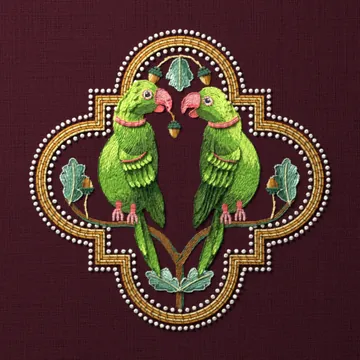
Advanced prints 3–14 in · 14 colors
Opus Anglicanum style birds
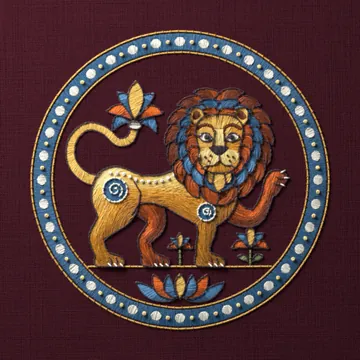
Advanced prints 3–14 in · 14 colors
Romanesque style lion roundel
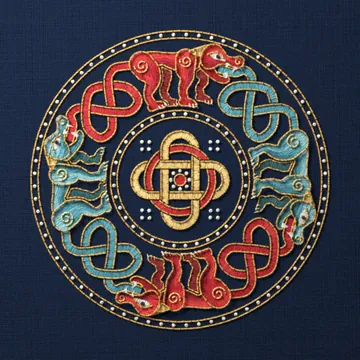
Advanced prints 3–14 in · 13 colors
Anglo-Saxon interlace beast border
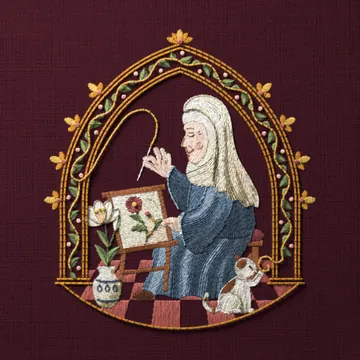
Advanced 3–8 in hoop · 21 colors
Medieval nun at her needlework
Advanced 3–8 in hoop · 16 colors
Medieval cloak trim with pearl knots
Intermediate 3–8 in hoop · 7 colors
15th century couched pomegranate motif
Advanced prints 3–14 in · 15 colors
Medieval Slavic ornament with two birds
New to hand embroidery? Starting hand embroidery, step by step