Olive branch coaster hand embroidery pattern
Advanced · 16 colors · 3.2 × 3.2 in · 6 kinds of stitch · one of a set of 4
Download free PDFPDFPrints on US Letter and A4You may sell what you make from it by hand, in small quantities. The PDF itself is not to be sold or shared. Selling, classes and kits: the rules
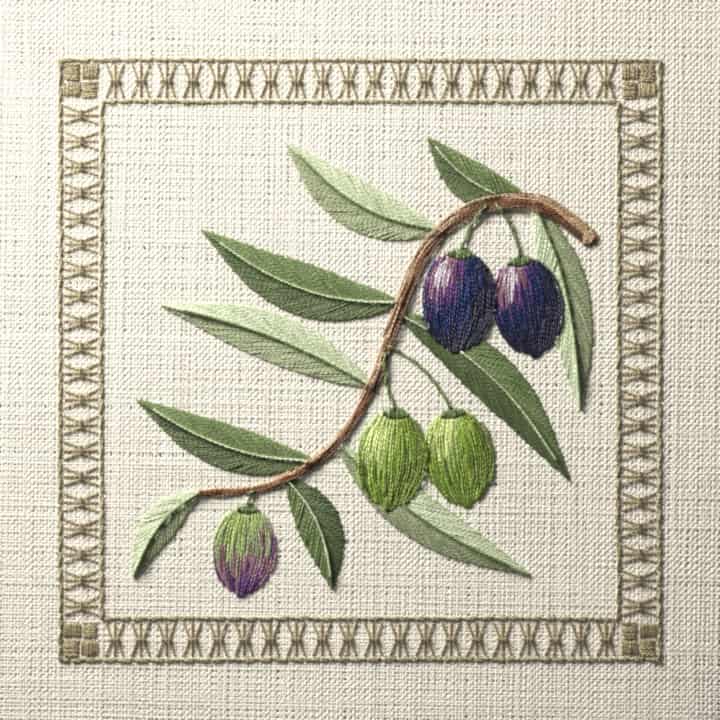
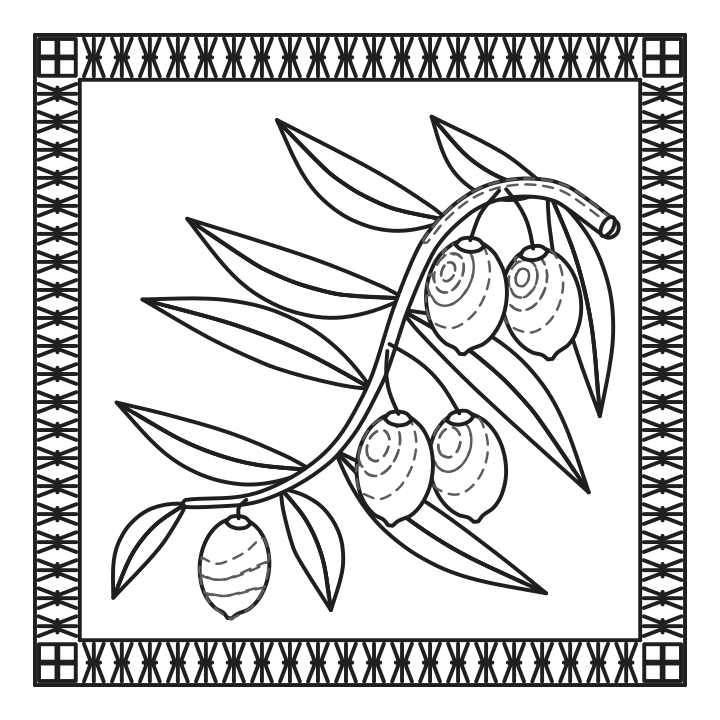
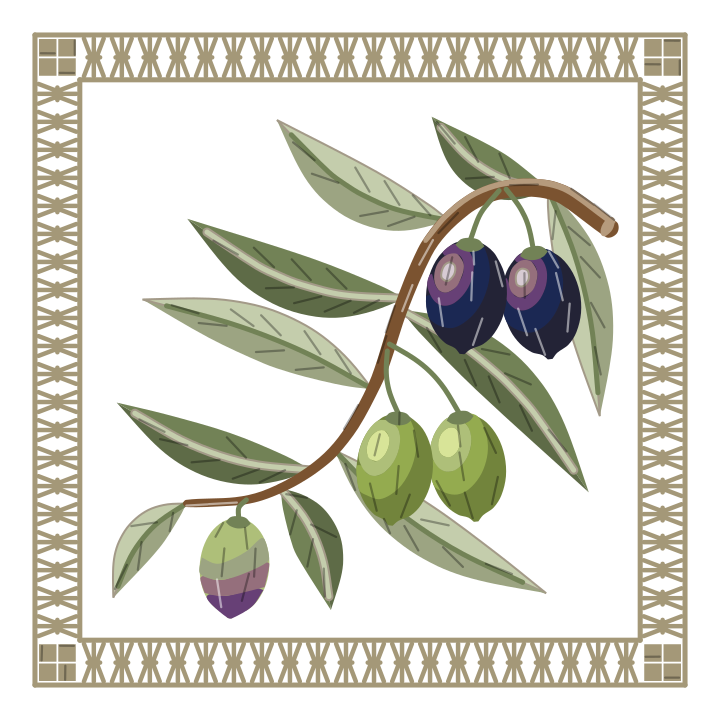
One olive branch bends in a gentle S from the upper right to the lower left. A dark ripe pair, a green pair and one olive just turning hang close beneath it on short stalks.
Size and details
Advanced. Uses long and short stitch, 16 colors and a great deal of stitching.
The ten leaves are fishbone stitch, dark on the face and silver on the back, with split stitch veins. The olives and the branch are long and short stitch, the stalks are split stitch, and the olive caps and the cut end of the branch are satin stitch. The square border is back stitch rails with sheaf stitch groups between them and four satin blocks turned in each corner. In the picture of where the colors go, the fine lines show which way the stitches lie.
| Hoop | Inches | Centimeters | Satin stitch up to |
|---|---|---|---|
| 3 in (8 cm) | 1.3 × 1.3 in | 3.3 × 3.3 cm | 1/16 in (1.6 mm) |
| 4 in (10 cm) | 1.9 × 1.9 in | 4.8 × 4.8 cm | 1/16 in (1.6 mm) |
| 5 in (13 cm) | 2.6 × 2.6 in | 6.6 × 6.6 cm | 1/16 in (1.6 mm) |
| 6 in (15 cm) | 3.2 × 3.2 in | 8.1 × 8.1 cm | 1/8 in (3 mm) |
| 8 in (20 cm) | 4.5 × 4.5 in | 11.4 × 11.4 cm | 1/8 in (3 mm) |
On linens. Wash and press the piece first. A pillowcase takes its design in the middle of the hem band; a napkin or a handkerchief in one corner, set on the diagonal. Keep the stitches short and low, and press face down on soft cloth. How to embroider pillowcases and napkins has the sizes and the places.
What you need
- Fabric
- Plain cotton or linen, cut 9 in (23 cm) square.
- Needle
- Embroidery needle, size 9 for 1 strand, size 7 for 2 (a lower number is a thicker needle).
- Floss
- 16 colors of six-strand cotton, listed below. DMC is a brand: another brand in a like color will do.
- Marker
- A pen or a sheet that suits the fabric: how to transfer a pattern says which.
Floss
- 1DMC 642 Dark Beige GrayBorder sheaves, border rails and border corners
- 2DMC 3362 Dark Pine GreenLeaves (darkest)
- 3DMC 3363 Medium Pine GreenLeaves (dark), leaf veins (darker), stalks and olive caps
- 4DMC 524 Very Light Fern GreenLeaves (lightest), leaf veins (lighter)
- 5DMC 3053 Green GrayLeaves and turning olive (light)
- 6DMC 433 Medium BrownBranch (darker)
- 7DMC 841 Light Beige BrownBranch (lighter), cut end
- 8DMC 310 BlackRipe olives (darkest)
- 9DMC 939 Very Dark Navy BlueRipe olives (dark)
- 10DMC 29 EggplantRipe olives (middle), turning olive (darkest)
- 11DMC 3041 Medium Antique VioletRipe olives (light), turning olive (dark)
- 12DMC 3743 Very Light Antique VioletRipe olives (lightest)
- 13DMC 469 Avocado GreenGreen olives (darkest)
- 14DMC 470 Light Avocado GreenGreen olives (dark)
- 15DMC 471 Very Light Avocado GreenTurning olive (lightest), green olives (light)
- 16DMC 472 Ultra Light Avocado GreenGreen olives (lightest)
Skeins: one of each color is enough. An estimate for the 6 inch hoop, from the length of each line and the area of each filled shape, with a fifth added for tails.
How to stitch it
- New to hand embroidery? Start here.
- Print at 100%, trace the pattern onto the fabric, and put it in the hoop: inner ring under, drawing up, tight as a drum.
- Floss is six strands. Cut 18 inches (45 cm), pull out the number given one at a time, and lay them together.
- Begin with no knot on the back where it is seen and washed, as on a towel, a napkin or clothes; for a piece in a hoop a small knot is fine. End each thread by whipping it around the backs of four or five stitches, with one small hitch.
- A fine broken line inside a shape is where two shades meet: trace it, do not stitch it.
- A number under “Where colors go” is a color of the list. The fine lines on the colors show which way the stitches lie.
Stitch in this order
Filled parts from the back of the picture forward, then lines. Where a stitch page names another number of strands, use the number here.
- Sheaf stitch 1 strandBorder sheaves
- Satin stitch2 strands: cut end, olive caps1 strand: border corners
- Fishbone stitch 1 strandLeaves
- Long and short stitch 1 strandBranch, ripe olives, green olives, turning olive
- Back stitch 2 strandsBorder rails
- Split stitch2 strands: stalks1 strand: leaf veins
When it is done, take off any lines that still show and finish the hoop.
The rest of this set
More patterns like this
New to hand embroidery? Starting hand embroidery, step by step