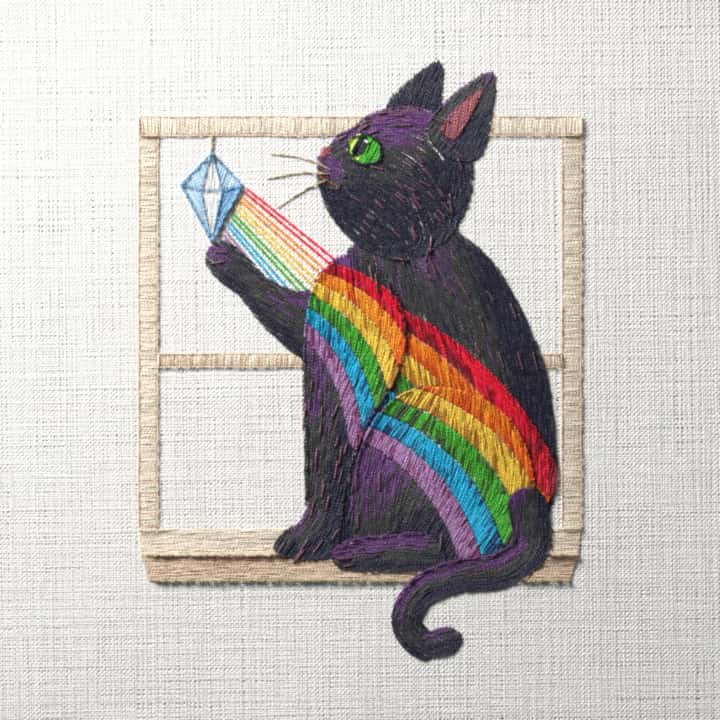
Rainbow cat on a windowsill hand embroidery pattern
Advanced · 24 colors · 6 kinds of stitch
Download free PDFPDF, US Letter · 51 KBFor your own stitching, gifts and handmade pieces you sell. Do not resell or share this PDF. What you may do, in full
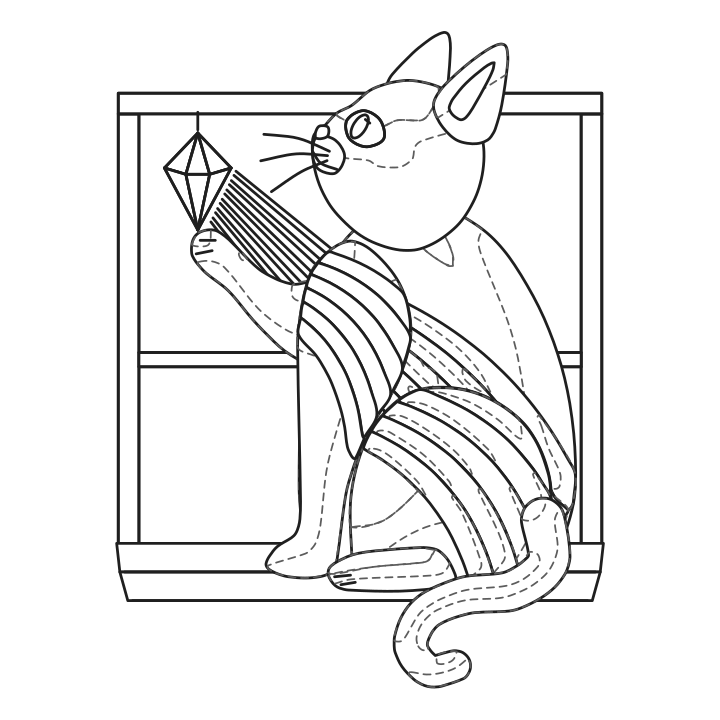
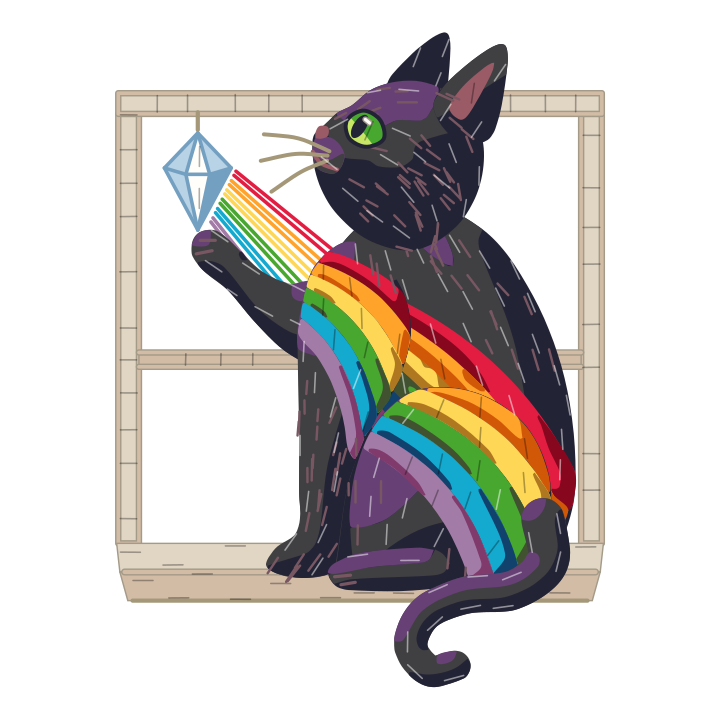
A black cat sits with its back three quarters to us, green eye lifted to a glass prism that hangs in the window. The prism throws a slanting rainbow, fine lines of split stitch in the air and solid stripes of color on the fur, each stripe bending over shoulder, ribs and haunch. One paw reaches for the beam and the tail curls down over the sill. The fur and the stripes are long and short stitch, the window frame, prism and eye are satin stitch, and the whiskers are stem stitch. In the picture of where the colors go, the fine lines show which way the stitches lie.
Size and details
Advanced. Uses long and short stitch over much of the design, 24 colors and a great deal of stitching; from a 6 inch hoop up the widest satin stitches are long.
24 colors of floss and 6 kinds of stitch:
- Satin stitch
- Split stitch
- Long and short stitch
- Stem stitch
- Back stitch
- Straight stitch
- Which stitch goes where
| Hoop | Inches | Centimeters | Satin stitch up to |
|---|---|---|---|
| 3 in (8 cm) | 1.4 × 1.8 in | 3.6 × 4.6 cm | 3/16 in (5 mm) |
| 4 in (10 cm) | 2 × 2.7 in | 5.1 × 6.9 cm | 1/4 in (6 mm) |
| 5 in (13 cm) | 2.7 × 3.7 in | 6.9 × 9.4 cm | 5/16 in (8 mm) |
| 6 in (15 cm) | 3.4 × 4.6 in | 8.6 × 11.7 cm | 7/16 in (11 mm) |
| 8 in (20 cm) | 4.8 × 6.4 in | 12.2 × 16.3 cm | 9/16 in (14 mm) |
- In an 8 inch hoop the widest satin stitch shape is 9/16 in (14 mm) across. Satin stitches longer than about 12 mm (just under 1/2 in) tend to work loose: divide the shape into sections, or work it in long and short stitch.
The pattern is drawn inside a circle about half an inch (1.3 cm) smaller all around than the hoop.
What you need
- DMC 3033 Very Light Mocha BrownWindow frame (lighter), windowsill
- DMC 3782 Light Mocha BrownFrame edges and sill front, window frame (darker), sill edges (lighter)
- DMC 666 Bright RedRed light (lighter), beam (darkest)
- DMC 741 Medium TangerineOrange light (lighter), beam (light)
- DMC 726 Light TopazYellow light (lighter), beam (lightest)
- DMC 702 Kelly GreenGreen light (lighter), beam (middle dark), eye (darker)
- DMC 3843 Electric BlueBlue light (lighter), beam (middle light)
- DMC 209 Dark LavenderViolet light (lighter), beam (dark)
- DMC 642 Dark Beige GraySill edges (darker), whiskers and cord
- DMC 3325 Light Baby BluePrism (middle)
- DMC BLANC WhitePrism (light), eye light
- DMC 334 Medium Baby BluePrism edges, prism (dark)
- DMC 3799 Very Dark Pewter GrayBack, shoulder and foreleg, tail, haunch and reaching paw (middle) and 4 more parts
- DMC 310 BlackBack, haunch and shoulder and foreleg (dark), head (darkest) and 6 more parts
- DMC 29 EggplantHaunch, shoulder and foreleg, head, tail and hind paw (light) and 3 more parts
- DMC 3740 Dark Antique VioletFur lights and toe lines, head (lightest)
- DMC 815 Medium GarnetRed light (darker)
- DMC 900 Dark Burnt OrangeOrange light (darker)
- DMC 782 Dark TopazYellow light (darker)
- DMC 986 Very Dark Forest GreenGreen light (darker)
- DMC 796 Dark Royal BlueBlue light (darker)
- DMC 552 Medium VioletViolet light (darker)
- DMC 3726 Dark Antique MauveInner ear, mouth and nose
- DMC 907 Light Parrot GreenEye (lighter)
Skeins: 2 for back, shoulder and foreleg, tail, haunch and reaching paw (middle) and 4 more parts and 2 for back, haunch and shoulder and foreleg (dark), head (darkest) and 6 more parts; one of each other color. An estimate for the largest size, the 8 inch hoop: the length of each line and the area of each filled shape, a fifth added for tails and ends, a tenth of every 8 m (8.7 yd) skein kept spare.
The floss is six-strand cotton; the stitch guide says how many strands to use. You also need a hoop, an embroidery needle (a size 7 to 9 suits two or three strands) and plain cotton or linen fabric. To frame the piece in its hoop, cut a square 3 inches (8 cm) wider than the hoop: a 9 inch (23 cm) square for a 6 inch hoop.
When it is stitched, how to finish a hoop shows how to back it for the wall.
Stitch guide
- Put the pattern on the fabric (how to transfer a pattern) and the fabric in the hoop.
- Stitch the filled parts first, what lies behind before what lies in front of it.
- Then stitch the lines: stems, veins and outlines over the edges of the filled parts.
Start each thread with a small knot on the back or one of the knotless starts, and end it by running the needle under the backs of a few stitches (starting and ending a thread). Use the strands this list gives, also where a page about a stitch names another number.
- Satin stitch 2 strandsWindow frame, prism, inner ear, nose, eye, pupil
- Split stitch 1 to 2 strandsFrame edges, beam, prism edges
- Long and short stitch 1 strandWindowsill, sill front, reaching paw, back, red light, orange light, yellow light, green light, blue light, violet light, and 8 more
- Stem stitch 1 to 2 strandsSill edges, cord, mouth, eye edge, whiskers
- Back stitch 2 strandsPrism edges
- Straight stitch 1 to 2 strandsToe lines, eye light
Getting it onto your fabric
The PDF holds the pattern twice at actual size: once as drawn, and once mirrored for an iron-on transfer pen. Print it at 100% with scaling off and check the one-inch square (25.4 mm) with a ruler before you trace. How to transfer a pattern explains tracing, carbon paper and the other ways. The files are under Downloads.
Downloads
- Download free PDF PDF, US Letter, 3 pages, for a 6 inch (15 cm) hoop
- Download free PDF, A4 PDF, A4, 3 pages, for a 6 inch (15 cm) hoop
More patterns like this
Advanced 3–8 in hoop · 20 colors
Sleeping black cat Christmas ornament
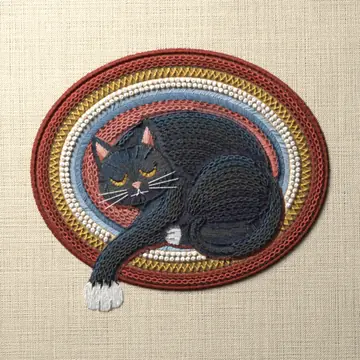
Advanced 3–8 in hoop · 20 colors
Black cat asleep on a hooked rug
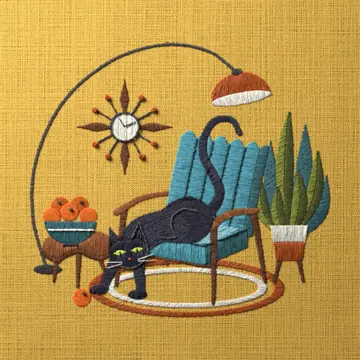
Advanced 3–8 in hoop · 15 colors
Mid century modern room with a cat
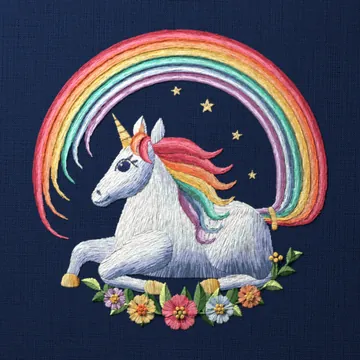
Advanced 3–8 in hoop · 24 colors
Unicorn with rainbow tail
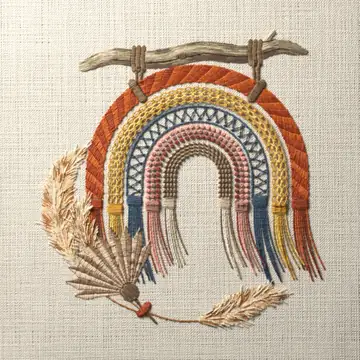
Advanced 3–8 in hoop · 24 colors
Boho rainbow
Advanced 3–8 in hoop · 24 colors
Rainbow stacking rings
Advanced 3–8 in hoop · 22 colors
Rainbow rose bookmark
Advanced 3–8 in hoop · 22 colors
Sunburst rainbow
New to hand embroidery? Starting hand embroidery, step by step