Stumpwork landscape with 3D clouds hand embroidery pattern
Advanced · 22 colors · 6 kinds of stitch
Download free PDFPDF, US Letter · 147 KBFor your own stitching, gifts and handmade pieces you sell. Do not resell or share this PDF. What you may do, in full
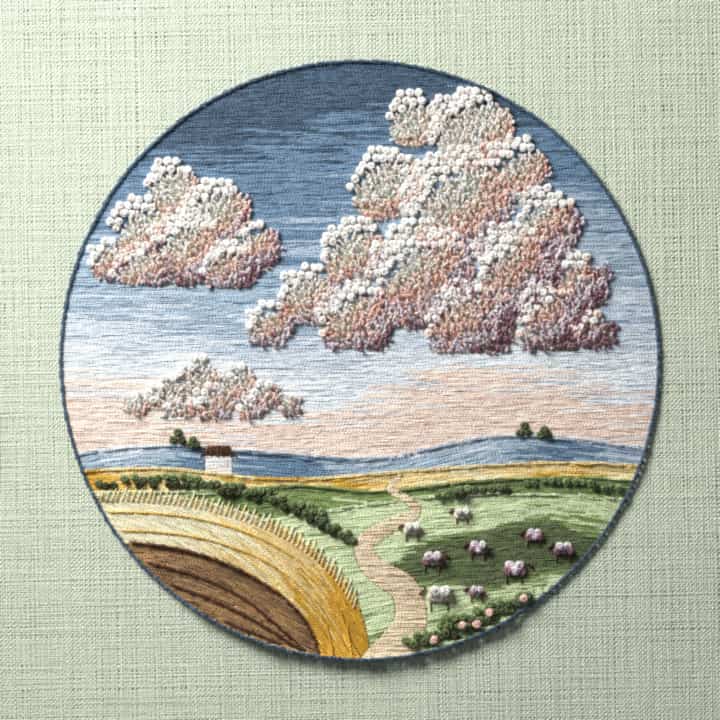
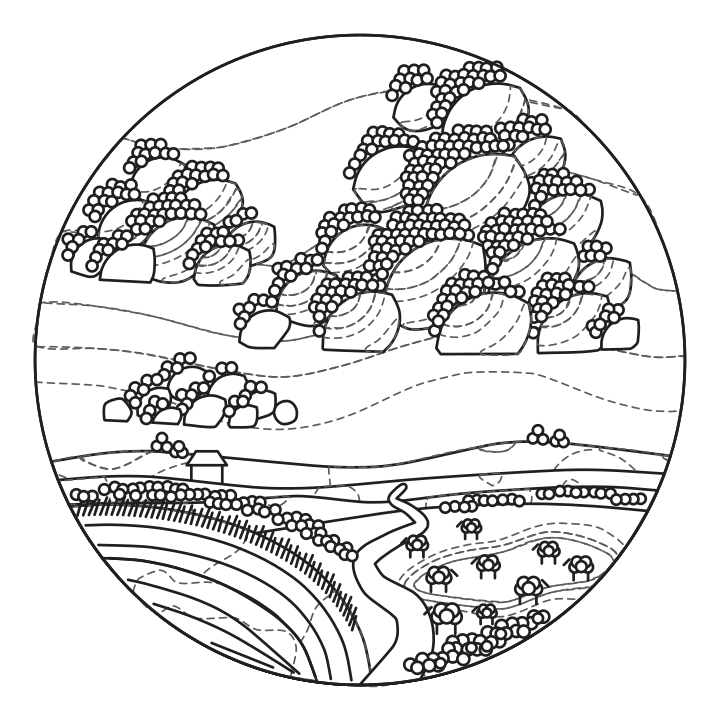
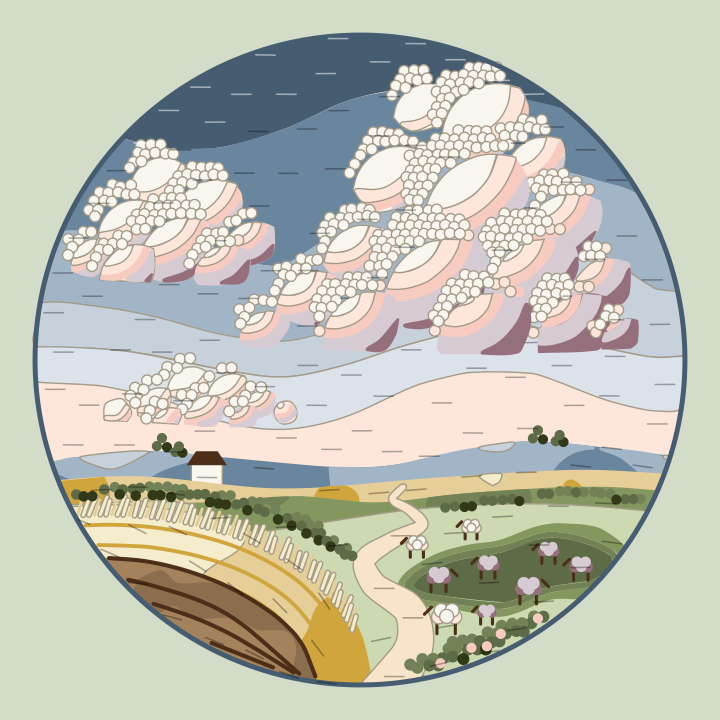
Three clouds tower over a low country of barley, ploughland and pasture, with a pale path winding to the far hill. Nine small sheep graze on the right, and the shadow of a cloud lies across some of them. The clouds are turkey work with crowns of French knots, peach and white where the light falls and lilac beneath. The sky, hills and fields are long and short stitch, the path and farmhouse are satin stitch, the hedges and sheep are French knots, and the barley rows, furrows and rim are stem stitch. It is drawn for sage green linen. In the picture of where the colors go, the fine lines show which way the stitches lie.
Size and details
Advanced. Uses long and short stitch over much of the design, turkey work, more than a hundred French knots, 22 colors and a great deal of stitching; from a 6 inch hoop up the widest satin stitches are long.
22 colors of floss and 6 kinds of stitch:
- Long and short stitch
- Turkey work
- French knot
- Satin stitch
- Stem stitch
- Straight stitch
- Which stitch goes where
| Hoop | Inches | Centimeters | Satin stitch up to |
|---|---|---|---|
| 3 in (8 cm) | 1.9 × 1.9 in | 4.8 × 4.8 cm | 1/8 in (3 mm) |
| 4 in (10 cm) | 2.8 × 2.8 in | 7.1 × 7.1 cm | 1/4 in (6 mm) |
| 5 in (13 cm) | 3.8 × 3.8 in | 9.7 × 9.7 cm | 5/16 in (8 mm) |
| 6 in (15 cm) | 4.7 × 4.7 in | 11.9 × 11.9 cm | 3/8 in (10 mm) |
| 8 in (20 cm) | 6.6 × 6.6 in | 16.8 × 16.8 cm | 9/16 in (14 mm) |
- In an 8 inch hoop the widest satin stitch shape is 9/16 in (14 mm) across. Satin stitches longer than about 12 mm (just under 1/2 in) tend to work loose: divide the shape into sections, or work it in long and short stitch.
- In a 3, 4 or 5 inch hoop the French knots are drawn smaller than about 2 mm (a little over 1/16 in). Use one strand of floss for them there, or choose a larger hoop.
The pattern is drawn inside a circle about half an inch (1.3 cm) smaller all around than the hoop.
What you need
- DMC 948 Very Light PeachSky (lightest), cloud pile and sheep (light), cloud crowns (middle)
- DMC 930 Dark Antique BlueSky (darkest), rim
- DMC 931 Medium Antique BlueFar hills and sky (dark)
- DMC 932 Light Antique BlueSky (middle dark), far hills (middle)
- DMC 3752 Very Light Antique BlueSky (middle light), far hills (light)
- DMC 3753 Ultra Very Light Antique BlueSky (light)
- DMC 3865 Winter WhiteCloud crowns (light), cloud pile and sheep (lightest), farmhouse
- DMC 754 Light PeachCloud pile (middle), hedge blossom, cloud crowns (dark)
- DMC 3743 Very Light Antique VioletCloud pile and sheep (dark)
- DMC 3041 Medium Antique VioletCloud pile and sheep (darkest)
- DMC 898 Very Dark Coffee BrownFurrows, field edge, sheep legs, farmhouse roof and sheep faces
- DMC 676 Light Old GoldFar fields and barley (middle), barley ears (darker)
- DMC 729 Medium Old GoldFar fields and barley (dark), barley rows
- DMC 677 Very Light Old GoldFar fields and barley (light), barley ears (lighter)
- DMC 3364 Pine GreenFar meadow (middle), pasture (light)
- DMC 3363 Medium Pine GreenFar meadow and pasture (dark), hedges (light)
- DMC 3348 Light Yellow GreenPasture (lightest), far meadow (light)
- DMC 3362 Dark Pine GreenPasture (darkest), hedges (middle), far trees (lighter)
- DMC 3863 Medium Mocha BeigePloughland (lighter)
- DMC 3862 Dark Mocha BeigePloughland (darker)
- DMC 739 Ultra Very Light TanPath
- DMC 934 Black Avocado GreenHedges (dark), far trees (darker)
Skeins: 3 for sky (lightest), cloud pile and sheep (light), cloud crowns (middle), 2 for far hills and sky (dark), 2 for cloud crowns (light), cloud pile and sheep (lightest), farmhouse and 2 for far fields and barley (middle), barley ears (darker); one of each other color. An estimate for the largest size, the 8 inch hoop: the length of each line and the area of each filled shape, a fifth added for tails and ends, a tenth of every 8 m (8.7 yd) skein kept spare.
The floss is six-strand cotton; the stitch guide says how many strands to use. You also need a hoop, an embroidery needle (a size 7 to 9 suits two or three strands) and plain cotton or linen fabric. To frame the piece in its hoop, cut a square 3 inches (8 cm) wider than the hoop: a 9 inch (23 cm) square for a 6 inch hoop.
When it is stitched, how to finish a hoop shows how to back it for the wall.
Stitch guide
- Put the pattern on the fabric (how to transfer a pattern) and the fabric in the hoop.
- Stitch the filled parts first, what lies behind before what lies in front of it.
- Then stitch the lines: stems, veins and outlines over the edges of the filled parts.
- Keep the raised parts and the knots for the end, so that the hoop and your hand do not flatten them.
Start each thread with a small knot on the back or one of the knotless starts, and end it by running the needle under the backs of a few stitches (starting and ending a thread). Use the strands this list gives, also where a page about a stitch names another number.
- Long and short stitch 2 strandsSky, far hills, far fields, far meadow, pasture, barley, ploughland
- Turkey work 2 strandsCloud pile
- French knot 1 to 2 strands, two wrapsCloud crowns, hedges, hedge blossom, far trees, sheep
- Satin stitch 2 strandsFarmhouse, farmhouse roof, path
- Stem stitch 1 to 3 strandsBarley rows, furrows, field edge, rim
- Straight stitch 1 to 3 strandsBarley ears, sheep legs, sheep faces
Getting it onto your fabric
The PDF holds the pattern twice at actual size: once as drawn, and once mirrored for an iron-on transfer pen. Print it at 100% with scaling off and check the one-inch square (25.4 mm) with a ruler before you trace. How to transfer a pattern explains tracing, carbon paper and the other ways. The files are under Downloads.
Downloads
- Download free PDF PDF, US Letter, 3 pages, for a 6 inch (15 cm) hoop
- Download free PDF, A4 PDF, A4, 3 pages, for a 6 inch (15 cm) hoop
More patterns like this
Advanced 3–8 in hoop · 22 colors
Naughty or nice
Advanced 3–8 in hoop · 22 colors
Baby love in daisies
Advanced 3–8 in hoop · 23 colors
Antique stumpwork lady in a garden
Advanced 3–8 in hoop · 23 colors
3D angel Christmas stocking
Advanced 3–8 in hoop · 23 colors
Koi pond in raised 3D stitches
Advanced 3–8 in hoop · 23 colors
Wolf in sheep’s clothing
Advanced 3–8 in hoop · 23 colors
The Lord is my shepherd
Advanced 3–8 in hoop · 21 colors
Woolly sheep in the snow
New to hand embroidery? Starting hand embroidery, step by step