St Francis of Assisi, birds and a wolf hand embroidery pattern
Advanced · 6 colors · 8 kinds of stitch
Download free PDFPDF, US Letter · 46 KBFor your own stitching, gifts and handmade pieces you sell. Do not resell or share this PDF or copies of it. Selling, classes and kits: the rules
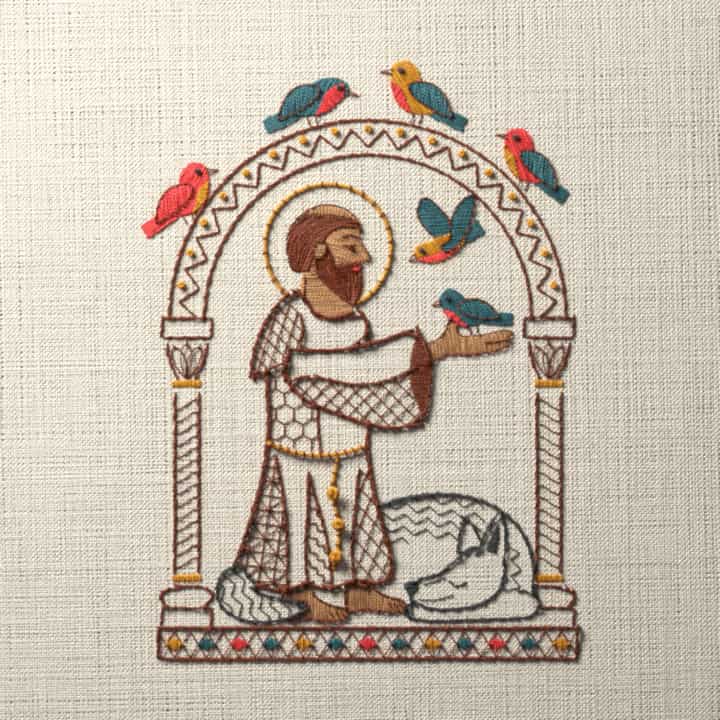
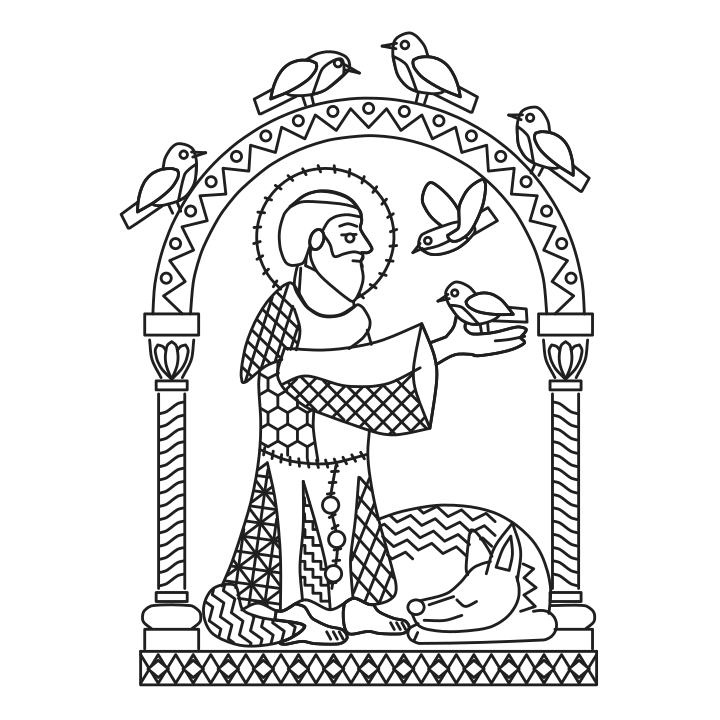
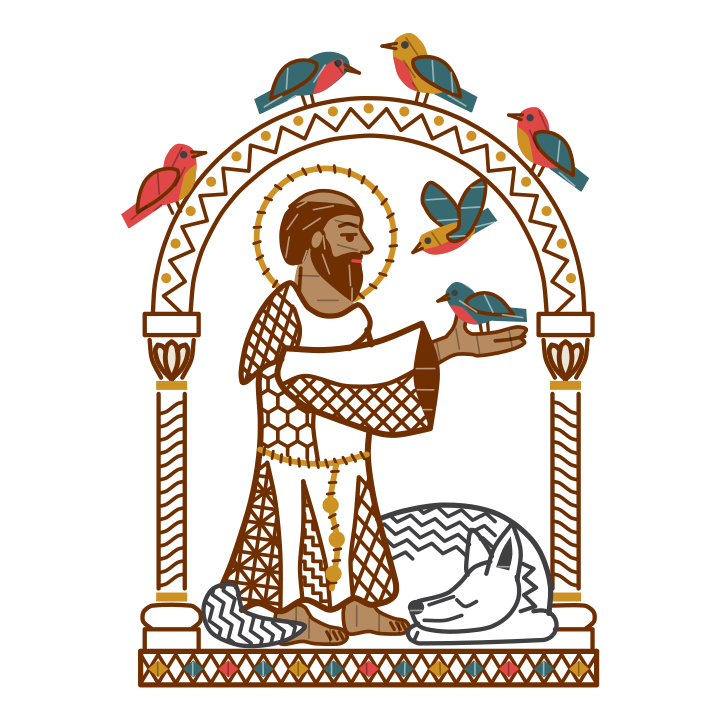
Saint Francis stands barefoot under a round arch, a bird on his open hand and a sleeping wolf curled at his hem. Draw the habit, the arch and the wolf in stem stitch, then fill the folds with lattices of one-strand back stitch: hexagons, diamonds, squares and stairs. The birds and the set stones are satin stitch, and his hair and beard are long and short stitch. The halo and the rope belt are couching, with French knots for the three knots of the rope. In the picture of where the colors go, the fine lines show which way the stitches lie.
Size and details
Advanced. Uses couching and long and short stitch; from a 6 inch hoop up the widest satin stitches are long.
6 colors of floss and 8 kinds of stitch:
- Stem stitch
- Back stitch
- French knot
- Lazy daisy stitch
- Satin stitch
- Straight stitch
- Couching
- Long and short stitch
- Which stitch goes where
| Hoop | Inches | Centimeters | Satin stitch up to |
|---|---|---|---|
| 3 in (8 cm) | 1.3 × 1.8 in | 3.3 × 4.6 cm | 3/16 in (5 mm) |
| 4 in (10 cm) | 2 × 2.7 in | 5.1 × 6.9 cm | 1/4 in (6 mm) |
| 5 in (13 cm) | 2.6 × 3.6 in | 6.6 × 9.1 cm | 5/16 in (8 mm) |
| 6 in (15 cm) | 3.3 × 4.5 in | 8.4 × 11.4 cm | 7/16 in (11 mm) |
| 8 in (20 cm) | 4.6 × 6.2 in | 11.7 × 15.7 cm | 5/8 in (16 mm) |
- In an 8 inch hoop the widest satin stitch shape is 5/8 in (16 mm) across. Satin stitches longer than about 12 mm (just under 1/2 in) tend to work loose: divide the shape into sections, or work it in long and short stitch.
- In a 3, 4 or 5 inch hoop the French knots are drawn smaller than about 2 mm (a little over 1/16 in). Use one strand of floss for them there, or choose a larger hoop.
The pattern is drawn inside a circle about half an inch (1.3 cm) smaller all around than the hoop.
What you need
- DMC 300 Very Dark MahoganyHabit lattice, step lattice, columns, habit outline and arch and 14 more parts
- DMC 783 Medium TopazBirds and set stones (light), halo and rope belt (lighter), arch knots and 2 more parts
- DMC 3808 Ultra Very Dark TurquoiseBird wings and bird tails (darker), birds and set stones (dark)
- DMC 350 Medium CoralBirds (middle), bird breasts (darker), bird wings (lighter) and 3 more parts
- DMC 3799 Very Dark Pewter GrayWolf outline, wolf fur, wolf face, wolf ears, bird eyes and wolf nose
- DMC 3828 Hazelnut BrownFace and feet and hands
Skeins: 2 for habit lattice, step lattice, columns, habit outline and arch and 14 more parts; one of each other color. An estimate for the largest size, the 8 inch hoop: the length of each line and the area of each filled shape, a fifth added for tails and ends, a tenth of every 8 m (8.7 yd) skein kept spare.
The floss is six-strand cotton; the stitch guide says how many strands to use. You also need a hoop, an embroidery needle (a size 9 or 10 for one strand, 7 to 9 for two or three, and 3 to 5 for four or more) and plain cotton or linen fabric. To frame the piece in its hoop, cut a square 3 inches (8 cm) wider than the hoop: a 9 inch (23 cm) square for a 6 inch hoop.
When it is stitched, how to finish a hoop shows how to back it for the wall.
Stitch guide
- Put the pattern on the fabric (how to transfer a pattern) and the fabric in the hoop.
- Stitch the filled parts first, what lies behind before what lies in front of it.
- Then stitch the lines: stems, veins and outlines over the edges of the filled parts.
- Keep the knots for the end, so that the hoop and your hand do not flatten them.
Inside a filled shape start with two or three tiny stitches, which the filling covers: a knot shows as a bump. A line may start with a small knot on the back or one of the knotless starts. End each thread by running the needle under the backs of a few stitches. (Starting and ending a thread shows how.) Use the strands this list gives, and begin as it says, also where a page about a stitch names another number or begins with a knot.
- Stem stitch 1 to 4 strandsArch, columns, steps, wolf outline, habit folds, habit outline
- Back stitch 1 to 2 strandsArch chevrons, twisted shafts, step lattice, wolf fur, skin outline, habit lattice, brow, wolf face, bird lines
- French knot 1 to 2 strands, two wrapsArch knots, rope knots, eye, bird eyes
- Lazy daisy stitch 1 strandCapital leaves
- Satin stitch 2 strandsSet stones, feet and hands, face, sleeve opening, wolf ears, wolf nose, bird tails, birds, bird breasts, bird wings
- Straight stitch 1 to 2 strandsSkin outline, eye, mouth, bird legs, bird lines
- Couching 4 to 5 strandsRope belt, halo
- Long and short stitch 1 strandHair and beard
Getting it onto your fabric
The PDF holds the pattern twice at actual size: once as drawn, and once mirrored for an iron-on transfer pen. Print it at 100% with scaling off and check the one-inch square (25.4 mm) with a ruler before you trace. How to transfer a pattern explains tracing, carbon paper, the sticky wash-away sheet for knits, denim and dark cloth, and the other ways. The files are under Downloads.
Downloads
- Download free PDF PDF, US Letter, 3 pages, for a 6 inch (15 cm) hoop
- Download free PDF, A4 PDF, A4, 3 pages, for a 6 inch (15 cm) hoop
More patterns like this
Advanced 3–8 in hoop · 7 colors
Gold chalice and grapevine border
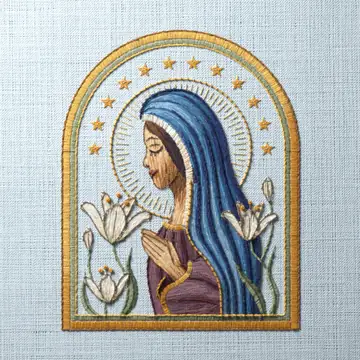
Advanced 3–8 in hoop · 23 colors
Our Lady with lilies and stars
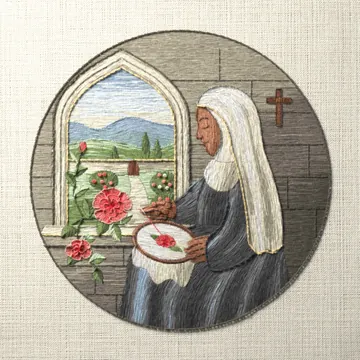
Advanced prints 3–14 in · 23 colors
Nun embroidering by an open window
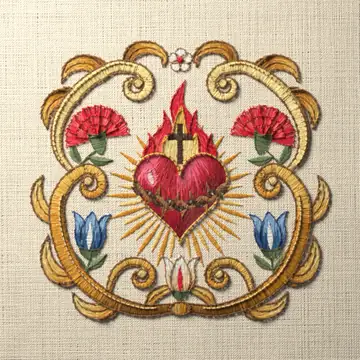
Advanced 3–8 in hoop · 23 colors
Sacred Heart with baroque gold scrolls
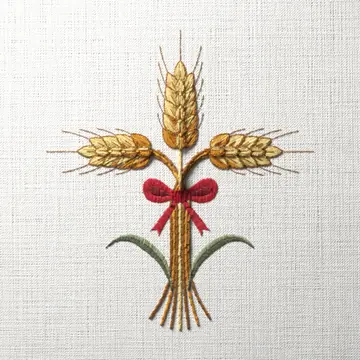
Easy 3–8 in hoop · 7 colors
Small and easy wheat cross
Advanced 3–8 in hoop · 24 colors
First communion cup, wheat and grapes
Advanced 3–8 in hoop · 16 colors
Brown scapular with heart and lily
Advanced 3–8 in hoop · 17 colors
Lamb of God for a stole
New to hand embroidery? Starting hand embroidery, step by step