Santa suit on the washing line hand embroidery pattern
Advanced · 24 colors · 11 kinds of stitch
Download free PDFPDF, US Letter · 67 KBFor your own stitching, gifts and handmade pieces you sell. Do not resell or share this PDF. What you may do, in full
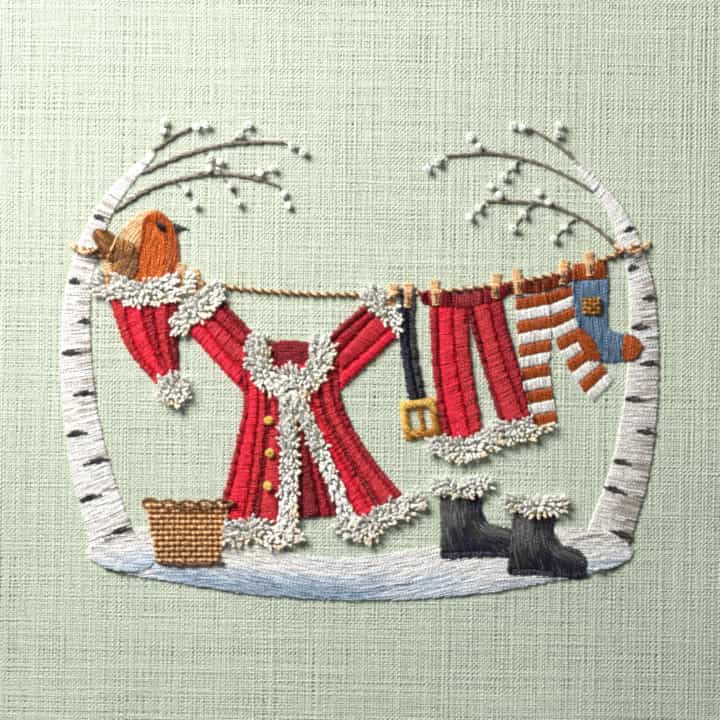
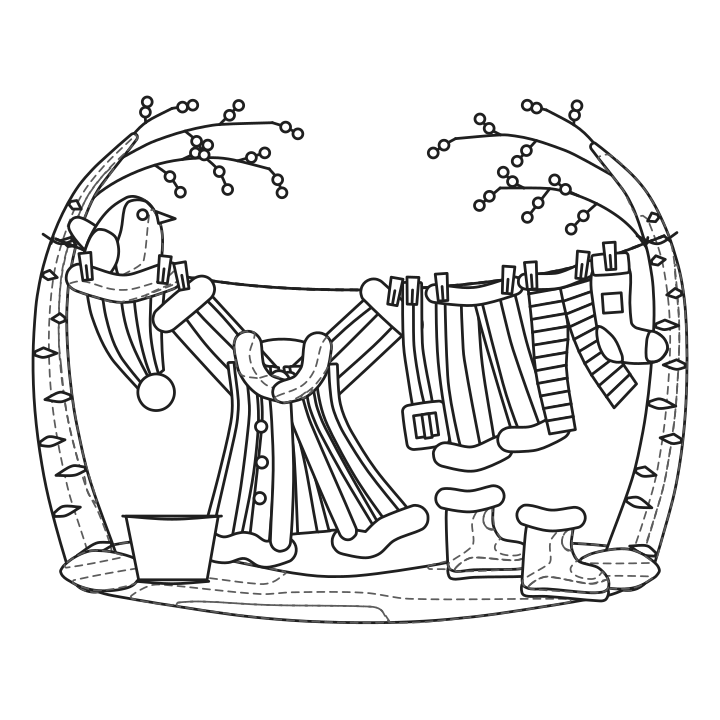
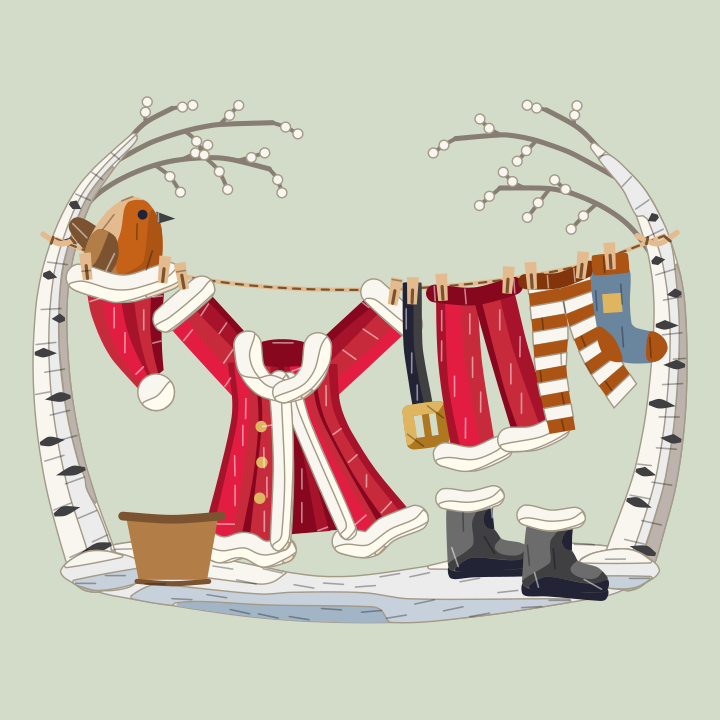
The day after: Santa’s coat hangs by its cuffs beside his hat, belt, trousers, striped long johns and one darned sock, and a robin has settled in the hat. The red cloth is worked in raised bars of padded satin stitch, dark beside light, so that it hangs in folds. Cuffs, collar, hems and pompom are turkey work, left as a soft cut pile. The birches, the snow, the boots and the robin are long and short stitch, the line is whipped back stitch, and the basket and the darn are woven filling. French knots make the frost on the twigs and the gold coat buttons. In the picture of where the colors go, the fine lines show which way the stitches lie.
Size and details
Advanced. Uses long and short stitch, couching, padded satin stitch, turkey work, dozens of French knots, 24 colors and a great deal of stitching; from a 6 inch hoop up the widest satin stitches are long.
24 colors of floss and 11 kinds of stitch:
- Long and short stitch
- Stem stitch
- French knot
- Satin stitch
- Whipped back stitch
- Couching
- Padded satin stitch
- Turkey work
- Straight stitch
- Woven filling stitch
- Chain stitch
- Which stitch goes where
| Hoop | Inches | Centimeters | Satin stitch up to |
|---|---|---|---|
| 3 in (8 cm) | 1.8 × 1.5 in | 4.6 × 3.8 cm | 1/8 in (3 mm) |
| 4 in (10 cm) | 2.7 × 2.2 in | 6.9 × 5.6 cm | 1/4 in (6 mm) |
| 5 in (13 cm) | 3.7 × 2.9 in | 9.4 × 7.4 cm | 5/16 in (8 mm) |
| 6 in (15 cm) | 4.6 × 3.7 in | 11.7 × 9.4 cm | 3/8 in (10 mm) |
| 8 in (20 cm) | 6.4 × 5.1 in | 16.3 × 13 cm | 9/16 in (14 mm) |
- In an 8 inch hoop the widest satin stitch shape is 9/16 in (14 mm) across. Satin stitches longer than about 12 mm (just under 1/2 in) tend to work loose: divide the shape into sections, or work it in long and short stitch.
- In a 3, 4, 5 or 6 inch hoop the French knots are drawn smaller than about 2 mm (a little over 1/16 in). Use one strand of floss for them there, or choose a larger hoop.
The pattern is drawn inside a circle about half an inch (1.3 cm) smaller all around than the hoop.
What you need
- DMC 762 Very Light Pearl GraySnow (light), birch trunks (middle)
- DMC 932 Light Antique BlueSnow (darkest)
- DMC 3752 Very Light Antique BlueSnow (dark)
- DMC 3865 Winter WhiteBirch trunks (light), snow (lightest) and 10 more parts
- DMC 646 Dark Beaver GrayBranches and twigs
- DMC 648 Light Beaver GrayBirch trunks (dark)
- DMC 3799 Very Dark Pewter GrayBoots (middle), bark marks and robin beak, belt (lighter)
- DMC 437 Light TanRobin back (light), washing line (lighter), pegs
- DMC 433 Medium BrownWashing line and robin wing (darker), robin back (dark) and 3 more parts
- DMC 435 Very Light BrownBasket, robin back (middle), robin wing (lighter)
- DMC 921 CopperRobin breast (light)
- DMC 918 Dark Red CopperLong johns waistband, robin breast (dark)
- DMC 920 Medium CopperLong johns (darker), robin breast (middle), sock top and 2 more parts
- DMC 310 BlackBoots (dark), boot soles and robin eye, belt (darker)
- DMC 321 RedCoat, trousers, coat sleeves and hat (light)
- DMC 666 Bright RedCoat, coat sleeves, trousers and hat (lightest)
- DMC 498 Dark RedCoat, trousers, coat sleeves and hat (dark), coat lining (lighter)
- DMC 815 Medium GarnetCoat lining (darker), coat and coat sleeves (darkest) and 3 more parts
- DMC 739 Ultra Very Light TanHat brim, coat collar, coat hem, coat cuffs and coat front (dark)
- DMC 712 CreamCoat collar, coat front, coat hem and coat cuffs (light) and 4 more parts
- DMC 3820 Dark StrawBelt buckle (lighter), darn and coat buttons
- DMC 782 Dark TopazBelt buckle (darker)
- DMC 317 Pewter GrayBoots (light)
- DMC 931 Medium Antique BlueSock
Skeins: one of each color is enough. An estimate for the largest size, the 8 inch hoop: the length of each line and the area of each filled shape, a fifth added for tails and ends, a tenth of every 8 m (8.7 yd) skein kept spare.
The floss is six-strand cotton; the stitch guide says how many strands to use. You also need a hoop, an embroidery needle (a size 7 to 9 suits two or three strands) and plain cotton or linen fabric. To frame the piece in its hoop, cut a square 3 inches (8 cm) wider than the hoop: a 9 inch (23 cm) square for a 6 inch hoop.
When it is stitched, how to finish a hoop shows how to back it for the wall.
Stitch guide
- Put the pattern on the fabric (how to transfer a pattern) and the fabric in the hoop.
- Stitch the filled parts first, what lies behind before what lies in front of it.
- Then stitch the lines: stems, veins and outlines over the edges of the filled parts.
- Keep the raised parts and the knots for the end, so that the hoop and your hand do not flatten them.
Start each thread with a small knot on the back or one of the knotless starts, and end it by running the needle under the backs of a few stitches (starting and ending a thread). Use the strands this list gives, also where a page about a stitch names another number.
- Long and short stitch 1 strandSnow, birch trunks, robin tail, robin back, robin breast, robin wing, boots
- Stem stitch 1 to 3 strandsBranches, twigs, basket rim
- French knot 2 strands, two wrapsFrost, robin eye, coat buttons
- Satin stitch 2 strandsBark marks, robin beak, pegs, coat lining, belt buckle, trousers waistband, long johns, and 6 more
- Whipped back stitch 3 strandsWashing line
- Couching 4 strandsWashing line
- Padded satin stitch 2 strandsHat, coat lining, coat sleeves, coat, belt, belt buckle, trousers
- Turkey work 2 strandsHat brim, hat pompom, coat hem, coat front, coat collar, coat cuffs, trousers fur, boot fur
- Straight stitch 1 strandPeg grooves
- Woven filling stitch 3 strandsBasket, darn
- Chain stitch 4 strandsBasket rim
Getting it onto your fabric
The PDF holds the pattern twice at actual size: once as drawn, and once mirrored for an iron-on transfer pen. Print it at 100% with scaling off and check the one-inch square (25.4 mm) with a ruler before you trace. How to transfer a pattern explains tracing, carbon paper and the other ways. The files are under Downloads.
Downloads
- Download free PDF PDF, US Letter, 3 pages, for a 6 inch (15 cm) hoop
- Download free PDF, A4 PDF, A4, 3 pages, for a 6 inch (15 cm) hoop
More patterns like this
Advanced 3–8 in hoop · 24 colors
Santa bag full of toys in the snow
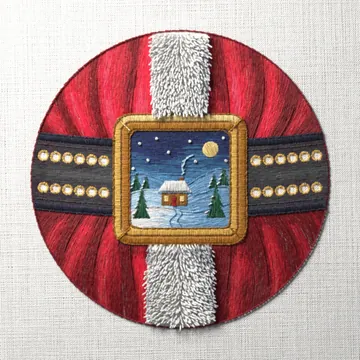
Advanced 3–8 in hoop · 24 colors
Santa belt Christmas countdown
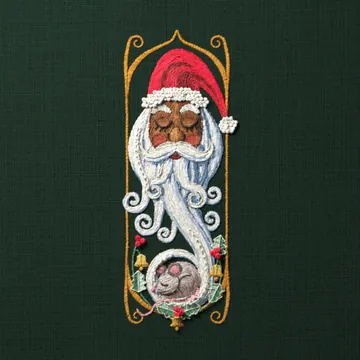
Advanced 3–8 in hoop · 24 colors
Swirly beard Santa bookmark
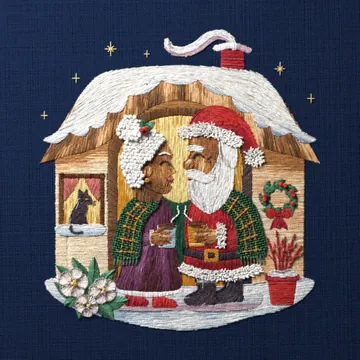
Advanced 3–8 in hoop · 24 colors
Mr. and Mrs. Santa Claus at home
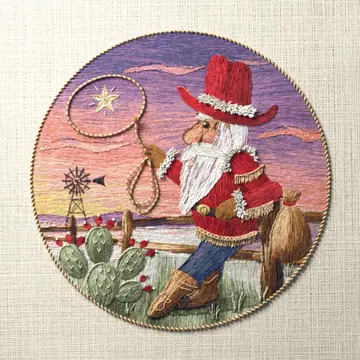
Advanced 3–8 in hoop · 24 colors
Cowboy Santa at the prairie fence
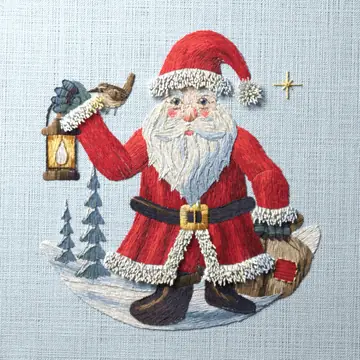
Advanced 3–8 in hoop · 24 colors
Santa Claus from the front
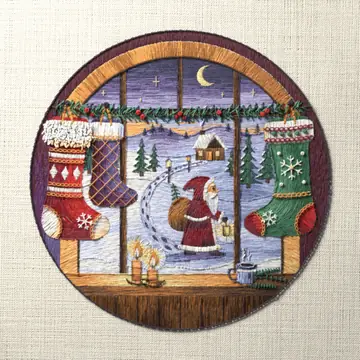
Advanced 3–8 in hoop · 23 colors
Santa and stockings at a snowy window
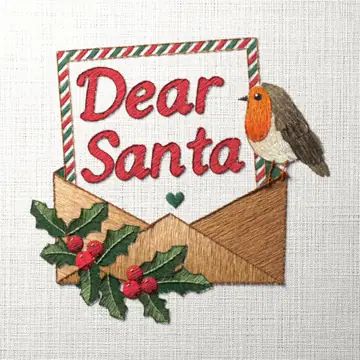
Advanced 3–8 in hoop · 23 colors
Dear Santa
New to hand embroidery? Starting hand embroidery, step by step