Santa with a chainsaw in the snow hand embroidery pattern
Advanced · 16 colors · 4.8 × 4.8 in · 8 kinds of stitch
Download free PDFPDFPrints on US Letter and A4You may sell what you make from it by hand, in small quantities. The PDF itself is not to be sold or shared. Selling, classes and kits: the rules
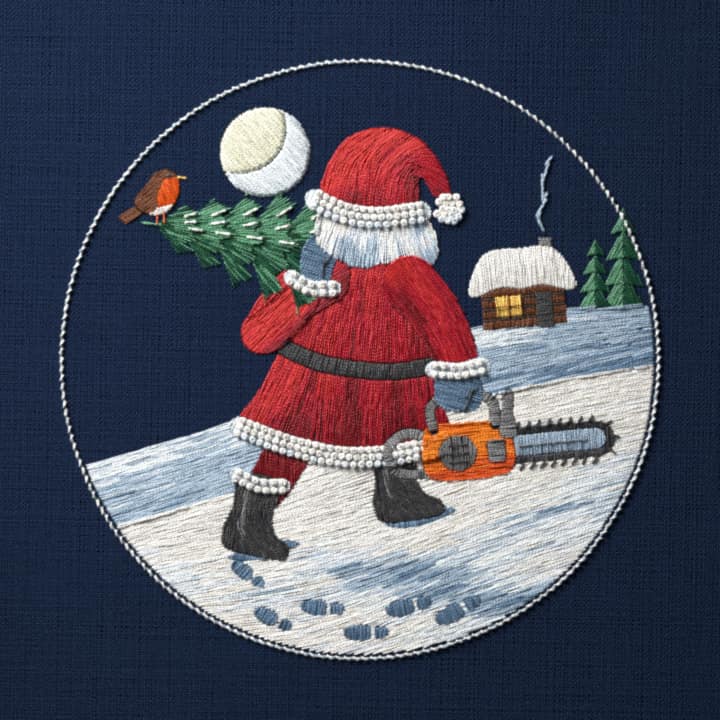
Santa walks away from us toward a cabin with one lit window, his footprints curving in from the foreground.
Size and details
Advanced. Uses padded satin stitch, long and short stitch over much of the design, more than a hundred French knots, 16 colors and a great deal of stitching; from a 5 inch hoop up the widest satin stitches are long.
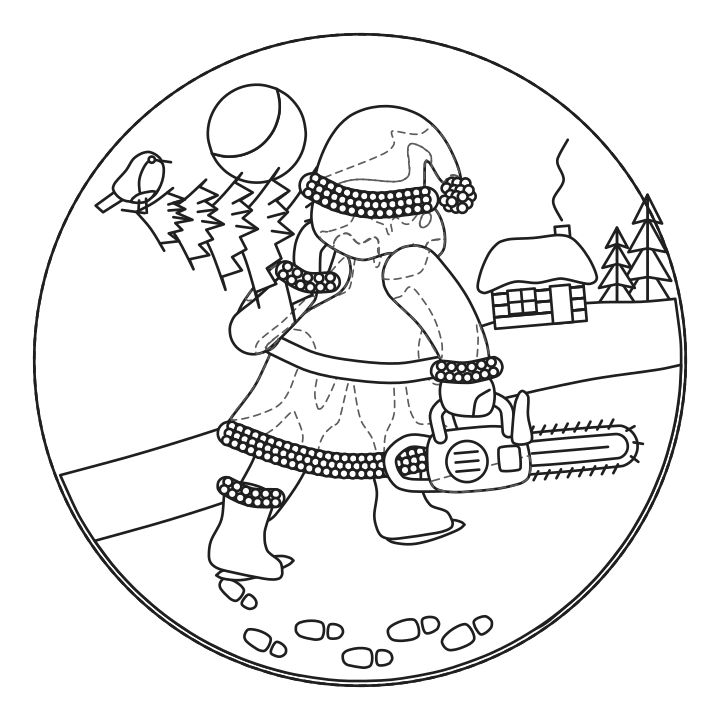
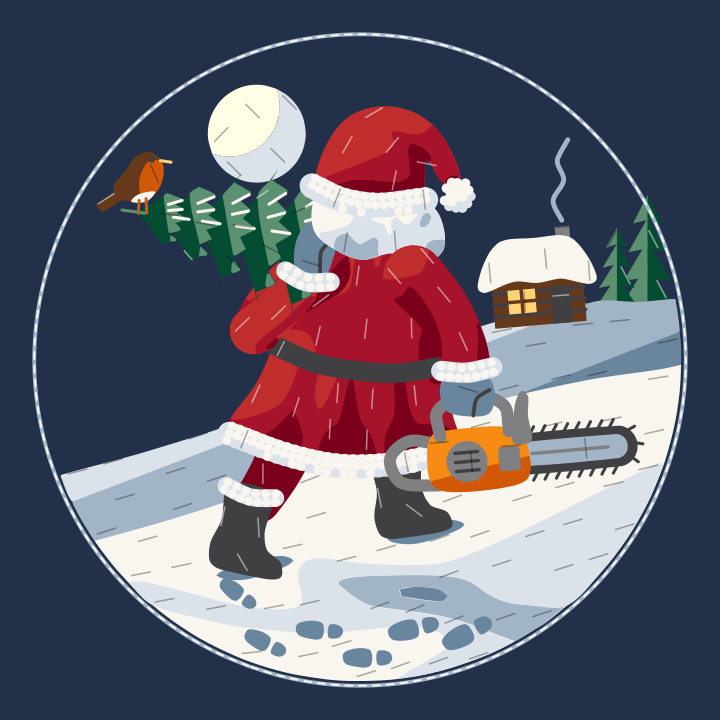
The coat, snow, boots and spruce are long and short stitch, the moon is padded satin stitch, and the fur trim is rows of French knots over satin stitch. The chainsaw is long and short stitch and satin stitch with straight stitch teeth along the chain. The night sky is bare navy cloth, and a whipped back stitch ring closes the hoop. In the picture of where the colors go, the fine lines show which way the stitches lie.
| Hoop | Inches | Centimeters | Satin stitch up to |
|---|---|---|---|
| 3 in (8 cm) | 1.9 × 1.9 in | 4.8 × 4.8 cm | 3/16 in (5 mm) |
| 4 in (10 cm) | 2.9 × 2.9 in | 7.4 × 7.4 cm | 1/4 in (6 mm) |
| 5 in (13 cm) | 3.8 × 3.8 in | 9.7 × 9.7 cm | 3/8 in (10 mm) |
| 6 in (15 cm) | 4.8 × 4.8 in | 12.2 × 12.2 cm | 7/16 in (11 mm) |
| 8 in (20 cm) | 6.7 × 6.7 in | 17 × 17 cm | 5/8 in (16 mm) |
- In an 8 inch hoop the widest satin stitch shape is 5/8 in (16 mm) across. Satin stitches longer than about 12 mm (just under 1/2 in) tend to work loose: divide the shape into sections, or work it in long and short stitch.
- In a 3, 4, 5 or 6 inch hoop the French knots are drawn smaller than about 2 mm (a little over 1/16 in). Use one strand of floss for them there, or choose a larger hoop.
What you need
- Fabric
- Plain cotton or linen in navy, cut 9 in (23 cm) square. On white cloth its palest threads do not show: choose other colors under Options. A pencil line does not show on it: see how to transfer a pattern to dark fabric.
- Needle
- Embroidery needle, size 9 for 1 strand, size 7 for 2 or 3 (a lower number is a thicker needle).
- Floss
- 16 colors of six-strand cotton, listed below. DMC is a brand: another brand in a like color will do.
- Marker
- A pen or a sheet that suits the fabric: how to transfer a pattern says which.
Floss
- 1DMC 3753 Ultra Very Light Antique BlueSnow and far ridge (light), fur trim and moon (darker) and 3 more parts
- 2DMC 3823 Ultra Pale YellowMoon (lighter)
- 3DMC 500 Very Dark Blue GreenSpruce and far spruces (darker)
- 4DMC 502 Blue GreenSpruce and far spruces (lighter)
- 5DMC 931 Medium Antique BlueFar ridge (dark), mittens, footprints and boot shadows, snow (darkest)
- 6DMC 932 Light Antique BlueFar ridge (middle), ring (darker), snow (dark), guide bar and 2 more parts
- 7DMC 3865 Winter WhiteSnow (lightest), ring and fur trim (lighter), beard and hair (light) and 5 more parts
- 8DMC 414 Dark Steel GraySaw handles, saw cover, hand guard, chimney and bar groove
- 9DMC 801 Dark Coffee BrownCabin logs, robin, spruce trunk, robin tail and window bars
- 10DMC 3799 Very Dark Pewter GrayBoots, chain, belt, log seams, chain teeth and cabin door and 3 more parts
- 11DMC 743 Medium YellowLit window and robin beak
- 12DMC 814 Dark GarnetTrousers, coat, sleeves and hat (dark)
- 13DMC 498 Dark RedCoat, sleeves and hat (middle)
- 14DMC 347 Very Dark SalmonHat, coat and sleeves (light)
- 15DMC 970 Light PumpkinSaw body (lighter)
- 16DMC 900 Dark Burnt OrangeSaw body (darker), robin breast and robin legs
Skeins: 2 of DMC 3865; one of each other color. An estimate for the 6 inch hoop, from the length of each line and the area of each filled shape, with a fifth added for tails.
How to stitch it
- New to hand embroidery? Start here.
- Print at 100%, trace the pattern onto the fabric, and put it in the hoop: inner ring under, drawing up, tight as a drum.
- Floss is six strands. Cut 18 inches (45 cm), pull out the number given one at a time, and lay them together.
- Inside a filled shape start with two or three tiny stitches, which the filling covers. Start a line with a small knot on the back. End each thread by running the needle under the backs of a few stitches.
- Each small ring is one French knot. A dashed line is whipped back stitch. A fine broken line inside a shape is where two shades meet: trace it, do not stitch it.
- A number under “Where colors go” is a color of the list. The fine lines on the colors show which way the stitches lie.
Stitch in this order
Filled parts from the back of the picture forward, then lines and knots. Where a stitch page names another number of strands, use the number here.
- Padded satin stitch 2 strandsMoon
- Satin stitch2 strands: lit window, snowy roof, footprints, boot shadows, belt, mittens, guide bar, saw handles, saw cover, hand guard, robin breast1 strand: far spruces, chimney, cabin logs, cabin door, boot cuffs, fur trim, chain, robin tail, robin belly
- Long and short stitch2 strands: far ridge, snow1 strand: trousers, boots, coat, sleeves, spruce trunk, spruce, beard and hair, hat, saw body, robin
- Back stitch 1 strandLog seams, window bars, bar groove, cover vents
- Stem stitch3 strands: chimney smoke1 strand: mitten thumbs
- Straight stitch2 strands: snow on the boughs, spruce, chain teeth, robin beak1 strand: robin legs
- Whipped back stitch 2 strandsRing
- French knot two wraps2 strands: boot cuffs, fur trim, hat pompom1 strand: robin eye
When it is done, take off any lines that still show and finish the hoop. A guide to this kind of work: How to embroider a face.
More patterns like this
Advanced 3–8 in hoop · 17 colors
Santa in holly
Advanced prints 3–14 in · 14 colors
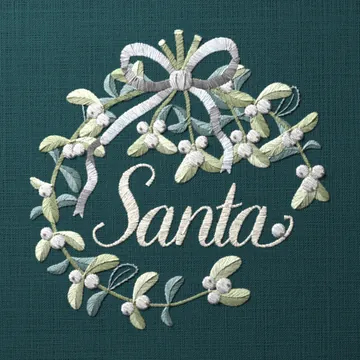
Santa in mistletoe
Advanced prints 3–14 in · 21 colors
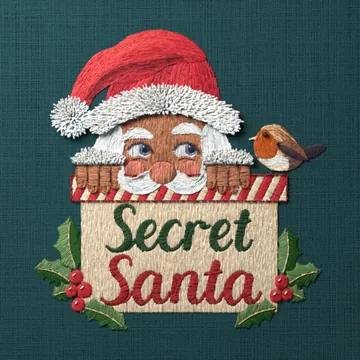
Secret Santa
Advanced 3–8 in hoop · 23 colors
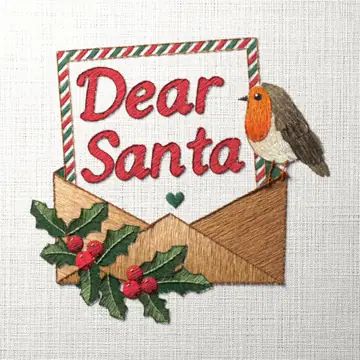
Dear Santa
Advanced prints 3–14 in · 24 colors
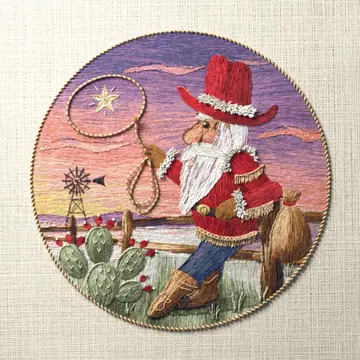
Cowboy Santa at the prairie fence
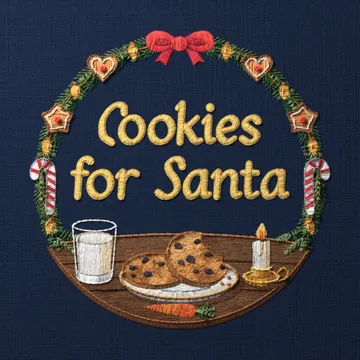
Advanced prints 3–14 in · 21 colors
Cookies for Santa with cookies and milk
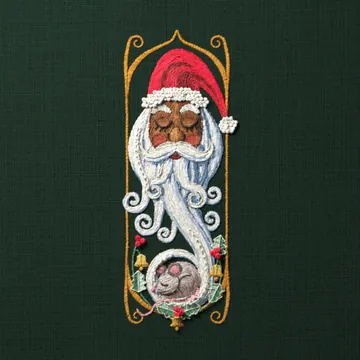
Advanced 3–8 in hoop · 24 colors
Swirly beard Santa bookmark
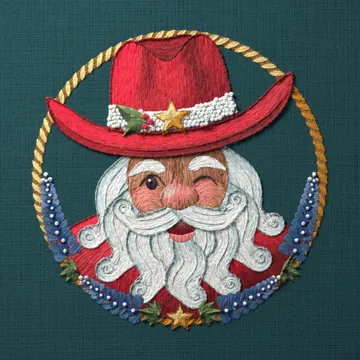
Advanced prints 3–14 in · 23 colors
Texas Santa in a cowboy hat
New to hand embroidery? Starting hand embroidery, step by step