Six easy earrings to mix and match hand embroidery pattern
Easy · 7 colors · 8 kinds of stitch
Download free PDFPDF, US Letter · 40 KBFor your own stitching, gifts and handmade pieces you sell. Do not resell or share this PDF. What you may do, in full
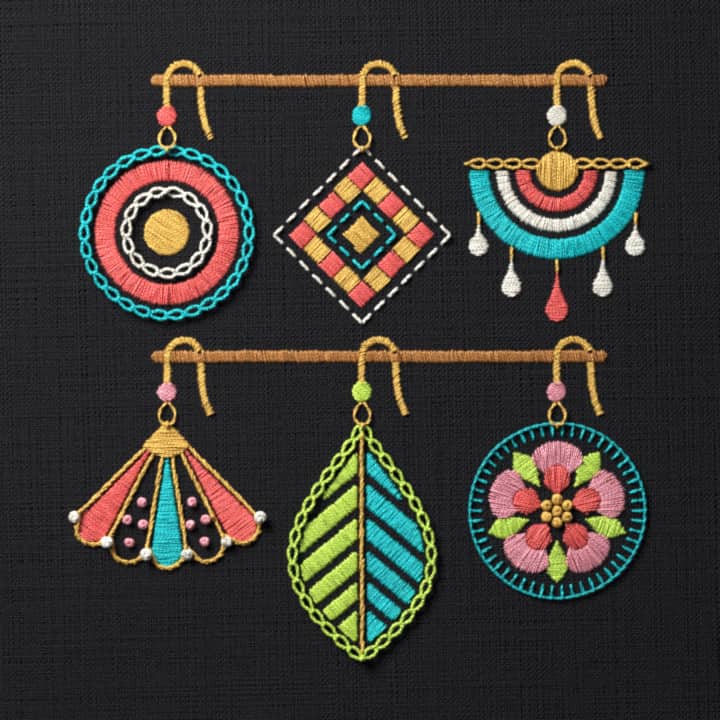
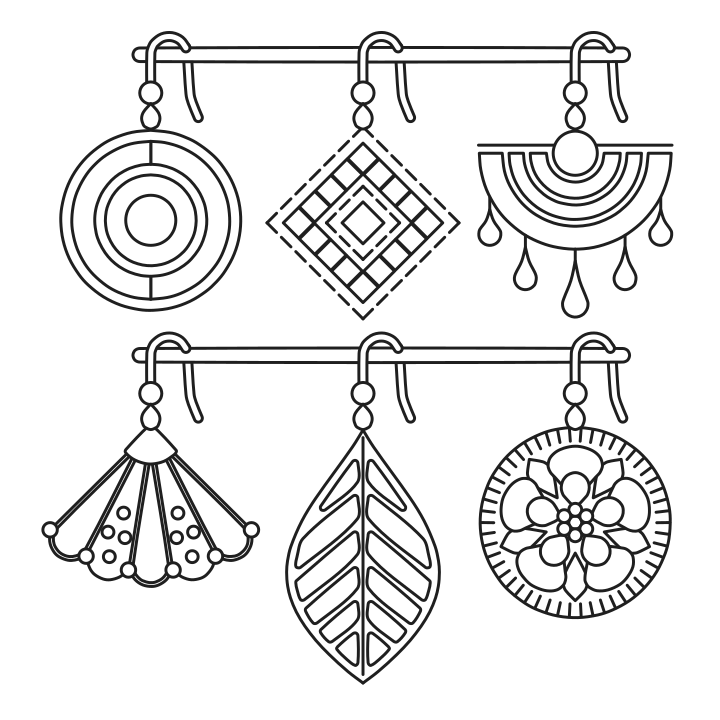
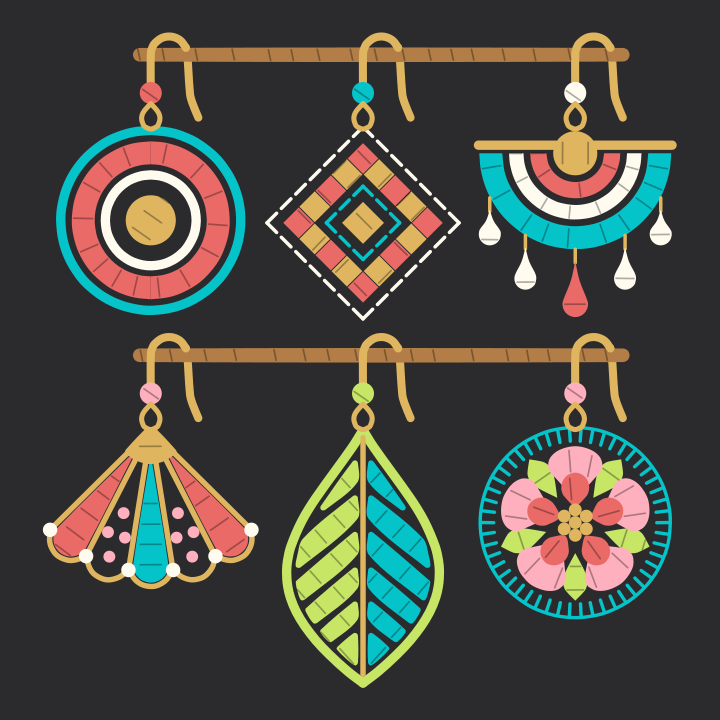
Six earrings hang from gold ear wires over two teak rails worked in satin stitch. Above are a disc with rings of chain stitch round a satin stitch band, a diamond with running stitch frames and a checked band of satin stitch blocks, and a half round of satin stitch bands with a chain stitch top and five small drops. Below are a fan with stem stitch ribs, satin stitch panels and French knots, a leaf drop with slanting satin stitch leaflets inside a chain stitch outline, and a flower of satin stitch petals in a blanket stitch rim. Each ear wire has a satin stitch bead and one lazy daisy stitch for its jump ring. Seven threads are used: coral, gold, turquoise, cream, lime, pink and teak. It is drawn for charcoal linen. In the picture of where the colors go, the fine lines show which way the stitches lie.
Size and details
Easy. In a hoop of 6 inches or less: short satin stitches, no shading; in a larger hoop the widest satin stitches are long.
7 colors of floss and 8 kinds of stitch:
- Satin stitch
- Chain stitch
- Lazy daisy stitch
- Running stitch
- Straight stitch
- Stem stitch
- French knot
- Blanket stitch
- Which stitch goes where
| Hoop | Inches | Centimeters | Satin stitch up to |
|---|---|---|---|
| 3 in (8 cm) | 1.7 × 1.7 in | 4.3 × 4.3 cm | 1/8 in (3 mm) |
| 4 in (10 cm) | 2.5 × 2.6 in | 6.4 × 6.6 cm | 3/16 in (5 mm) |
| 5 in (13 cm) | 3.3 × 3.4 in | 8.4 × 8.6 cm | 1/4 in (6 mm) |
| 6 in (15 cm) | 4.2 × 4.3 in | 10.7 × 10.9 cm | 5/16 in (8 mm) |
| 8 in (20 cm) | 5.8 × 6 in | 14.7 × 15.2 cm | 7/16 in (11 mm) |
- In a 3, 4 or 5 inch hoop the French knots are drawn smaller than about 2 mm (a little over 1/16 in). Use one strand of floss for them there, or choose a larger hoop.
The pattern is drawn inside a circle about half an inch (1.3 cm) smaller all around than the hoop.
What you need
- DMC 3820 Dark StrawEar wires, fan ribs and ring center, checked band (lighter) and 9 more parts
- DMC 435 Very Light BrownDisplay rails
- DMC 3845 Medium Bright TurquoiseDisc rim, leaflets (darker), half round and rings (middle) and 3 more parts
- DMC 712 CreamHalf round and rings (light), diamond frames and drops (lighter) and 2 more parts
- DMC 351 CoralRings (dark), fan panels and checked band (darker), petal bases and 3 more parts
- DMC 604 Light CranberryPetals and fan knots, beads (middle)
- DMC 907 Light Parrot GreenLeaflets (lighter), flower leaves and leaf drop outline, beads (light)
Skeins: one of each color is enough. An estimate for the largest size, the 8 inch hoop: the length of each line and the area of each filled shape, a fifth added for tails and ends, a tenth of every 8 m (8.7 yd) skein kept spare.
The floss is six-strand cotton; the stitch guide says how many strands to use. You also need a hoop, an embroidery needle (a size 7 to 9 suits two or three strands) and plain cotton or linen fabric. To frame the piece in its hoop, cut a square 3 inches (8 cm) wider than the hoop: a 9 inch (23 cm) square for a 6 inch hoop.
When it is stitched, how to finish a hoop shows how to back it for the wall.
Stitch guide
- Put the pattern on the fabric (how to transfer a pattern) and the fabric in the hoop.
- Stitch the filled parts first, what lies behind before what lies in front of it.
- Then stitch the lines: stems, veins and outlines over the edges of the filled parts.
- Keep the knots for the end, so that the hoop and your hand do not flatten them.
Start each thread with a small knot on the back or one of the knotless starts, and end it by running the needle under the backs of a few stitches (starting and ending a thread). Use the strands this list gives, also where a page about a stitch names another number.
- Satin stitch 2 strandsEar wires, display rails, rings, ring center, beads, checked band, diamond center, half round, half round center, drops, fan panels, and 5 more
- Chain stitch 3 strandsRings, half round top, leaf drop outline
- Lazy daisy stitch 2 strandsJump rings
- Running stitch 3 strandsDiamond frames
- Straight stitch 3 strandsDrop links
- Stem stitch 3 strandsFan edge, fan ribs, midrib
- French knot 2 strands, two wrapsFan knots, fan tips, flower center
- Blanket stitch 2 strandsDisc rim
Getting it onto your fabric
The PDF holds the pattern twice at actual size: once as drawn, and once mirrored for an iron-on transfer pen. Print it at 100% with scaling off and check the one-inch square (25.4 mm) with a ruler before you trace. How to transfer a pattern explains tracing, carbon paper and the other ways. The files are under Downloads.
Downloads
- Download free PDF PDF, US Letter, 3 pages, for a 6 inch (15 cm) hoop
- Download free PDF, A4 PDF, A4, 3 pages, for a 6 inch (15 cm) hoop
More patterns like this
Advanced 3–8 in hoop · 24 colors
Nine little gemstones
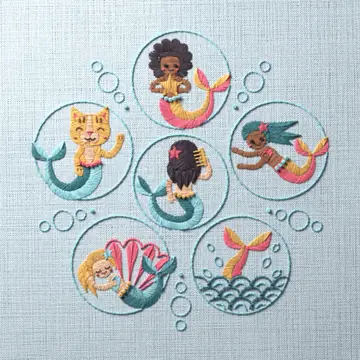
Easy 3–8 in hoop · 7 colors
Six easy mini mermaid motifs
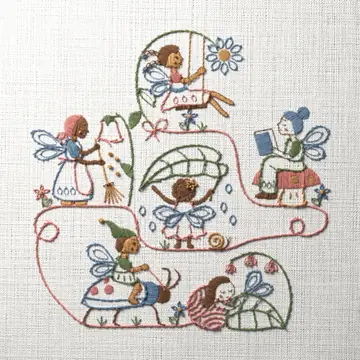
Easy 3–8 in hoop · 5 colors
Six little vintage fairies to trace
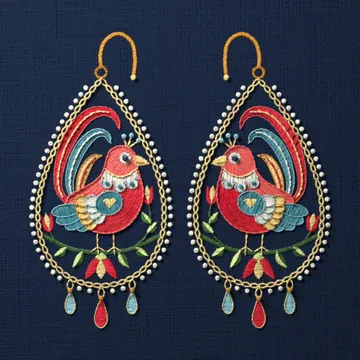
Advanced 3–8 in hoop · 11 colors
Folk bird teardrop earrings
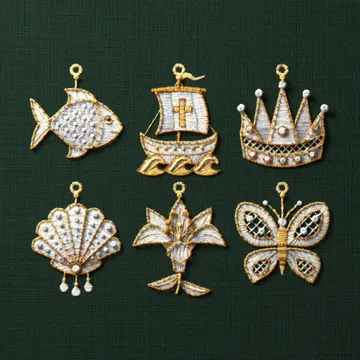
Advanced 3–8 in hoop · 10 colors
Six white and gold Chrismon ornaments
Advanced 3–8 in hoop · 10 colors
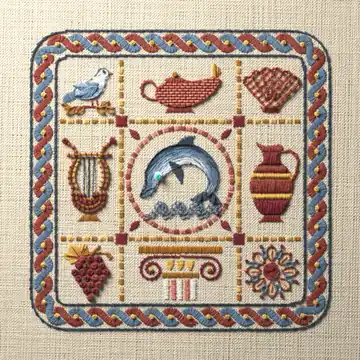
Ancient Roman motifs mosaic sampler
Advanced 3–8 in hoop · 12 colors
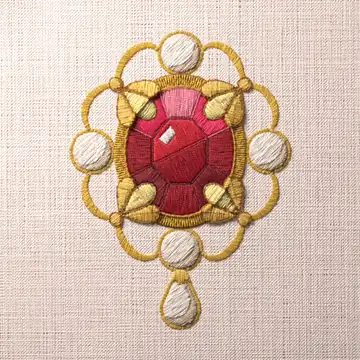
Ruby and pearl brooch
Advanced 3–8 in hoop · 13 colors
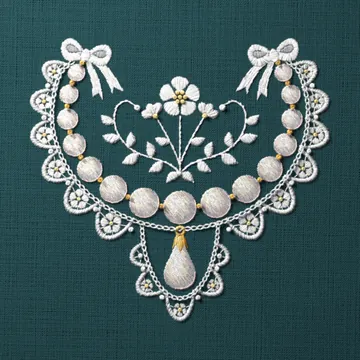
Pearl necklace neckline
New to hand embroidery? Starting hand embroidery, step by step