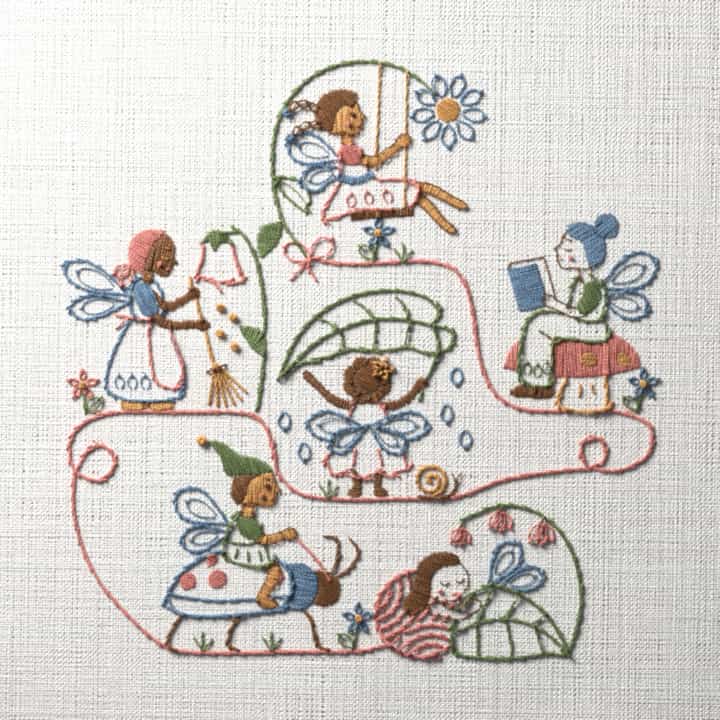
Six little vintage fairies to trace hand embroidery pattern
Easy · 5 colors · 7 kinds of stitch

Download free PDFPDF, US Letter · 78 KBFor your own stitching, gifts and handmade pieces you sell. Do not resell or share this PDF. What you may do, in full
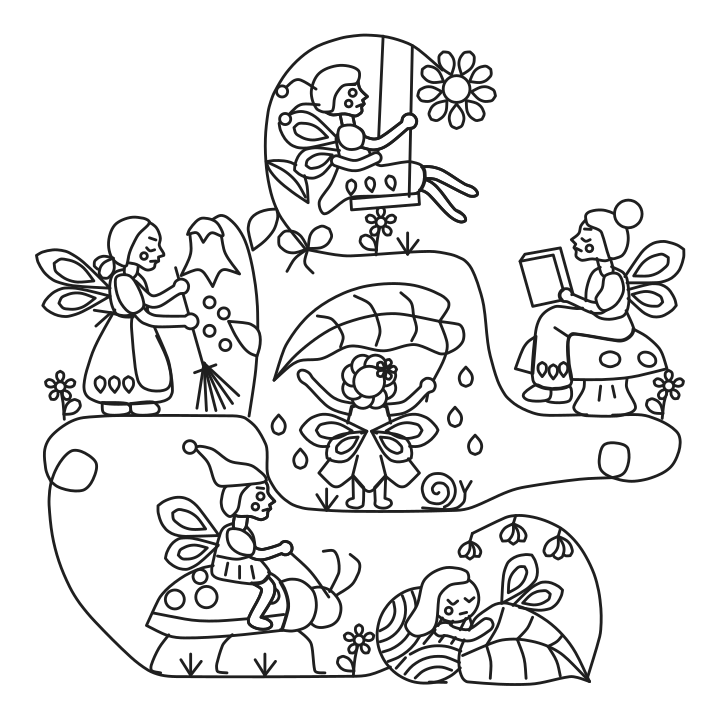
Six small fairies sit in rows of one, three and two, and each scene can be traced by itself. One rose thread starts as a bow at the daisy stem, runs along as the ground of every scene and ends in the ball under the sleeper’s head. Wings, skirts, leaves and the thread are stem stitch, with lazy daisies inside the wings and for petals and raindrops. Hair, curls, sleeves, caps and the toadstool are small patches of satin stitch, the swinging fairy’s plaits are chain stitch, and the fine face lines are back stitch. Five faded colors do it all, with French knots for eyes, cheeks and pollen. In the picture of where the colors go, the fine lines show which way the stitches lie.
Size and details
Easy. In a hoop of 6 inches or less: short satin stitches, no shading; in a larger hoop the widest satin stitches are long.
5 colors of floss and 7 kinds of stitch:
- Stem stitch
- Lazy daisy stitch
- French knot
- Satin stitch
- Back stitch
- Straight stitch
- Chain stitch
- Which stitch goes where
| Hoop | Inches | Centimeters | Satin stitch up to |
|---|---|---|---|
| 3 in (8 cm) | 1.8 × 1.8 in | 4.6 × 4.6 cm | 1/8 in (3 mm) |
| 4 in (10 cm) | 2.7 × 2.7 in | 6.9 × 6.9 cm | 3/16 in (5 mm) |
| 5 in (13 cm) | 3.6 × 3.6 in | 9.1 × 9.1 cm | 1/4 in (6 mm) |
| 6 in (15 cm) | 4.5 × 4.5 in | 11.4 × 11.4 cm | 5/16 in (8 mm) |
| 8 in (20 cm) | 6.3 × 6.3 in | 16 × 16 cm | 7/16 in (11 mm) |
- In a 3, 4 or 5 inch hoop the French knots are drawn smaller than about 2 mm (a little over 1/16 in). Use one strand of floss for them there, or choose a larger hoop.
- In a 3, 4, 5 or 6 inch hoop the shortest lazy daisy loops are drawn smaller than about 2 mm (a little over 1/16 in). Use one strand of floss for them there, or choose a larger hoop.
The pattern is drawn inside a circle about half an inch (1.3 cm) smaller all around than the hoop.
What you need
- DMC 223 Light Shell PinkTrail of thread, toadstool cap and ball of thread, dresses (light) and 13 more parts
- DMC 3363 Medium Pine GreenFlower stems, leaf veins, leaf umbrella and leaves, dresses (dark) and 11 more parts
- DMC 931 Medium Antique BlueWings, wing veins, daisy petals and beetle back, hair (lighter) and 9 more parts
- DMC 436 TanFaces, legs, broom bristles and arms (lighter), swing ropes and 13 more parts
- DMC 433 Medium BrownHair, arms, faces and legs (darker), beetle head and beetle legs and 10 more parts
Skeins: one of each color is enough. An estimate for the largest size, the 8 inch hoop: the length of each line and the area of each filled shape, a fifth added for tails and ends, a tenth of every 8 m (8.7 yd) skein kept spare.
The floss is six-strand cotton; the stitch guide says how many strands to use. You also need a hoop, an embroidery needle (a size 7 to 9 suits two or three strands) and plain cotton or linen fabric. To frame the piece in its hoop, cut a square 3 inches (8 cm) wider than the hoop: a 9 inch (23 cm) square for a 6 inch hoop.
When it is stitched, how to finish a hoop shows how to back it for the wall.
Stitch guide
- Put the pattern on the fabric (how to transfer a pattern) and the fabric in the hoop.
- Stitch the filled parts first, what lies behind before what lies in front of it.
- Then stitch the lines: stems, veins and outlines over the edges of the filled parts.
- Keep the knots for the end, so that the hoop and your hand do not flatten them.
Start each thread with a small knot on the back or one of the knotless starts, and end it by running the needle under the backs of a few stitches (starting and ending a thread). Use the strands this list gives, also where a page about a stitch names another number.
- Stem stitch 2 to 3 strandsTrail of thread, little flowers, thread bow, flower stems, leaves, wings, dresses, toadstool stalk, leaf umbrella, leaf veins, leaf stalk, and 12 more
- Lazy daisy stitch 1 to 2 strandsLittle flowers, thread bow, daisy petals, wing veins, dress trim, hair flower, raindrops, kerchief, bells
- French knot 1 to 2 strands, two wrapsLittle flowers, eyes, cheeks, bows, pollen, cap
- Satin stitch 2 strandsLeaves, daisy heart, legs, sash, swing seat, necks, faces, hair, arms, sleeves, toadstool cap, toadstool spots, shoes, book, kerchief, and 5 more
- Back stitch 1 to 2 strandsLeaves, swing ropes, legs, necks, faces, arms, toadstool stalk, dress folds, eyes, book pages, apron, tunic
- Straight stitch 1 to 3 strandsBrows, mouths, snail, apron, broom bristles, tunic, bell stems, grass
- Chain stitch 2 strandsPlaits
Getting it onto your fabric
The PDF holds the pattern twice at actual size: once as drawn, and once mirrored for an iron-on transfer pen. Print it at 100% with scaling off and check the one-inch square (25.4 mm) with a ruler before you trace. How to transfer a pattern explains tracing, carbon paper and the other ways. The files are under Downloads.
Downloads
- Download free PDF PDF, US Letter, 3 pages, for a 6 inch (15 cm) hoop
- Download free PDF, A4 PDF, A4, 3 pages, for a 6 inch (15 cm) hoop
More patterns like this
Easy 3–8 in hoop · 7 colors
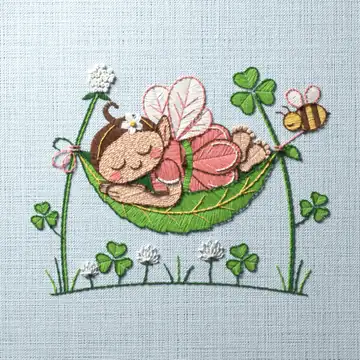
Baby fairy asleep, small and easy
Easy 3–8 in hoop · 1 color
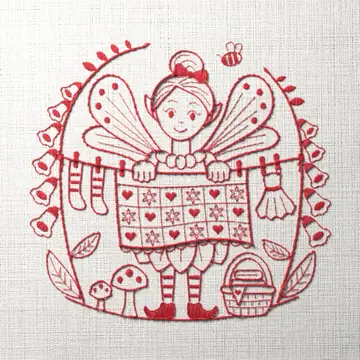
Redwork fairy on washing day
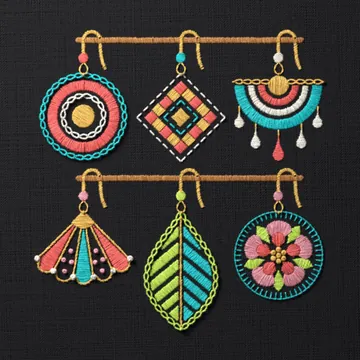
Easy 3–8 in hoop · 7 colors
Six easy earrings to mix and match
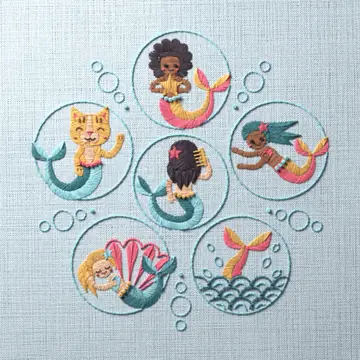
Easy 3–8 in hoop · 7 colors
Six easy mini mermaid motifs
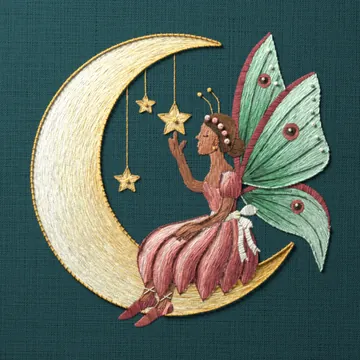
Advanced 3–8 in hoop · 23 colors
Vintage fairy on a crescent moon
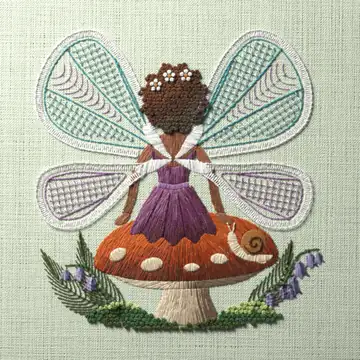
Advanced 3–8 in hoop · 23 colors
Fairy with lace wings on a mushroom
Advanced 3–8 in hoop · 10 colors
Six white and gold Chrismon ornaments
Advanced 3–8 in hoop · 10 colors
Ancient Roman motifs mosaic sampler
New to hand embroidery? Starting hand embroidery, step by step