Thanksgiving owls for a table runner hand embroidery pattern
Advanced · 16 colors · 4.3 × 2.6 in · 6 kinds of stitch
Download free PDFPDFPrints on US Letter and A4You may sell what you make from it by hand, in small quantities. The PDF itself is not to be sold or shared. Selling, classes and kits: the rules
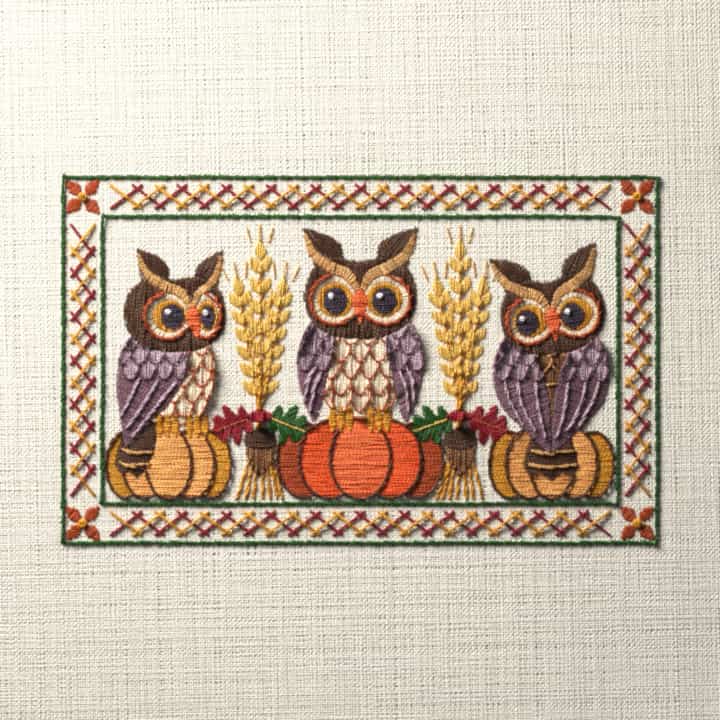
A panel for the end of a table runner. The biggest owl faces you from an orange pumpkin, the owl on the left turns toward it, and the owl on the right sits with its back to you and looks round. Sheaves of wheat stand between them, each tied with two oak leaves and an acorn.
Size and details
Advanced. Satin stitch over about a third of the cloth in a 6 inch hoop, 16 colors and a great deal of stitching; from a 5 inch hoop up some of the satin stitches are long.
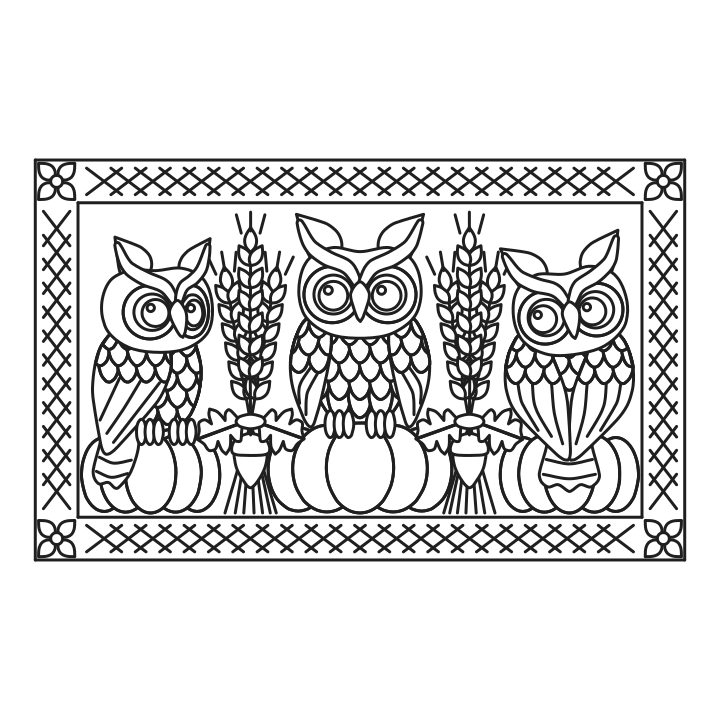
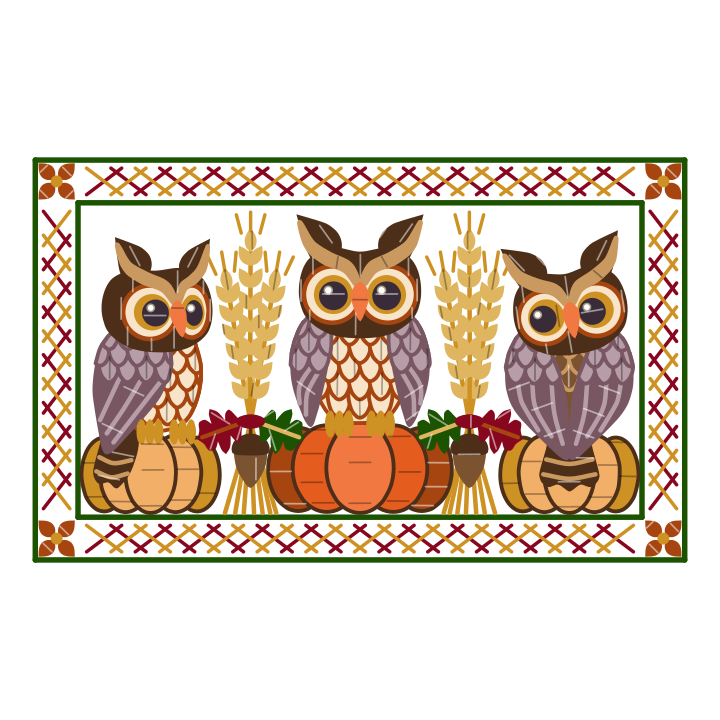
The owls, pumpkins, wheat and leaves are satin stitch, with split stitch round the feathers and pumpkin ribs and stem stitch for the long wing feathers. Two rows of herringbone stitch in wine and gold cross on all four sides between stem stitch lines, with a four-leaf satin block in each corner. In the picture of where the colors go, the fine lines show which way the stitches lie.
| Hoop | Inches | Centimeters | Satin stitch up to |
|---|---|---|---|
| 3 in (8 cm) | 1.7 × 1.1 in | 4.3 × 2.8 cm | 3/16 in (5 mm) |
| 4 in (10 cm) | 2.6 × 1.6 in | 6.6 × 4.1 cm | 1/4 in (6 mm) |
| 5 in (13 cm) | 3.4 × 2.1 in | 8.6 × 5.3 cm | 3/8 in (10 mm) |
| 6 in (15 cm) | 4.3 × 2.6 in | 10.9 × 6.6 cm | 7/16 in (11 mm) |
| 8 in (20 cm) | 6 × 3.7 in | 15.2 × 9.4 cm | 5/8 in (16 mm) |
- In an 8 inch hoop the widest satin stitch shape is 5/8 in (16 mm) across. Satin stitches longer than about 12 mm (just under 1/2 in) tend to work loose: divide the shape into sections, or work it in long and short stitch.
- In a 3, 4 or 5 inch hoop the French knots are drawn smaller than about 2 mm (a little over 1/16 in). Use one strand of floss for them there, or choose a larger hoop.
On linens. Wash and press the piece first. A pillowcase takes its design in the middle of the hem band; a napkin or a handkerchief in one corner, set on the diagonal. Keep the stitches short and low, and press face down on soft cloth. How to embroider pillowcases and napkins has the sizes and the places.
What you need
- Fabric
- Plain cotton or linen, cut 9 in (23 cm) square.
- Needle
- Embroidery needle, size 9 for 1 strand, size 7 for 2 or 3 (a lower number is a thicker needle).
- Floss
- 16 colors of six-strand cotton, listed below. DMC is a brand: another brand in a like color will do.
- Marker
- A pen or a sheet that suits the fabric: how to transfer a pattern says which.
Floss
- 1DMC 895 Very Dark Hunter GreenFrame lines, oak leaves (lighter)
- 2DMC 815 Medium GarnetHerringbone and oak leaves (darker), sheaf ties
- 3DMC 783 Medium TopazHerringbone (lighter), wheat stalks, eyes and feet, pumpkins (light) and 2 more parts
- 4DMC 919 Red CopperFeather edges (middle), pumpkins (darkest), face edges and 2 more parts
- 5DMC 3820 Dark StrawWheat ears, leaf veins (lighter)
- 6DMC 898 Very Dark Coffee BrownHead, pumpkin ribs, tail and acorn caps
- 7DMC 720 Dark Orange SpicePumpkins (dark)
- 8DMC 721 Medium Orange SpicePumpkins (middle), bills
- 9DMC 3854 Medium Autumn GoldPumpkins (lightest)
- 10DMC 433 Medium BrownBack and acorns
- 11DMC 436 TanBrows and tail bars, feather edges (light)
- 12DMC 739 Ultra Very Light TanBreast and face
- 13DMC 3740 Dark Antique VioletWings, feather edges (dark)
- 14DMC 3042 Light Antique VioletWing shoulders and wing feathers
- 15DMC 3371 Black BrownPupils
- 16DMC BLANC WhiteEye lights
Skeins: one of each color is enough. An estimate for the 6 inch hoop, from the length of each line and the area of each filled shape, with a fifth added for tails.
How to stitch it
- New to hand embroidery? Start here.
- Print at 100%, trace the pattern onto the fabric, and put it in the hoop: inner ring under, drawing up, tight as a drum.
- Floss is six strands. Cut 18 inches (45 cm), pull out the number given one at a time, and lay them together.
- Begin with no knot on the back where it is seen and washed, as on a towel, a napkin or clothes; for a piece in a hoop a small knot is fine. End each thread by whipping it around the backs of four or five stitches, with one small hitch.
- Each small ring is one French knot.
- A number under “Where colors go” is a color of the list. The fine lines on the colors show which way the stitches lie.
Stitch in this order
Filled parts from the back of the picture forward, then lines and knots. Where a stitch page names another number of strands, use the number here.
- Satin stitch 2 strandsCorner leaves, wheat ears, pumpkins, acorns, acorn caps, oak leaves, sheaf ties, tail, breast, wings, wing shoulders, feet, head, face, eyes, pupils, brows, bills, back
- Stem stitch3 strands: frame lines2 strands: wheat stalks, tail bars, wing feathers, face edges1 strand: leaf veins
- Herringbone stitch 3 strandsHerringbone
- Straight stitch3 strands: acorn caps1 strand: wheat beards
- Split stitch2 strands: pumpkin ribs1 strand: feather edges
- French knot two wraps2 strands: corner knots1 strand: eye lights
When it is done, take off any lines that still show and finish the hoop.
More patterns like this
Advanced prints 3–14 in · 15 colors
Mystical night owl and moon phases
Advanced prints 3–14 in · 15 colors
Graduation owl card
Advanced 3–8 in hoop · 21 colors
Musical owl with headphones
Advanced prints 3–14 in · 22 colors
Three owls in a crewel tree
Advanced prints 3–14 in · 23 colors
Happy fall y’all with an owl and a moon
Advanced 3–8 in hoop · 23 colors
Great horned owl head
Advanced prints 3–14 in · 24 colors
Owl in an enchanted forest
Advanced 3–8 in hoop · 7 colors
Mother owl and baby in a wreath
New to hand embroidery? Starting hand embroidery, step by step