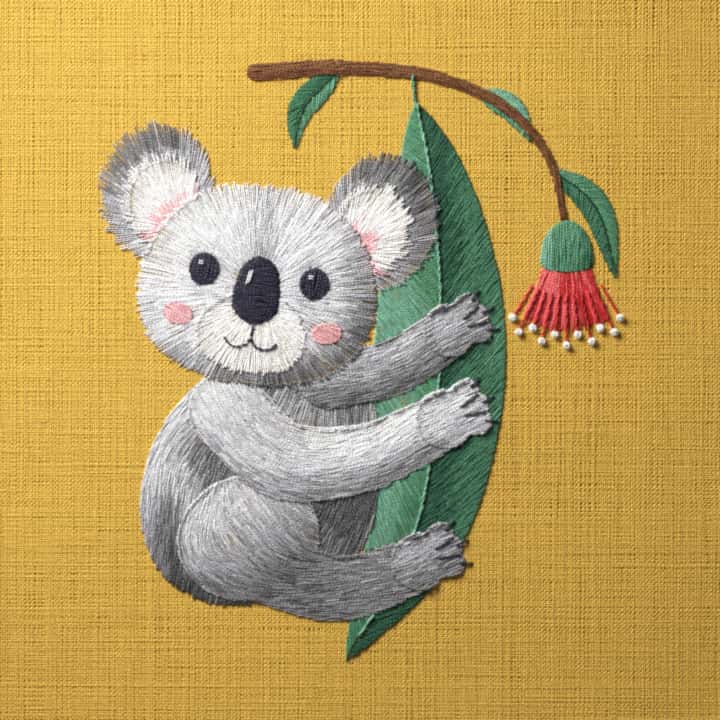
Tiny koala hugging a gum leaf hand embroidery pattern
Advanced · 17 colors · 4.1 × 4.8 in · 7 kinds of stitch
Download free PDFPDFPrints on US Letter and A4You may sell what you make from it by hand, in small quantities. The PDF itself is not to be sold or shared. Selling, classes and kits: the rules
One long gum leaf hangs from a twig, and a baby koala hugs it like a tree trunk with both arms and a foot across it.
Size and details
Advanced. Uses long and short stitch over much of the design, 17 colors and a great deal of stitching; from a 6 inch hoop up the widest satin stitches are long.
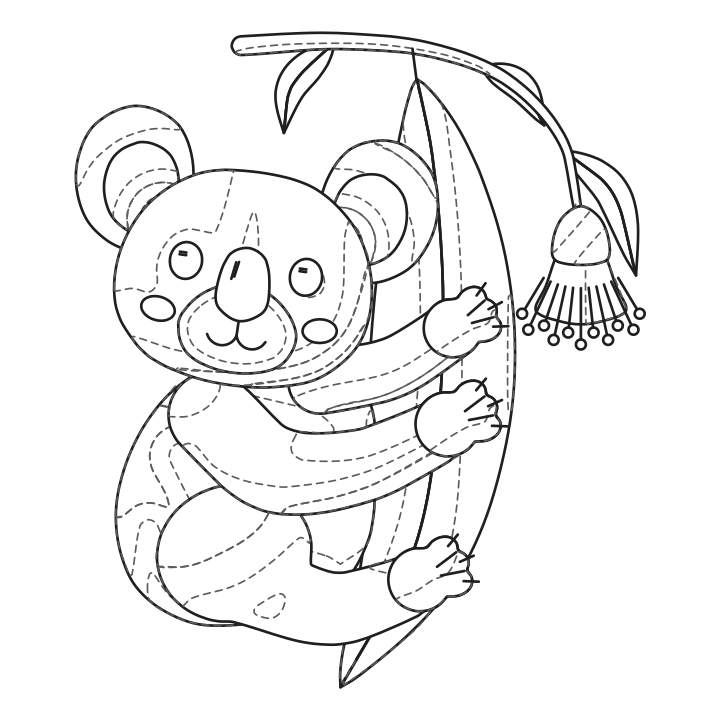
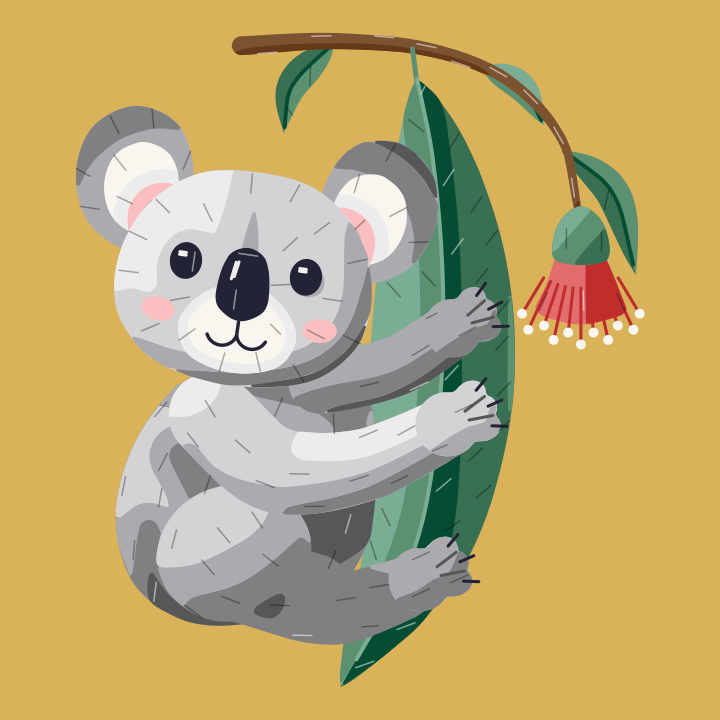
The fur, the ears and the big leaf are long and short stitch, combed out from the nose on the head and along the arms and leg. The eyes, cheeks, gum cap and small leaves are satin stitch, the nose is padded satin stitch and the smile is back stitch. The coral blossom ends in white French knots, and the leaf veins are stem stitch. It is drawn for mustard yellow linen. In the picture of where the colors go, the fine lines show which way the stitches lie.
| Hoop | Inches | Centimeters | Satin stitch up to |
|---|---|---|---|
| 3 in (8 cm) | 1.7 × 1.9 in | 4.3 × 4.8 cm | 3/16 in (5 mm) |
| 4 in (10 cm) | 2.5 × 2.9 in | 6.4 × 7.4 cm | 1/4 in (6 mm) |
| 5 in (13 cm) | 3.3 × 3.8 in | 8.4 × 9.7 cm | 5/16 in (8 mm) |
| 6 in (15 cm) | 4.1 × 4.8 in | 10.4 × 12.2 cm | 7/16 in (11 mm) |
| 8 in (20 cm) | 5.8 × 6.7 in | 14.7 × 17 cm | 5/8 in (16 mm) |
- In an 8 inch hoop the widest satin stitch shape is 5/8 in (16 mm) across. Satin stitches longer than about 12 mm (just under 1/2 in) tend to work loose: divide the shape into sections, or work it in long and short stitch.
- In a 3, 4 or 5 inch hoop the French knots are drawn smaller than about 2 mm (a little over 1/16 in). Use one strand of floss for them there, or choose a larger hoop.
What you need
- Fabric
- Plain cotton or linen in mustard yellow, cut 9 in (23 cm) square. On white cloth its palest threads do not show: choose other colors under Options.
- Needle
- Embroidery needle, size 9 for 1 strand, size 7 for 2 or 3 (a lower number is a thicker needle).
- Floss
- 17 colors of six-strand cotton, listed below. DMC is a brand: another brand in a like color will do.
- Marker
- A pen or a sheet that suits the fabric: how to transfer a pattern says which.
Floss
- 1DMC 501 Dark Blue GreenBig leaf, small leaves and gum cap (dark)
- 2DMC 502 Blue GreenBig leaf and small leaves (light), gum cap (middle), big leaf vein (darker)
- 3DMC 500 Very Dark Blue GreenBig leaf and small leaves (darkest)
- 4DMC 503 Medium Blue GreenBig leaf and small leaves (lightest), big leaf vein (lighter), gum cap (light)
- 5DMC 433 Medium BrownTwig (lighter)
- 6DMC 801 Dark Coffee BrownTwig (darker)
- 7DMC 414 Dark Steel GrayBody, leg, head and paws (dark), ears and far arm (middle), arm (darkest)
- 8DMC 413 Dark Pewter GrayBody, head and leg (darkest), far arm and ears (dark), toes
- 9DMC 318 Light Steel GrayEars, body, far arm and leg (light), paws and head (middle), arm (dark)
- 10DMC 415 Pearl GrayHead, arm and paws (light), leg and body (lightest)
- 11DMC 310 BlackNose, eyes, claws and smile
- 12DMC 762 Very Light Pearl GrayHead and arm (lightest), muzzle (darker), inner ears (light), nose light
- 13DMC 3865 Winter WhiteInner ears (lightest), muzzle (lighter), pollen and eye lights
- 14DMC 3688 Medium MauveInner ears (darkest)
- 15DMC 3689 Light MauveInner ears (dark), cheeks
- 16DMC 3328 Dark SalmonBlossom fringe (lighter)
- 17DMC 347 Very Dark SalmonBlossom fringe (darker)
Skeins: one of each color is enough. An estimate for the 6 inch hoop, from the length of each line and the area of each filled shape, with a fifth added for tails.
How to stitch it
- New to hand embroidery? Start here.
- Print at 100%, trace the pattern onto the fabric, and put it in the hoop: inner ring under, drawing up, tight as a drum.
- Floss is six strands. Cut 18 inches (45 cm), pull out the number given one at a time, and lay them together.
- Inside a filled shape start with two or three tiny stitches, which the filling covers. Start a line with a small knot on the back. End each thread by running the needle under the backs of a few stitches.
- Each small ring is one French knot. A fine broken line inside a shape is where two shades meet: trace it, do not stitch it.
- A number under “Where colors go” is a color of the list. The fine lines on the colors show which way the stitches lie.
Stitch in this order
Filled parts from the back of the picture forward, then lines and knots. Where a stitch page names another number of strands, use the number here.
- Satin stitch 2 strandsSmall leaves, cheeks, eyes, gum cap
- Long and short stitch 1 strandTwig, big leaf, body, far arm, paws, leg, arm, ears, inner ears, head, muzzle, blossom fringe
- Padded satin stitch 2 strandsNose
- Stem stitch2 or 3 strands: big leaf vein1 strand: small leaves
- Straight stitch2 strands: toes, claws, blossom fringe1 strand: eye lights, nose light
- Back stitch 2 strandsSmile
- French knot 2 strands, two wrapsPollen
When it is done, take off any lines that still show and finish the hoop. A guide to this kind of work: Stitches for fur, hair and feathers.
More patterns like this
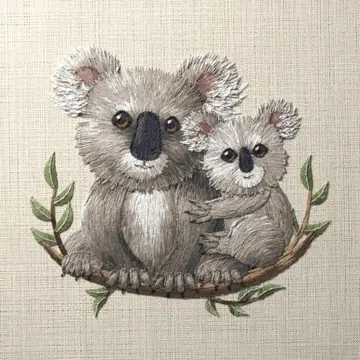
Advanced 3–8 in hoop · 23 colors
Mother koala and joey
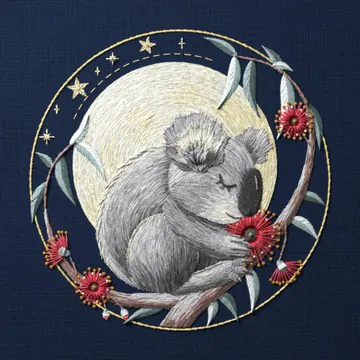
Advanced prints 3–14 in · 16 colors
Sleeping koala, moon and red gum blossom
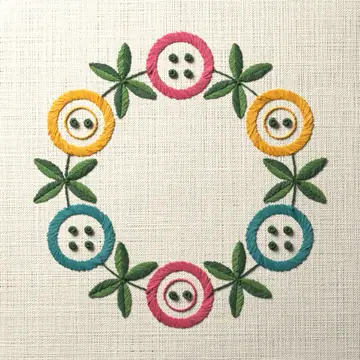
Easy prints 3–14 in · 5 colors
Wreath of buttons and leaves
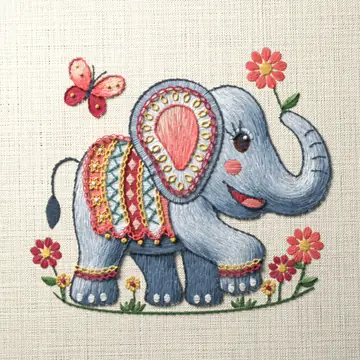
Advanced 3–8 in hoop · 17 colors
Cute African elephant calf
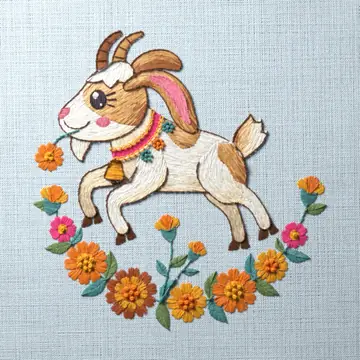
Advanced prints 3–14 in · 16 colors
Little goat for a kids’ dress
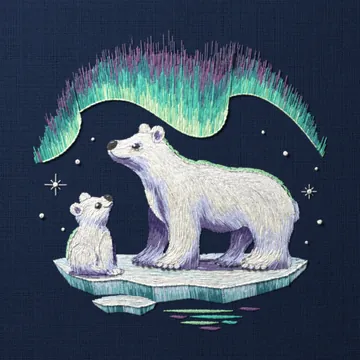
Advanced prints 3–14 in · 18 colors
Polar bear and cub under northern lights
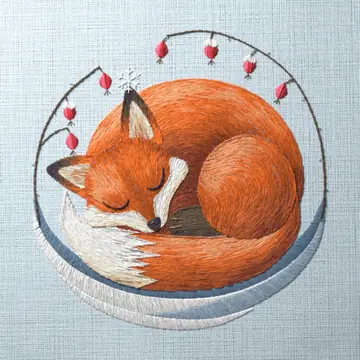
Advanced prints 3–14 in · 18 colors
Baby fox asleep in the snow
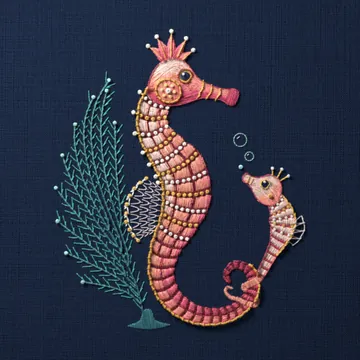
Advanced 3–8 in hoop · 16 colors
Jeweled seahorse and baby
New to hand embroidery? Starting hand embroidery, step by step