Vintage gymnast with ribbon hand embroidery pattern
Advanced · 21 colors · 6 kinds of stitch

Download free PDFPDF, US Letter · 51 KBFor your own stitching, gifts and handmade pieces you sell. Do not resell or share this PDF. What you may do, in full
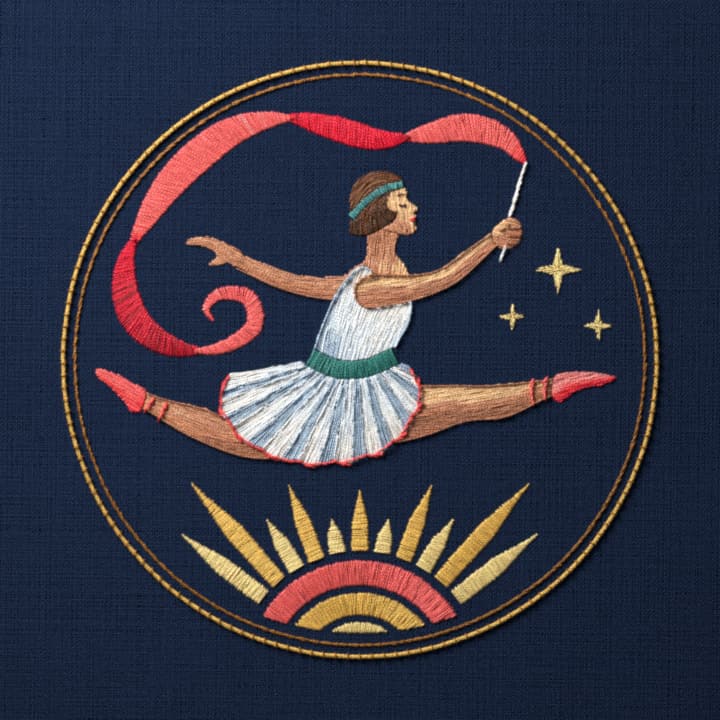
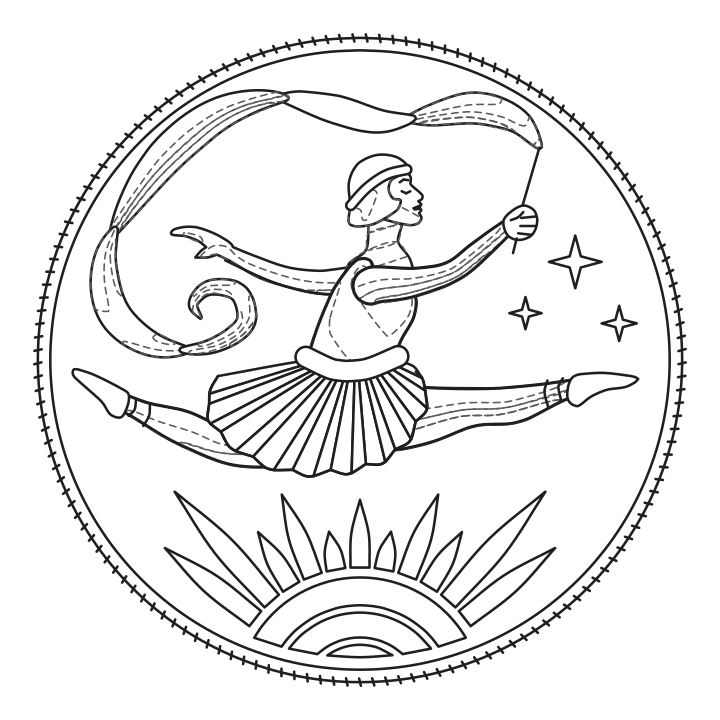
A gymnast of the 1920s sails over a rising sun in a split leap, a ribbon sweeping from the stick in her hand, over her head and round to a free curl behind her. Her skin, bobbed hair, slippers and pleated white tunic are long and short stitch, with split stitch for the fine edges. The twisting ribbon, sash, headband, sun, rays and stars are satin stitch. The stick, hem, ankle ribbons and inner ring are stem stitch, her eye, brow and mouth are straight stitch, and the outer gold ring is couching. It is drawn for navy linen. In the picture of where the colors go, the fine lines show which way the stitches lie.
Size and details
Advanced. Uses couching, long and short stitch, 21 colors and a great deal of stitching.
21 colors of floss and 6 kinds of stitch:
- Couching
- Stem stitch
- Satin stitch
- Long and short stitch
- Split stitch
- Straight stitch
- Which stitch goes where
| Hoop | Inches | Centimeters | Satin stitch up to |
|---|---|---|---|
| 3 in (8 cm) | 2 × 2 in | 5.1 × 5.1 cm | 1/8 in (3 mm) |
| 4 in (10 cm) | 3 × 3 in | 7.6 × 7.6 cm | 3/16 in (5 mm) |
| 5 in (13 cm) | 4 × 4 in | 10.2 × 10.2 cm | 1/4 in (6 mm) |
| 6 in (15 cm) | 5 × 5 in | 12.7 × 12.7 cm | 5/16 in (8 mm) |
| 8 in (20 cm) | 7 × 7 in | 17.8 × 17.8 cm | 7/16 in (11 mm) |
The pattern is drawn inside a circle about half an inch (1.3 cm) smaller all around than the hoop.
What you need
- DMC 3820 Dark StrawRing (lighter), sun rays (darker), sun (middle)
- DMC 780 Ultra Very Dark TopazInner ring, ring (darker)
- DMC 3822 Light StrawSun rays (lighter), stars, sun (light)
- DMC 351 CoralRibbon and slippers (light), sun (dark), ankle ribbons (lighter)
- DMC 3064 Desert SandLegs, arms and neck and shoulders (light), face (darker)
- DMC 3772 Very Dark Desert SandFine edges (darker), legs, arms and neck and shoulders (darkest)
- DMC 407 Dark Desert SandLegs, arms and neck and shoulders (dark)
- DMC 349 Dark CoralRibbon (middle dark), slippers (darkest), mouth
- DMC 350 Medium CoralRibbon (middle light), hem, slippers (dark), ankle ribbons (darker)
- DMC 352 Light CoralRibbon and slippers (lightest)
- DMC 815 Medium GarnetRibbon (darkest)
- DMC 498 Dark RedRibbon (dark)
- DMC 437 Light TanLegs, arms and neck and shoulders (lightest), face (lighter)
- DMC 3865 Winter WhiteTunic (light), stick
- DMC 3753 Ultra Very Light Antique BlueTunic (middle)
- DMC 932 Light Antique BlueTunic (dark), fine edges (lighter)
- DMC 3847 Dark Teal GreenSash
- DMC 801 Dark Coffee BrownHair (lighter), finger lines
- DMC 898 Very Dark Coffee BrownHair (darker)
- DMC 3848 Medium Teal GreenHeadband
- DMC 3371 Black BrownEye and brow
Skeins: one of each color is enough. An estimate for the largest size, the 8 inch hoop: the length of each line and the area of each filled shape, a fifth added for tails and ends, a tenth of every 8 m (8.7 yd) skein kept spare.
The floss is six-strand cotton; the stitch guide says how many strands to use. You also need a hoop, an embroidery needle (a size 7 to 9 suits two or three strands) and plain cotton or linen fabric. To frame the piece in its hoop, cut a square 3 inches (8 cm) wider than the hoop: a 9 inch (23 cm) square for a 6 inch hoop.
When it is stitched, how to finish a hoop shows how to back it for the wall.
Stitch guide
- Put the pattern on the fabric (how to transfer a pattern) and the fabric in the hoop.
- Stitch the filled parts first, what lies behind before what lies in front of it.
- Then stitch the lines: stems, veins and outlines over the edges of the filled parts.
Start each thread with a small knot on the back or one of the knotless starts, and end it by running the needle under the backs of a few stitches (starting and ending a thread). Use the strands this list gives, also where a page about a stitch names another number.
- Couching 6 strandsRing
- Stem stitch 2 to 3 strandsInner ring, ankle ribbons, hem, stick
- Satin stitch 2 strandsSun rays, sun, stars, ribbon, sash, headband
- Long and short stitch 1 strandArms, legs, slippers, neck and shoulders, tunic, face, hair
- Split stitch 1 strandFine edges, finger lines
- Straight stitch 1 to 2 strandsEye, brow, mouth
Getting it onto your fabric
The PDF holds the pattern twice at actual size: once as drawn, and once mirrored for an iron-on transfer pen. Print it at 100% with scaling off and check the one-inch square (25.4 mm) with a ruler before you trace. How to transfer a pattern explains tracing, carbon paper and the other ways. The files are under Downloads.
Downloads
- Download free PDF PDF, US Letter, 3 pages, for a 6 inch (15 cm) hoop
- Download free PDF, A4 PDF, A4, 3 pages, for a 6 inch (15 cm) hoop
More patterns like this
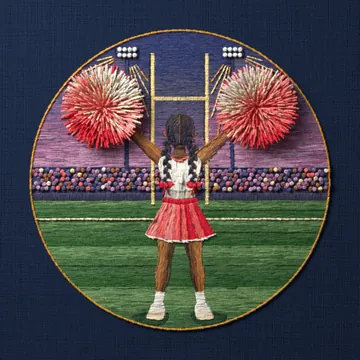
Advanced 3–8 in hoop · 23 colors
Cheerleader with pom poms at night
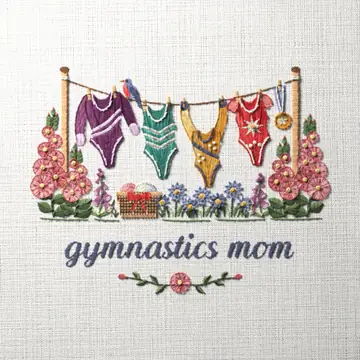
Advanced 3–8 in hoop · 24 colors
Gymnastics mom leotard clothesline
Advanced 3–8 in hoop · 16 colors
Small cheer megaphone
Advanced 3–8 in hoop · 11 colors
Cheer mom in laurel
Easy 3–8 in hoop · 7 colors
Easy stick people gymnasts
Advanced 3–8 in hoop · 16 colors
1920s flower basket corner
Advanced 3–8 in hoop · 13 colors
Ship’s anchor
Advanced 3–8 in hoop · 21 colors
Medieval nun at her needlework
New to hand embroidery? Starting hand embroidery, step by step