Vintage seashell pillowcase corner hand embroidery pattern
Advanced · 17 colors · 6 kinds of stitch

Download free PDFPDF, US Letter · 74 KBFor your own stitching, gifts and handmade pieces you sell. Do not resell or share this PDF or copies of it. Selling, classes and kits: the rules
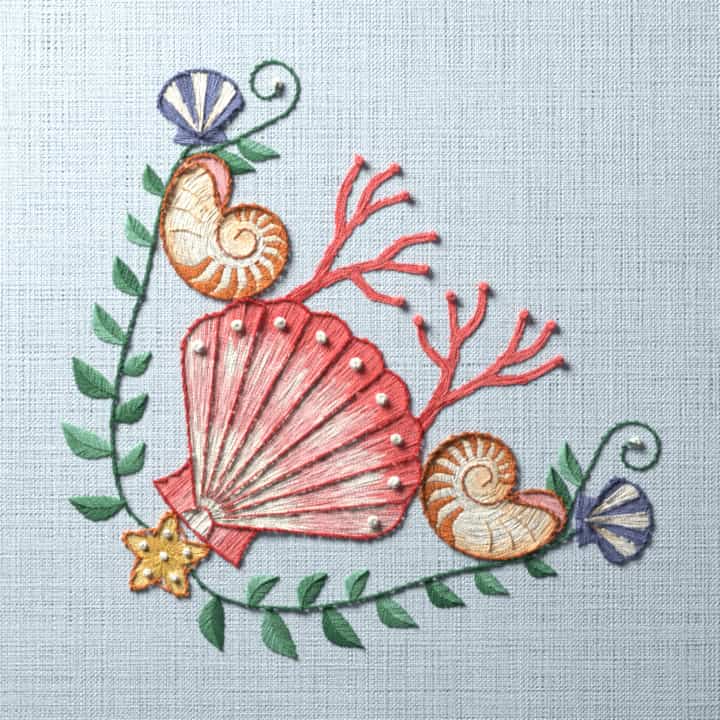
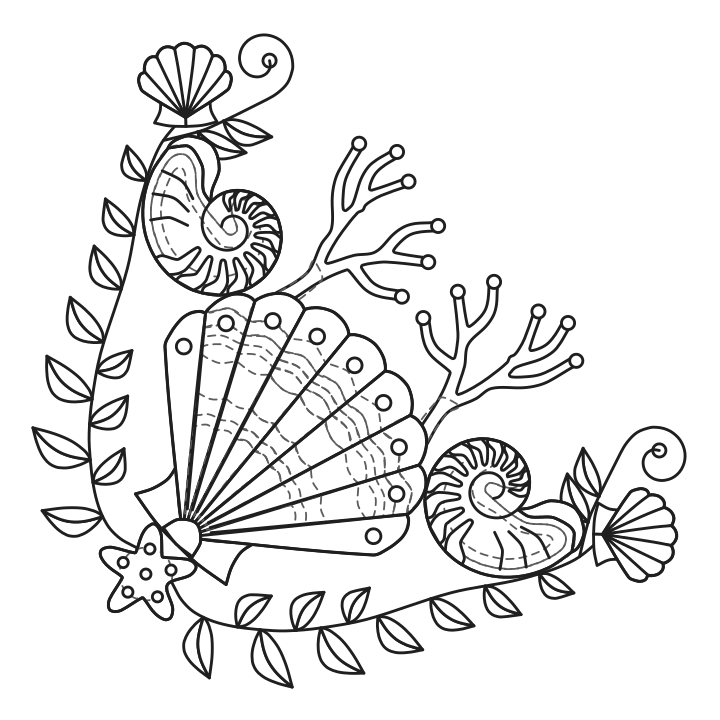
A large scallop stands on the diagonal of the corner, with one cream knot in each of its nine ribs and a gold starfish at its hinge. The two arms mirror each other: a striped nautilus, a spray of coral, a leafy seaweed stem, and a small blue and cream scallop at the end. The shells, coral and starfish are filled in long and short stitch, and the nautilus stripes and the scallop hinges are satin stitch. The leaves are fishbone stitch, the stems and outlines are stem stitch, and fine growth lines on the nautilus are split stitch. French knots make the pearls and the coral tips. It is drawn for pale blue linen. In the picture of where the colors go, the fine lines show which way the stitches lie.
Size and details
Advanced. Uses long and short stitch, 17 colors and a great deal of stitching.
17 colors of floss and 6 kinds of stitch:
- Long and short stitch
- French knot
- Stem stitch
- Fishbone stitch
- Satin stitch
- Split stitch
- Which stitch goes where
| Hoop | Inches | Centimeters | Satin stitch up to |
|---|---|---|---|
| 3 in (8 cm) | 1.8 × 1.8 in | 4.6 × 4.6 cm | 1/8 in (3 mm) |
| 4 in (10 cm) | 2.7 × 2.7 in | 6.9 × 6.9 cm | 3/16 in (5 mm) |
| 5 in (13 cm) | 3.5 × 3.5 in | 8.9 × 8.9 cm | 1/4 in (6 mm) |
| 6 in (15 cm) | 4.4 × 4.4 in | 11.2 × 11.2 cm | 5/16 in (8 mm) |
| 8 in (20 cm) | 6.2 × 6.2 in | 15.7 × 15.7 cm | 7/16 in (11 mm) |
- In a 3, 4 or 5 inch hoop the French knots are drawn smaller than about 2 mm (a little over 1/16 in). Use one strand of floss for them there, or choose a larger hoop.
The pattern is drawn inside a circle about half an inch (1.3 cm) smaller all around than the hoop.
What you need
- DMC 3328 Dark SalmonShell ribs (darkest), coral (lighter), coral tips
- DMC 347 Very Dark SalmonShell grooves, shell outline and shell ears outline, coral and shell crown (darker)
- DMC 712 CreamNautilus (light), shell ribs and cockle ribs (lightest), pearls and 2 more parts
- DMC 501 Dark Blue GreenSeaweed stem, seaweed leaves (dark)
- DMC 502 Blue GreenSeaweed leaves (middle)
- DMC 503 Medium Blue GreenSeaweed leaves (light)
- DMC 161 Gray BlueCockle ribs (dark), cockle ears
- DMC 739 Ultra Very Light TanNautilus (middle), cockle ribs (light)
- DMC 3807 Cornflower BlueCockle outline, cockle ribs (darkest)
- DMC 761 Light SalmonShell ribs (light), nautilus mouth (lighter)
- DMC 760 SalmonShell ribs (middle), shell ears (lighter), nautilus mouth (darker)
- DMC 301 Medium MahoganyNautilus outline and nautilus spiral
- DMC 437 Light TanNautilus (dark), nautilus growth lines
- DMC 3776 Light MahoganyNautilus stripes and starfish outline
- DMC 3712 Medium SalmonShell ribs (dark), shell ears (darker)
- DMC 3822 Light StrawStarfish (lighter)
- DMC 3820 Dark StrawStarfish (darker)
Skeins: one of each color is enough. An estimate for the largest size, the 8 inch hoop: the length of each line and the area of each filled shape, a fifth added for tails and ends, a tenth of every 8 m (8.7 yd) skein kept spare.
On linens. Wash and press the piece first. A pillowcase takes its design in the middle of the hem band; a napkin or a handkerchief in one corner, set on the diagonal. Keep the stitches short and low, and press face down on soft cloth. How to embroider pillowcases and napkins has the sizes and the places.
In a hoop. The floss is six-strand cotton; the stitch guide says how many strands to use. You also need a hoop, an embroidery needle (a size 9 or 10 for one strand, 7 to 9 for two or three) and plain cotton or linen fabric. To frame the piece in its hoop, cut a square 3 inches (8 cm) wider than the hoop: a 9 inch (23 cm) square for a 6 inch hoop.
When it is stitched, how to finish a hoop shows how to back it for the wall.
Stitch guide
- Put the pattern on the fabric (how to transfer a pattern) and the fabric in the hoop.
- Stitch the filled parts first, what lies behind before what lies in front of it.
- Then stitch the lines: stems, veins and outlines over the edges of the filled parts.
- Keep the knots for the end, so that the hoop and your hand do not flatten them.
Begin with no knot on the back where it is seen and washed, as on a towel, a napkin or clothes; for a piece in a hoop a small knot is fine. End each thread by running the needle under the backs of a few stitches. (Starting and ending a thread shows how.) Use the strands this list gives, and begin as it says, also where a page about a stitch names another number or begins with a knot.
- Long and short stitch 1 strandCoral, cockle ribs, nautilus mouth, nautilus, shell ribs, starfish
- French knot 2 strands, two wrapsCoral tips, pearls, starfish knots
- Stem stitch 1 to 3 strandsSeaweed stem, cockle outline, nautilus outline, nautilus spiral, shell ears outline, shell grooves, shell outline, shell crown, starfish outline
- Fishbone stitch 1 strandSeaweed leaves
- Satin stitch 2 strandsCockle ears, nautilus stripes, shell ears, shell crown
- Split stitch 1 strandNautilus growth lines
Getting it onto your fabric
The PDF holds the pattern twice at actual size: once as drawn, and once mirrored for an iron-on transfer pen. Print it at 100% with scaling off and check the one-inch square (25.4 mm) with a ruler before you trace. How to transfer a pattern explains tracing, carbon paper, the sticky wash-away sheet for knits, denim and dark cloth, and the other ways. The files are under Downloads.
Downloads
- Download free PDF PDF, US Letter, 3 pages, for a 6 inch (15 cm) hoop
- Download free PDF, A4 PDF, A4, 3 pages, for a 6 inch (15 cm) hoop
More patterns like this
Intermediate prints 3–14 in · 8 colors
Small seashells and a starfish
Advanced 3–8 in hoop · 18 colors
Rococo shell and ribbon with roses
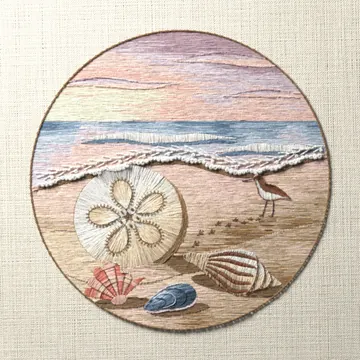
Advanced prints 3–14 in · 19 colors
Sand dollar and shells on the beach
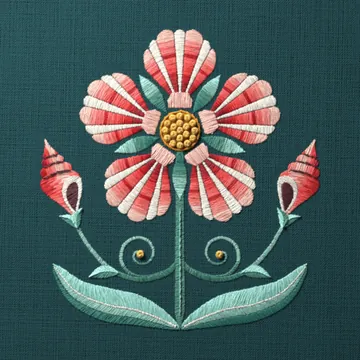
Advanced 3–8 in hoop · 15 colors
Shell flower
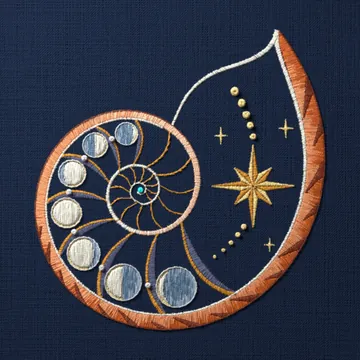
Advanced 3–8 in hoop · 14 colors
Nautilus shell with moon phases
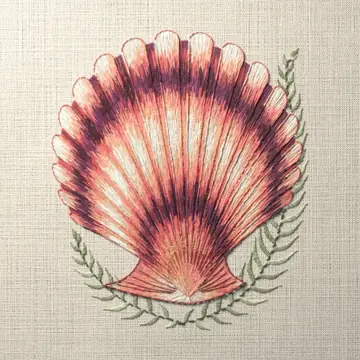
Advanced 3–8 in hoop · 13 colors
Scallop shell
Advanced 3–8 in hoop · 6 colors
Baptism shell with dove
Advanced prints 3–14 in · 8 colors
Filigree seashell monogram frame
New to hand embroidery? Starting hand embroidery, step by step