Yucatan huipil flower neckline hand embroidery pattern
Advanced · 13 colors · 3.8 × 4 in · 6 kinds of stitch
Download free PDFPDFPrints on US Letter and A4You may sell what you make from it by hand, in small quantities. The PDF itself is not to be sold or shared. Selling, classes and kits: the rules
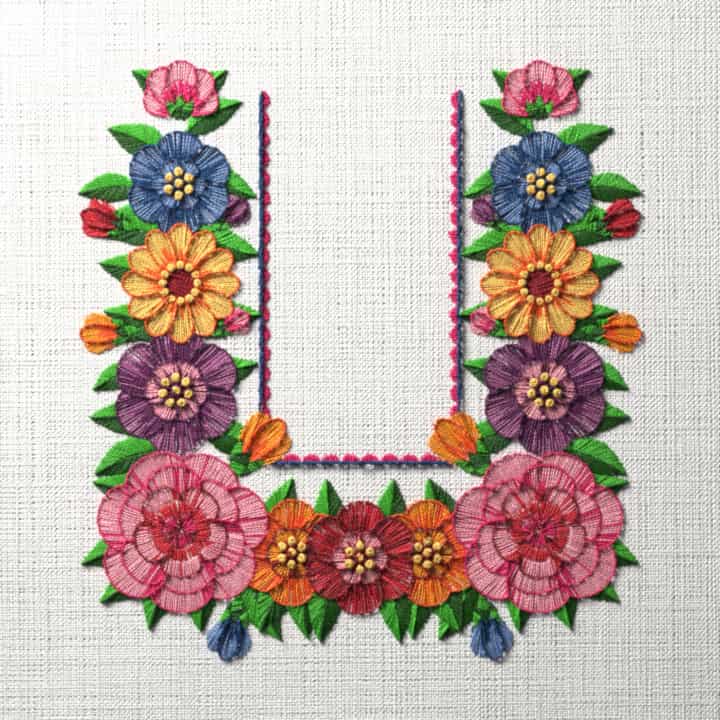
A thick garland runs down both sides of a square neck opening and turns across under it, with a full pink rose in each corner. Violet, yellow, blue, orange and red blooms, half blooms and buds follow, always touching, with leaves behind.
Size and details
Advanced. Uses long and short stitch over much of the design, dozens of French knots, 13 colors and a great deal of stitching.
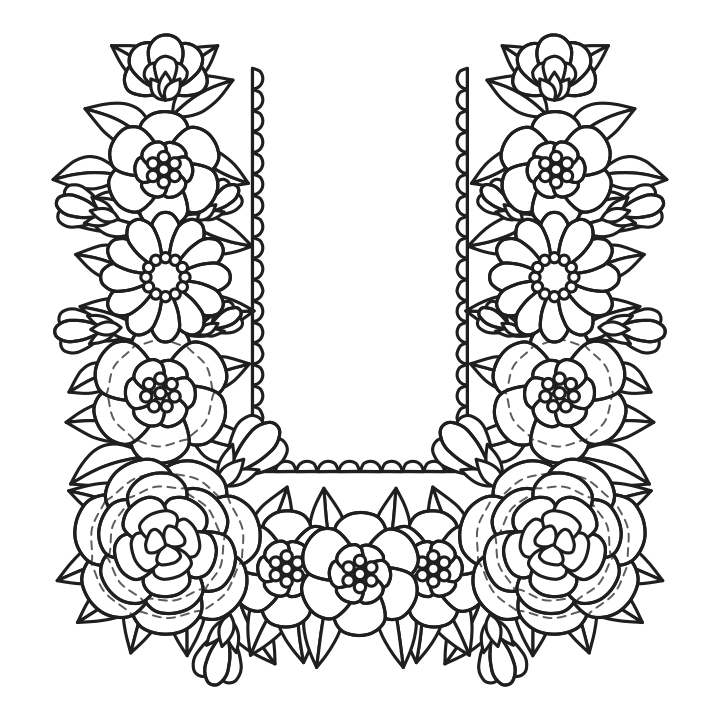
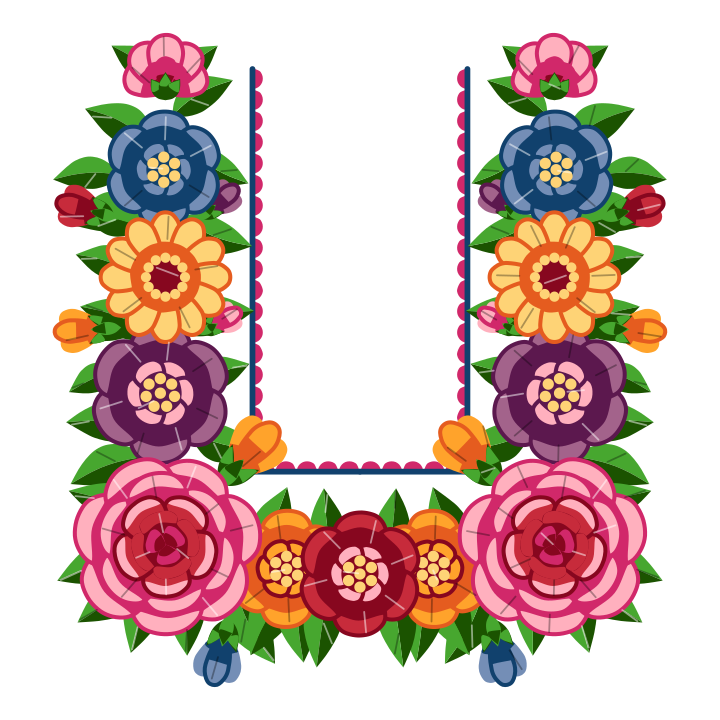
Each petal is two rows of long and short stitch, dark at the heart and light at the rim, with a fine split stitch edge. The leaves are fishbone stitch, the bloom hearts are French knots, and satin stitch scallops hang from a stem stitch line round the opening. One orange bud peeps over each corner. The two halves mirror exactly, so the corner can be traced twice more to close the square. In the picture of where the colors go, the fine lines show which way the stitches lie.
| Hoop | Inches | Centimeters | Satin stitch up to |
|---|---|---|---|
| 3 in (8 cm) | 1.5 × 1.6 in | 3.8 × 4.1 cm | 1/16 in (1.6 mm) |
| 4 in (10 cm) | 2.3 × 2.4 in | 5.8 × 6.1 cm | 1/8 in (3 mm) |
| 5 in (13 cm) | 3 × 3.2 in | 7.6 × 8.1 cm | 3/16 in (5 mm) |
| 6 in (15 cm) | 3.8 × 4 in | 9.7 × 10.2 cm | 3/16 in (5 mm) |
| 8 in (20 cm) | 5.3 × 5.7 in | 13.5 × 14.5 cm | 5/16 in (8 mm) |
- In a 3, 4, 5 or 6 inch hoop the French knots are drawn smaller than about 2 mm (a little over 1/16 in). Use one strand of floss for them there, or choose a larger hoop.
What you need
- Fabric
- Plain cotton or linen, cut 9 in (23 cm) square.
- Needle
- Embroidery needle, size 9 for 1 strand, size 7 for 2 or 3 (a lower number is a thicker needle).
- Floss
- 13 colors of six-strand cotton, listed below. DMC is a brand: another brand in a like color will do.
- Marker
- A pen or a sheet that suits the fabric: how to transfer a pattern says which.
On clothes. Wash and dry the garment first. Denim and twill need no backing and take a sharp needle, embroidery or chenille; T-shirts, sweatshirts and other knits need a backing that sticks or irons on. This pattern is drawn smaller than a neck opening: choose how wide it is under Options, and it prints at that width, on sheets to join. How to embroider on clothes has every step, the guide to shirts says how to reach a neckline, a collar or a sleeve, and the placement chart says where a design goes.
Floss
- 1DMC 601 Dark CranberryCorner roses and petal edges (light), half blooms (middle), scallops and 1 more part
- 2DMC 796 Dark Royal BlueOpen blooms and buds (shade 2 of 10), petal edges (dark), neck edge
- 3DMC 702 Kelly GreenLeaves and sepals (lighter)
- 4DMC 895 Very Dark Hunter GreenLeaves and sepals (darker)
- 5DMC 604 Light CranberryCorner roses (lightest), open blooms (shade 9 of 10) and 2 more parts
- 6DMC 815 Medium GarnetPetal edges (middle), open blooms (shade 3 of 10) and 4 more parts
- 7DMC 321 RedCorner roses (dark), open blooms and buds (shade 4 of 10)
- 8DMC 553 VioletOpen blooms (shade 5 of 10), buds (shade 6 of 10)
- 9DMC 550 Very Dark VioletOpen blooms and buds (shade 1 of 10), petal edges (darkest)
- 10DMC 741 Medium TangerineOpen blooms (shade 8 of 10), buds (shade 9 of 10)
- 11DMC 720 Dark Orange SpiceOpen blooms (shade 6 of 10), petal edges (lightest), buds (shade 7 of 10)
- 12DMC 799 Medium Delft BlueOpen blooms (shade 7 of 10), buds (shade 8 of 10)
- 13DMC 743 Medium YellowOpen blooms (shade 10 of 10), bloom hearts (lighter)
Skeins: one of each color is enough. An estimate for the 6 inch hoop, from the length of each line and the area of each filled shape, with a fifth added for tails.
How to stitch it
- New to hand embroidery? Start here.
- Print at 100%, trace the pattern onto the fabric, and put it in the hoop: inner ring under, drawing up, tight as a drum.
- Floss is six strands. Cut 18 inches (45 cm), pull out the number given one at a time, and lay them together.
- Begin with no knot on the back where it is seen and washed, as on a towel, a napkin or clothes; for a piece in a hoop a small knot is fine. End each thread by whipping it around the backs of four or five stitches, with one small hitch.
- Each small ring is one French knot. A fine broken line inside a shape is where two shades meet: trace it, do not stitch it.
- A number under “Where colors go” is a color of the list. The fine lines on the colors show which way the stitches lie.
Stitch in this order
Filled parts from the back of the picture forward, then lines and knots. Where a stitch page names another number of strands, use the number here.
- Satin stitch 2 strandsScallops, sepals, bloom hearts
- Fishbone stitch 2 strandsLeaves
- Long and short stitch 1 strandHalf blooms, buds, open blooms, corner roses
- Stem stitch 3 strandsNeck edge
- Split stitch 1 strandPetal edges
- French knot 2 strands, two wrapsBloom hearts
When it is done, take off any lines that still show. A guide to this kind of work: Stitches for flowers.
More patterns like this
Advanced 3–8 in hoop · 14 colors
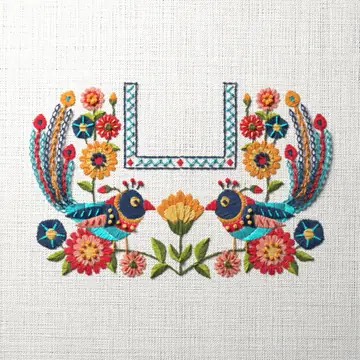
Chiapas style flower yoke
Advanced 3–8 in hoop · 9 colors
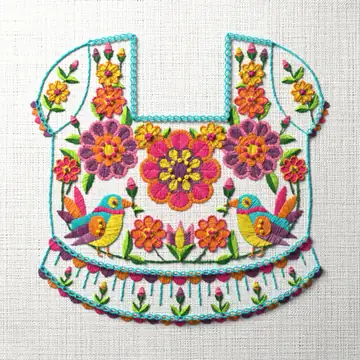
Huipil yoke in the manner of Oaxaca
Advanced 3–8 in hoop · 9 colors
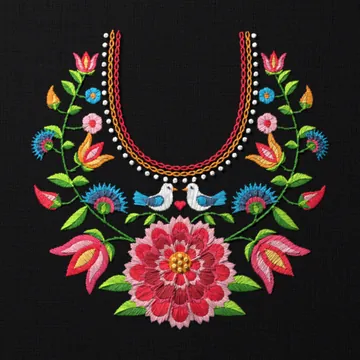
Mexican dress yoke with bright flowers
Advanced opening to 6 in · 12 colors
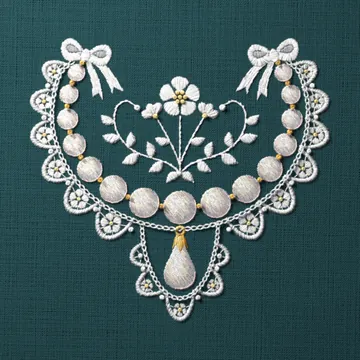
Hungarian-inspired floral neckline
Advanced 3–8 in hoop · 13 colors
Pearl necklace neckline
Advanced opening to 8 in · 15 colors
Paisley neckline
Advanced opening to 8 in · 12 colors
Waterfall blouse neckline border
Advanced 3–8 in hoop · 12 colors
15th century style smock neckline border
New to hand embroidery? Starting hand embroidery, step by step