Needlepoint guide
What is needlepoint?
Needlepoint is embroidery stitched by hand on stiff, open canvas, in stitches that nearly always cover the canvas whole. The plainest kind is one small slanted stitch, the tent stitch, repeated across the whole design.
On this page 10 parts
What needlepoint is
Embroidery is the decorating of cloth with a needle and thread, and needlepoint is the kind done on canvas. The canvas is a grid of threads, usually cotton or linen, with a hole between each. A blunt needle, called a tapestry needle, carries wool or another thread through the holes: being blunt, it slips between the canvas threads and does not split them.
The basic stitch is tent stitch: one small stitch that slants from lower left to upper right over one intersection, the place where two canvas threads cross.

No stitch on canvas is simpler or more used. How to needlepoint shows how to work it. There are more than 150 canvas stitches in all, most of them variations or combinations of two: the tent stitch, and the long stitch, which crosses more than one intersection. The stitch library has diagrams.
The design usually comes in one of two ways. On a painted or printed canvas it is already on the canvas in color, and each color is stitched where it shows. A chart is the design drawn on paper as a grid, each square standing for one stitch: the canvas is blank, and the stitcher counts squares on the chart and puts each stitch on the matching intersection. See how to read a needlepoint chart.
Either way, every stitch has its place on the grid of the canvas, which makes needlepoint counted-thread embroidery: the weave decides where the needle goes. In tent stitch, only a chart asks the stitcher to count.
What it looks like
From the front, plain needlepoint is a close surface of small slanted stitches, every one leaning the same way.

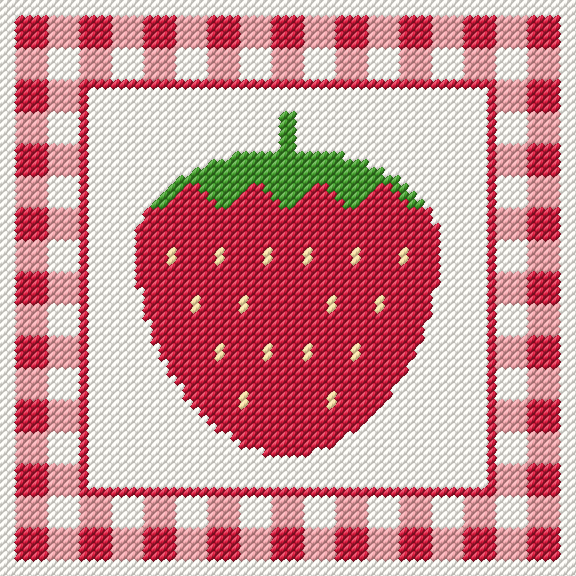
The design is made by changing the color of the thread from one stitch to the next, so it is built of small squares of color, like the squares of a chart. A pillow front, a belt or a chair seat in needlepoint is one cloth of stitches with the canvas hidden beneath: what shows is thread.
Not all needlepoint is slanted stitches. Stitches other than tent stitch are called decorative stitches: they give texture to a background or to one part of a design, and which stitch to use helps in choosing them.
Other names for needlepoint
- Canvas work, also written canvaswork, and canvas embroidery are the older names: until the early nineteenth century the craft was known as canvas work. Needlepoint is the American word for the same thing, and in Britain canvas work is still the careful word.
- Tapestry is the everyday name in Britain, and a stitched tapestry and a needlepoint are the same thing. Strictly, a tapestry is a cloth woven on a loom, with the picture built up in the weaving: there is no canvas and no needle. Stitching on canvas was made to look like those weavings and took their name. The name has stuck to the tools as well: the blunt needle is a tapestry needle, and a wool much used on canvas is tapestry wool.
- Needlepoint embroidery, tapestry work and tapestry embroidery are further names for the same craft. Needlepoint tapestry joins two of the names, and like tapestry it does not say by itself whether a piece is stitched or woven: see the section Hand work and machine-made "needlepoint" below.
- Gobelin is the word for canvas work in Germany. It comes from a tapestry works in Paris known for its woven hangings, and in English it names a stitch, longer than tent stitch, made to imitate them: see upright Gobelin and slanted Gobelin. A piece called a Gobelin, or a Gobelin tapestry, may be woven or stitched.
Sellers sometimes keep tapestry for a design all in tent stitch, and needlepoint or canvas work for one in mixed stitches. The craft is the same.
The word needlepoint
Needlepoint is written as one word, and it is a verb as well as a noun: to needlepoint. The people who do it are needlepointers, or simply stitchers.
The word is needle joined to point. It is recorded from 1590, and it first meant the tip of a needle. In 1865 it is recorded for lace made with a needle, a different craft that is still one of the word's meanings.
Words a newcomer meets
- Canvas. The three usual kinds: mono canvas is a plain weave of single threads; Penelope canvas is double-thread canvas, woven of threads in pairs; interlock canvas has paired fine threads that twist around each crossing thread, so that no intersection can shift.
- Mesh, also called count. The number of holes in an inch of canvas: 13 mesh canvas has 13 holes, and takes 13 stitches, to the inch. The higher the number, the smaller the stitches. Canvas and mesh sizes explains mesh and the kinds of canvas.
- Kit. A canvas sold together with the materials to stitch it, often with the design printed on the canvas.
- Tapestry wool, Persian wool. Tapestry wool is one thick strand, used as it comes. Persian wool is three thinner strands that pull apart, so that one, two or three are used to suit the mesh. The thread guide covers these and the cottons and silks.
- Stretcher bars, scroll frame. Two kinds of frame that keep the canvas from pulling out of shape while it is stitched: stretcher bars are straight bars joined into a square or a rectangle, and a scroll frame holds the canvas between two rollers, top and bottom. See frames and stretcher bars.
- Stitch guide. Written instructions for one canvas, part by part, with a list of threads and diagrams of the stitches. See what is a stitch guide.
- Blocking. Returning a stitched canvas to its original shape. See how to block needlepoint.
- Finishing. Making the stitched canvas into the thing it is to be: a pillow, an ornament, a belt. See needlepoint finishing.
The glossary has the rest.
The kinds people name
These are names for needlepoint by its stitch, its scale, its canvas or its period, not separate crafts.
- Tent stitch needlepoint. The plain kind. Tent stitch is made in three ways, called continental, basketweave and half cross. They look the same from the front and differ on the back, in how much thread they use and in how well they wear: see basketweave vs continental.
- Petit point, gros point and quick point. Names by scale: small stitches on fine canvas, larger stitches, and the biggest stitches, on canvas so coarse that it is sold as rug canvas. The table under this list gives the sizes, and petit point and gros point has more.
- Bargello, also called Florentine work or flame stitch. Upright stitches, each over several canvas threads, set in stepped rows of color that rise and fall in zigzags and waves. See what is bargello and the bargello patterns.
- Berlin work, or Berlin wool work. The fashion of the nineteenth century: bright wools on canvas, copied square by square from colored charts that were first published in Berlin in 1804. It was stitched in one stitch throughout, most often tent stitch or cross stitch. Old needlepoint says more about it.
- Plastic canvas. Needlepoint stitches on plastic: a sheet with square holes, made to stand in for woven canvas. It suits three-dimensional pieces. See plastic canvas needlepoint.
| Name | Holes to the inch |
|---|---|
| Petit point | 16 and finer |
| Gros point | 8 to 15 |
| Quick point | 3 to 7 |
The names overlap at the edges: 16 mesh is also called gros point, and 7 mesh both gros point and quick point. By these figures everyday 18 mesh is petit point, but the name is also kept for 22 mesh and finer alone.
On Penelope canvas the first two names are exact. A tent stitch over a pair of threads each way is gros point. Part the pairs and stitch over single threads, and it is petit point, with four stitches in the space of one gros point.
What it is used for
Stitched in wool, needlepoint is a very durable cloth, which suits it to things that get hard use. Today it is made up into pillows, stockings, ornaments, belts, key fobs, pet collars and purses, and into stand-ups, which are pieces finished to stand upright. Rugs and furniture are the large pieces, and a piece can be framed as a picture. What to make with needlepoint goes through the choices.
The uses are old: from the sixteenth century on, stitching on canvas was common work in the home, for cushion covers, upholstered furniture, bed hangings and other hangings. See the history of needlepoint.
A craft, a hobby, an art
Needlepoint is all three, and a fiber art as well: embroidery is one of the fiber arts.
How creative it is depends on the stitcher. A painted canvas in tent stitch asks for one stitch and no counting, which makes it friendly to beginners. From there a stitcher can choose the threads, bring in decorative stitches for texture, invent stitch patterns or paint a canvas. For a first piece, see how to needlepoint, tools and supplies and the easy patterns.
Hand work and machine-made "needlepoint"
Needlepoint is hand work: embroidery worked by hand on canvas. Machines weave three kinds of cloth that share its names or its look, and none of them is stitched.
- Woven "tapestry". Tapestry is a loose name for almost any heavy furnishing cloth, and for pictures woven on machine looms, often under computer control.
- Cloth woven to look stitched. Machine looms have imitated needlepoint, petit point included, for a century or more.
- Looped cloth called gros point. A hard-wearing furnishing cloth with a surface of loops, which looks like the background of a needlepoint.
To tell stitched canvas from woven cloth:
- From the back, where it can be seen without undoing anything. On needlepoint the stitches show: short upright ones behind half cross, long slanted ones behind continental, a weave like a basket behind basketweave. An unstitched margin shows the canvas itself, an open grid of threads.
- From the front. Tent stitch is slanted stitches on a square grid, all leaning one way. Hand-woven tapestry has lines of ridges instead, all running one way, where the colored threads pass over the threads they are woven on. The front does not always settle it: bargello and other upright stitches are not slanted, and machine-woven cloth need not show ridges and can be made to look stitched.
- Do not open anything to look. Leave a piece in its frame, its lining or its pillow, or on its chair. Wrong handling can damage a textile, and one that is already framed is a textile conservator's to open. Old needlepoint says who can examine a piece.
Before buying, ask the seller one plain question: was it stitched by hand on canvas, or woven? Only the first is needlepoint.
Crafts like needlepoint
The first two of these are other kinds of embroidery; woven tapestry and needle lace, which share needlepoint's names, are covered above.
- Cross stitch. Stitched on a grid, like needlepoint, and often from the same kind of chart. Its stitches are crosses, made on evenly woven fabric, and the fabric commonly shows around and between them, where needlepoint covers its canvas. The same stitch made on canvas is a needlepoint stitch. See needlepoint vs cross stitch.
- Crewel. Wool and a needle again, but on a firm, closely woven cloth, and nothing is counted: the stitches go where the drawing goes, not where the weave does. It is named for its yarn, a fine wool of two threads twisted loosely together. See needlepoint vs embroidery.
- Latch hook. Made on rug canvas, like quick point, but knotted, not stitched: short cut lengths of yarn are each knotted onto the canvas with a hooked tool that has a small latch, and their ends stand up as tufts.
- Rug hooking and punch needle. Used, like needlepoint, for rugs, wall hangings and pillow covers. Loops of yarn or strips of fabric are pulled through a backing cloth with a hook, or pushed through from the back with a hollow needle. The surface is loops, not stitches.
- Crochet. Yarn again, but with no cloth underneath: the fabric is made from a single thread and one hook, loop through loop.