Needlepoint guide
Variegated and overdyed threads
The thread changes color along its length, and the order of your stitches decides where each color lands. Stitches in level rows give bars, stitches in slanting rows give streaks, and small blocks give patches. Find the repeat, which is the length before a color comes back. Then choose the stitch from the pictures below.
On this page 15 parts
- What the words mean
- Find the repeat
- The same thread in twelve ways
- The width of the row decides too
- You want this: do that
- Cut it and keep the order
- Where it works
- A French knot flower, light to dark
- An ombre from plain shades
- Coasters and other small sets
- How much to buy
- Water, steam and colors that run
- Overdyed canvas
- What goes wrong
- Questions people ask
What the words mean
| Word | What it is | What it does on canvas |
|---|---|---|
| Variegated | Dyed in color after color, at even intervals | Marks that come back regularly. You can plan them |
| Overdyed | Dyed, then dyed again in other colors over the first, by hand as a rule | Uneven lengths, soft edges between colors. You can steer it, not plan it |
| Hand dyed | Dyed in small batches, in one color or several | Clouds of one color, or any of the rest. No two batches match |
| Space dyed | Color put on at set places along the thread | Like variegated, with longer or sharper changes |
| Tonal, or semi-solid | Close shades of one color | Movement with no stripes to see. The easiest to begin with |
| Ombre | One color from light to dark, in three shades or more | A slow change, if the area is the right size |
A label may use any of them, so look at the thread. Two questions settle it: how many inches before a color comes back, and how far apart are the lightest and the darkest?
What to do next:
- Find the repeat, below.
- Pick the look you want from the pictures or from the table. It names the stitch and the order.
- Work a trial on a spare piece of the same canvas, in that stitch: six rows, as wide as the area you will fill, or 3 inches (7.6 cm) if it is wider. The width counts, so a small square tells you little.
- Compare it with the pictures. If it blotches or stripes, change the order, the width or the place where you cut.
If it is your first, take a tonal thread and stitch level rows. Any order looks right in it.
The stitches in the pictures, in a line each. The tables further down link each to its page with steps.
| Stitch | What it is |
|---|---|
| Tent | A small slanted stitch over one crossing of the canvas threads, up to the right |
| Continental | Tent worked in level rows, or in upright columns |
| Basketweave | Tent worked in slanting rows, from corner to corner |
| Skip tent | Tent on every other crossing, a checkerboard. The gaps can be filled afterward with a second thread |
| Mosaic | A block of three slanted stitches, short, long, short, two threads square |
| Scotch | A block of five, growing and shrinking, three threads square |
| Brick | Upright stitches, every other one half a stitch lower |
| Rhodes | A raised star, long stitches crossing in the middle of a square |
| Cross | Two slanted stitches, one over the other |
| French knot | A bead of thread, wrapped round the needle |
| Long stitch | Straight stitches side by side, from edge to edge of a shape |
Find the repeat
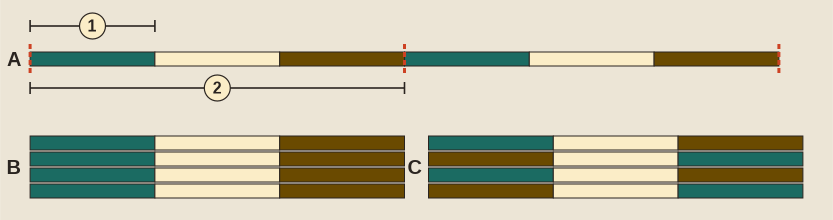
- Draw out a length from the skein and lay it along a ruler. Do not stretch it.
- Mark where one color begins, and where the same color begins again. That length is the repeat (2).
- Count the runs in it: the stretches of one color. One run is marked 1. This thread has three to a repeat.
- Turn it into stitches with the table. A tent stitch, the small slanted stitch of most needlepoint, uses thread on the front and behind: about a quarter of an inch (6.7 mm) on 13 mesh, and less than a fifth (4.8 mm) on 18.
| Repeat | Tent stitches, 13 mesh | Tent stitches, 18 mesh |
|---|---|---|
| 2 in (5 cm) | 8 | 11 |
| 4 in (10 cm) | 15 | 21 |
| 6 in (15 cm) | 23 | 32 |
| 8 in (20 cm) | 30 | 42 |
| 12 in (30 cm) | 46 | 63 |
| 18 in (46 cm) | 69 | 95 |
Mesh is the number of holes to the inch (2.5 cm). For other repeats multiply the inches by 3.8 on 13 mesh and by 5.3 on 18. Tight hands use a little less thread, and so get a stitch or two more.
The same thread in twelve ways
All of these are one thread: green, cream and brown. Each color lasts for about seven tent stitches. That is a run of 1.8 inches (4.7 cm) on 13 mesh and 1.3 inches (3.4 cm) on 18, so a repeat of 5.5 inches (14 cm) or 4 inches (10.2 cm). Your own thread will give longer or shorter marks of the same kind.
Tent stitch

Basketweave in variegated yarn, step by step
In basketweave the colors fall in broken streaks that slant down to the right, across the slant of the stitches: C in the picture above. The rows lie that way, and the color follows them.
- Cut every length at the same point of the repeat, so that the colors come in the same order in each, and thread the end you have just cut.
- Begin at the upper right corner with one stitch. From there the rows lie on the slant, up and down by turns. Follow the steps of basketweave, which say whether the first row goes up or down on your canvas.
- Pass straight from row to row, so that the color runs on round each turn.
- Stop a length 3 inches (8 cm) from its end, and note the color of your last stitch and which way the row was going. Run the tail level or upright under stitches at the back.
- Trim the next length to match. Both tails lie hidden at the back and their colors are lost, so a length cut as in step 1 does not join as it is. Lay it beside the work, tail end first. Find the place that has the color of your last stitch, with the right color after it, and cut 2 inches (5 cm) before that place, for the tail: the four steps say more.
- Go on in the next stitch of the same row, in the same direction.
- Look from across the room when three repeats are in. With a repeat of 6 inches (15 cm) on 13 mesh that is about 70 stitches, the first eleven or twelve rows of a corner.
To break the streaks, turn every other strand end for end before you thread, if the thread is one of several strands. In any thread, one thick strand too, work small uneven patches, each from its own upper right, or use skip tent with a second thread in the gaps. To make them bold, work a narrow band whose slanting rows are as long as one run: each row is then about one color.
Blocks, brick and Rhodes

Crosses, knots and long stitch

A knot's thread depends on how tightly you wrap, so your knots may keep a color longer or shorter than C does.
One repeat of 6 inches (15 cm) makes about:
| Stitch | On 13 mesh | On 18 mesh |
|---|---|---|
| Continental or basketweave | 23 stitches | 32 |
| Mosaic | 6 blocks | 8 or 9 |
| Scotch, over three threads | 3 blocks | 4 |
| Brick, over four | 11 stitches | 15 |
| Cross stitch, over two threads | 7 crosses | 10 |
| Rhodes, over six | Half a block | Two thirds of one |
| Long stitch, over fourteen | 3 stitches | 4 |
The width of the row decides too

When a row is as wide as one run, every row is about one color (A). At half a repeat (B) and at a whole repeat (C) a color comes back in the same place in row after row and makes a block, which is called pooling. Where rows meet end to end, two colors take turns. A row a few stitches wider or narrower breaks it up. So if a patch pools, turn the work and go in columns, or begin the next length elsewhere in the repeat.
You want this: do that
| You want | Stitch | Order |
|---|---|---|
| Level bars | Continental | In rows |
| Upright bars: bark, rain, a curtain | Continental in columns, long stitch | In columns |
| Slanting streaks | Basketweave | From one corner |
| Patches | Scotch, mosaic | Each block finished before the next |
| Blocks of one color each | Mosaic or Scotch, if one run is long enough: see below | A new length for each block, with that color in its middle |
| Speckle | Cross stitch in two journeys, the second on the way back; or skip tent, its gaps filled by a second thread threaded from the other end | In rows |
| Dashes | Brick, over four | In rows |
| A slow change | Any | Use a thread whose repeat is as long as the whole area takes, or plain shades, below |
| As little pattern as can be | Any, with several strands | Turn every other strand end for end (C in the first picture) |
For a block of one color a run must be as long as the thread the block takes:
| Block | 13 mesh | 18 mesh |
|---|---|---|
| Mosaic | 1 in (2.4 cm) | 0.7 in (1.8 cm) |
| Scotch, over three | 2.2 in (5.5 cm) | 1.6 in (4 cm) |
| Rhodes, over six | 12.5 in (32 cm) | 9 in (23 cm) |
Cut each length with 2 inches (5 cm) of the colors before and after the run. Those are the ends you run under on the back, where their color does not show. With the thread of the pictures, a run of 1.8 inches (4.7 cm) on 13 mesh, only mosaic comes out whole. For a larger block in one color use a plain thread.
Cut it and keep the order
- Cut on the repeat. Every length begins at the same color and holds as many whole repeats as fit in 18 inches (45 cm): three of 6 inches (15 cm), two of 8 (20 cm).
- Mark the outer end with a loose knot. That is the loose end that you pull from the skein, before the cut.
- Thread the other end, the one you have just cut. The knotted end becomes the tail. Take the knot out when the needle is threaded. Every length is now worked in the order of the skein.
- Keep strands level. Floss that has been pulled apart goes back together with its colors side by side (B in the first picture). Out of step, it spots.
- Or turn half of them (C): the colors mix in the needle, and the stripes soften. Somewhere in each repeat a color still meets itself, as cream does in C, and shows there as one short band.
- Skip a color by cutting it out. Keep the piece for an eye, a berry or a leaf.
A new area begins with the whole length from step 1. In the middle of an area a new length must take up where the old one stopped, or a bar shows. The tails of both are hidden on the back, so the colors in them are lost, and the new length has to be trimmed:
- Look at your last stitch: its color, and the color that should come next.
- Lay the new thread beside it, tail end first. Find the place where it has that color with the same one after it. That place goes into the next stitch.
- Cut it 2 inches (5 cm) before that place. That piece is the tail, run under stitches on the back.
- Make the next stitch, and compare. If it jumps, pull back and trim a little more.
Across a seam or a gap, go on in the same row with the same thread where you can. Where you cannot, note which color the row ended in, and begin there again.
The short rules for a mixed bag of such threads are in specialty threads.
Where it works
| Subject | Thread | Stitch and order |
|---|---|---|
| Water, calm | Tonal blues, or blue and green | Continental in level rows, or long stitch laid level |
| Water, choppy | The same | Nobuko in level rows, criss-cross Hungarian, or a low bargello wave |
| Sky | The palest, closest shades | Continental in rows. Keep basketweave for rain |
| Grass, a lawn | Two or three greens | Level rows for a mown lawn, brick or columns for blades |
| Leaves, treetops | Overdyed green | Leaf stitch, one leaf to a cut, or French knots |
| Bark, a trunk | Browns with gray | Columns |
| Hair | Tonal | Lines that follow the hair, from the part out: hair and faces |
| A face or hands | None | Plain thread. A stripe across a face is the first thing anyone sees |
| A robe, a kimono, a quilt | Any you like | Patches: Scotch or mosaic |
| A background | Close shades only | Skip tent, or rows. See background stitches |
| Letters | None, or tonal | A letter that changes color half way is hard to read |
| A belt | A repeat of about 6 inches (15 cm) | Continental in columns across the belt. 22 stitches on 18 mesh are two thirds of that repeat, so the bars creep along. A repeat of 4 inches (10 cm) is one whole column and 8 inches (20 cm) two, and both pool |
Beside plain thread. Choose the plain color from the middle of the variegated one, not its brightest. One variegated area in a piece is enough: let the rest be plain and flat. A border in a plain thread holds it together.
Under a pattern. A busy stitch and a busy thread hide each other. Put a strong pattern in a tonal thread, and a strong thread in a plain stitch.
A French knot flower, light to dark

Use a tonal thread or an ombre whose change is as long as the flower takes. This one has 37 knots: 1, 6, 12 and 18.
- Work one knot and measure what it used: thread before, less thread after. Say 3/4 inch (1.9 cm).
- Multiply by the knots: 37 times 3/4 inch is 28 inches (70 cm). That is the length from lightest to darkest you would like. Cut it with 2 inches (5 cm) more at each end for the tails: 32 inches (81 cm) in one piece. It is longer than you would cut for tent stitch, but it goes through the canvas only 74 times, and 18 inches (45 cm) of tent on 13 mesh goes through nearly 140 times. If it frays, cut it in two and join on in the shade you stopped in. A thread with a shorter change comes back to pale before the flower is full: pick the part you want, and use a second length cut at the same place.
- Choose the end. Pale first gives a glowing middle (A), dark first a deep one (B).
- Work the middle, then ring by ring, always round the same way. French knot has the knot itself.
- Run on to the next ring without ending the thread.
With plain shades, work the same rings in four threads, and mix two in one needle for the ring where they meet.
An ombre from plain shades
You choose where the change falls, the colors can be matched again, and nothing runs that you did not choose.
- Take three shades or more of one color, next to each other on a card.
- Count the rows of the area.
- Divide by the steps. With three shades and the mixture between each two there are five steps: 30 rows give six rows to a step.
- Mix in the needle: half the strands of one shade, half of the next.
- Work all rows in the same direction: end the thread at the end of the row, and begin the next where the last began. For smaller steps see how to shade.
Coasters and other small sets
A coaster of 4 inches (10 cm) on 13 mesh is 52 stitches wide. In rows, a repeat of 6 inches (15 cm) comes round a little more than twice in each row, so bars creep sideways from row to row.
- Four alike: begin each in the same corner, at the same point of the repeat.
- Four different: begin each where the last one stopped.
- In squares: Scotch blocks over three threads are the surest. A block takes about 2.2 inches (5.5 cm) of thread on 13 mesh, so with a run of that length or more each block is mostly one color. 52 is not a multiple of three: work 51 and one row of tent, or 54.
- In wool yarn: knitting yarn in long runs gives wide bars. See knitting yarn for what wears.
How to make coasters has the steps for a set.
How much to buy
Yards are an estimate. Work them out with the thread calculator as for plain thread, and add about a fifth for what is trimmed to match. If a color is cut out of every repeat, add that share too: one run of three is half as much again. Buy it all at once. The next dye lot may look like another color.
Water, steam and colors that run
Reds, oranges, greens and darks are the ones best known for running, and hand-dyed thread runs more often than other thread.
- Cut a length that holds every color of the repeat.
- Soak it in cool water.
- Press it between two white cloths, and look.
- If color comes off, do not wet the piece, ever. Put a note with it for the finisher.
- If none does, still do not soak it to block it: steam is kinder, as how to block says for all overdyed thread. Work it on a frame, so that little blocking is needed.
Overdyed canvas
Canvas is dyed too, in cloudy patches that never match twice. It is meant to show: work an open stitch over it, or leave the sky bare. Buy one piece for the whole project. A variegated thread on it is one thing too many, so take a plain thread from one of its colors. Types of canvas has the rest.
What goes wrong
| Problem | Cure |
|---|---|
| A bar where a new length began | It began in another shade. Take back a few stitches, trim the new thread as in Cut it and keep the order, and go on |
| One big blotch | Pooling: the row is as wide as the repeat. Turn the work, or start the next length half a repeat on |
| Stripes you did not want | Turn every other strand end for end, or use skip tent with a second thread, or crosses in two journeys |
| It spots | Strands out of step. Lay them level before you thread the needle |
| It is muddy | Complementary colors, such as red and green, mixed in the needle. Turn no strands, and let each color be seen |
| The face went striped | Take it out. Plain thread |
| A block is half one color and half another | The run is shorter than the block. Take a smaller block, such as mosaic, or a plain thread. If the run is long enough, cut a new length with that color in its middle |
| Two skeins do not match | Two dye lots. Work a row of each by turns where they meet |
| The pattern of the stitch is lost | Use a plain thread, or a plain stitch |
| The end of the thread is the wrong color for the last stitch | Stop there. Save the tail for something small |
Questions people ask
Is variegated thread good for a beginner? A tonal one is. It hides small slips, and any order of stitches looks right.
Can I use it in basketweave? Yes, if slanting streaks suit the picture: rain, a hill, hair. The shorter the runs, the more it looks like tweed.
Continental or basketweave for a large ground? Basketweave for the canvas, since it pulls out of shape less. If the streaks trouble you, skip tent and a second thread hide them best.
Can I mix it with another thread? Yes. One strand of plain thread from its middle shade calms it.
Why does mine look different from the picture? Your repeat is longer or shorter, or your lengths began at another point. Work the sample, and move the start.
Does it need a special needle? No. Take the needle for that kind of thread in the thread and needle chart.