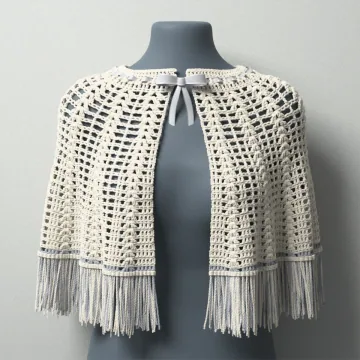
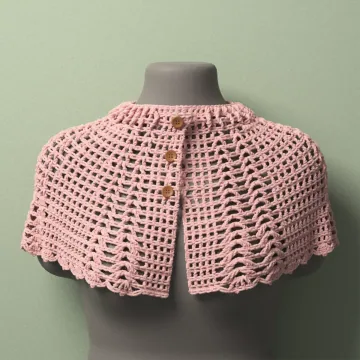
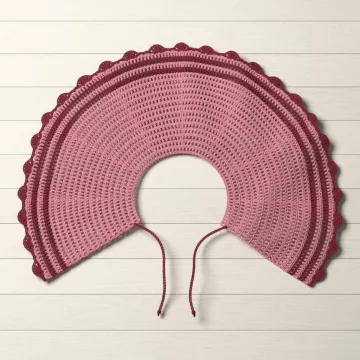
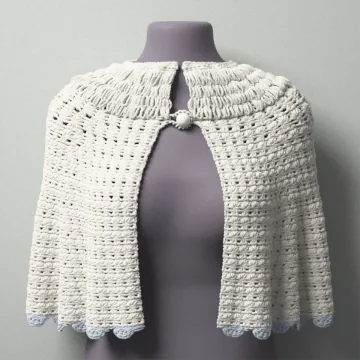
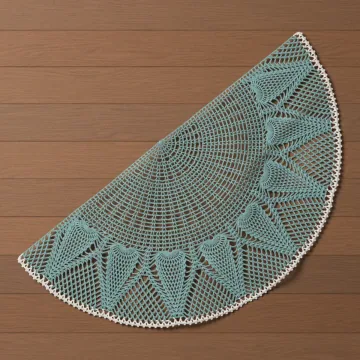
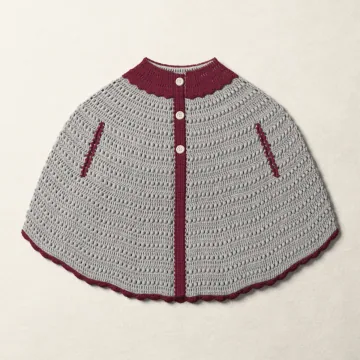
Victorian lace capelet crochet pattern
Crochet, 45½ in round, 2 colors, intermediate
Size: S to M Change size
S to MAbout 45½ in (115.5 cm) roundL to XLAbout 49¼ in (125 cm) round2X to 3XAbout 56¾ in (144 cm) round
Which size? Size chart for clothes
PDF. Prints on US Letter and A4.
What you need
- Yarn A ivoryabout 475 yd (434 m), an estimatelace
- Yarn B roseabout 95 yd (87 m), an estimatepicot edges
- Yarn in all
- About 570 yd (521 m) or 160 g, an estimate
- Weight
- Fine weight, 2 on the label
- Hook
- 4.5 mm (US 7), or the size that gives you the gauge
- Also
- Yarn needle, scissors, tape measure, one pearl button, 0.6 in (15 mm) across, 0.7 yd (0.6 m) of rose satin ribbon, 0.5 in (1.3 cm) wide, sewing needle and sewing thread in the color of yarn A
- Gauge
- 17 stitches and 9 rows to 4 in (10 cm) in double crochet (UK treble). How to check it
Instructions S to M
How to read these rows
US terms · Show UK terms
- ch chain, sl st slip stitch, sc single crochet (UK double crochet), dc double crochet (UK treble).
- sk skip. BLO: only the loop away from you. RS right side, the one that shows, WS wrong side, the back.
- 2 dc in next st: both in one stitch. dc in next 3 sts: one in each. ch-1 sp: the gap under the one chain; the hook goes in the gap.
- [ ] 15 times: work what is inside 15 times in all. ( ): all of it goes into the one place.
- (65 dc): the stitches you have when the row is done. How to read a pattern.
- BLO means back loop only: work under the back loop of the stitch, the one farther from you. The last dc of such a row goes into the top of the turning ch under both loops.
- The ch 3 at the start of a row counts as a dc; the last stitch of the next row is worked into the top of it. The chain stands on the first stitch of the row: "same st" right after it is that stitch, and "next st" is the one after it.
- The ch 4 at the start of a row counts as a dc and a ch-1 sp. The stitch that closes over it goes into its 3rd chain. The chain stands on the first stitch of the row: "same st" right after it is that stitch, and "next st" is the one after it.
Special stitches
Go to: Yoke · First tier · Second tier · Third tier · Collar · Assembly
Yoke
Yarn A, ivory.
- StartCh 67.
- Row 1RSDc in 4th ch from hook (skipped chs count as dc) and in each ch acrossleaves (65 dc)
- Row 2WSCh 3 (counts as dc), turn; repeat: dc in next 3 sts, 2 dc in next st 15 times, dc in next 2 sts, 2 dc in next st, dc in top of turning chleaves (81 dc)
- Row 3RSCh 4 (counts as dc and ch-1 sp), turn; sk next st, repeat: dc in next st, ch 1, sk next st 39 times, dc in top of turning chleaves (41 dc, 40 ch-1 sps)
- Row 4WSCh 3 (counts as dc), turn; repeat: 2 dc in next ch-1 sp, dc in next st, repeat: dc in next ch-1 sp, dc in next st 3 times, 2 dc in next ch-1 sp, dc in next st 7 times, 2 dc in next ch-1 sp, dc in next st, repeat: dc in next ch-1 sp, dc in next st 3 times, 2 dc in next ch-1 sp, dc in 3rd ch of turning chleaves (97 dc)
- Row 5RSCh 4 (counts as dc and ch-1 sp), turn; sk next st, repeat: dc in next st, ch 1, sk next st 47 times, dc in top of turning chleaves (49 dc, 48 ch-1 sps)
- Row 6WSCh 3 (counts as dc), turn; repeat: 2 dc in next ch-1 sp, dc in next st, repeat: dc in next ch-1 sp, dc in next st 4 times, 2 dc in next ch-1 sp, dc in next st 7 times, 2 dc in next ch-1 sp, dc in next st, repeat: dc in next ch-1 sp, dc in next st 4 times, 2 dc in next ch-1 sp, dc in 3rd ch of turning chleaves (113 dc)
- Row 7RSCh 4 (counts as dc and ch-1 sp), turn; sk next st, repeat: dc in next st, ch 1, sk next st 55 times, dc in top of turning chleaves (57 dc, 56 ch-1 sps)
- Row 8WSCh 3 (counts as dc), turn; repeat: 2 dc in next ch-1 sp, dc in next st, repeat: dc in next ch-1 sp, dc in next st 5 times, 2 dc in next ch-1 sp, dc in next st 7 times, 2 dc in next ch-1 sp, dc in next st, repeat: dc in next ch-1 sp, dc in next st 5 times, 2 dc in next ch-1 sp, dc in 3rd ch of turning chleaves (129 dc)
- Row 9RSCh 4 (counts as dc and ch-1 sp), turn; sk next st, repeat: dc in BLO of next st, ch 1, sk next st 63 times, dc in top of turning chleaves (65 dc, 64 ch-1 sps)
- Row 10WSCh 3 (counts as dc), turn; repeat: 2 dc in next ch-1 sp, dc in next st, repeat: dc in next ch-1 sp, dc in next st 6 times, 2 dc in next ch-1 sp, dc in next st 7 times, 2 dc in next ch-1 sp, dc in next st, repeat: dc in next ch-1 sp, dc in next st 6 times, 2 dc in next ch-1 sp, dc in 3rd ch of turning chleaves (145 dc)
- Row 11RSCh 4 (counts as dc and ch-1 sp), turn; sk next st, repeat: dc in next st, ch 1, sk next st 71 times, dc in top of turning chleaves (73 dc, 72 ch-1 sps)
- Row 12WSCh 3 (counts as dc), turn; repeat: 2 dc in next ch-1 sp, dc in next st, repeat: dc in next ch-1 sp, dc in next st 7 times, 2 dc in next ch-1 sp, dc in next st 7 times, 2 dc in next ch-1 sp, dc in next st, repeat: dc in next ch-1 sp, dc in next st 7 times, 2 dc in next ch-1 sp, dc in 3rd ch of turning chleaves (161 dc)
- Row 13RSCh 4 (counts as dc and ch-1 sp), turn; sk next st, repeat: dc in BLO of next st, ch 1, sk next st 79 times, dc in top of turning chleaves (81 dc, 80 ch-1 sps)
- Row 14WSCh 3 (counts as dc), turn; repeat: 2 dc in next ch-1 sp, dc in next st, repeat: dc in next ch-1 sp, dc in next st 8 times, 2 dc in next ch-1 sp, dc in next st 7 times, 2 dc in next ch-1 sp, dc in next st, repeat: dc in next ch-1 sp, dc in next st 8 times, 2 dc in next ch-1 sp, dc in 3rd ch of turning chleaves (177 dc)
- Row 15RSCh 4 (counts as dc and ch-1 sp), turn; sk next st, repeat: dc in next st, ch 1, sk next st 87 times, dc in top of turning chleaves (89 dc, 88 ch-1 sps)
- Row 16WSCh 3 (counts as dc), turn; repeat: 2 dc in next ch-1 sp, dc in next st, repeat: dc in next ch-1 sp, dc in next st 9 times, 2 dc in next ch-1 sp, dc in next st 7 times, 2 dc in next ch-1 sp, dc in next st, repeat: dc in next ch-1 sp, dc in next st 9 times, 2 dc in next ch-1 sp, dc in 3rd ch of turning chleaves (193 dc)
- EndFasten off.
First tier
Yarns in order of use: A, ivory; B, rose.
- All three tiers hang down over the yoke and are worked with the right side of the yoke facing you and its neck edge at the bottom, so that they grow toward the hem. The first tier stands on row 8: its 129 sts are the sts of that row, one after another, the first of them at the right-hand end (at the left-hand end if you are left handed). Work into the front loops, which row 9 left free, and into the front loops of the sts that it skipped; at the end of the row where there is no free loop, because the last dc of row 9 went into the turning chain, work into that chain too. In every tier the fan goes into the 4th of the 7 sts between two single dc.
- StartThe outer edge of the yoke at row 8: 129 sts across, with the right side facing you, as told in the notes.
- Row 1RSJoin A with sl st in first st, ch 3 (counts as dc), repeat: sk next 3 sts, (dc, ch 1, dc, ch 1, dc, ch 1, dc, ch 1, dc) in next st, sk next 3 sts, dc in next st 16 timesleaves (97 dc, 64 ch-1 sps)
- Row 2WSCh 3 (counts as dc), turn; repeat: repeat: dc in next st, ch 2, sk next ch-1 sp 4 times, dc in next 2 sts 15 times, repeat: dc in next st, ch 2, sk next ch-1 sp 4 times, dc in next st, dc in top of turning chleaves (97 dc, 64 ch-2 sps)
- Row 3RSCh 3 (counts as dc), turn; repeat: repeat: (dc, ch 1, dc) in next ch-2 sp 4 times, sk next st, dc in next st 15 times, repeat: (dc, ch 1, dc) in next ch-2 sp 4 times, sk next st, dc in top of turning chleaves (145 dc, 64 ch-1 sps)
- Row 4WSCh 3 (counts as dc), turn; repeat: repeat: 3 dc in next ch-1 sp, ch 1 3 times, 3 dc in next ch-1 sp, sk next st, dc in next st 15 times, repeat: 3 dc in next ch-1 sp, ch 1 3 times, 3 dc in next ch-1 sp, sk next st, dc in top of turning ch. Change to yarn B on the last pull through.leaves (209 dc, 48 ch-1 sps)
- Row 5RSCh 1, turn; sc in first st, repeat: repeat: sc in next 2 sts, picot, sc in next st, sc in next ch-1 sp 3 times, sc in next 2 sts, picot, sc in next 2 sts 15 times, repeat: sc in next 2 sts, picot, sc in next st, sc in next ch-1 sp 3 times, sc in next 2 sts, picot, sc in next st, sc in top of turning chleaves (257 sc, 64 picots)
- EndFasten off.
Second tier
Yarns in order of use: A, ivory; B, rose.
- The second tier stands on row 12, 161 sts, in the same way: in the front loops of all its sts, which row 13 left free or skipped.
- StartThe outer edge of the yoke at row 12: 161 sts across, with the right side facing you, as told in the notes.
- Row 1RSJoin A with sl st in first st, ch 3 (counts as dc), repeat: sk next 3 sts, (dc, ch 1, dc, ch 1, dc, ch 1, dc, ch 1, dc) in next st, sk next 3 sts, dc in next st 20 timesleaves (121 dc, 80 ch-1 sps)
- Row 2WSCh 3 (counts as dc), turn; repeat: repeat: dc in next st, ch 2, sk next ch-1 sp 4 times, dc in next 2 sts 19 times, repeat: dc in next st, ch 2, sk next ch-1 sp 4 times, dc in next st, dc in top of turning chleaves (121 dc, 80 ch-2 sps)
- Row 3RSCh 3 (counts as dc), turn; repeat: repeat: (dc, ch 1, dc) in next ch-2 sp 4 times, sk next st, dc in next st 19 times, repeat: (dc, ch 1, dc) in next ch-2 sp 4 times, sk next st, dc in top of turning chleaves (181 dc, 80 ch-1 sps)
- Row 4WSCh 3 (counts as dc), turn; repeat: repeat: 3 dc in next ch-1 sp, ch 1 3 times, 3 dc in next ch-1 sp, sk next st, dc in next st 19 times, repeat: 3 dc in next ch-1 sp, ch 1 3 times, 3 dc in next ch-1 sp, sk next st, dc in top of turning ch. Change to yarn B on the last pull through.leaves (261 dc, 60 ch-1 sps)
- Row 5RSCh 1, turn; sc in first st, repeat: repeat: sc in next 2 sts, picot, sc in next st, sc in next ch-1 sp 3 times, sc in next 2 sts, picot, sc in next 2 sts 19 times, repeat: sc in next 2 sts, picot, sc in next st, sc in next ch-1 sp 3 times, sc in next 2 sts, picot, sc in next st, sc in top of turning chleaves (321 sc, 80 picots)
- EndFasten off.
Third tier
Yarns in order of use: A, ivory; B, rose.
- The third tier is worked into the tops of the sts of row 16, the last row of the yoke, under both loops, 193 sts, the turning chain at the one end among them. Begin at the right-hand end (at the left-hand end if you are left handed).
- StartThe outer edge of the yoke at row 16: 193 sts across, with the right side facing you, as told in the notes.
- Row 1RSJoin A with sl st in first st, ch 3 (counts as dc), repeat: sk next 3 sts, (dc, ch 1, dc, ch 1, dc, ch 1, dc, ch 1, dc) in next st, sk next 3 sts, dc in next st 24 timesleaves (145 dc, 96 ch-1 sps)
- Row 2WSCh 3 (counts as dc), turn; repeat: repeat: dc in next st, ch 2, sk next ch-1 sp 4 times, dc in next 2 sts 23 times, repeat: dc in next st, ch 2, sk next ch-1 sp 4 times, dc in next st, dc in top of turning chleaves (145 dc, 96 ch-2 sps)
- Row 3RSCh 3 (counts as dc), turn; repeat: repeat: (dc, ch 1, dc) in next ch-2 sp 4 times, sk next st, dc in next st 23 times, repeat: (dc, ch 1, dc) in next ch-2 sp 4 times, sk next st, dc in top of turning chleaves (217 dc, 96 ch-1 sps)
- Row 4WSCh 3 (counts as dc), turn; repeat: repeat: 3 dc in next ch-1 sp, ch 1 3 times, 3 dc in next ch-1 sp, sk next st, dc in next st 23 times, repeat: 3 dc in next ch-1 sp, ch 1 3 times, 3 dc in next ch-1 sp, sk next st, dc in top of turning ch. Change to yarn B on the last pull through.leaves (313 dc, 72 ch-1 sps)
- Row 5RSCh 1, turn; sc in first st, repeat: repeat: sc in next 2 sts, picot, sc in next st, sc in next ch-1 sp 3 times, sc in next 2 sts, picot, sc in next 2 sts 23 times, repeat: sc in next 2 sts, picot, sc in next st, sc in next ch-1 sp 3 times, sc in next 2 sts, picot, sc in next st, sc in top of turning chleaves (385 sc, 96 picots)
- EndFasten off.
Collar
Yarns in order of use: A, ivory; B, rose.
- Hold the yoke with its right side facing you and the neck edge at the top. The 65 sts are the places of the foundation chain along its free side, from the right-hand end to the left-hand end (the other way if you are left handed): the chain under each of the 64 dc of row 1 that are worked into a chain and the bottom one of the 3 skipped chs, which is at the end you come to last.
- StartThe neck edge of the yoke: 65 sts across, with the right side facing you, as told in the notes.
- Row 1RSJoin A with sl st in first st, ch 3 (counts as dc), dc in next 63 sts, dc in last stleaves (65 dc)
- Rows 2 to 4Ch 3 (counts as dc), turn; dc in next 63 sts, dc in top of turning chleaves (65 dc)Next: row 2 of rows 2 to 4
- Row 5RSCh 3 (counts as dc), turn; dc in same st, repeat: 2 dc in next st 63 times, 2 dc in top of turning chleaves (130 dc)
- Row 6WSCh 3 (counts as dc), turn; dc in next 128 sts, dc in top of turning ch. Change to yarn B on the last pull through.leaves (130 dc)
- Row 7RSCh 1, turn; sc in first st, repeat: sc in next 2 sts, picot, sc in next st 42 times, sc in next 2 sts, sc in top of turning chleaves (130 sc, 42 picots)
- EndFasten off.
Assembly
- Button loop: with the right side facing you, at the front edge that is at your left as you look at the capelet with its neck up, join yarn A with a slip stitch round the end of row 1 of the yoke, leaving a tail of about 6 in (15.2 cm), ch 7, work a slip stitch round the end of row 1 of the collar, and fasten off, leaving a tail of the same length. With the sewing thread and the sewing needle sew the button to the right side of the other front edge, at the line between the yoke and the collar, opposite the loop.
- Ribbon: tie the ribbon in a bow, its loops about 1.5 in (3.8 cm) long, trim its ends on a slant, and sew the knot with the sewing thread to the front edge that has the loop, just below it, so that the bow lies over the opening when the button is closed.
Finishing
- Weave in the ends.
About
The yoke is worked from the neck down, open rows of double crochet (UK treble) and chains in turn with solid ones. Two of its rows leave their front loops free, and a tier of scalloped fans is worked into each; a third tier is the hem. The collar stands up from the neck and opens in a ruffle, in the manner of about 1,890.