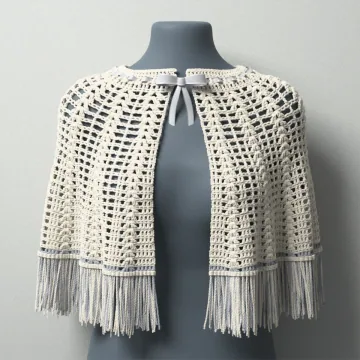
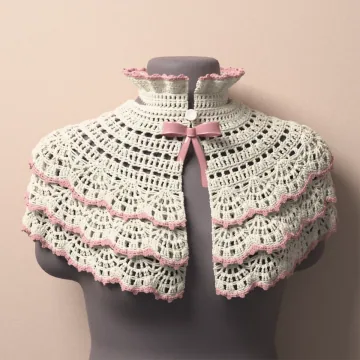
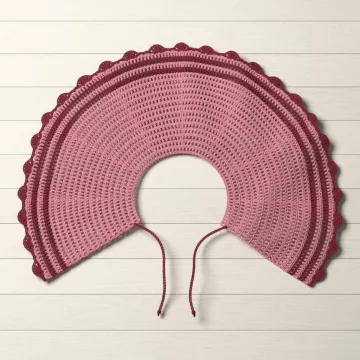
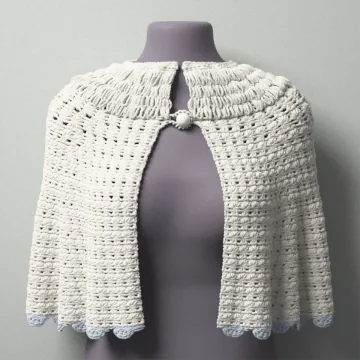
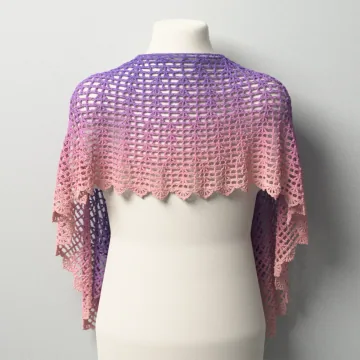
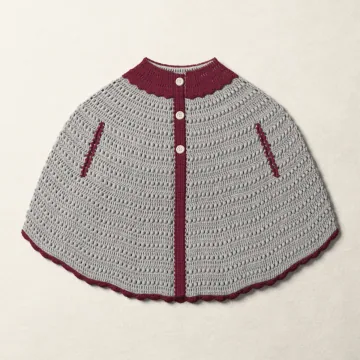
Easy lace shoulder capelet crochet pattern
Crochet, 46 in round, 1 color, easy
PDF. Prints on US Letter and A4.
What you need
- Yarn Any one color (dusty rose in the picture)about 250 yd (229 m) or 100 g, an estimate
- Weight
- Light weight, 3 on the label (UK DK)
- Hook
- 5 mm (US H-8), or the size that gives you the gauge
- Also
- Yarn needle, scissors, tape measure, 3 wood buttons about 0.6 in (1.5 cm) across and sewing thread and a sewing needle
- Gauge
- 15 stitches and 8 rows to 4 in (10 cm) in double crochet (UK treble). How to check it
Instructions S to M
How to read these rows
US terms · Show UK terms
- ch chain, sl st slip stitch, sc single crochet (UK double crochet), dc double crochet (UK treble).
- sk skip, yo yarn over the hook, RS right side, the one that shows, WS wrong side, the back.
- 2 dc in next st: both in one stitch. dc in next 2 sts: one in each. ch-1 sp: the gap under the one chain; the hook goes in the gap.
- [ ] 30 times: work what is inside 30 times in all. ( ): all of it goes into the one place.
- (70 dc): the stitches you have when the row is done. How to read a pattern.
- Post stitches.
- The first 5 sts and the last 5 sts of every row are the front bands. The ch 3 and the dc in the top of the turning ch are the outermost of them.
- The ch 3 at the start of a row counts as a dc; the last stitch of the next row is worked into the top of it. The chain stands on the first stitch of the row, so "next st" right after it is the second stitch.
- A ch 1 at the start of a row does not count as a stitch.
Special stitches
- FPdc front post double crochet (UK: FPtr)
- Yo, insert the hook from front to back to front round the post (the upright part) of the st, yo and pull up a loop, (yo and draw through 2 loops) 2 times.
- BPdc back post double crochet (UK: BPtr)
- Yo, insert the hook from back to front to back round the post (the upright part) of the st, yo and pull up a loop, (yo and draw through 2 loops) 2 times.
- StartCh 72.
- Row 1RSDc in 4th ch from hook (skipped chs count as dc) and in each ch acrossleaves (70 dc)
- Row 2WSCh 3 (counts as dc), turn; dc in next st, ch 1, sk next st, dc in next 2 sts, repeat: FPdc around next st, BPdc around next st 30 times, dc in next 4 sts, dc in top of turning chleaves (9 dc, 1 ch-1 sp, 30 FPdc, 30 BPdc)
- Row 3RSCh 3 (counts as dc), turn; dc in next 4 sts, repeat: FPdc around next st, BPdc around next st 30 times, dc in next 2 sts, dc in next ch-1 sp, dc in next st, dc in top of turning chleaves (10 dc, 30 FPdc, 30 BPdc)
- Row 4WSCh 3 (counts as dc), turn; dc in next 4 sts, repeat: sk next st, (dc, ch 1, dc) in next st, sk next 2 sts, (dc, ch 1, dc) in next st, sk next st, 2 dc in next st, dc in next st, 2 dc in next st 6 times, sk next st, (dc, ch 1, dc) in next st, sk next 2 sts, (dc, ch 1, dc) in next st, sk next st, dc in next 4 sts, dc in top of turning chleaves (68 dc, 14 ch-1 sps)
- Row 5RSCh 3 (counts as dc), turn; dc in next 4 sts, repeat: (dc, ch 1, dc) in next ch-1 sp, (dc, ch 1, dc) in next ch-1 sp, sk next st, dc in next 5 sts 6 times, (dc, ch 1, dc) in next ch-1 sp, (dc, ch 1, dc) in next ch-1 sp, sk next st, dc in next 4 sts, dc in top of turning chleaves (68 dc, 14 ch-1 sps)
- Row 6WSCh 3 (counts as dc), turn; dc in next st, ch 1, sk next st, dc in next 2 sts, repeat: (dc, ch 1, dc) in next ch-1 sp, (dc, ch 1, dc) in next ch-1 sp, sk next st, dc in next 5 sts 6 times, (dc, ch 1, dc) in next ch-1 sp, (dc, ch 1, dc) in next ch-1 sp, sk next st, dc in next 4 sts, dc in top of turning chleaves (67 dc, 15 ch-1 sps)
- Row 7RSCh 3 (counts as dc), turn; dc in next 4 sts, repeat: (dc, ch 1, dc) in next ch-1 sp, (dc, ch 1, dc) in next ch-1 sp, sk next st, dc in next 5 sts 6 times, (dc, ch 1, dc) in next ch-1 sp, (dc, ch 1, dc) in next ch-1 sp, sk next st, dc in next 2 sts, dc in next ch-1 sp, dc in next st, dc in top of turning chleaves (68 dc, 14 ch-1 sps)
- Row 8WSCh 3 (counts as dc), turn; dc in next 4 sts, repeat: (dc, ch 1, dc) in next ch-1 sp, (dc, ch 1, dc) in next ch-1 sp, sk next st, 2 dc in next st, dc in next 3 sts, 2 dc in next st 6 times, (dc, ch 1, dc) in next ch-1 sp, (dc, ch 1, dc) in next ch-1 sp, sk next st, dc in next 4 sts, dc in top of turning chleaves (80 dc, 14 ch-1 sps)
- Row 9RSCh 3 (counts as dc), turn; dc in next 4 sts, repeat: (dc, ch 1, dc) in next ch-1 sp, (dc, ch 1, dc) in next ch-1 sp, sk next st, dc in next 7 sts 6 times, (dc, ch 1, dc) in next ch-1 sp, (dc, ch 1, dc) in next ch-1 sp, sk next st, dc in next 4 sts, dc in top of turning chleaves (80 dc, 14 ch-1 sps)
- Row 10WSCh 3 (counts as dc), turn; dc in next st, ch 1, sk next st, dc in next 2 sts, repeat: (dc, ch 2, dc) in next ch-1 sp, (dc, ch 2, dc) in next ch-1 sp, sk next st, dc in next 7 sts 6 times, (dc, ch 2, dc) in next ch-1 sp, (dc, ch 2, dc) in next ch-1 sp, sk next st, dc in next 4 sts, dc in top of turning chleaves (79 dc, 1 ch-1 sp, 14 ch-2 sps)
- Row 11RSCh 3 (counts as dc), turn; dc in next 4 sts, repeat: (dc, ch 2, dc) in next ch-2 sp, (dc, ch 2, dc) in next ch-2 sp, sk next st, dc in next 7 sts 6 times, (dc, ch 2, dc) in next ch-2 sp, (dc, ch 2, dc) in next ch-2 sp, sk next st, dc in next 2 sts, dc in next ch-1 sp, dc in next st, dc in top of turning chleaves (80 dc, 14 ch-2 sps)
- Row 12WSCh 3 (counts as dc), turn; dc in next 4 sts, repeat: (dc, ch 2, dc) in next ch-2 sp, (dc, ch 2, dc) in next ch-2 sp, sk next st, 2 dc in next st, dc in next 5 sts, 2 dc in next st 6 times, (dc, ch 2, dc) in next ch-2 sp, (dc, ch 2, dc) in next ch-2 sp, sk next st, dc in next 4 sts, dc in top of turning chleaves (92 dc, 14 ch-2 sps)
- Rows 13 to 15Ch 3 (counts as dc), turn; dc in next 4 sts, repeat: (dc, ch 2, dc) in next ch-2 sp, (dc, ch 2, dc) in next ch-2 sp, sk next st, dc in next 9 sts 6 times, (dc, ch 2, dc) in next ch-2 sp, (dc, ch 2, dc) in next ch-2 sp, sk next st, dc in next 4 sts, dc in top of turning chleaves (92 dc, 14 ch-2 sps)Next: row 13 of rows 13 to 15
- Row 16WSCh 3 (counts as dc), turn; dc in next 4 sts, repeat: (2 dc, ch 2, 2 dc) in next ch-2 sp, (2 dc, ch 2, 2 dc) in next ch-2 sp, sk next st, 2 dc in next st, dc in next 7 sts, 2 dc in next st 6 times, (2 dc, ch 2, 2 dc) in next ch-2 sp, (2 dc, ch 2, 2 dc) in next ch-2 sp, sk next st, dc in next 4 sts, dc in top of turning chleaves (132 dc, 14 ch-2 sps)
- Rows 17 to 19Ch 3 (counts as dc), turn; dc in next 4 sts, repeat: (2 dc, ch 2, 2 dc) in next ch-2 sp, (2 dc, ch 2, 2 dc) in next ch-2 sp, sk next 2 sts, dc in next 11 sts 6 times, (2 dc, ch 2, 2 dc) in next ch-2 sp, (2 dc, ch 2, 2 dc) in next ch-2 sp, sk next 2 sts, dc in next 4 sts, dc in top of turning chleaves (132 dc, 14 ch-2 sps)Next: row 17 of rows 17 to 19
- Row 20WSCh 3 (counts as dc), turn; dc in next 4 sts, repeat: (2 dc, ch 2, 2 dc) in next ch-2 sp, (2 dc, ch 2, 2 dc) in next ch-2 sp, sk next 2 sts, 2 dc in next st, dc in next 9 sts, 2 dc in next st 6 times, (2 dc, ch 2, 2 dc) in next ch-2 sp, (2 dc, ch 2, 2 dc) in next ch-2 sp, sk next 2 sts, dc in next 4 sts, dc in top of turning chleaves (144 dc, 14 ch-2 sps)
- Row 21RSCh 1, turn; sc in first st, sc in next 4 sts, repeat: (2 dc, picot, 2 dc) in next ch-2 sp, sk next 2 sts, sc in sp before next st, (2 dc, picot, 2 dc) in next ch-2 sp, sk next 2 sts, sc in next st, repeat: sk next st, (2 dc, picot, 2 dc) in next st, sk next st, sc in next st 3 times 6 times, (2 dc, picot, 2 dc) in next ch-2 sp, sk next 2 sts, sc in sp before next st, (2 dc, picot, 2 dc) in next ch-2 sp, sk next 2 sts, sc in next 4 sts, sc in top of turning chleaves (41 sc, 128 dc, 32 picots)
- EndFasten off.
Finishing
- Buttons: they go on the left front as you wear it, the band where the right side rows begin. Sew them with sewing thread to the middle stitch of the band, the third from the front edge, one in row 2, one in row 6 and one in row 10, each opposite a buttonhole. Lay the right front band over the left one to button it.
- Weave in the ends.
About
A short lace capelet in dusty rose DK: columns of V-stitches and shells between plain panels, a ribbed neck, three wood buttons. Easy, three sizes. It is worked in one piece from the neck down, in rows of double crochet (UK treble), and opens at the front. Columns of lace, V-stitches that open into shells toward the edge, stand between plain panels that widen over the shoulders.