Cross stitch guide
Cross stitch at fairs: entering and judging
Many fairs hold open competitions for needlework, with classes for counted cross stitch. You register a finished piece in a class, deliver it clean and ready to show, and a judge scores it, mostly on workmanship. One of the first things a judge notices is whether every cross is crossed the same way. Each fair sets its own rules, so read its rule book before anything else.
On this page 7 parts
How a fair competition works
A fair's needlework competition is an open one: hobby stitchers enter their own work. The work is sorted into classes, so that like is judged against like. Judging is done before the fair opens, and the entries are then put on show with their ribbons. Winners get a ribbon and often a small cash prize, and the best piece in a group may take a best of show award. Many fairs also have separate divisions by age, for juniors or for seniors.
Every fair publishes its rules and its list of classes each year. Rules differ from fair to fair and change from year to year. What follows is what such rule books commonly say. Your fair's own book decides.
The classes for counted cross stitch
- Counted work has its own classes. Counted cross stitch means work stitched from a chart. Stamped cross stitch, where the design is printed on the cloth, is entered somewhere else, or is not accepted in those classes at all.
- Classes go by the kind of thing. Pictures, wall hangings, pillows and Christmas pieces are typical, each with its own class.
- Pictures are divided by size. The size is measured over the stitched area, not over the cloth or the frame. Measure yours before you choose a class.
The usual entry rules
- The stitching must be your own.
- One entry in a class. To enter more pieces, find another class each fits.
- Residents only. Many fairs take entries only from people who live in their own state or area.
- New to that fair. A piece that has been shown there before, or has won there, usually cannot come back. Some fairs also ask that it was finished within the last few years.
- Register ahead. There is a deadline, well before the fair, and sometimes a fee.
- Finished and ready to show. A picture needs a way to hang. A wire across the back of the frame is the safe choice.
- Clean. A soiled piece is not judged.
What judges look at
Workmanship counts most. One fair's score sheet gives it 40 points in 100, and shares the rest among general appearance, color, design, the condition of the piece and the materials chosen.
For cross stitch, workmanship comes down to a short list:
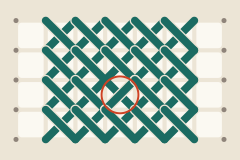
- Every cross crossed the same way. The top leg of every stitch should lean in one direction. Which direction does not matter. A cross that leans the other way, like the ringed stitch in the picture, is among the first things a judge notices.
- Even tension and coverage. Stitches that cover the cloth evenly, none of them bulky or twisted. Railroading helps the strands lie side by side.
- No knots. Thread ends are run under stitches and trimmed.
- Nothing showing through. The back does not have to be perfect, but loose tails and long carried threads should not show from the front. See the back of your cross stitch.
- A clean, pressed piece, with no hoop marks.
- Finishing that suits the piece. A frame that fits the design, or neat seams and even stuffing on a pillow or an ornament.
How to get a piece ready
- Read the fair's rules and pick the class. Note the deadline.
- Look the piece over, front and back. Check for a cross that leans the wrong way, a missed stitch, a knot or a trailing end. How to fix cross stitch mistakes covers putting them right.
- Wash and press it. How to wash cross stitch and how to iron cross stitch show how, including what to do about hoop rings and creases.
- Finish it for showing. For a picture, see how to frame cross stitch and mounting and lacing.
- Write down what you may be asked for: the name of the design, the fabric and its count, and the threads you used.
- Register, then label and deliver the piece exactly as the rules say.
When the ribbons are given
A judge does not have to award every ribbon, and the judge's decision stands. A fair may send back a score sheet with the piece. It tells you what the judge saw in your stitching, which is worth having whatever the ribbon.
Where to go next
Finishing cross stitch sets out the ways to make a stitched piece up, with a guide for each.