Cross stitch groups and retreats
People stitch together in a local group, a guild chapter, an online group, a stitch-along, a round robin, a class or a retreat. To find one near you, ask at the library and the needlework shop first. Then search the web for an embroidery guild in your country, and look on its site for a chapter (a local branch). If there is nothing, one room, one fixed evening and a few chairs are enough to start.
On this page
- The ways to stitch together
- How to find a group near you
- How to find a class, an online group, a stitch-along or a retreat
- How to start one
- Stitch-alongs
- Round robins
- Planning the cloth
- What a cloth of blocks comes to on 14 count
- Preparing a round robin's cloth
- One piece made by a group
- Online groups
- Retreats
- Trunk shows, markets and exhibitions
- Stitching in public
- Words you will hear
- Where to go next
The ways to stitch together
| What | What it is | What it asks of you | Bring |
|---|---|---|---|
| Local group | A few people in one room, with their own work | An evening now and then | A project, a light |
| Guild chapter | A branch of a needlework guild | Dues, meetings, sometimes a shared project | A project, questions |
| Online group | A forum, chat or video evening | As much or as little as you like | A picture of your piece |
| Stitch-along | Many people, one design, in parts | A part at a time | Cloth and thread from the list |
| Round robin | One cloth that travels, each adds a part | Care with other people's cloth, and dates kept | Your own piece to send |
| Class or workshop | A teacher and a set project | A fixed time, and it costs | What the teacher lists |
| Retreat | Two or more days away, stitching | Time, travel, and it costs | The checklist below |
| Show or fair | Finished work on view | A visit, or an entry | A finished piece, if you enter |
How to find a group near you
- Ask at the library. Many lend a room to a needlework circle, or know of one.
- Ask at a needlework or yarn shop. A shop that sells the thread knows who buys it. Knitting circles often welcome other crafts.
- Look for a guild chapter. A guild is a national society for a craft, and its chapters are its local branches. Cross stitch is a kind of embroidery, so type "embroidery guild" and the name of your country into a search engine. On the guild's site, open "Find a chapter" (some guilds say groups) and look for your town. If none is near, ask whether you can join as a member at large, without a chapter, and whether any meet by video.
- Look at notice boards. Try the community center, places of worship, the senior center, cafes and the town's online calendar.
- Ask on a neighborhood page. "Is there a stitching group, or would anyone like one?" often finds both.
Before you go, ask: when and how often it meets, whether beginners come, whether there is a fee, what people bring, whether the room has good light and a level entrance, and whether you may visit once before you join.
How to find a class, an online group, a stitch-along or a retreat
Start with the website of a needlework guild. Beside its chapters it often lists classes, events and a stitch-along. For more, type these words into a search engine.
| What you want | Where to look | Words to type |
|---|---|---|
| A class | Guilds and needlework shops. Ask at the shop who teaches | cross stitch class, and your town |
| An online group | A forum, a chat or a group on a social network | cross stitch forum, or cross stitch group |
| A stitch-along | Designers' own sites, guilds, shops, online groups | cross stitch SAL (a stitch-along), and the year or a designer's name |
| A retreat | A guild's list of events. Ask at the needlework shop too | needlework retreat, and your state or country |
A round robin begins inside a group. Ask in yours, or start a group.
How to start one
- Find a room. A library, a community center, a place of worship or a cafe is easier for strangers than a private home, and is often free.
- Fix one evening. Keep to the same place, day and hour, once or twice a month, so that nobody has to ask.
- Ask five people. If two or three come, that is a group.
- Check the light and the chairs. Ask people to bring a small clip-on lamp. Chairs with backs and a few tables do more than any program.
- Put up a poster. Name, place, day, hour, "beginners welcome" and one way to reach you. Ask before you hang it. Put the same words on a free event calendar.
- Choose a first project. A tiny pattern in two colors from the mini patterns will do. Its chart, the plan you stitch from, is a grid in which each marked square is one cross.
- Send everyone the address of the pattern's page. Each person downloads a copy and prints it. Our terms do not let one person hand out copies. Ask first if you want to print for the whole table. A pattern from elsewhere has terms of its own.
- Have the rest ready for each person. That is the two colors of floss (the thread), a piece of 14 count Aida 10 inches (25 cm) square, and a threaded needle. Aida is cotton cloth woven in small squares, and 14 count has 14 of them to the inch (2.5 cm). The aim is that everyone goes home with ten crosses made.
- Begin each meeting the same way. Names first, then show and tell, then stitching. Leave time for questions.
- Agree on a few rules. No food on the table with the work, phones quiet, nobody's stitching judged unless they ask.
Later come swaps of unwanted thread and charts, a lesson from a member, an outing, a piece made for a good cause. A group in a living room has no costs. A large one may have to pay for a room or show insurance, so stay small as long as you can.
Names for a cross stitch club
Build the name on a stitching word, and add your town or your meeting day to make it yours: Tuesday Cross and Count, or the Hillside Frog Pond. Here are some to begin with.
- On counting: Cross and Count, Two by Two, Count Me In.
- On thread and hoops: No Knots Allowed, Six Strands, Hoops and Crosses.
- On the frog (to frog is to unpick a mistake): The Frog Pond, Frogs and Floss.
Cross stitch terms has more words to build on. Before you put a name on the poster, check that no group near you uses it, say it aloud to somebody who does not stitch, to hear whether they can repeat it and spell it, and see that it fits on one line.
Stitch-alongs
In a stitch-along, or SAL, many people stitch the same design over the same weeks. The chart usually comes in parts. A mystery one keeps the picture hidden until the parts add up.
To join one: find one by the words to type. Then read how long it runs and how often parts come, whether it is free, what cloth and thread it needs, and whether beginners are helped. Start with a short one whose picture you can see.
If you fall behind: nothing is lost. Earlier parts usually stay where they are, so take them in order at your own pace. Nobody has to finish on time.
To run one for friends:
- Choose one chart. Have everyone get a copy of their own. A chart under copyright is not yours to send round.
- Agree on cloth and thread. Or agree that everyone chooses.
- Divide the chart. Cut it into parts along the heavy lines that stand every ten squares. Make each part small enough for the slowest stitcher.
- Set a day for each part. Leave one week in every four free for catching up.
- Show pictures on that day. Help whoever is stuck.
Round robins
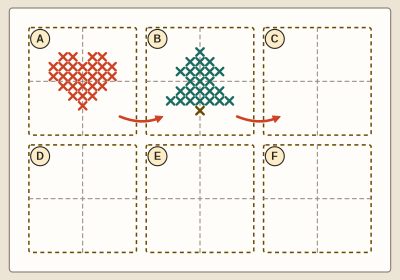
In a round robin a piece of cloth passes from person to person, and each adds a part. Usually everyone starts a cloth of their own, and all the cloths move on together. With six people there are six cloths and six blocks on each. On the first turn you stitch block A of your own cloth and send it to the next person in the circle. On the second turn you stitch block B of the cloth that has come to you, and so on. After six turns each cloth comes home full.
Agree on these before anyone stitches:
- the cloth, its count (squares to the inch) and how many strands of floss to stitch with (a length of floss is six thin strands that pull apart);
- which way the top leg of every cross leans (a cross is two slanted stitches, its legs, one lying over the other);
- the size of a block, and the gap between blocks (the next part has a size to begin with);
- the theme, and any colors to use or leave out;
- who sends to whom, and on what day;
- a packet that can be tracked, and who pays for it;
- how long each person keeps a cloth: quilters' round robins give two or three months;
- one leader who keeps the list and the dates;
- what happens if someone has to stop.
Planning the cloth
Blocks of 50 by 50 stitches with 5 empty squares between them are a friendly size. Four blocks, two across and two down, make 105 by 105 squares: 50 + 5 + 50. Six blocks, three across and two down, make 160 by 105, and nine make 160 by 160. The table turns these into cloth.
What a cloth of blocks comes to on 14 count
| Design, in stitches | Stitched size, inches | Stitched size, centimeters | Fabric to cut, inches | Fabric to cut, centimeters |
|---|---|---|---|---|
| 105 × 105 | 7 1/2 × 7 1/2 in | 19.1 × 19.1 cm | 14 × 14 in | 35 × 35 cm |
| 160 × 105 | 11 3/8 × 7 1/2 in | 29.0 × 19.1 cm | 18 × 14 in | 45 × 35 cm |
| 160 × 160 | 11 3/8 × 11 3/8 in | 29.0 × 29.0 cm | 18 × 18 in | 45 × 45 cm |
The fabric to cut leaves 3 inches (7.5 cm) on every side for framing, rounded up to a whole inch or centimeter. For a design of another size, open the fabric calculator on 160 × 160 stitches at this count and change the numbers.
Preparing a round robin's cloth
- Draw a plan. Sketch the blocks on paper and letter them, A to F for six.
- Cut the cloth to the size in the table: 18 by 14 inches (45 by 35 cm) for six blocks of 50 by 50 on 14 count.
- Bind the edges. Many hands will hold it, so fold tape over the raw edges or hem them. Preparing fabric has the ways.
- Baste block A. To baste is to sew long, loose stitches that come out later. Measure 3 inches (7.5 cm) in from the top edge and from the left edge: that is the corner of the block. From there run a line of pale sewing thread round 50 squares by 50. Go over 5 squares and under 5, so that a stitch and the gap after it make 10.
- Baste the other blocks. Count 5 empty squares and begin the next.
- Baste two center lines in each block, one down its middle and one across it, 25 squares in. A stitcher who opens the packet should see at once where the middle is.
- Pack a card and a small notebook. Put on the card your count and strands, your thread numbers, colors you love, and anything you would hate. Each stitcher writes a few lines in the notebook.
- Send it flat or rolled, in plastic, with the plan. Never fold it through stitching.
When a cloth comes to you: wash your hands, count your block twice, pull your stitches as tight as those in the block beside it and no tighter, keep the back as neat as the front, and follow the owner's wishes. Never unpick or change another stitcher's work. Add no name or date unless the owner asked.
When the basting comes out: pull out the two center lines of your block a little at a time, as your stitches reach them. A line that is stitched over is hard to get out. Leave the lines round the blocks. The owner pulls those out when the cloth is home.
One piece made by a group
A banner, a hanging or an altar cloth can be shared out in panels. Draw the whole first, give each stitcher a panel from the same roll of cloth and the same batch of thread, and write down once, for everybody, how many strands to use and which way the top legs lean. Sew the panels together at the end. A guild's panels have been filled by thousands of members this way, each on a small part.
Stitching on one large frame together works as well. Sit so that each person keeps one area, since no two hands pull alike, and change color rather than stitcher in the middle of a block.
Online groups
To find one, use the words to type. Then:
- Read before you post. Most groups have rules, and your question may be answered already. Reading without posting is fine.
- Ask so that you can be answered. Send one picture of the front and one of the back, in daylight. Give the count, the strands, the thread, and what you have tried.
- Show your work. Say what it is and who designed it. A piece in progress gets as warm a welcome as a finished one.
- Guard secrets. In a mystery stitch-along, warn people before you show a part on its first day.
- Be kind about backs and mistakes. Nobody asked for a grade.
- Never post a whole chart. A picture that others could stitch from gives away what is not yours.
Some groups hold an evening by video. Cameras may be on or off, and people stitch and talk for an hour or two. There are also stitchers who make videos about their projects, and live streams where you watch someone stitch and write in as they go. They are company for your own stitching, with no need to join anything.
Retreats
A retreat is a stay of two or more days with a group whose only plan is to stitch. Some have teachers and classes. Others are an open room with good light, where you come early, stay late and bring whatever you like, unfinished work above all. Meals mark the day. There may be a swap table, a talk or a shop.
To find one, use the words to type.
Ask before you book: what the price covers, whether rooms are shared, how the tables are lit, whether you may bring a lamp and a stand, what kind of chairs there are, stairs and walking, food needs, classes and their level, quiet hours, and what happens if you cancel.
What to pack:
- two or three projects: one large, one easy enough to do while talking, one small enough to finish;
- the chart on paper, and a pencil;
- every thread for it, in order, plus spare needles and a second pair of scissors;
- hoop or frame, stand, and clips;
- a lamp, its charger, and an extension cord;
- glasses, and a magnifier if you use one;
- a seat cushion and a warm layer;
- a name label on every tool, since everybody's scissors look alike;
- something to show, and something to swap.
A day's retreat at home for four: choose a Saturday, share out the meals beforehand, put a lamp at every chair, ask each person for one thing to show and one skill to teach, and put the phones in a basket.
Trunk shows, markets and exhibitions
- A trunk show. A maker or designer brings a collection, often of stitched models, to a shop or a meeting. You see the pieces close up, hear about them, and may be able to order.
- A needlework market. Designers and makers show new work in one place. Some are for shops only, so ask whether the public may come.
- An exhibition. Finished pieces on view, at a guild, a museum or a fair. To enter one, see cross stitch at fairs.
Stitching in public
Choose a small piece with few colors, and thread several needles before you leave. A case with a lid, a magnet that holds the needle, and small blunt-ended scissors keep everyone safe. Sit under a light or by a window. People will ask what you are doing: have a short answer, and let them look at the back. Cross stitch on a plane has a packing list that suits a train or a waiting room too.
Alone, many stitchers listen to books, music or talk. A chart that needs counting goes with something you can stop.
Words you will hear
SAL is a stitch-along. RR is a round robin. WIP is a work in progress. Cross stitch terms has the rest.
Where to go next
To teach the first evening's beginners, see teaching children, whose first lesson suits anyone. For a shared piece, look at the samplers. A group clearing out its cupboard can use donating supplies, and a project journal keeps track of what went where. To choose a pattern the whole group can work, see how to find a pattern.