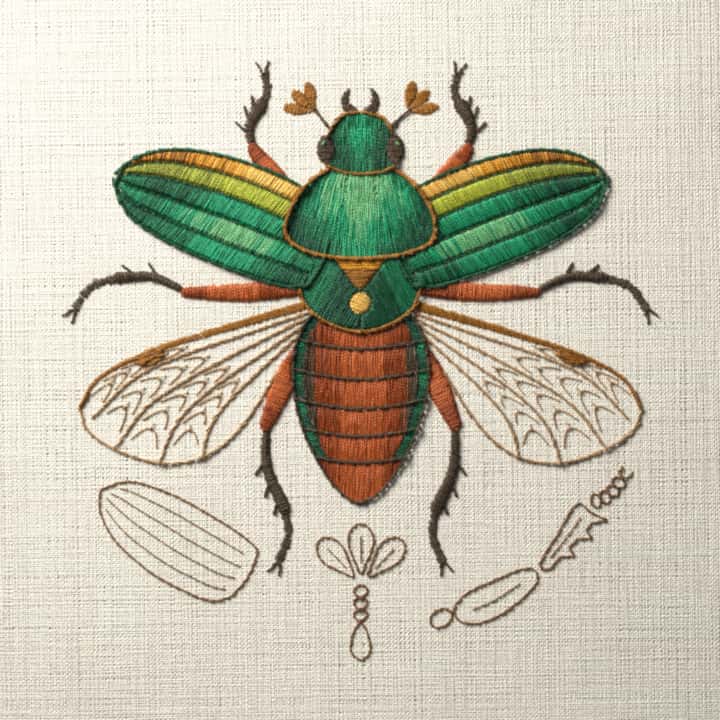
Anatomical beetle with open wings hand embroidery pattern
Advanced · 14 colors · 4.8 × 4.8 in · 7 kinds of stitch
Download free PDFPDFPrints on US Letter and A4You may sell what you make from it by hand, in small quantities. The PDF itself is not to be sold or shared. Selling, classes and kits: the rules
A large green beetle lies open like an old naturalist’s plate, the same on both sides.
Size and details
Advanced. Uses padded satin stitch, long and short stitch, satin stitch over about a quarter of the cloth in a 6 inch hoop, 14 colors and a great deal of stitching; from a 5 inch hoop up some of the satin stitches are long.
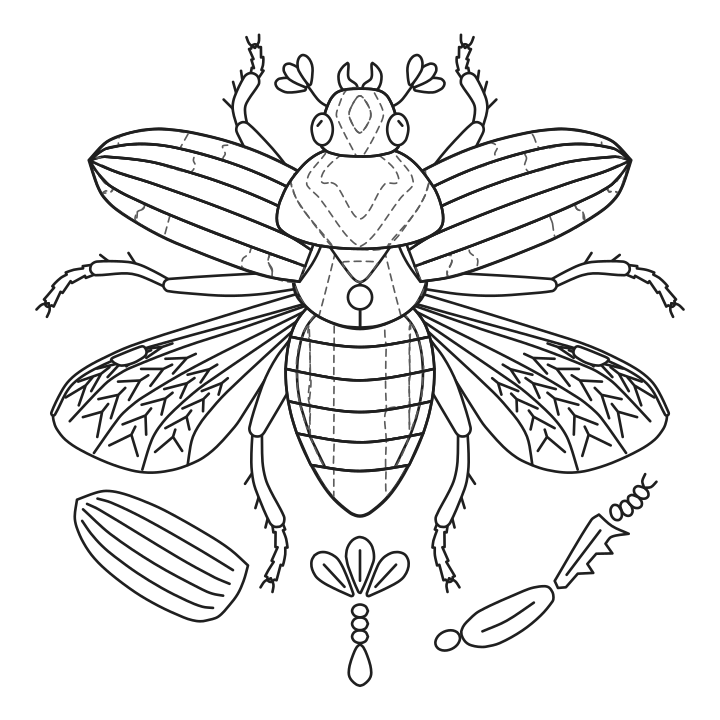
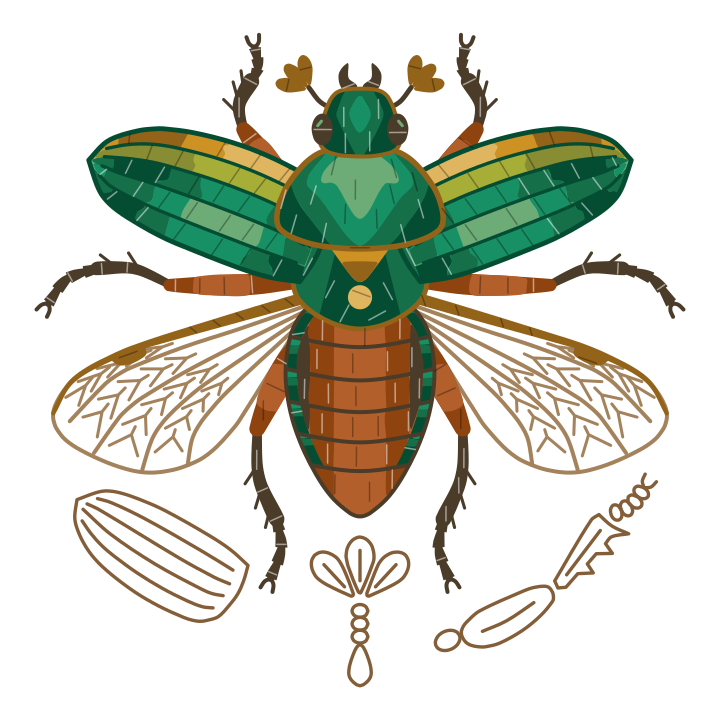
Its wing cases are strips of padded satin stitch that pass from bronze through olive to emerald, with back stitch in the grooves. The clear hind wings are stem stitch veins and open fly stitch on bare cloth, and the shield and head are long and short stitch. Short satin stitch bands the copper abdomen, and the six jointed legs are satin and padded satin stitch. A wing case, a fanned antenna and a toothed leg are drawn below in fine brown back stitch, and a tiny gold pin head sits where the four wings meet. In the picture of where the colors go, the fine lines show which way the stitches lie.
| Hoop | Inches | Centimeters | Satin stitch up to |
|---|---|---|---|
| 3 in (8 cm) | 1.9 × 1.9 in | 4.8 × 4.8 cm | 3/16 in (5 mm) |
| 4 in (10 cm) | 2.9 × 2.9 in | 7.4 × 7.4 cm | 1/4 in (6 mm) |
| 5 in (13 cm) | 3.8 × 3.8 in | 9.7 × 9.7 cm | 3/8 in (10 mm) |
| 6 in (15 cm) | 4.8 × 4.8 in | 12.2 × 12.2 cm | 7/16 in (11 mm) |
| 8 in (20 cm) | 6.7 × 6.7 in | 17 × 17 cm | 5/8 in (16 mm) |
- In an 8 inch hoop the widest satin stitch shape is 5/8 in (16 mm) across. Satin stitches longer than about 12 mm (just under 1/2 in) tend to work loose: divide the shape into sections, or work it in long and short stitch.
What you need
- Fabric
- Plain cotton or linen, cut 9 in (23 cm) square.
- Needle
- Embroidery needle, size 9 for 1 strand, size 7 for 2 or 3, size 5 for 4 (a lower number is a thicker needle).
- Floss
- 14 colors of six-strand cotton, listed below. DMC is a brand: another brand in a like color will do.
- Marker
- A pen or a sheet that suits the fabric: how to transfer a pattern says which.
Floss
- 1DMC 3863 Medium Mocha BeigeHind wing cells, hind wing veins and hind wing edges
- 2DMC 780 Ultra Very Dark TopazFront wing veins and shield rim, wing cases (shade 3 of 9) and 5 more parts
- 3DMC 3031 Very Dark Mocha BrownShins, leg joints, abdomen lines and abdomen edge and 6 more parts
- 4DMC 400 Dark MahoganyThighs (darker), abdomen bands (middle)
- 5DMC 301 Medium MahoganyAbdomen bands (light), thighs (lighter)
- 6DMC 909 Very Dark Emerald GreenWing cases (shade 2 of 9), mid body (lighter), shoulder shield (dark) and 2 more parts
- 7DMC 500 Very Dark Blue GreenMid body (darker), wing case grooves and wing case edges and 4 more parts
- 8DMC 911 Medium Emerald GreenWing cases (shade 4 of 9), shoulder shield, abdomen side plates and head (light)
- 9DMC 913 Medium Nile GreenWing cases (shade 7 of 9), shoulder shield (lightest), eye lights
- 10DMC 581 Moss GreenWing cases (shade 8 of 9)
- 11DMC 580 Dark Moss GreenWing cases (shade 5 of 9)
- 12DMC 783 Medium TopazWing cases (shade 6 of 9), scutellum (lighter)
- 13DMC 3820 Dark StrawWing cases (shade 9 of 9), gold pin
- 14DMC 869 Very Dark Hazelnut BrownBrown studies
Skeins: one of each color is enough. An estimate for the 6 inch hoop, from the length of each line and the area of each filled shape, with a fifth added for tails.
How to stitch it
- New to hand embroidery? Start here.
- Print at 100%, trace the pattern onto the fabric, and put it in the hoop: inner ring under, drawing up, tight as a drum.
- Floss is six strands. Cut 18 inches (45 cm), pull out the number given one at a time, and lay them together.
- Inside a filled shape start with two or three tiny stitches, which the filling covers. Start a line with a small knot on the back. End each thread by running the needle under the backs of a few stitches.
- A fine broken line inside a shape is where two shades meet: trace it, do not stitch it.
- A number under “Where colors go” is a color of the list. The fine lines on the colors show which way the stitches lie.
Stitch in this order
Filled parts from the back of the picture forward, then lines. Where a stitch page names another number of strands, use the number here.
- Satin stitch 2 strandsFront wing veins, wing spots, leg joints, abdomen side plates, abdomen bands, antenna clubs, jaws
- Padded satin stitch 2 strandsShins, thighs, mid body, wing cases, scutellum, eyes, gold pin
- Long and short stitch 1 strandShoulder shield, head
- Fly stitch 1 strandHind wing cells
- Stem stitch4 strands: shield rim3 strands: mid body edge, wing case edges, antennae2 strands: hind wing veins, hind wing edges, claws, abdomen lines, abdomen edge, head edge
- Straight stitch3 strands: leg spines2 strands: eye lights
- Back stitch1 or 2 strands: brown studies1 strand: wing case grooves
When it is done, take off any lines that still show and finish the hoop.
More patterns like this
Advanced 3–8 in hoop · 16 colors
Emerald jewel beetle
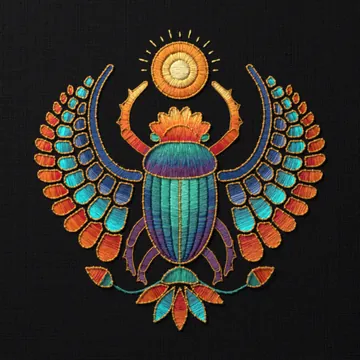
Advanced prints 3–14 in · 18 colors
Winged scarab beetle with the sun
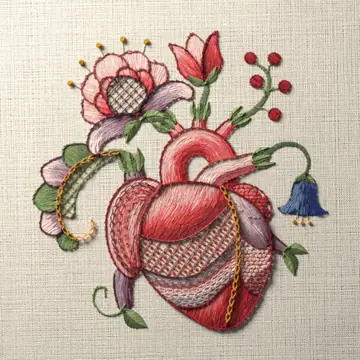
Advanced prints 3–14 in · 15 colors
Floral anatomical heart
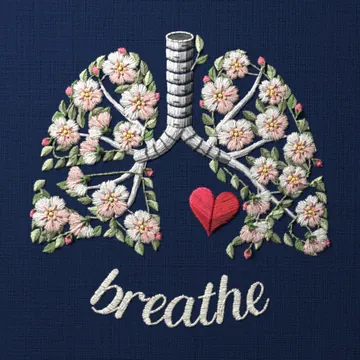
Advanced prints 3–14 in · 16 colors
Breathe lungs with flowers and heart
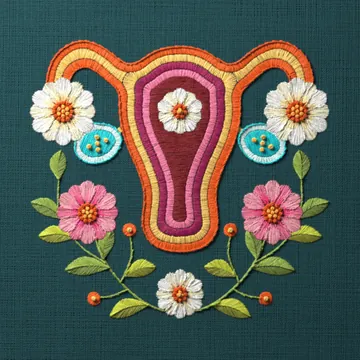
Advanced 3–8 in hoop · 18 colors
Retro uterus with daisies
Advanced prints 3–14 in · 18 colors
Blood vessels of the body, red and blue
Advanced prints 3–14 in · 20 colors
Vintage rib cage with goldfinch
Advanced 3–8 in hoop · 20 colors
Kidney pair sharing a heart
New to hand embroidery? Starting hand embroidery, step by step