Bee happy, bee with a looping trail hand embroidery pattern
Intermediate · 10 colors · 3.5 × 4.5 in · 6 kinds of stitch
Download free PDFPDFPrints on US Letter and A4You may sell what you make from it by hand, in small quantities. The PDF itself is not to be sold or shared. Selling, classes and kits: the rules
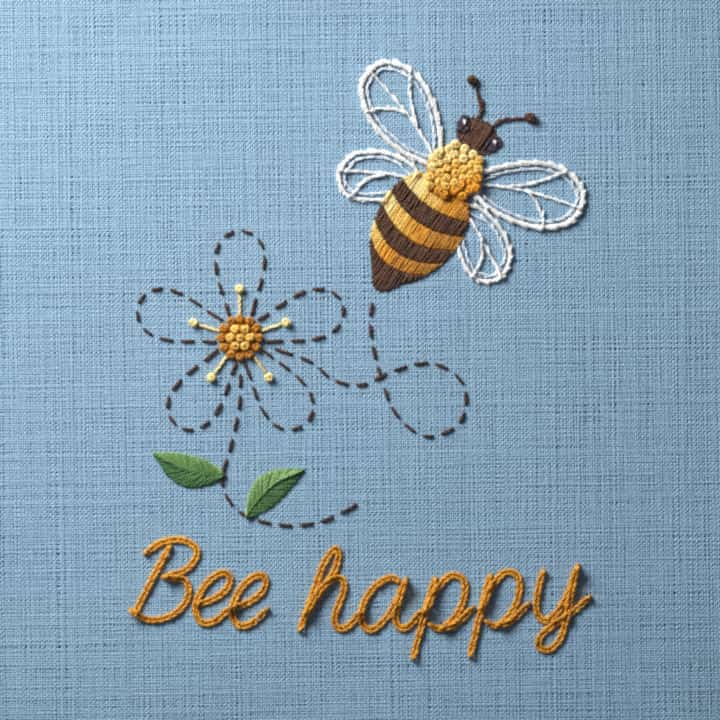
The words “Bee happy” stand under small bee with a looping trail.
Size and details
Intermediate. Dozens of French knots and ten colors.
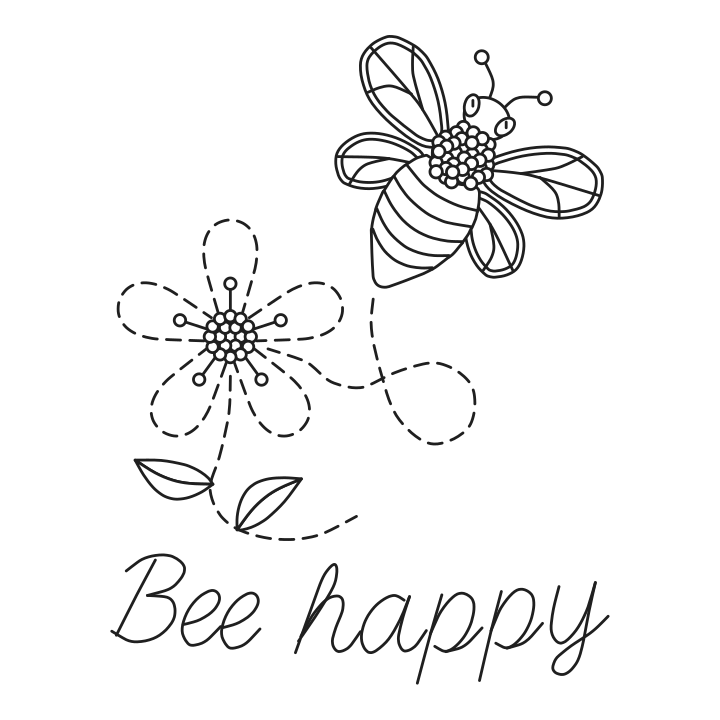
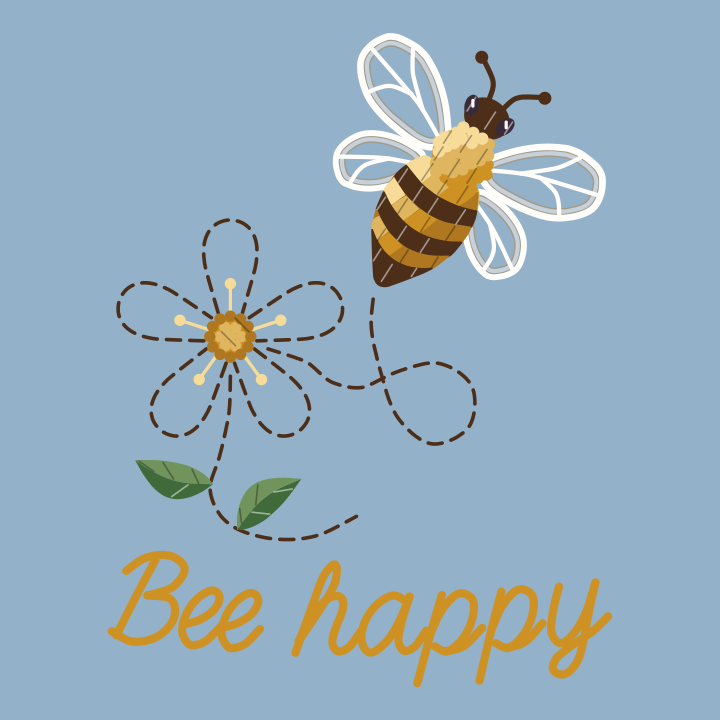
The words are worked in two rows of stem stitch side by side, in a flowing joined hand. The bee is seen from above, climbing to the upper right, on dusty blue linen. Her egg-shaped body is bands of satin stitch that turn from bright gold to amber, with French knots over the thorax and at the tips of the feelers. The wings are open stem stitch with a pale blue-gray line inside the white edge and forked veins. The flight path is running stitch from end to end: it loops once and draws the flower’s five petals and its stem. In the picture of where the colors go, the fine lines show which way the stitches lie.
| Hoop | Inches | Centimeters | Satin stitch up to |
|---|---|---|---|
| 3 in (8 cm) | 1.4 × 1.8 in | 3.6 × 4.6 cm | 1/8 in (3 mm) |
| 4 in (10 cm) | 2.1 × 2.7 in | 5.3 × 6.9 cm | 3/16 in (5 mm) |
| 5 in (13 cm) | 2.8 × 3.6 in | 7.1 × 9.1 cm | 1/4 in (6 mm) |
| 6 in (15 cm) | 3.5 × 4.5 in | 8.9 × 11.4 cm | 1/4 in (6 mm) |
| 8 in (20 cm) | 4.9 × 6.3 in | 12.4 × 16 cm | 3/8 in (10 mm) |
- In a 3, 4 or 5 inch hoop the French knots are drawn smaller than about 2 mm (a little over 1/16 in). Use one strand of floss for them there, or choose a larger hoop.
What you need
- Fabric
- Plain cotton or linen in pale blue, cut 9 in (23 cm) square. On white cloth its palest threads do not show: choose other colors under Options.
- Needle
- Embroidery needle, size 7 for 2 or 3 strands, size 3 for 4 or 5 (a lower number is a thicker needle).
- Floss
- 10 colors of six-strand cotton, listed below. DMC is a brand: another brand in a like color will do.
- Marker
- A pen or a sheet that suits the fabric: how to transfer a pattern says which.
On clothes. Wash and dry the garment first. Denim and twill need no backing and take a sharp needle, embroidery or chenille; T-shirts, sweatshirts and other knits need a backing that sticks or irons on. How to embroider on clothes has every step, the guide to shirts says how to reach a neckline, a collar or a sleeve, and the placement chart says where a design goes.
Floss
- 1DMC 898 Very Dark Coffee BrownFlight path, dark bands, head, feelers and feeler tips
- 2DMC 3822 Light StrawThorax fluff (light), gold bands (lightest), stamens and stamen tips
- 3DMC 783 Medium TopazWords and flower center, gold bands and thorax fluff (dark), thorax (darker)
- 4DMC 3820 Dark StrawGold bands (light), thorax fluff (middle), thorax and flower center knots (lighter)
- 5DMC 782 Dark TopazGold bands (darkest), flower center knots (darker)
- 6DMC 3347 Medium Yellow GreenLeaves (lighter)
- 7DMC 3346 Hunter GreenLeaves (darker)
- 8DMC 3752 Very Light Antique BlueWing shadows
- 9DMC BLANC WhiteWing veins, wing edges, hind wing edges and eye lights
- 10DMC 3371 Black BrownEyes
Skeins: one of each color is enough. An estimate for the 6 inch hoop, from the length of each line and the area of each filled shape, with a fifth added for tails.
How to stitch it
- New to hand embroidery? Start here.
- Print at 100%, trace the pattern onto the fabric, and put it in the hoop: inner ring under, drawing up, tight as a drum.
- Floss is six strands. Cut 18 inches (45 cm), pull out the number given one at a time, and lay them together.
- Begin with no knot on the back where it is seen and washed, as on a towel, a napkin or clothes; for a piece in a hoop a small knot is fine. End each thread by whipping it around the backs of four or five stitches, with one small hitch.
- Each small ring is one French knot. A dashed line is running stitch.
- A number under “Where colors go” is a color of the list. The fine lines on the colors show which way the stitches lie.
Stitch in this order
Filled parts from the back of the picture forward, then lines and knots. Where a stitch page names another number of strands, use the number here.
- Satin stitch 2 strandsFlower center, gold bands, dark bands, head, eyes, thorax
- Fishbone stitch 2 strandsLeaves
- Running stitch 3 strandsFlight path
- Straight stitch3 strands: stamens2 strands: eye lights
- Stem stitch5 strands: wing edges4 strands: hind wing edges3 strands: feelers, words2 strands: wing shadows, wing veins
- French knot 2 strands, two wrapsStamen tips, flower center knots, feeler tips, thorax fluff
When it is done, take off any lines that still show. A guide to this kind of work: Stitches for letters, words and names.
More patterns like this
Intermediate prints 3–14 in · 10 colors
Small bee with a looping trail
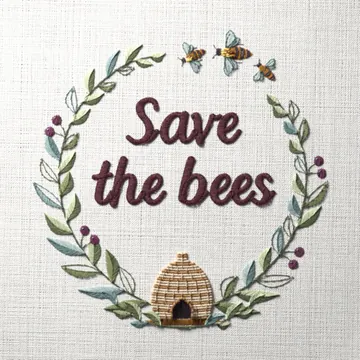
Advanced prints 3–14 in · 15 colors
Save the bees with laurel and bees
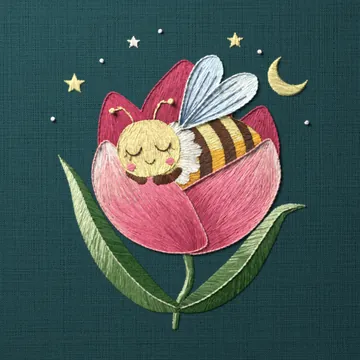
Advanced 3–8 in hoop · 23 colors
Small bee asleep in a tulip
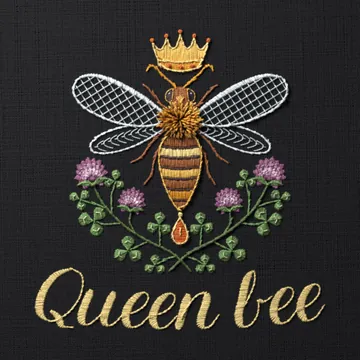
Advanced 3–8 in hoop · 16 colors
Queen bee with a crown
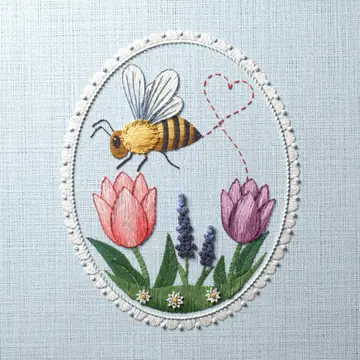
Advanced 3–8 in hoop · 24 colors
Spring bee card
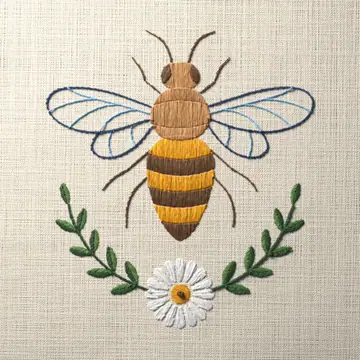
Intermediate 3–8 in hoop · 8 colors
Bee over daisy crescent
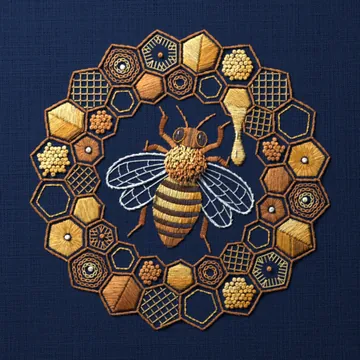
Advanced prints 3–14 in · 13 colors
Bee in honeycomb ring
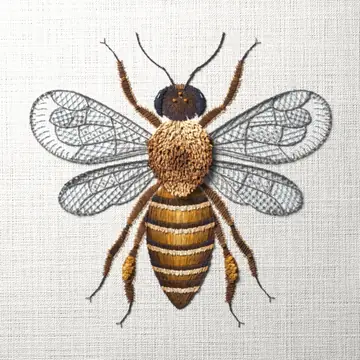
Advanced prints 3–14 in · 18 colors
Honey bee from above
New to hand embroidery? Starting hand embroidery, step by step