Best papa in a laurel wreath hand embroidery pattern
Advanced · 24 colors · 8 kinds of stitch
Download free PDFPDF, US Letter · 127 KBFor your own stitching, gifts and handmade pieces you sell. Do not resell or share this PDF. What you may do, in full
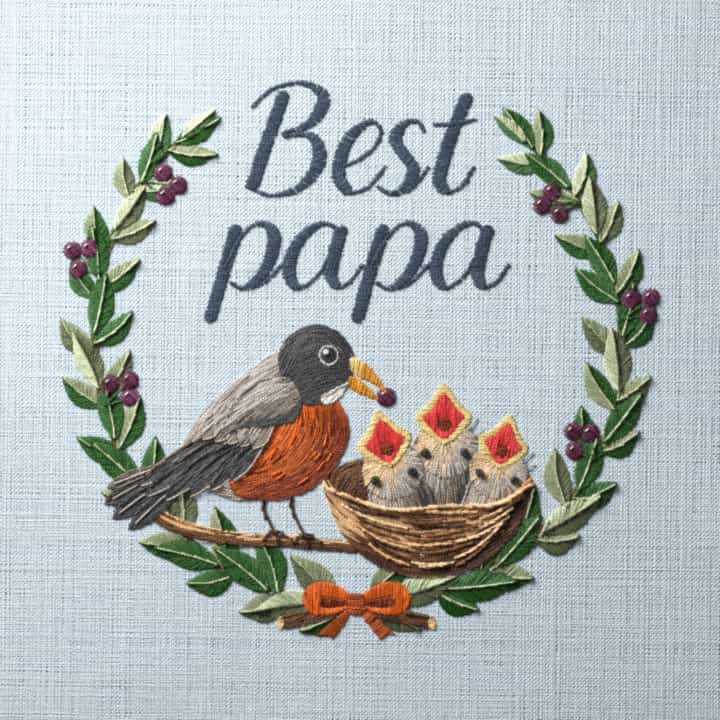
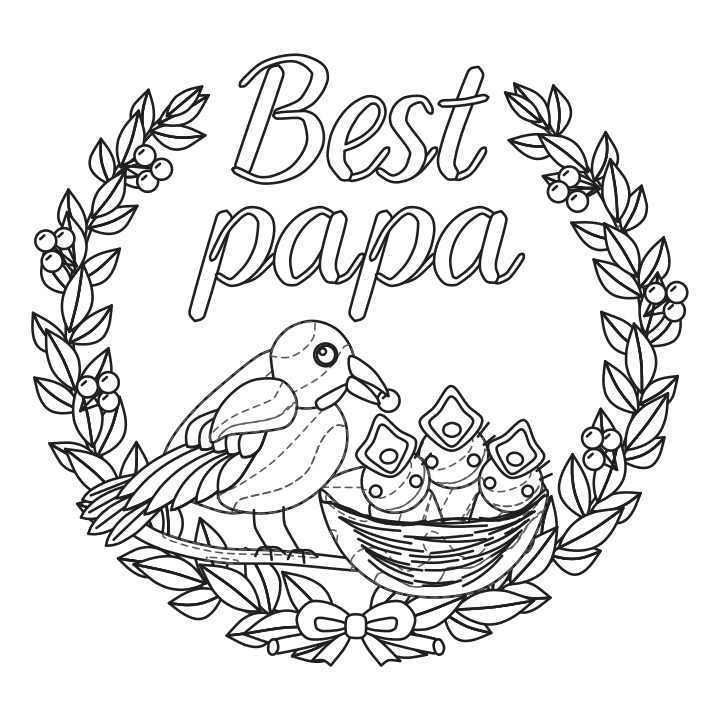
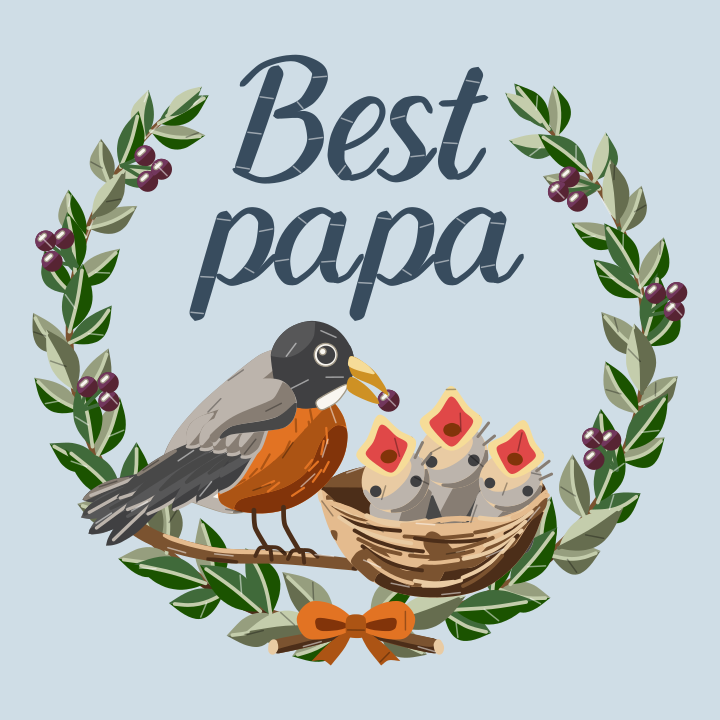
A robin leans over a round nest with a laurel berry in his bill while three chicks hold their mouths wide open. Broad laurel leaves and plum berries circle them, the branches are tied at the foot with a rust bow, and the words Best papa stand in ink blue script at the top. The feathers, breast and twig are long and short stitch, the laurel leaves are fishbone stitch, and the letters, bills and bow are satin stitch. Loose straws in stem stitch build the nest, the berries are padded satin stitch, and the chicks’ eyes are French knots. It is drawn for pale blue linen. In the picture of where the colors go, the fine lines show which way the stitches lie.
Size and details
Advanced. Uses long and short stitch over much of the design, padded satin stitch, 24 colors and a great deal of stitching.
24 colors of floss and 8 kinds of stitch:
- Long and short stitch
- Fishbone stitch
- Stem stitch
- Padded satin stitch
- Straight stitch
- Satin stitch
- French knot
- Split stitch
- Which stitch goes where
| Hoop | Inches | Centimeters | Satin stitch up to |
|---|---|---|---|
| 3 in (8 cm) | 2 × 1.8 in | 5.1 × 4.6 cm | 1/8 in (3 mm) |
| 4 in (10 cm) | 3 × 2.8 in | 7.6 × 7.1 cm | 3/16 in (5 mm) |
| 5 in (13 cm) | 3.9 × 3.7 in | 9.9 × 9.4 cm | 1/4 in (6 mm) |
| 6 in (15 cm) | 4.9 × 4.6 in | 12.4 × 11.7 cm | 5/16 in (8 mm) |
| 8 in (20 cm) | 6.9 × 6.4 in | 17.5 × 16.3 cm | 3/8 in (10 mm) |
- In a 3, 4 or 5 inch hoop the French knots are drawn smaller than about 2 mm (a little over 1/16 in). Use one strand of floss for them there, or choose a larger hoop.
The pattern is drawn inside a circle about half an inch (1.3 cm) smaller all around than the hoop.
What you need
- DMC 433 Medium BrownLaurel stems and nest (middle), nest hollow (lighter) and 2 more parts
- DMC 898 Very Dark Coffee BrownNest hollow (darker), laurel stems and nest (dark) and 4 more parts
- DMC 3346 Hunter GreenLaurel leaves (dark), berry stalks, laurel stems (light)
- DMC 524 Very Light Fern GreenLaurel leaves (lightest)
- DMC 895 Very Dark Hunter GreenLaurel leaves (darkest)
- DMC 522 Fern GreenLaurel leaves (light)
- DMC 520 Dark Fern GreenLaurel leaves (middle)
- DMC 154 Very Dark GrapeLaurel berries (darker)
- DMC 3834 Dark GrapeLaurel berries (lighter)
- DMC 3865 Winter WhiteBelly (light), berry lights, eye ring, throat and eye light
- DMC 437 Light TanNest, nest twigs and perch (light), nest rim (darker)
- DMC 648 Light Beaver GrayChicks, shoulder and back (light), feather edges and 2 more parts
- DMC 844 Ultra Dark Beaver GrayWing feathers, back, tail and shoulder (dark), chicks (darkest)
- DMC 646 Dark Beaver GrayBack (middle), chicks (dark), wing coverts (darker) and 5 more parts
- DMC 738 Very Light TanChicks and nest twigs (lightest), nest rim (lighter), cut ends
- DMC 3822 Light StrawChick bills, bill (lighter)
- DMC 350 Medium CoralOpen mouths
- DMC 918 Dark Red CopperBreast and ribbon (dark), throats
- DMC 3799 Very Dark Pewter GrayHead (darker), wing feathers and tail (darkest), chick eyes and eye
- DMC 413 Dark Pewter GrayWing feathers and tail (light), head (lighter)
- DMC 922 Light CopperBreast and ribbon (light)
- DMC 920 Medium CopperBreast and ribbon (middle), ribbon knot
- DMC 783 Medium TopazBill (darker)
- DMC 3750 Very Dark Antique BlueLetters
Skeins: one of each color is enough. An estimate for the largest size, the 8 inch hoop: the length of each line and the area of each filled shape, a fifth added for tails and ends, a tenth of every 8 m (8.7 yd) skein kept spare.
The floss is six-strand cotton; the stitch guide says how many strands to use. You also need a hoop, an embroidery needle (a size 7 to 9 suits two or three strands) and plain cotton or linen fabric. To frame the piece in its hoop, cut a square 3 inches (8 cm) wider than the hoop: a 9 inch (23 cm) square for a 6 inch hoop.
When it is stitched, how to finish a hoop shows how to back it for the wall.
Stitch guide
- Put the pattern on the fabric (how to transfer a pattern) and the fabric in the hoop.
- Stitch the filled parts first, what lies behind before what lies in front of it.
- Then stitch the lines: stems, veins and outlines over the edges of the filled parts.
- Keep the knots for the end, so that the hoop and your hand do not flatten them.
Start each thread with a small knot on the back or one of the knotless starts, and end it by running the needle under the backs of a few stitches (starting and ending a thread). Use the strands this list gives, also where a page about a stitch names another number.
- Long and short stitch 1 strandLaurel stems, perch, nest hollow, chicks, nest, tail, belly, breast, back, head, throat, and 3 more
- Fishbone stitch 2 strandsLaurel leaves
- Stem stitch 1 to 3 strandsLaurel leaves, berry stalks, nest twigs, nest rim, legs, feet
- Padded satin stitch 2 strandsLaurel berries
- Straight stitch 1 strandBerry lights, chick down
- Satin stitch 2 strandsChick bills, open mouths, throats, eye ring, eye, bill, cut ends, ribbon, ribbon knot, letters
- French knot 1 to 2 strands, two wrapsChick eyes, eye light
- Split stitch 1 strandFeather edges
Getting it onto your fabric
The PDF holds the pattern twice at actual size: once as drawn, and once mirrored for an iron-on transfer pen. Print it at 100% with scaling off and check the one-inch square (25.4 mm) with a ruler before you trace. How to transfer a pattern explains tracing, carbon paper and the other ways. The files are under Downloads.
Downloads
- Download free PDF PDF, US Letter, 3 pages, for a 6 inch (15 cm) hoop
- Download free PDF, A4 PDF, A4, 3 pages, for a 6 inch (15 cm) hoop
More patterns like this
Advanced 3–8 in hoop · 22 colors
Flower wreath on a cottage door
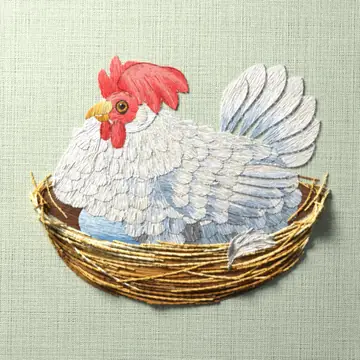
Advanced 3–8 in hoop · 24 colors
White chicken in a nest
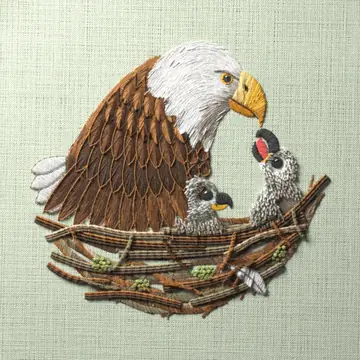
Advanced 3–8 in hoop · 23 colors
Mother eagle and eaglets in the nest
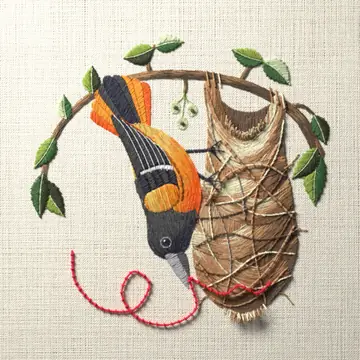
Advanced 3–8 in hoop · 23 colors
Baltimore oriole and woven nest
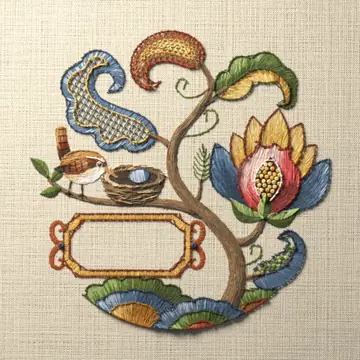
Advanced 3–8 in hoop · 22 colors
Crewel birth sampler with tree and nest
Advanced 3–8 in hoop · 20 colors
Baby owl in a feather nest
Advanced 3–8 in hoop · 22 colors
Papa in holly
Intermediate 3–8 in hoop · 15 colors
Leafless tree outline
New to hand embroidery? Starting hand embroidery, step by step