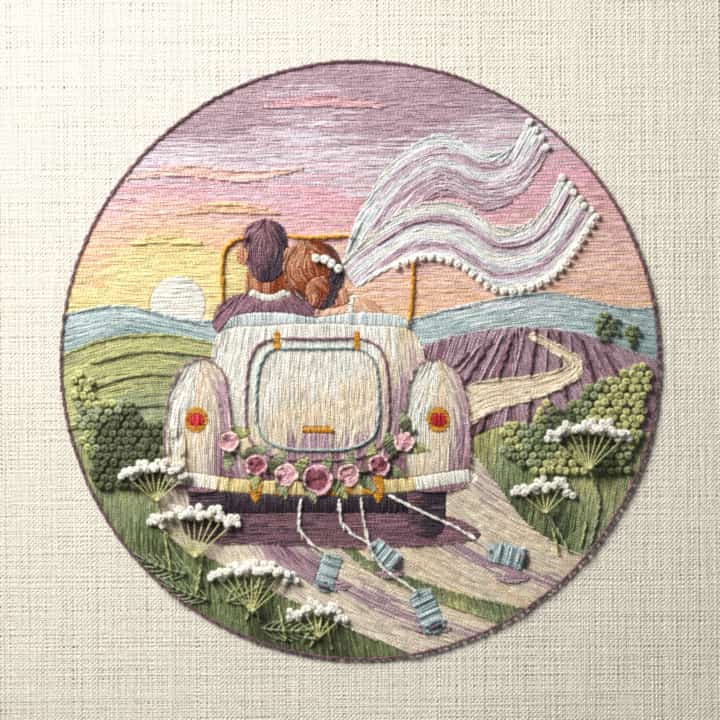
Bride and groom in a vintage car hand embroidery pattern
Advanced · 24 colors · 8 kinds of stitch

Download free PDFPDF, US Letter · 152 KBFor your own stitching, gifts and handmade pieces you sell. Do not resell or share this PDF or copies of it. Selling, classes and kits: the rules
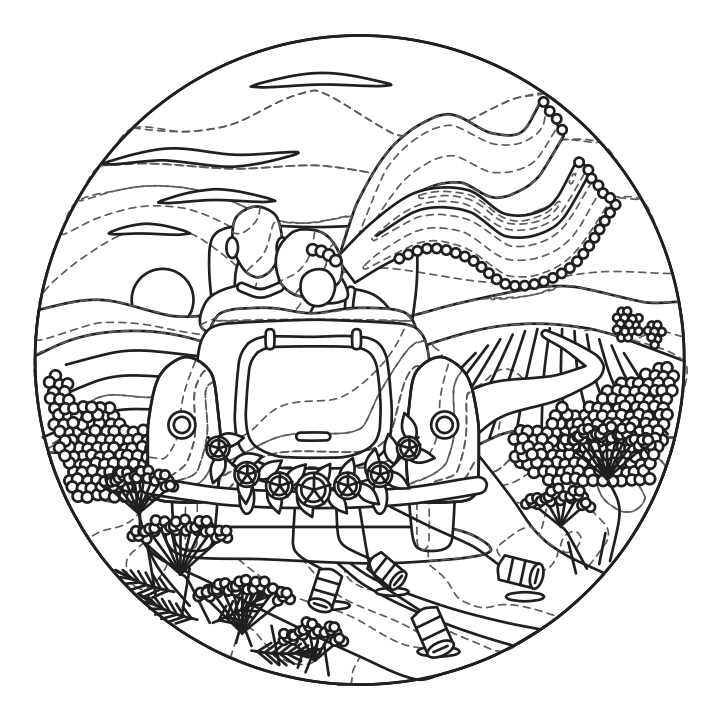
Seen from behind, an open cream roadster takes a bride and groom down a country lane at sunset, tin cans hopping along behind them. The sky, hills, car and veil are long and short stitch, with the sky laid in long level rows. The hedges, the veil’s lace edge and the cow parsley are French knots, with straight stitch rays and fly stitch leaves under the flowers. Woven wheel stitch roses hang along the bumper, the furrows and the windshield frame are stem stitch, and the two small red tail lights are satin stitch. In the picture of where the colors go, the fine lines show which way the stitches lie.
Size and details
Advanced. Uses long and short stitch over much of the design, woven wheels, more than a hundred French knots, 24 colors and a great deal of stitching; from a 5 inch hoop up the widest satin stitches are long.
24 colors of floss and 8 kinds of stitch:
- Long and short stitch
- Satin stitch
- Stem stitch
- French knot
- Split stitch
- Woven wheel stitch
- Straight stitch
- Fly stitch
- Which stitch goes where
| Hoop | Inches | Centimeters | Satin stitch up to |
|---|---|---|---|
| 3 in (8 cm) | 1.9 × 1.9 in | 4.8 × 4.8 cm | 3/16 in (5 mm) |
| 4 in (10 cm) | 2.8 × 2.8 in | 7.1 × 7.1 cm | 1/4 in (6 mm) |
| 5 in (13 cm) | 3.8 × 3.8 in | 9.7 × 9.7 cm | 3/8 in (10 mm) |
| 6 in (15 cm) | 4.7 × 4.7 in | 11.9 × 11.9 cm | 7/16 in (11 mm) |
| 8 in (20 cm) | 6.6 × 6.6 in | 16.8 × 16.8 cm | 5/8 in (16 mm) |
- In an 8 inch hoop the widest satin stitch shape is 5/8 in (16 mm) across. Satin stitches longer than about 12 mm (just under 1/2 in) tend to work loose: divide the shape into sections, or work it in long and short stitch.
- In a 3, 4 or 5 inch hoop the French knots are drawn smaller than about 2 mm (a little over 1/16 in). Use one strand of floss for them there, or choose a larger hoop.
The pattern is drawn inside a circle about half an inch (1.3 cm) smaller all around than the hoop.
What you need
- DMC 3856 Ultra Very Light MahoganySky (middle light) and 2 more parts
- DMC 745 Light Pale YellowSky and clouds (lightest), bumper (middle)
- DMC 353 PeachSky, garland roses and clouds (light)
- DMC 778 Very Light Antique MauveSky (dark) and 2 more parts
- DMC 3743 Very Light Antique VioletSky (middle dark), veil (dark)
- DMC 3042 Light Antique VioletPlowed hill (light) and 8 more parts
- DMC 712 CreamCar body (lightest) and 10 more parts
- DMC 926 Medium Gray GreenFar hills and seat back (dark) and 4 more parts
- DMC 927 Light Gray GreenFar hills, tin cans and seat back (middle)
- DMC 928 Very Light Gray GreenVeil, seat back, tin cans and far hills (light)
- DMC 3041 Medium Antique VioletPlowed hill (middle) and 7 more parts
- DMC 3740 Dark Antique VioletCar shadow (darker), hoop edge and 6 more parts
- DMC 3051 Dark Green GrayLeft hill and verges (darkest) and 5 more parts
- DMC 3052 Medium Green GrayVerges and left hill (dark) and 4 more parts
- DMC 3053 Green GrayVerges and left hill (light) and 5 more parts
- DMC 3013 Light Khaki GreenLeft hill (lightest) and 6 more parts
- DMC 739 Ultra Very Light TanLane, car body and fenders (light)
- DMC 3033 Very Light Mocha BrownLane, car body and fenders (middle)
- DMC 3371 Black BrownUnderside, tires (darker) and 4 more parts
- DMC 783 Medium TopazWindshield frame and 5 more parts
- DMC 3064 Desert SandBride hair (light) and 5 more parts
- DMC 400 Dark MahoganyBride hair (middle) and 2 more parts
- DMC 321 RedTail lights
- DMC 3726 Dark Antique MauveGarland roses (dark)
Skeins: 2 for sky (middle light) and 2 more parts, 2 for car body (lightest) and 10 more parts, 2 for plowed hill (middle) and 7 more parts, 2 for left hill and verges (darkest) and 5 more parts and 2 for verges and left hill (dark) and 4 more parts; one of each other color. An estimate for the largest size, the 8 inch hoop: the length of each line and the area of each filled shape, a fifth added for tails and ends, a tenth of every 8 m (8.7 yd) skein kept spare.
The floss is six-strand cotton; the stitch guide says how many strands to use. You also need a hoop, an embroidery needle (a size 9 or 10 for one strand, 7 to 9 for two or three) and plain cotton or linen fabric. To frame the piece in its hoop, cut a square 3 inches (8 cm) wider than the hoop: a 9 inch (23 cm) square for a 6 inch hoop.
When it is stitched, how to finish a hoop shows how to back it for the wall.
Stitch guide
- Put the pattern on the fabric (how to transfer a pattern) and the fabric in the hoop.
- Stitch the filled parts first, what lies behind before what lies in front of it.
- Then stitch the lines: stems, veins and outlines over the edges of the filled parts.
- Keep the raised parts and the knots for the end, so that the hoop and your hand do not flatten them.
Inside a filled shape start with two or three tiny stitches, which the filling covers: a knot shows as a bump. A line may start with a small knot on the back or one of the knotless starts. End each thread by running the needle under the backs of a few stitches. (Starting and ending a thread shows how.) Use the strands this list gives, and begin as it says, also where a page about a stitch names another number or begins with a knot.
- Long and short stitch 1 strandSky, clouds, far hills, plowed hill, left hill, lane, and 15 more
- Satin stitch 2 strandsSun, underside, ears, collar, gown straps, and 10 more
- Stem stitch 1 to 3 strandsFurrows, field lines, windshield frame, garland, and 4 more
- French knot 1 to 2 strands, two wrapsHedgerows, far trees, veil lace, hair flowers, and 1 more
- Split stitch 1 to 2 strandsVeil folds, trunk lid, fender edges
- Woven wheel stitch 3 strandsGarland roses
- Straight stitch 1 to 3 strandsCan openings, can ribs, grass blades, umbel rays
- Fly stitch 1 strandCow parsley leaves
Getting it onto your fabric
The PDF holds the pattern twice at actual size: once as drawn, and once mirrored for an iron-on transfer pen. Print it at 100% with scaling off and check the one-inch square (25.4 mm) with a ruler before you trace. How to transfer a pattern explains tracing, carbon paper, the sticky wash-away sheet for knits, denim and dark cloth, and the other ways. The files are under Downloads.
Downloads
- Download free PDF PDF, US Letter, 3 pages, for a 6 inch (15 cm) hoop
- Download free PDF, A4 PDF, A4, 3 pages, for a 6 inch (15 cm) hoop
More patterns like this
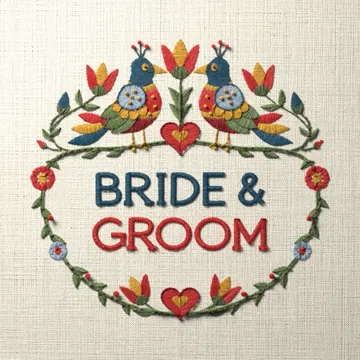
Advanced 3–8 in hoop · 9 colors
Bride & groom with two folk birds
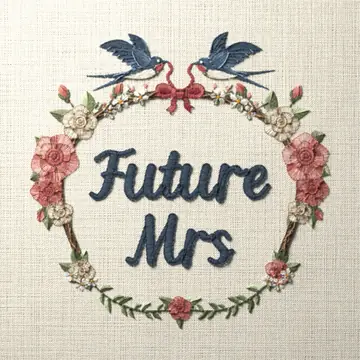
Advanced prints 3–14 in · 22 colors
Future Mrs, roses and swallows
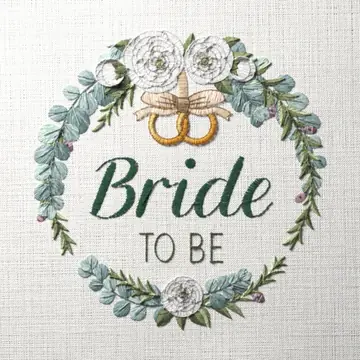
Advanced prints 3–14 in · 22 colors
Bride to be with wedding greenery
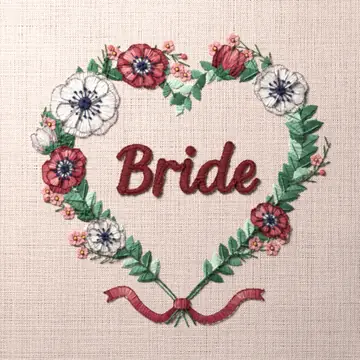
Advanced prints 3–14 in · 17 colors
Bride with an anemone heart
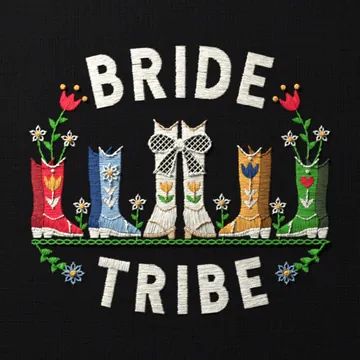
Advanced 3–8 in hoop · 10 colors
Bride tribe
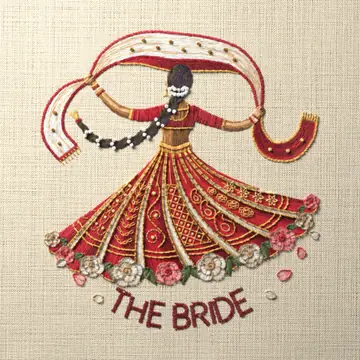
Advanced prints 3–14 in · 23 colors
The bride in roses
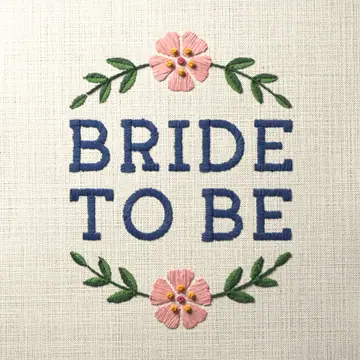
Intermediate 3–8 in hoop · 6 colors
Bride to be
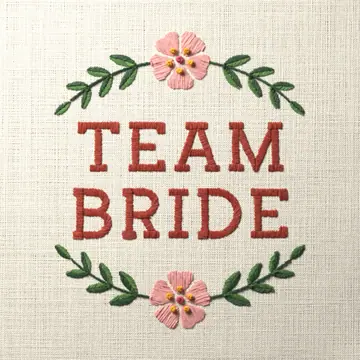
Intermediate 3–8 in hoop · 6 colors
Team bride
New to hand embroidery? Starting hand embroidery, step by step