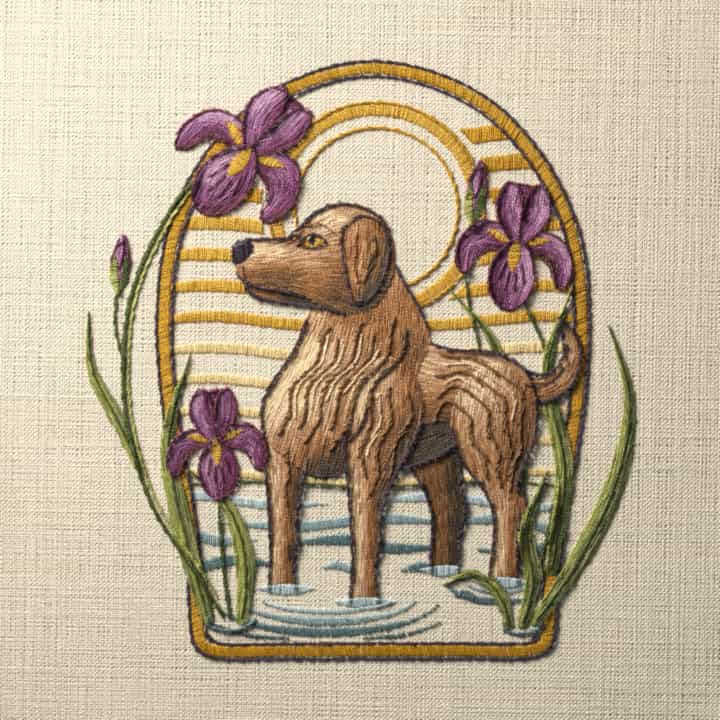
Chesapeake Bay retriever among irises hand embroidery pattern
Advanced · 21 colors · 5 kinds of stitch
Download free PDFPDF, US Letter · 119 KBFor your own stitching, gifts and handmade pieces you sell. Do not resell or share this PDF. What you may do, in full
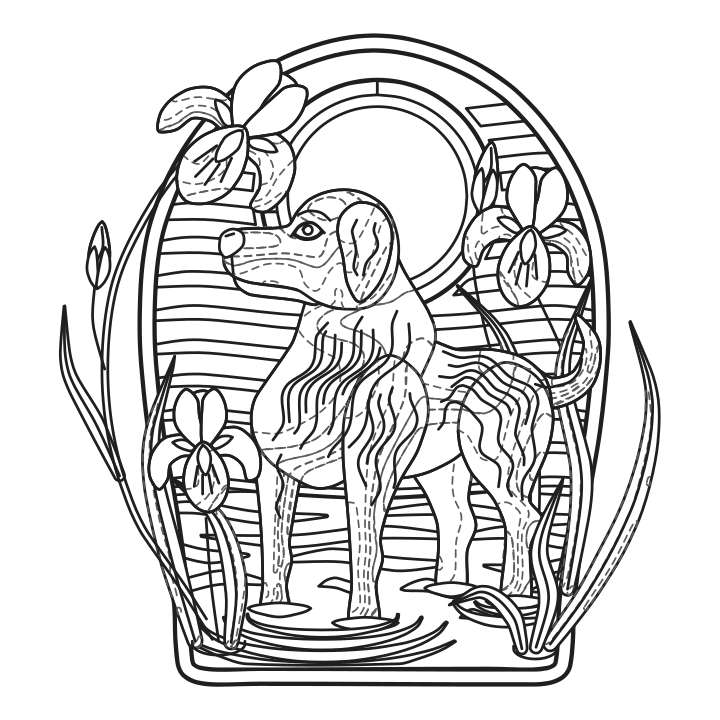
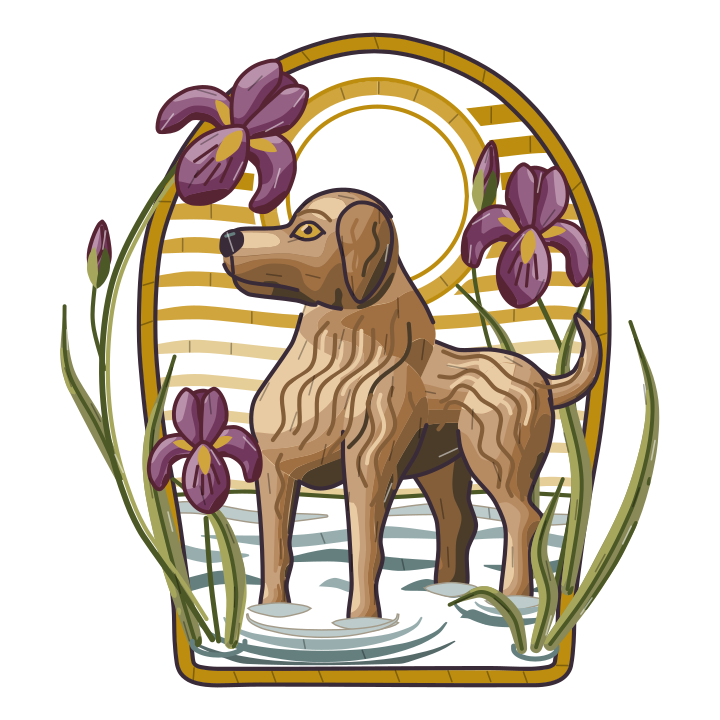
A Chesapeake Bay retriever stands in quiet water inside a tall gold arch, and one iris bends in over the frame. The coat is long and short stitch in deadgrass browns, with nested waves of stem stitch in dark and pale thread on top. The irises and sword leaves are long and short stitch with satin stitch signals and straight stitch veins. The sky bars, the sun ring, the frame and the rings on the water are satin stitch. A fine split stitch line sets off the pale amber eye. In the picture of where the colors go, the fine lines show which way the stitches lie.
Size and details
Advanced. Uses long and short stitch over much of the design, satin stitch over about a fifth of the cloth in a 6 inch hoop, 21 colors and a great deal of stitching.
21 colors of floss and 5 kinds of stitch:
| Hoop | Inches | Centimeters | Satin stitch up to |
|---|---|---|---|
| 3 in (8 cm) | 1.7 × 1.9 in | 4.3 × 4.8 cm | 1/16 in (1.6 mm) |
| 4 in (10 cm) | 2.5 × 2.8 in | 6.4 × 7.1 cm | 1/8 in (3 mm) |
| 5 in (13 cm) | 3.4 × 3.7 in | 8.6 × 9.4 cm | 1/8 in (3 mm) |
| 6 in (15 cm) | 4.2 × 4.6 in | 10.7 × 11.7 cm | 3/16 in (5 mm) |
| 8 in (20 cm) | 5.9 × 6.5 in | 15 × 16.5 cm | 1/4 in (6 mm) |
The pattern is drawn inside a circle about half an inch (1.3 cm) smaller all around than the hoop.
What you need
- DMC 680 Dark Old GoldFrame and sun lines, sky bars (dark)
- DMC 729 Medium Old GoldSky bars (middle), sun ring and signals, eye (lighter)
- DMC 676 Light Old GoldSky bars (light)
- DMC 936 Very Dark Avocado GreenLeaf lines and far shore, stalks and sheaths (darker), leaves (dark)
- DMC 927 Light Gray GreenWater and water rings (lightest)
- DMC 926 Medium Gray GreenWater and water rings (light)
- DMC 3768 Dark Gray GreenWater and water rings (dark), nose light
- DMC 924 Very Dark Gray GreenWater rings and water (darkest)
- DMC 3371 Black BrownFrame lines, dog outline, nose and mouth, eye (darker)
- DMC 3011 Dark Khaki GreenLeaves (middle)
- DMC 3012 Medium Khaki GreenLeaves (light), stalks and sheaths (lighter)
- DMC 3835 Medium GrapeFalls, standards and buds (light)
- DMC 154 Very Dark GrapePetal edges and veins, standards, falls and buds (darkest)
- DMC 3834 Dark GrapeFalls, standards and buds (dark)
- DMC 3836 Light GrapeFalls, standards and buds (lightest)
- DMC 869 Very Dark Hazelnut BrownHead, coat waves, body and chest (dark), far hind leg (middle) and 6 more parts
- DMC 3031 Very Dark Mocha BrownBody, head, chest and coat waves (darkest), far hind leg (dark) and 4 more parts
- DMC 420 Dark Hazelnut BrownChest, head, body and near foreleg (middle dark), ear (light) and 5 more parts
- DMC 422 Light Hazelnut BrownBody, near foreleg, far foreleg, chest, tail, near hind leg and head (light)
- DMC 3828 Hazelnut BrownNear hind leg, chest, head, body and near foreleg (middle light) and 3 more parts
- DMC 738 Very Light TanChest, body, coat waves, near hind leg and near foreleg (lightest) and 4 more parts
Skeins: one of each color is enough. An estimate for the largest size, the 8 inch hoop: the length of each line and the area of each filled shape, a fifth added for tails and ends, a tenth of every 8 m (8.7 yd) skein kept spare.
The floss is six-strand cotton; the stitch guide says how many strands to use. You also need a hoop, an embroidery needle (a size 7 to 9 suits two or three strands) and plain cotton or linen fabric. To frame the piece in its hoop, cut a square 3 inches (8 cm) wider than the hoop: a 9 inch (23 cm) square for a 6 inch hoop.
When it is stitched, how to finish a hoop shows how to back it for the wall.
Stitch guide
- Put the pattern on the fabric (how to transfer a pattern) and the fabric in the hoop.
- Stitch the filled parts first, what lies behind before what lies in front of it.
- Then stitch the lines: stems, veins and outlines over the edges of the filled parts.
Start each thread with a small knot on the back or one of the knotless starts, and end it by running the needle under the backs of a few stitches (starting and ending a thread). Use the strands this list gives, also where a page about a stitch names another number.
- Satin stitch 2 strandsSky bars, sun ring, water, frame, sheaths, signals, nose, eye, water rings
- Stem stitch 1 to 4 strandsSun lines, far shore, frame lines, stalks, leaf lines, petal edges, dog outline, coat waves, mouth, brow, water rings
- Long and short stitch 1 strandLeaves, buds, standards, falls, far hind leg, tail, body, near hind leg, far foreleg, chest, near foreleg, head, ear
- Split stitch 1 to 2 strandsPetal edges, mouth, eye
- Straight stitch 1 strandVeins, nose light, eye light
Getting it onto your fabric
The PDF holds the pattern twice at actual size: once as drawn, and once mirrored for an iron-on transfer pen. Print it at 100% with scaling off and check the one-inch square (25.4 mm) with a ruler before you trace. How to transfer a pattern explains tracing, carbon paper and the other ways. The files are under Downloads.
Downloads
- Download free PDF PDF, US Letter, 3 pages, for a 6 inch (15 cm) hoop
- Download free PDF, A4 PDF, A4, 3 pages, for a 6 inch (15 cm) hoop
More patterns like this
Advanced 3–8 in hoop · 20 colors
Jordanian black iris
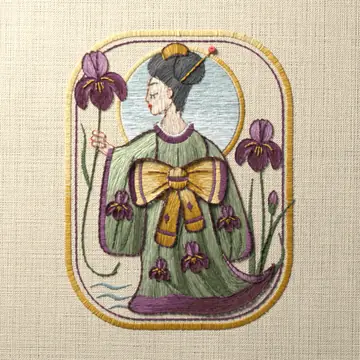
Advanced 3–8 in hoop · 23 colors
Lady in a flowered kimono
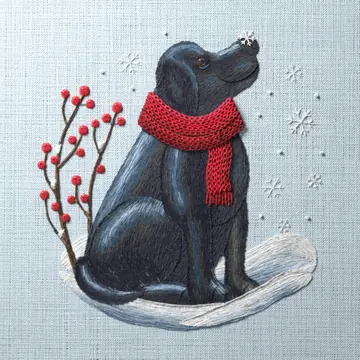
Advanced 3–8 in hoop · 21 colors
Black Lab in the snow
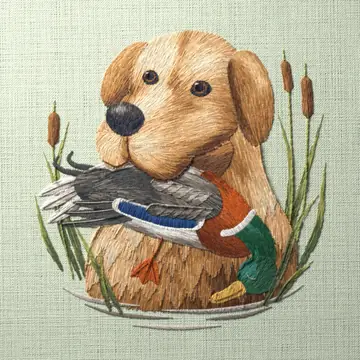
Advanced 3–8 in hoop · 22 colors
Hunting Labrador with a duck
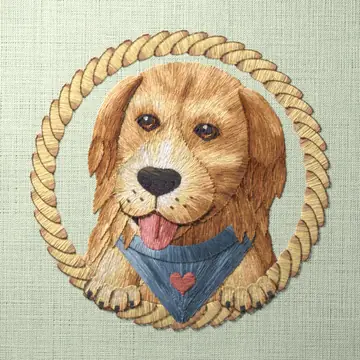
Advanced 3–8 in hoop · 23 colors
Therapy dog patch, golden retriever
Advanced 3–8 in hoop · 23 colors
Choose joy
Advanced 3–8 in hoop · 23 colors
Puppy’s first Christmas
Intermediate 3–8 in hoop · 5 colors
Iris with leaves and tendrils
New to hand embroidery? Starting hand embroidery, step by step