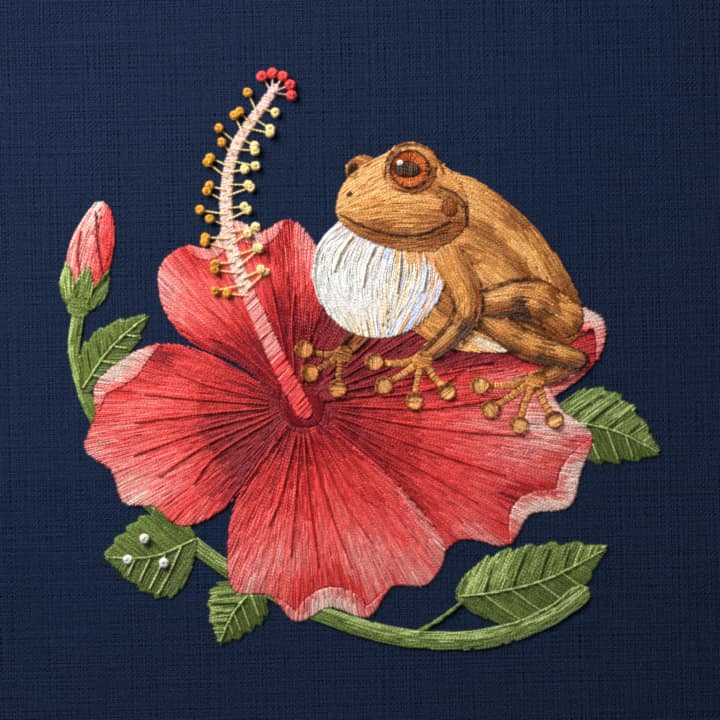
Coqui frog on a hibiscus for Puerto Rico hand embroidery pattern
Advanced · 20 colors · 6 kinds of stitch
Download free PDFPDF, US Letter · 108 KBFor your own stitching, gifts and handmade pieces you sell. Do not resell or share this PDF or copies of it. Selling, classes and kits: the rules
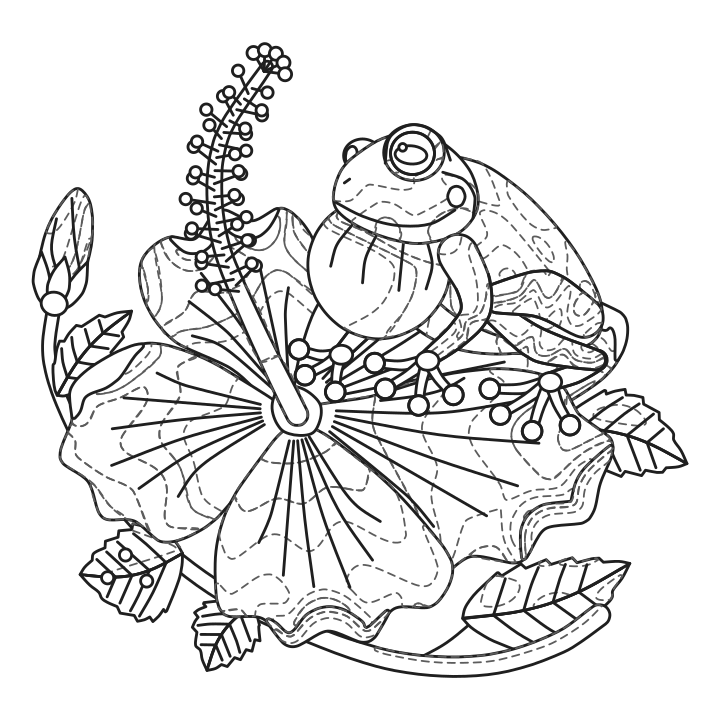
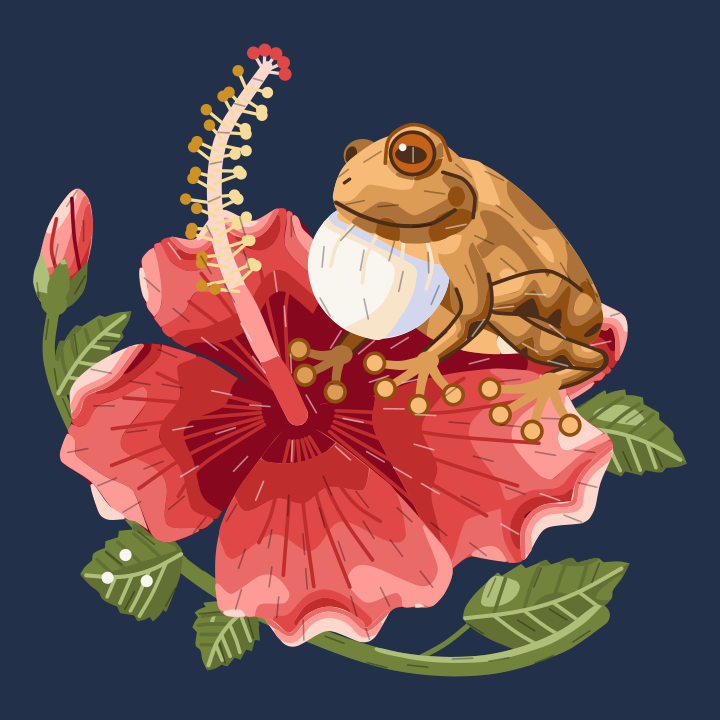
A little coqui sings on a hibiscus far bigger than he is, his throat round and pale as a pearl. Frog, petals, curled petal rims and leaves are shaded in long and short stitch. The stamen, eye and round toe pads are satin stitch, and the veins and fine outlines are split stitch. French knots make the anthers, the red stigma tips and three drops of dew. The frog is a fond sign of Puerto Rico, drawn here in a natural manner. It is drawn for navy linen. In the picture of where the colors go, the fine lines show which way the stitches lie.
Size and details
Advanced. Uses long and short stitch over much of the design, dozens of French knots, 20 colors and a great deal of stitching.
20 colors of floss and 6 kinds of stitch:
- Stem stitch
- Long and short stitch
- Split stitch
- Satin stitch
- French knot
- Straight stitch
- Which stitch goes where
| Hoop | Inches | Centimeters | Satin stitch up to |
|---|---|---|---|
| 3 in (8 cm) | 1.8 × 1.7 in | 4.6 × 4.3 cm | 1/8 in (3 mm) |
| 4 in (10 cm) | 2.7 × 2.6 in | 6.9 × 6.6 cm | 3/16 in (5 mm) |
| 5 in (13 cm) | 3.6 × 3.5 in | 9.1 × 8.9 cm | 1/4 in (6 mm) |
| 6 in (15 cm) | 4.5 × 4.3 in | 11.4 × 10.9 cm | 5/16 in (8 mm) |
| 8 in (20 cm) | 6.3 × 6 in | 16 × 15.2 cm | 7/16 in (11 mm) |
- In a 3, 4 or 5 inch hoop the French knots are drawn smaller than about 2 mm (a little over 1/16 in). Use one strand of floss for them there, or choose a larger hoop.
The pattern is drawn inside a circle about half an inch (1.3 cm) smaller all around than the hoop.
What you need
- DMC 469 Avocado GreenLeaves and sepals (middle), stem (darker), leaf stalks
- DMC 937 Medium Avocado GreenLeaves and sepals (dark), leaf veins (darker)
- DMC 471 Very Light Avocado GreenLeaf veins and stem (lighter), leaves and sepals (light)
- DMC 352 Light CoralPetals and bud (light), petal rims and stamen (middle)
- DMC 347 Very Dark SalmonPetals and bud (dark), petal veins (lighter)
- DMC 350 Medium CoralPetals and bud (middle dark), stamen (dark), stigma (darker)
- DMC 351 CoralPetals and bud (middle light), petal rims (dark)
- DMC 353 PeachPetal rims and stamen (light), petals and bud (lightest), stigma (lighter)
- DMC 815 Medium GarnetPetals and bud (darkest), petal veins (darker), flower heart
- DMC 975 Dark Golden BrownLegs, body, toe pads and head (dark), outlines (lighter), ear disk
- DMC 898 Very Dark Coffee BrownOutlines and eye (darker), legs, body and head (darkest), mouth and pupil
- DMC 3826 Golden BrownBody, head and legs (middle), belly (darkest), feet (darker)
- DMC 977 Light Golden BrownBody, head and legs (light), feet (lighter), belly (dark), toe pads (middle)
- DMC 3827 Pale Golden BrownHead, body and legs (lightest), toe pads and belly (light), throat (darkest)
- DMC 739 Ultra Very Light TanThroat (light), throat folds, belly (lightest)
- DMC 3865 Winter WhiteThroat (lightest), dew and eye light
- DMC 3747 Very Light Blue VioletThroat (dark)
- DMC 921 CopperEye (lighter)
- DMC 3822 Light StrawFilaments, anthers (lighter)
- DMC 783 Medium TopazAnthers (darker)
Skeins: 2 for petals and bud (darkest), petal veins (darker), flower heart; one of each other color. An estimate for the largest size, the 8 inch hoop: the length of each line and the area of each filled shape, a fifth added for tails and ends, a tenth of every 8 m (8.7 yd) skein kept spare.
The floss is six-strand cotton; the stitch guide says how many strands to use. You also need a hoop, an embroidery needle (a size 9 or 10 for one strand, 7 to 9 for two or three) and plain cotton or linen fabric. To frame the piece in its hoop, cut a square 3 inches (8 cm) wider than the hoop: a 9 inch (23 cm) square for a 6 inch hoop.
When it is stitched, how to finish a hoop shows how to back it for the wall.
Stitch guide
- Put the pattern on the fabric (how to transfer a pattern) and the fabric in the hoop.
- Stitch the filled parts first, what lies behind before what lies in front of it.
- Then stitch the lines: stems, veins and outlines over the edges of the filled parts.
- Keep the knots for the end, so that the hoop and your hand do not flatten them.
Inside a filled shape start with two or three tiny stitches, which the filling covers: a knot shows as a bump. A line may start with a small knot on the back or one of the knotless starts. End each thread by running the needle under the backs of a few stitches. (Starting and ending a thread shows how.) Use the strands this list gives, and begin as it says, also where a page about a stitch names another number or begins with a knot.
- Stem stitch 1 to 3 strandsLeaf stalks, leaf veins, mouth
- Long and short stitch 1 strandLeaves, stem, bud, sepals, petals, petal rims, legs, head, body, belly, throat
- Split stitch 1 strandLeaf veins, bud, petal veins, outlines, toe pads, throat folds
- Satin stitch 2 strandsSepals, flower heart, feet, toe pads, eye, ear disk, pupil, stamen
- French knot 1 to 2 strands, two wrapsEye light, anthers, stigma, dew
- Straight stitch 1 to 2 strandsOutlines, filaments, stigma
Getting it onto your fabric
The PDF holds the pattern twice at actual size: once as drawn, and once mirrored for an iron-on transfer pen. Print it at 100% with scaling off and check the one-inch square (25.4 mm) with a ruler before you trace. How to transfer a pattern explains tracing, carbon paper, the sticky wash-away sheet for knits, denim and dark cloth, and the other ways. The files are under Downloads.
Downloads
- Download free PDF PDF, US Letter, 3 pages, for a 6 inch (15 cm) hoop
- Download free PDF, A4 PDF, A4, 3 pages, for a 6 inch (15 cm) hoop
More patterns like this
Advanced prints 3–14 in · 21 colors
Toad under a mushroom
Advanced 3–8 in hoop · 21 colors
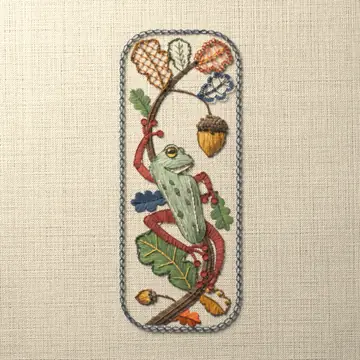
Red-legged tree frog oak bookmark
Advanced prints 3–14 in · 23 colors
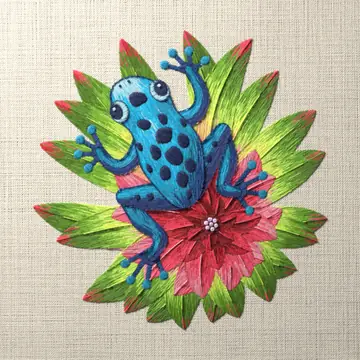
Blue dart frog on a bromeliad
Advanced prints 3–14 in · 23 colors
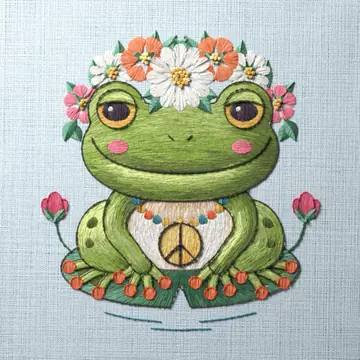
Hippie frog in a flower crown
Intermediate 3–8 in hoop · 6 colors
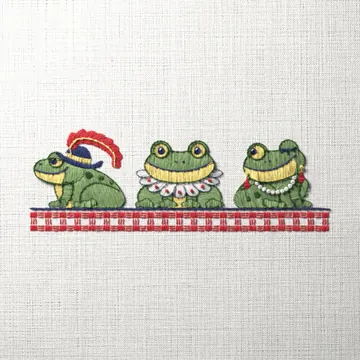
Three fancy frogs towel border
Advanced 3–8 in hoop · 23 colors
Be happy
Advanced 3–8 in hoop · 24 colors
Golfing frog on a lily pad
Advanced prints 3–14 in · 20 colors
Red hibiscus, a Hawaiian flower
New to hand embroidery? Starting hand embroidery, step by step