Dad’s hunting buddy hand embroidery pattern
Advanced · 9 colors · 8 kinds of stitch
Download free PDFPDF, US Letter · 50 KBFor your own stitching, gifts and handmade pieces you sell. Do not resell or share this PDF. What you may do, in full
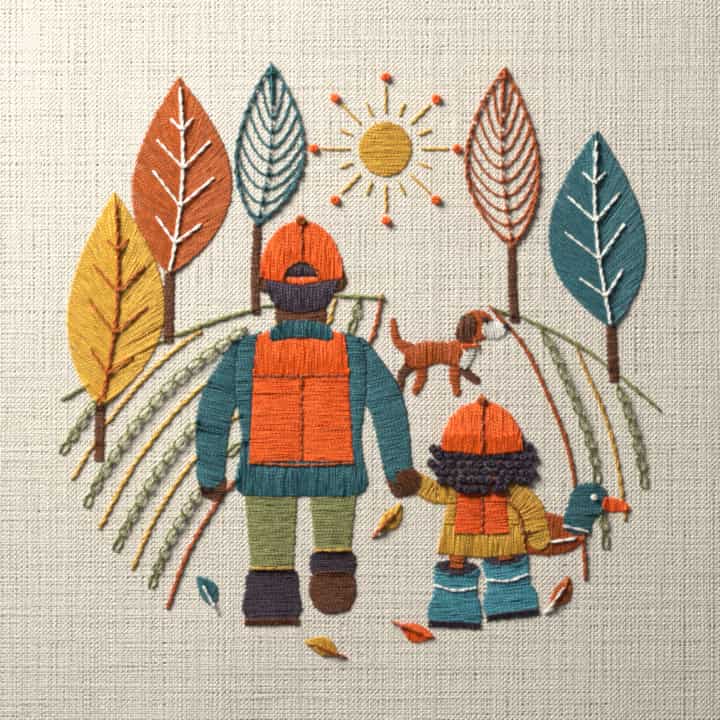
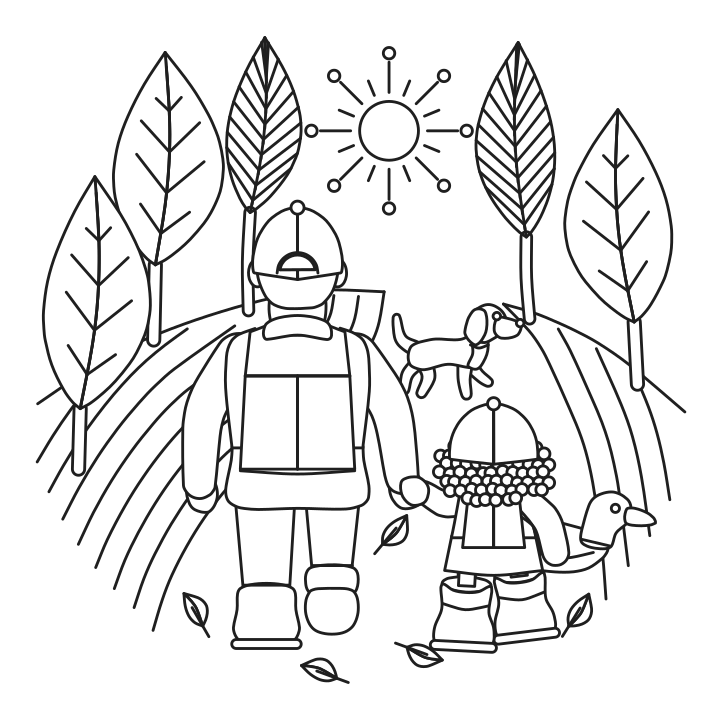
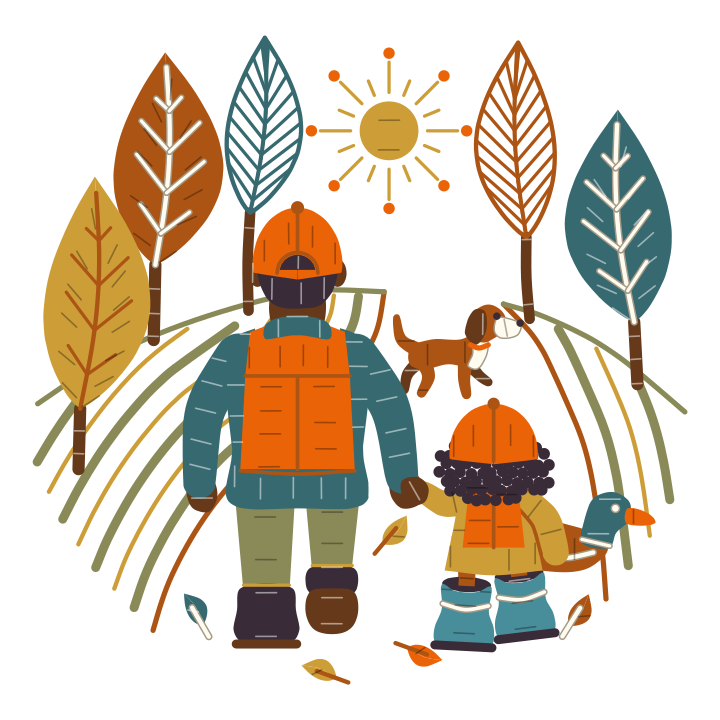
Seen from behind, a broad dad in a teal coat and his small daughter in a mustard coat walk hand in hand up an autumn path in matching orange vests and caps. Her boots are far too big, she has a wooden duck tucked under her arm, and a pup in an orange collar trots ahead. The figures are flat satin stitch, her curls are French knots, and the trees are great leaves in fishbone stitch or open fly stitch. Rows of chain stitch and stem stitch follow the banks of the path, and a sun with straight stitch rays stands above the crest. In the picture of where the colors go, the fine lines show which way the stitches lie.
Size and details
Advanced. Dozens of French knots, satin stitch over about a fifth of the cloth in a 6 inch hoop and nine colors; from a 5 inch hoop up some of the satin stitches are long.
9 colors of floss and 8 kinds of stitch:
- Straight stitch
- Satin stitch
- French knot
- Stem stitch
- Chain stitch
- Fly stitch
- Fishbone stitch
- Back stitch
- Which stitch goes where
| Hoop | Inches | Centimeters | Satin stitch up to |
|---|---|---|---|
| 3 in (8 cm) | 1.8 × 1.8 in | 4.6 × 4.6 cm | 3/16 in (5 mm) |
| 4 in (10 cm) | 2.7 × 2.7 in | 6.9 × 6.9 cm | 1/4 in (6 mm) |
| 5 in (13 cm) | 3.6 × 3.6 in | 9.1 × 9.1 cm | 3/8 in (10 mm) |
| 6 in (15 cm) | 4.5 × 4.5 in | 11.4 × 11.4 cm | 7/16 in (11 mm) |
| 8 in (20 cm) | 6.2 × 6.2 in | 15.7 × 15.7 cm | 5/8 in (16 mm) |
- In an 8 inch hoop the widest satin stitch shape is 5/8 in (16 mm) across. Satin stitches longer than about 12 mm (just under 1/2 in) tend to work loose: divide the shape into sections, or work it in long and short stitch.
- In a 3, 4 or 5 inch hoop the French knots are drawn smaller than about 2 mm (a little over 1/16 in). Use one strand of floss for them there, or choose a larger hoop.
The pattern is drawn inside a circle about half an inch (1.3 cm) smaller all around than the hoop.
What you need
- DMC 3852 Very Dark StrawMustard leaf tree, girl coat, sun and sun rays, bank rows (lighter) and 2 more parts
- DMC 946 Medium Burnt OrangeVests, caps, sun tips, wooden duck bill and pup collar, fallen leaves (light)
- DMC 920 Medium CopperRust leaf tree, wooden duck and path edges, open leaf trees (lighter) and 12 more parts
- DMC 3011 Dark Khaki GreenDad trousers and hill line, bank rows (darker)
- DMC 801 Dark Coffee BrownTree trunks, hands, neck, dad boot soles, ears and pup ears, pup legs (darker)
- DMC 3808 Ultra Very Dark TurquoiseDad coat and teal leaf tree, open leaf trees (darker) and 3 more parts
- DMC 712 CreamLeaf veins and pup head (lighter), pup chest and boot bands and 4 more parts
- DMC 3371 Black BrownCurls, dad boots, dad hair, boot linings, boot heels and pup face
- DMC 3810 Dark TurquoiseBig boots
Skeins: one of each color is enough. An estimate for the largest size, the 8 inch hoop: the length of each line and the area of each filled shape, a fifth added for tails and ends, a tenth of every 8 m (8.7 yd) skein kept spare.
The floss is six-strand cotton; the stitch guide says how many strands to use. You also need a hoop, an embroidery needle (a size 7 to 9 suits two or three strands) and plain cotton or linen fabric. To frame the piece in its hoop, cut a square 3 inches (8 cm) wider than the hoop: a 9 inch (23 cm) square for a 6 inch hoop.
When it is stitched, how to finish a hoop shows how to back it for the wall.
Stitch guide
- Put the pattern on the fabric (how to transfer a pattern) and the fabric in the hoop.
- Stitch the filled parts first, what lies behind before what lies in front of it.
- Then stitch the lines: stems, veins and outlines over the edges of the filled parts.
- Keep the knots for the end, so that the hoop and your hand do not flatten them.
Start each thread with a small knot on the back or one of the knotless starts, and end it by running the needle under the backs of a few stitches (starting and ending a thread). Use the strands this list gives, also where a page about a stitch names another number.
- Straight stitch 2 strandsSun rays, leaf veins, trouser cuffs, wooden duck collar
- Satin stitch 2 strandsSun, tree trunks, pup legs, pup tail, pup body, pup chest, pup head, pup ears, dad trousers, dad boots, dad boot soles, hands, dad coat, and 14 more
- French knot 1 to 2 strands, two wrapsSun tips, pup face, cap buttons, wooden duck eye, curls
- Stem stitch 1 to 3 strandsPath edges, bank rows, hill line, open leaf trees, leaf veins, pup collar, fallen leaf stems, wooden duck wing
- Chain stitch 2 strandsBank rows
- Fly stitch 2 strandsOpen leaf trees
- Fishbone stitch 2 strandsRust leaf tree, teal leaf tree, mustard leaf tree, fallen leaves
- Back stitch 2 strandsVest seams, cap seams, boot bands, sleeve line
Getting it onto your fabric
The PDF holds the pattern twice at actual size: once as drawn, and once mirrored for an iron-on transfer pen. Print it at 100% with scaling off and check the one-inch square (25.4 mm) with a ruler before you trace. How to transfer a pattern explains tracing, carbon paper and the other ways. The files are under Downloads.
Downloads
- Download free PDF PDF, US Letter, 3 pages, for a 6 inch (15 cm) hoop
- Download free PDF, A4 PDF, A4, 3 pages, for a 6 inch (15 cm) hoop
More patterns like this
Advanced 3–8 in hoop · 9 colors
Camouflage with a hidden hunting trio
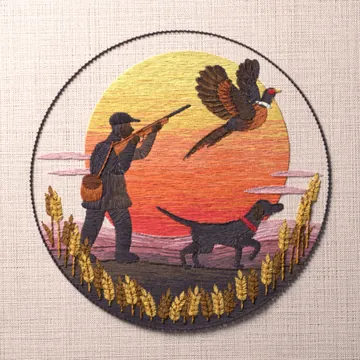
Advanced 3–8 in hoop · 19 colors
Hunter silhouette with pheasant
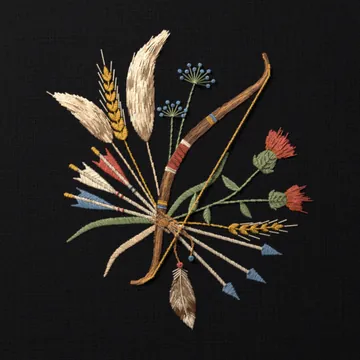
Advanced 3–8 in hoop · 12 colors
Hunting bow and arrows with grasses
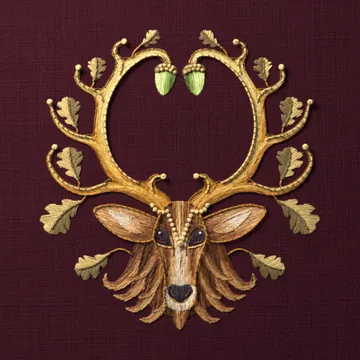
Advanced 3–8 in hoop · 15 colors
Stag head antler monogram frame
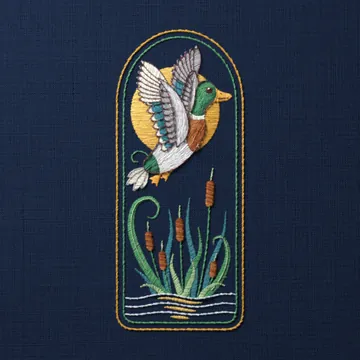
Advanced 3–8 in hoop · 16 colors
Duck flying over reeds bookmark
Advanced 3–8 in hoop · 17 colors
Long rifle with crewel vine
Easy 3–8 in hoop · 7 colors
Fish hook and deer antler
Advanced 3–8 in hoop · 22 colors
Hunting Labrador with a duck
New to hand embroidery? Starting hand embroidery, step by step