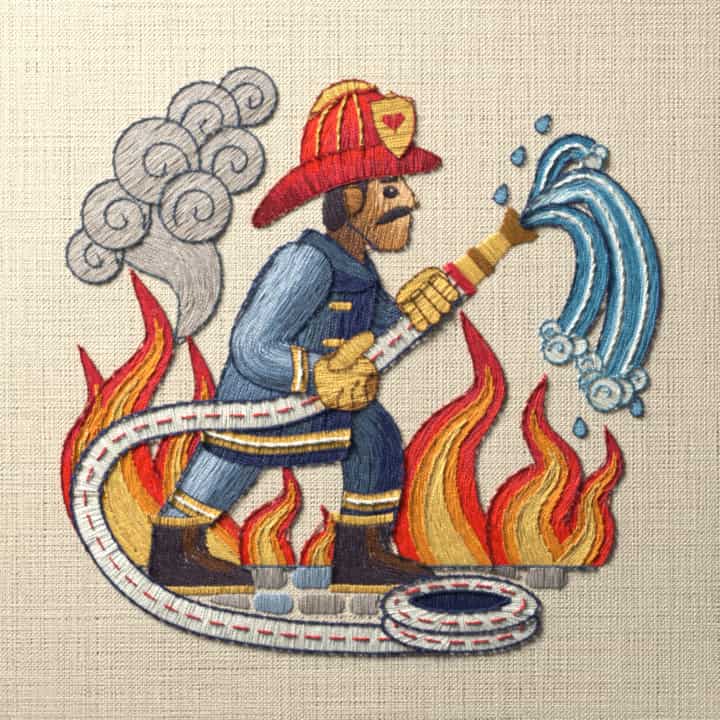
Firefighter with hose and flames hand embroidery pattern
Advanced · 23 colors · 7 kinds of stitch
Download free PDFPDF, US Letter · 105 KBFor your own stitching, gifts and handmade pieces you sell. Do not resell or share this PDF or copies of it. Selling, classes and kits: the rules
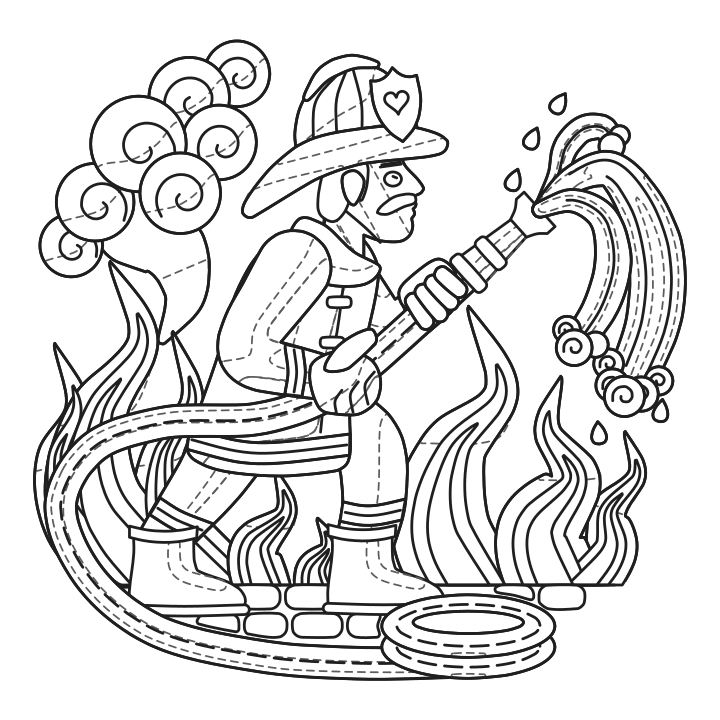
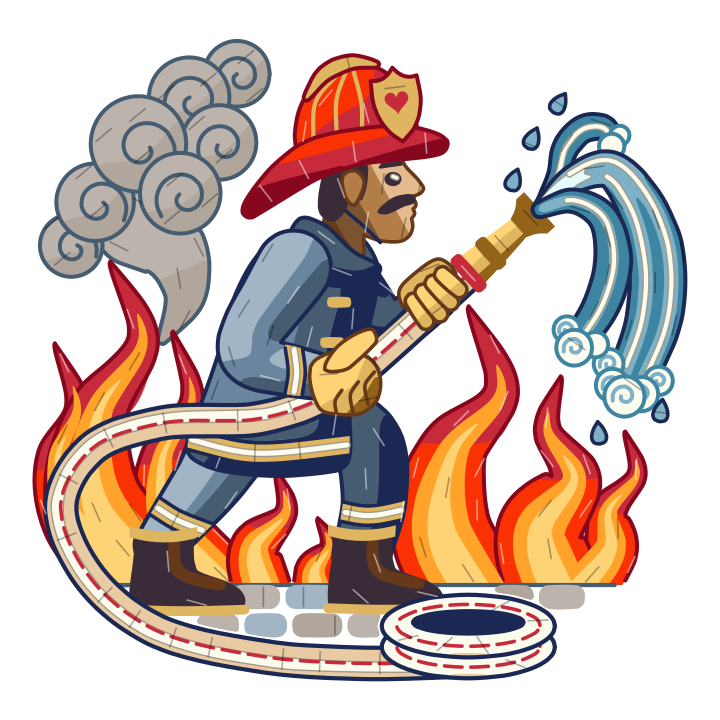
A firefighter leans into the hose, one knee bent and one leg braced behind, with both gloved hands on it and the brass nozzle raised. The water arcs over the fire and ends in curls of foam, and smoke rolls up on the other side. The gear, flames, smoke and water are long and short stitch. The hose, gloves, cobbles and foam are satin stitch, with gloves and flow lines finished in back stitch and stem stitch. A line of red running stitch follows the hose all the way to its coil, and stem stitch edges nearly every part. In the picture of where the colors go, the fine lines show which way the stitches lie.
Size and details
Advanced. Uses long and short stitch over much of the design, 23 colors and a great deal of stitching.
23 colors of floss and 7 kinds of stitch:
- Long and short stitch
- Stem stitch
- Satin stitch
- Back stitch
- Split stitch
- Straight stitch
- Running stitch
- Which stitch goes where
| Hoop | Inches | Centimeters | Satin stitch up to |
|---|---|---|---|
| 3 in (8 cm) | 1.8 × 1.8 in | 4.6 × 4.6 cm | 1/8 in (3 mm) |
| 4 in (10 cm) | 2.7 × 2.7 in | 6.9 × 6.9 cm | 3/16 in (5 mm) |
| 5 in (13 cm) | 3.6 × 3.6 in | 9.1 × 9.1 cm | 1/4 in (6 mm) |
| 6 in (15 cm) | 4.6 × 4.5 in | 11.7 × 11.4 cm | 5/16 in (8 mm) |
| 8 in (20 cm) | 6.4 × 6.3 in | 16.3 × 16 cm | 1/2 in (13 mm) |
- In an 8 inch hoop the widest satin stitch shape is 1/2 in (13 mm) across. Satin stitches longer than about 12 mm (just under 1/2 in) tend to work loose: divide the shape into sections, or work it in long and short stitch.
The pattern is drawn inside a circle about half an inch (1.3 cm) smaller all around than the hoop.
What you need
- DMC 648 Light Beaver GraySmoke (lighter), cobbles (light)
- DMC 647 Medium Beaver GraySmoke (darker), cobbles (dark)
- DMC 930 Dark Antique BlueTrousers and sleeves (dark), smoke edge, coat (middle) and 3 more parts
- DMC 606 Bright Orange-RedOuter flames (lighter), helmet crown and helmet brim (light)
- DMC 321 RedOuter flames (darker), hose stripe, helmet brim (middle) and 3 more parts
- DMC 815 Medium GarnetFlame edges and helmet edge, helmet crown and helmet brim (dark)
- DMC 741 Medium TangerineMiddle flames
- DMC 743 Medium YellowFlame hearts, gloves and nozzle (light)
- DMC 932 Light Antique BlueTrousers and sleeves (lightest), cobbles (middle)
- DMC 939 Very Dark Navy BlueHose edge, coat (dark), trousers (darkest) and 7 more parts
- DMC 3820 Dark StrawReflective bands and gloves (middle), helmet shield and 6 more parts
- DMC 746 Off WhiteHose (lighter), foam, foam lines and eye light, reflective bands (light)
- DMC 3371 Black BrownBoots (darker), hair, moustache, eyebrow and eye
- DMC 801 Dark Coffee BrownGlove lines and face edge, boots (lighter), face (darkest)
- DMC 931 Medium Antique BlueCoat, sleeves and trousers (light)
- DMC 435 Very Light BrownFace (light), ear
- DMC 433 Medium BrownFace (dark)
- DMC 437 Light TanFace (lightest)
- DMC 738 Very Light TanHose (darker)
- DMC 780 Ultra Very Dark TopazNozzle rings (lighter), nozzle and gloves (dark)
- DMC 3760 Medium WedgwoodWater (dark), water edge (lighter)
- DMC 519 Sky BlueWater (middle), foam curls and drops
- DMC 747 Very Light Sky BlueWater (light)
Skeins: 2 for outer flames (lighter), helmet crown and helmet brim (light); one of each other color. An estimate for the largest size, the 8 inch hoop: the length of each line and the area of each filled shape, a fifth added for tails and ends, a tenth of every 8 m (8.7 yd) skein kept spare.
The floss is six-strand cotton; the stitch guide says how many strands to use. You also need a hoop, an embroidery needle (a size 9 or 10 for one strand, 7 to 9 for two or three) and plain cotton or linen fabric. To frame the piece in its hoop, cut a square 3 inches (8 cm) wider than the hoop: a 9 inch (23 cm) square for a 6 inch hoop.
When it is stitched, how to finish a hoop shows how to back it for the wall.
Stitch guide
- Put the pattern on the fabric (how to transfer a pattern) and the fabric in the hoop.
- Stitch the filled parts first, what lies behind before what lies in front of it.
- Then stitch the lines: stems, veins and outlines over the edges of the filled parts.
Inside a filled shape start with two or three tiny stitches, which the filling covers: a knot shows as a bump. A line may start with a small knot on the back or one of the knotless starts. End each thread by running the needle under the backs of a few stitches. (Starting and ending a thread shows how.) Use the strands this list gives, and begin as it says, also where a page about a stitch names another number or begins with a knot.
- Long and short stitch 1 strandSmoke, outer flames, middle flames, flame hearts, trousers, boots, sleeves, coat, face, collar, and 4 more
- Stem stitch 1 to 3 strandsSmoke edge, smoke curls, flame edges, street edge, trousers, reflective bands, sleeves, coat, and 7 more
- Satin stitch 2 strandsCobbles, reflective bands, boot soles, boot tops, clasps, hair, ear, eye, moustache, helmet shield, and 9 more
- Back stitch 1 to 2 strandsReflective bands, coat seams, chin strap, glove lines, water edge
- Split stitch 1 strandFace edge
- Straight stitch 1 to 2 strandsEyebrow, eye light
- Running stitch 2 strandsHose stripe
Getting it onto your fabric
The PDF holds the pattern twice at actual size: once as drawn, and once mirrored for an iron-on transfer pen. Print it at 100% with scaling off and check the one-inch square (25.4 mm) with a ruler before you trace. How to transfer a pattern explains tracing, carbon paper, the sticky wash-away sheet for knits, denim and dark cloth, and the other ways. The files are under Downloads.
Downloads
- Download free PDF PDF, US Letter, 3 pages, for a 6 inch (15 cm) hoop
- Download free PDF, A4 PDF, A4, 3 pages, for a 6 inch (15 cm) hoop
More patterns like this
Advanced 3–8 in hoop · 23 colors
Firefighter’s helmet and axes
Advanced 3–8 in hoop · 23 colors
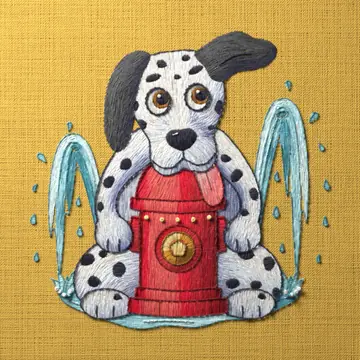
Funny Dalmatian and fire hydrant
Advanced 3–8 in hoop · 24 colors
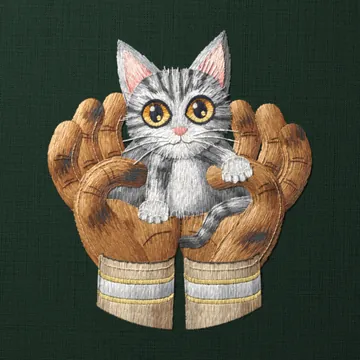
Rescued kitten in a firefighter’s gloves
Advanced 3–8 in hoop · 24 colors
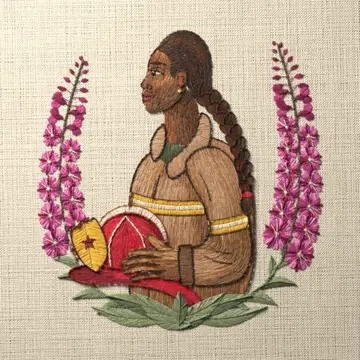
Woman firefighter with fireweed
Advanced 3–8 in hoop · 21 colors
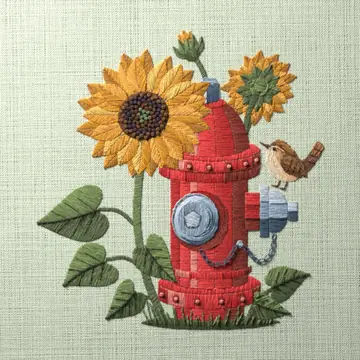
Fire hydrant with sunflowers
Advanced 3–8 in hoop · 11 colors
Small Maltese cross with a flame
Intermediate 3–8 in hoop · 16 colors
Duty Honor Courage firefighter bookmark
Advanced prints 3–14 in · 24 colors
Firefighter snowman and Dalmatian
New to hand embroidery? Starting hand embroidery, step by step